WORLD
WORLD
Pekko
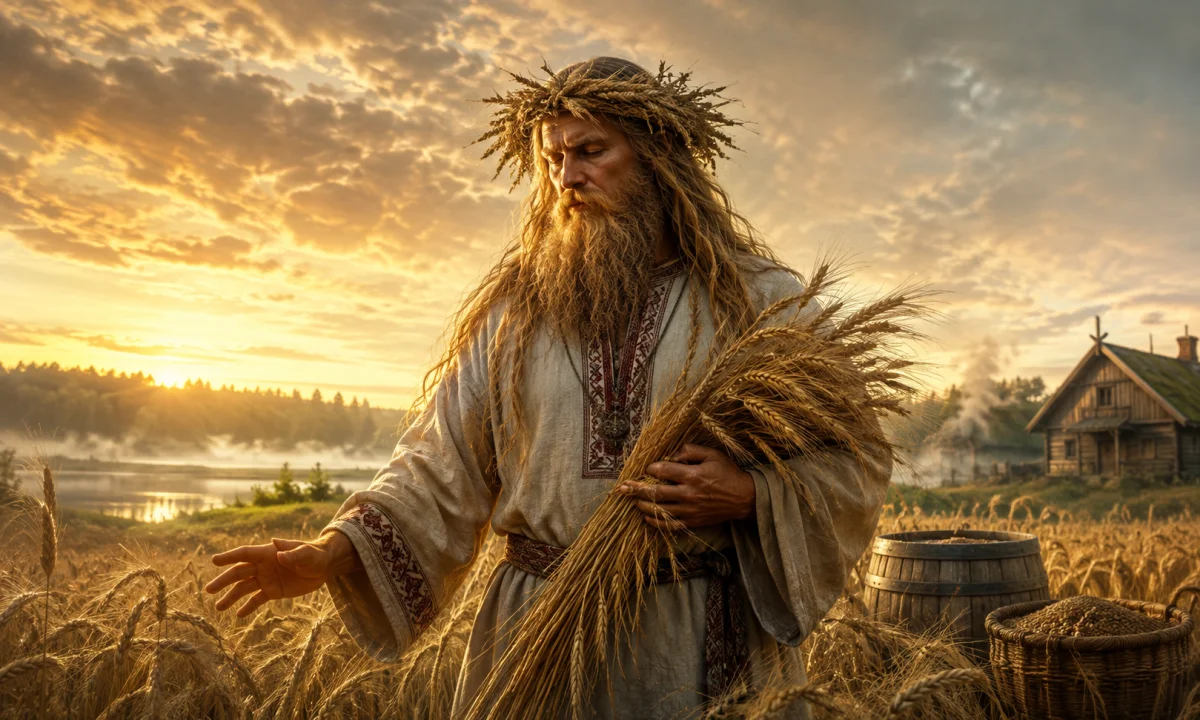
Pekko is a figure from Finnish folklore and the agrarian religious imagination of the Finns, best known as a spirit or deity associated with barley, brewing, and the success of the harvest. His place in older tradition is not fully certain, because the surviving evidence is limited and partly filtered through later written sources, but Pekko is consistently linked with cultivated grain and the well-being of crops. In that sense he belongs to the wider northern European world of agricultural ritual, where protection of seed, beer, and seasonal fertility could be expressed through local divine or spirit figures.
The name Pekko appears in Finnish tradition as a being invoked in connection with barley and beer, especially in western and central Finland. He is not one of the best-documented figures of Finnic mythology, and much of what is known comes from later collections of folklore, ethnographic notes, and scholarly interpretation rather than from a large body of pre-Christian narrative. Because of that, Pekko is often described cautiously: he may have been a local agricultural god, a household or field spirit, or a personification of barley prosperity. Different interpretations coexist, and no single reconstruction can be treated as certain.
Origins and cultural setting
Pekko belongs to the rural world of traditional Finnish farming, where survival depended on short growing seasons, uncertain weather, and the careful management of grain. In that environment, barley held special importance. It was a staple crop and also the main grain used for brewing beer, which had ceremonial, social, and practical value. A figure connected with barley would therefore have stood at the centre of everyday life, especially in rituals intended to secure a good harvest and successful brewing.
Finnish folklore preserved many traces of an older ritual calendar tied to sowing, growth, harvest, and feasting. In such a setting, Pekko is usually understood as part of a broader cluster of beliefs about agricultural luck rather than as a remote cosmic god. The surviving material does not present him as a grand mythological ruler with a large cycle of stories. Instead, he seems to have belonged to local, practical religion: the kind of sacred presence that was addressed when people needed grain to grow, malt to ferment, or beer to turn out well.
Scholars have sometimes compared Pekko to other northern agrarian beings who preside over a specific crop or resource. Such comparisons are useful, but they do not prove direct equivalence. Pekko remains a distinctly Finnish figure, and the evidence for him should not be smoothed into a generic “fertility god” without qualification. The tradition is too fragmentary for that.
Name and identity
The name Pekko has attracted considerable discussion. In Finnish tradition, the name can appear as a personal-sounding divine or spirit name, and it is often associated with barley itself, as if the crop and its protector were closely bound. In some contexts the name has been linked with words and forms related to brewing and grain, though the etymology is not universally settled. As with many older folklore names, later oral usage and scholarly reconstructions may not point to a single original form.
Identity is also uncertain. Pekko is often treated as male, and many modern presentations follow that assumption. However, the historical record does not allow every detail to be fixed with confidence. He may have functioned as a named force within ritual speech more than as a character in narrative myth. That would explain why there are so few stories about him and so many references that feel more like invocation than storytelling.
In Finnish mythological studies, Pekko is commonly classified as an agricultural spirit or god of barley. Some writers present him as a deity of beer and cultivation; others prefer the broader term “spirit” because the sources do not preserve enough evidence to define his status in a fully systematic way. The uncertainty matters. It is safer to say that Pekko was a traditional figure of barley prosperity than to insist that he belonged to a rigid pantheon in the later sense of the word.
Functions and symbolism
Pekko’s strongest association is with barley. In traditional Finnish life, barley was not just one crop among many; it carried food value, ritual value, and symbolic weight. A being linked to barley could therefore represent nourishment, endurance, and the fragile hope that the harvest would succeed despite a difficult climate. Pekko embodies that hope.
He is also connected with beer, especially the brewing of grain beer used in social and ceremonial settings. In premodern northern Europe, beer was often more than a drink of leisure. It could be part of hospitality, communal celebration, rites of passage, and seasonal feasting. A spirit governing the success of brewing would have had practical significance, because spoilage or poor fermentation could waste precious grain and diminish a household’s standing.
Because of these associations, Pekko can be read as a figure of controlled abundance. He is not a wild nature deity in the romantic sense, nor does he belong primarily to forests, storms, or hunting. Instead, he belongs to the cultivated field and the transformed grain that becomes food and drink. His symbolism is domestic, agricultural, and seasonal. He stands at the point where human labor meets natural growth.
Ritual context and traditional practice
Folkloric references indicate that Pekko may have been addressed in connection with sowing, harvest, or brewing rituals, especially when people wanted good fortune for barley. The exact forms of worship are not fully preserved, and it would be misleading to describe a complete formal cult. What survives suggests local custom rather than a standardized religion.
In agrarian tradition, such figures were often honored through practical acts rather than elaborate temple rites. People might make offerings, speak blessings, or observe taboos intended to protect the crop. If Pekko was invoked, he was likely called upon in a similar spirit: to ensure that the seed took root, the stalks ripened, the grain filled well, and the malt fermented properly. The point was less abstract theology than useful success.
It is important not to overstate the evidence. Later folklore often preserves names and functions without preserving the full ceremonial framework. As a result, modern reconstructions of Pekko’s rituals sometimes depend on inference. That inference may be reasonable, but it remains inference. The safest conclusion is that Pekko belonged to a living world of harvest custom in which barley had sacred and economic value.
Stories and surviving references
Unlike major mythological figures who appear in extended legends, Pekko survives in relatively sparse references. There is no widely known body of heroic tales, family genealogies, or epic adventures attached to him. This absence is itself informative. It suggests that Pekko was valued less as a narrative character than as a functional sacred presence.
Some later folkloric material presents Pekko almost as a name attached to the luck of barley rather than as a fully dramatized personage. In such contexts, the figure may be called upon indirectly, praised, or referenced in ritual language. These snippets are precious because they preserve a trace of older belief, but they do not allow a detailed mythology to be reconstructed with confidence.
Where later authors have expanded Pekko into a more elaborate god of fertility, caution is needed. That kind of enlargement can reflect comparative mythology or modern interpretation rather than attested traditional narrative. Pekko’s strength lies in his specificity: he is tied to the grain that mattered most, in a way that is practical, seasonal, and culturally grounded.
Relationship to beer, festivity, and social life
Beer occupied a significant place in Finnish and wider Baltic-Finnic social life, especially in contexts of hospitality and celebration. It accompanied weddings, seasonal gatherings, work feasts, and other occasions when community bonds were reaffirmed. Since beer depended on grain, water, and successful fermentation, a barley-associated figure naturally came to symbolize not only agricultural success but also the social flourishing that followed it.
Pekko’s role in this setting should not be reduced to “the god of drinking.” That phrase can mislead by making him sound trivial or purely recreational. In reality, beer in traditional society had ceremonial seriousness. It belonged to offerings, collective meals, and the rhythm of rural life. Pekko therefore sits at the intersection of subsistence and festivity: the field and the table, the seed and the cup.
This association also explains why Pekko is sometimes discussed alongside other protective figures of household and production. If the grain failed, the household suffered. If the brewing failed, the household lost a central symbol of welcome and celebration. Pekko thus represented a kind of economic and ritual continuity.
Interpretation in scholarship
Modern scholars generally treat Pekko as a fragmentary but meaningful survival from older Finnish agricultural religion. The difficulty lies in separating older belief from later speculation. Finnish folklore was recorded in a period when Christian traditions, local custom, and antiquarian interpretation all influenced what informants said and what collectors wrote down. Pekko therefore appears through a layered historical lens.
Some interpretations emphasize him as a pre-Christian deity of barley. Others prefer to see him as a personified spirit of the crop, perhaps not a deity in the strict sense. Both views remain plausible because the evidence does not permit a decisive answer. In many traditional religions, the line between god, spirit, and ritual personification is not always sharp, and Pekko may have occupied that flexible space.
There is also a broader interpretive issue. It is tempting to imagine that every named figure in folklore belonged to a neatly organized pantheon. Finnish traditional religion was often more local and situational than that. Pekko may have been honored in specific regions or communities without functioning as a universal national god. His importance may have been real, but it was probably seasonal and practical rather than doctrinal.
Distinction from similar names and figures
Pekko should not be confused with historical or modern uses of similar names that are unrelated to Finnish mythology. The name may resemble ordinary Finnish personal names or surnames, but those are not the same as the mythological figure. Nor should Pekko be merged with foreign fertility gods merely because they share agricultural associations.
He is also distinct from other Finnish mythic beings connected with weather, forests, or the broader fertility of nature. Pekko’s domain is narrower and more specific: barley and the success of its transformation into usable food and drink. That specificity is one of the most valuable clues about his place in tradition. It indicates the intimate, crop-based character of older Finnish belief.
Confusion can arise because many modern retellings broaden folk figures into generalized nature gods. For Pekko, such broadening can obscure what makes him distinctive. He is not primarily a woodland spirit, a sky god, or a heroic ancestor. He is a barley figure, and the agricultural meaning of that role should remain central.
Later reception and modern relevance
Pekko has remained a recognizable name in Finnish cultural memory, and he sometimes appears in modern discussions of pre-Christian Finnish religion, folklore collections, and regional heritage. In those settings he is often used as an example of how closely traditional belief was tied to farming life. His significance today lies less in active worship and more in cultural interpretation.
In modern popular culture, Pekko is not as widely used internationally as some other mythic beings, but the name does occasionally appear in Finnish contexts, sometimes playfully or symbolically. When that happens, it is usually because the figure evokes old rural Finland, grain culture, and a specifically local sense of mythic heritage. Such usage should be distinguished from the older tradition. Modern adaptations may expand, simplify, or stylize the figure in ways that have no direct historical basis.
Pekko’s continuing interest comes from his modest scale. He is not a universal mythic archetype with an elaborate saga. He is a deeply local figure whose meaning grows from the everyday stakes of food production, fermentation, and seasonal survival. In that respect, he offers an unusually clear glimpse into how mythology can arise from practical life rather than from grand narrative alone.
Why Pekko matters in Finnish mythology
Pekko matters because he preserves a link between myth and agriculture that is easy to overlook. In a landscape where harvest success could determine a family’s security, a barley spirit or god was not a minor detail. He represented the hope that human skill, weather, soil, and sacred favour could align.
He also shows how Finnish mythology was shaped by lived experience. The tradition does not always provide dramatic epics or heroic combat. Sometimes it preserves the names of forces people trusted when the grain was in the ground or the brew was in the barrel. Pekko belongs to that quieter and more intimate side of mythology, where divinity and daily necessity meet.
Key characteristics associated with Pekko
- Tradition: Finnish folklore and agrarian religious belief
- Primary association: barley
- Related sphere: brewing and beer
- Type of figure: likely agricultural spirit or deity, though the exact status is uncertain
- Context: harvest, sowing, fertility, and household prosperity
- Evidence: fragmentary folklore and later scholarly interpretation
Common interpretive cautions
- The sources do not preserve a full myth cycle about Pekko.
- His exact pre-Christian status cannot be proven with certainty.
- Later reconstructions may amplify his role beyond what the evidence supports.
- He should not be confused with unrelated names or with more general fertility deities.