WORLD
WORLD
Otr

Otr, or Ótr in Old Norse, is a shapeshifting figure in the Völsung tradition of Norse mythology. He is the son of Hreidmar and the brother of Fafnir and Regin. By day, Otr takes the form of an otter and catches fish; by night, he returns to his human household. His accidental death at the hands of the god Loki leads to the payment of a blood-price involving the treasure of the dwarf Andvari. That treasure brings a curse upon Otr’s family and sets in motion the later stories of Fafnir, Regin and the hero Sigurd.
Otr in Norse tradition
Otr is not a god, an object of worship or a major independent deity. He belongs to the legendary family history surrounding the Völsung heroes. His story is important because it provides the first link in a chain of events that becomes one of the best-known narratives in Germanic heroic tradition: the acquisition of Andvari’s gold, Fafnir’s transformation into a dragon and Sigurd’s killing of Fafnir.
The story survives chiefly in two related bodies of medieval Icelandic literature. One version appears in Skáldskaparmál, a section of Snorri Sturluson’s Prose Edda, which was composed in the early thirteenth century. Another appears in the heroic poems and prose passages associated with the Poetic Edda, especially Reginsmál. The Völsunga saga, written in Iceland in the thirteenth century, gives a fuller prose account of the family and the events that follow.
These works were written down after the conversion of Iceland to Christianity, but they preserve stories and poetic traditions that are generally understood to be older. The surviving versions are not records of a single official Norse religious doctrine. They are literary presentations of myth, heroic legend and inherited storytelling. Details can therefore vary between texts, particularly in the treatment of the treasure, the ransom and the identities of some supernatural beings.
Name and identity
The Old Norse name Ótr means “otter.” In English translations, the name may appear as Otr, Otter or Otrr, although Otr is the most common simplified form. The name reflects his defining characteristic: he is a human member of Hreidmar’s family who can live and act in otter form.
Otr should not be confused with Óttar, sometimes written Ottar or Otter in older English translations. Óttar is a different name belonging to several other figures in Norse literature, including a human hero associated with the goddess Freyja in Hyndluljóð. Otr is also distinct from any modern fictional character that happens to use the same name.
The texts do not present Otr as a separate species or as an established class of supernatural being. He is an individual with an unusual ability. The sources do not clearly explain how he acquired this power, whether it was inherited, or whether it reflects a broader magical tradition. His shapeshifting is simply part of his identity within the story.
Family and home
Otr is one of the three sons of Hreidmar. His brothers are Fafnir and Regin. Fafnir later becomes a dragon, while Regin becomes a smith, adviser and foster-father to Sigurd. The family is wealthy enough to demand a large compensation payment from the gods, and Hreidmar possesses or controls a substantial household and treasure.
Otr’s role within the family is less political and less ambitious than that of his brothers. He is described as an excellent fisherman. In otter form he goes into the water, catches salmon and eats his catch. At other times he returns to the family home in human form. This movement between the human household and the animal world makes him an unusual figure even before the central tragedy occurs.
Some versions describe the family as powerful or knowledgeable in magic, but the texts do not establish Hreidmar’s household as a formal religious cult or priestly lineage. Their significance comes from the treasure story and from the consequences of greed, revenge and betrayal within the family.
The accidental death of Otr
The story begins when Odin, Hœnir and Loki are travelling through the world. In the account preserved in Skáldskaparmál, the gods come to the area where Hreidmar and his sons live. Otr is in otter form at a waterfall or river, eating a salmon that he has caught.
Loki sees the otter and kills him by throwing a stone. He then takes the animal’s skin and the salmon. The gods continue to Hreidmar’s home, where they expect hospitality. When Hreidmar sees the otter skin, however, he recognizes it as the skin of his son. Otr’s death is therefore not treated as an ordinary hunting accident. It is a killing within the framework of family compensation and sacred or customary law.
Hreidmar demands a payment known as an otter-gild, meaning a wergild or blood-price for Otr. The condition is exceptionally exacting. The otter skin must be filled with gold and covered with gold on the outside. In some versions, every hair must be concealed, while in others a particular hair remains visible and must itself be covered. The demand turns Otr’s body into the measure of the compensation and makes the amount of gold effectively enormous.
The gods cannot simply refuse. Odin and Hœnir are powerful divine figures, but the story places them under an obligation created by their participation in Otr’s death. Loki is sent to obtain the treasure needed to settle the debt. His search brings him to Andvari.
Andvari’s gold and the curse
Andvari is generally described in these stories as a dwarf or dvergr, a supernatural being associated with craftsmanship, hidden wealth and the underground world. He possesses a large hoard of gold, together with a ring called Andvaranaut. The name of the ring is often interpreted as “Andvari’s gift” or “Andvari’s possession,” although translation details vary.
Loki captures Andvari and forces him to surrender his treasure. In the longer account, Andvari attempts to escape by taking the form of a pike or similar fish, but Loki catches him. The precise details of the encounter differ between the surviving narratives, yet the essential point is consistent: Loki takes the hoard, including the ring, to pay Otr’s ransom.
Andvari curses the treasure. The curse declares that the gold will bring death to whoever possesses it. In some versions, the curse particularly affects the ring; in others, the entire hoard is marked by it. Loki warns Hreidmar about the curse, but Hreidmar accepts the gold and keeps the treasure. The ransom is then spread over Otr’s skin until only one hair or a small remaining part requires the final piece of gold. Loki gives up Andvaranaut to complete the payment.
The curse is not merely a magical detail attached to an object. It changes the meaning of the compensation. The gold settles the legal and familial debt caused by Otr’s death, but it also transfers a destructive force into Hreidmar’s household. The payment resolves one conflict while creating another.
Fafnir, Regin and the destruction of the family
After Hreidmar receives the gold, the treasure becomes the focus of conflict among the surviving members of his family. Fafnir demands a share. Hreidmar refuses to give it to him, and Fafnir eventually kills his father and takes the hoard for himself.
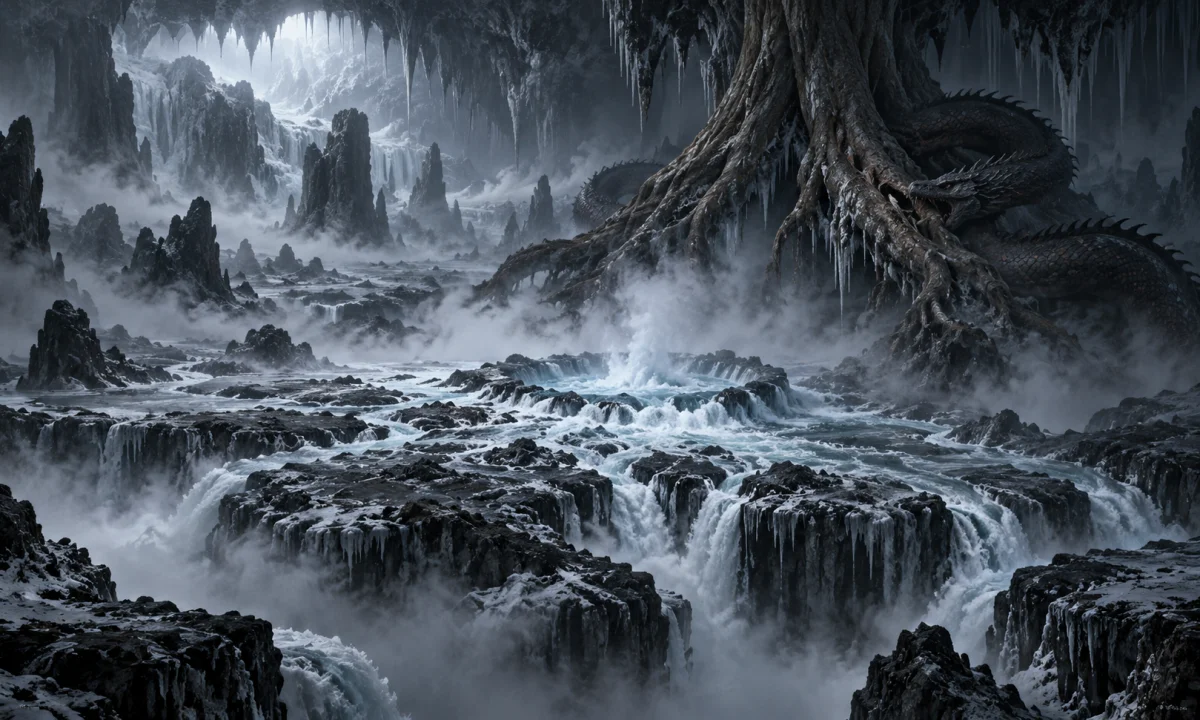
Fafnir then withdraws to guard the treasure. Under the influence of greed and the curse, he changes into a dragon or dragon-like monster. In Norse heroic literature, a dragon is not only a powerful animal but also a figure of hoarded wealth, isolation and destructive possessiveness. Fafnir’s transformation gives physical form to the corruption already present in the family’s response to Otr’s death.
Regin survives and later becomes involved in the upbringing of Sigurd. He tells Sigurd about the treasure and persuades him to kill Fafnir. Regin has his own interest in the hoard, and his relationship with Sigurd is shaped by manipulation as well as instruction. Sigurd forges or receives the sword Gram, kills Fafnir and later kills Regin after discovering that Regin intends to betray him.
Otr does not return in these stories, nor does he appear as a spirit guiding Sigurd. His death remains the opening tragedy that makes the later heroic events possible. The treasure that causes his ransom eventually passes through several hands, bringing violence to Hreidmar, Fafnir, Regin and Sigurd.
Shapeshifting and the human-animal boundary
Otr’s most distinctive attribute is his transformation into an otter. Norse literature contains several kinds of shape-changing, including magical transformations by gods, giants, witches and other supernatural beings. Otr’s case is different from Loki’s more elaborate transformations because the sources give little explanation and do not make him a master of illusion or sorcery.
His otter form is connected to ordinary activity rather than combat. He fishes, eats and rests in a pattern that resembles the life of a real otter. At the same time, his return to human form shows that the animal is not merely a disguise. Otr moves between two environments and two modes of existence while remaining a member of Hreidmar’s family.
This feature gives the story a strong boundary between the domestic and the wild. Otr can be encountered as an animal by someone who does not know his identity, yet killing that animal has the legal and emotional consequences of killing a person. Loki’s failure to recognize him is therefore central to the tragedy. The incident also illustrates how easily the natural world, the human household and the supernatural sphere overlap in Norse legend.
Meaning and cultural significance
Otr’s story is often interpreted through the themes of compensation, inherited violence and cursed wealth. The initial problem is a killing that appears accidental, but the payment transforms it into a transaction involving extraordinary wealth. Once the gold enters Hreidmar’s household, personal desire turns compensation into conflict.
The tale also shows that a lawful settlement does not necessarily restore balance. Hreidmar receives exactly what he demands, yet the payment carries a curse. Fafnir’s murder of his father is driven by the same treasure that was used to compensate the family. The story thus links legal obligation with greed rather than presenting wealth as a neutral reward.
Otr himself is less fully characterized than Fafnir or Regin. He does not receive a long speech, a heroic quest or an independent cycle of adventures. His importance lies in the position he occupies at the beginning of the narrative. He is the lost brother whose death creates the debt, the animal-person whose identity is misunderstood and the family member whose body becomes the measure of the ransom.
It is uncertain whether Otr originated as a figure from a pre-Christian religious tradition or whether his story developed primarily within heroic legend. The medieval texts do not describe sacrifices to him, prayers addressed to him or a cult connected with otters. His presence alongside Odin and Hœnir should not be taken as evidence that he was worshipped as a local deity. In the surviving tradition, he is a legendary shapeshifter whose story intersects with the gods.
Otr and later versions of the treasure story
The tale of Otr belongs to the wider Germanic tradition of the cursed hoard and the dragon-slayer. The same broad cycle appears in different forms in Scandinavian and continental Germanic literature, although names, relationships and events do not always match. The Scandinavian versions connect the hoard especially closely with Andvari, Fafnir, Regin and Sigurd.
Richard Wagner’s nineteenth-century opera cycle Der Ring des Nibelungen draws on the same general heroic and mythological materials but does not preserve Otr as a direct character. Wagner changes the beginning of the story substantially, including the roles of the giants Fasolt and Fafner and the ransom involving Freia. Wagner’s Fafner is therefore related to the traditional Fafnir but should not be treated as a straightforward portrayal of Otr’s brother or of the original otter-ransom episode.
Modern fantasy, games and fiction sometimes use the name Otr because it is short, distinctive and connected with shapeshifting or Norse legend. Such appearances may borrow only the name or the idea of an otter-like being. The traditional Otr remains specifically the son of Hreidmar, the brother of Fafnir and Regin, and the accidental victim whose death begins the history of Andvari’s cursed gold.