WORLD
WORLD
Ód
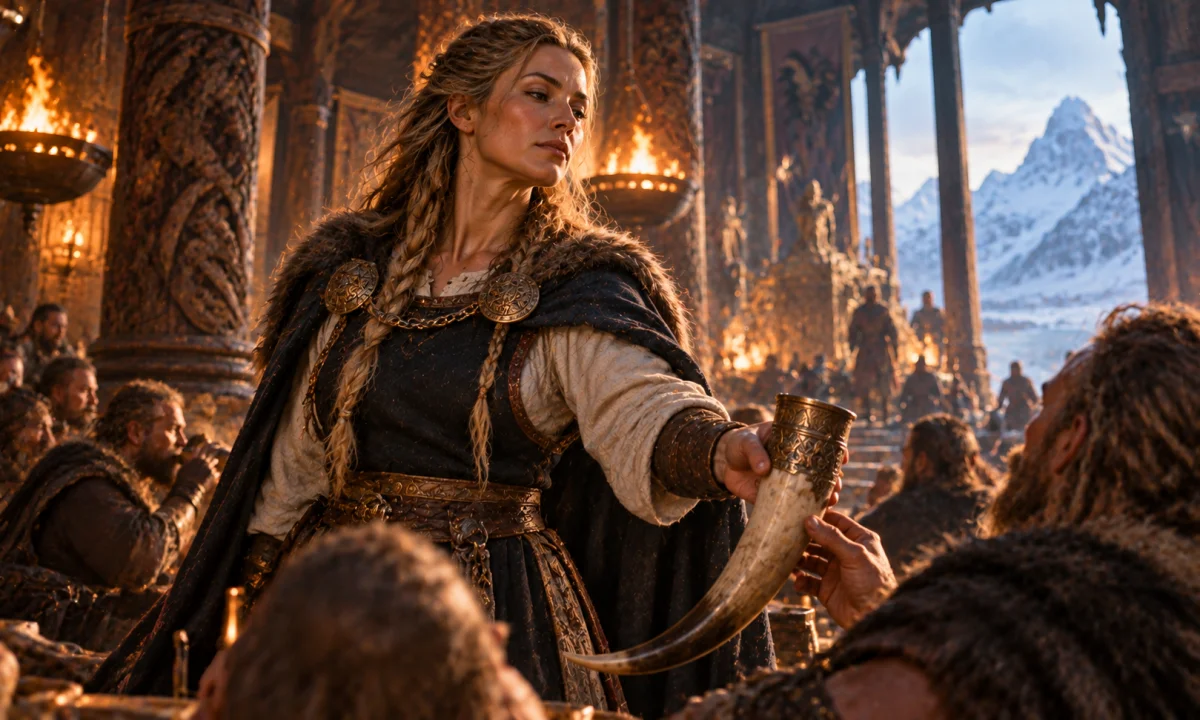
Ód, more fully written in Old Norse as Óðr, is a little-known figure associated with Freyja in Norse mythology. He is described primarily as her husband and as the father of Hnoss and Gersemi. Unlike Odin, Thor or Freyja, Óðr has no substantial independent mythology, and the surviving sources provide no clear account of his appearance, powers or personal cult. His importance comes chiefly from his absence: Óðr wanders away, Freyja searches for him, and her tears become gold.
Óðr in Norse tradition
Óðr belongs to the mythological world preserved in medieval Icelandic literature. These texts were written after the conversion of Iceland to Christianity, generally during the thirteenth century, but they preserve poems, names and stories that draw on older Scandinavian traditions. Norse mythology did not possess a single canonical scripture. Instead, knowledge of its gods and legendary beings comes from poetry, prose retellings, place-names, personal names and other scattered evidence.
The most important written account of Óðr appears in Gylfaginning, the first part of Snorri Sturluson's Prose Edda. In that work, Freyja is said to be married to Óðr. He travels far away, leaving her behind, and she follows him through many lands. Freyja weeps because of his absence, and her tears are described as red gold. The same passage names their daughters Hnoss and Gersemi, whose names are associated with precious things and treasure.
Óðr is also connected with Freyja in the poetic tradition. Völuspá, one of the central poems of the Poetic Edda, refers to Freyja as Óðr's wife. The poem does not give a full narrative of their relationship, but the brief reference confirms that the association was not invented solely by Snorri. Other references to Freyja's family preserve the names of Hnoss and Gersemi, although the details vary according to the text and interpretation.
The evidence is therefore narrow. Óðr is not the subject of a surviving poem, does not receive a developed genealogy and is not presented with a distinct set of myths comparable to those of major Norse gods. Any description of him as a god of a particular natural force, weapon or profession goes beyond what the sources securely establish.
The name Óðr
The Old Norse name is normally written Óðr. The letter ð is the letter eth, used in Old Norse and modern Icelandic to represent a dental sound. In English-language writing, the name may appear as Ód, Od, Odr or Odur. “Ód” is a simplified form, while Óðr is the form most often used in discussions of the Old Norse evidence.
The noun óðr also existed as a vocabulary word rather than only as a personal name. It could refer to mind, sense, feeling, inspiration, poetic inspiration or an intense, excited state. Depending on context, it may be translated with words such as “fury,” “ecstasy,” “passion,” “inspiration” or “mind.” These meanings are related but not identical, and no single English translation captures the entire range.
The name is especially significant because it resembles the first element of Óðinn, the Old Norse name of Odin. This resemblance has encouraged both ancient and modern interpreters to connect the two figures. Linguistic similarity, however, does not by itself prove that Óðr and Odin were originally the same character. The surviving myths treat them as separate names, and the texts do not explicitly identify Óðr with Odin.
Family and relationship with Freyja
Óðr's most firmly established relationship is with Freyja, one of the principal goddesses of the Norse tradition. Freyja is associated in different sources with love, sexuality, fertility, wealth, beauty, seiðr magic and the reception of some of the dead in Fólkvangr. These associations come from several bodies of material and should not be reduced to a single simple role.
In the surviving accounts, Óðr is Freyja's husband rather than her brother, father or divine attendant. Their daughters are usually given as Hnoss and Gersemi. Both names are linked with valuable possessions. Hnoss is commonly understood in relation to treasure or a precious object, while gersemi is an Old Norse word meaning a costly or precious thing. The names suggest that the children embody beauty, value or preciousness, although the sources do not provide stories about them as active characters.
Freyja's marriage to Óðr is unusual because the relationship is defined by separation. The texts do not describe a wedding, courtship or shared adventure. Instead, Óðr leaves on long journeys, and Freyja grieves and searches for him. In Snorri's account, her sorrow is expressed through tears of red gold. This image links emotional loss with one of the materials most strongly associated with Freyja's wealth and beauty.
Some versions of the tradition also explain Freyja's many names by saying that she used different names while travelling in search of Óðr. This detail fits a wider pattern in Norse myth, where a divine figure may possess several names or titles in different contexts. It does not mean that every name associated with Freyja was originally created for this story, and the sources do not give a complete itinerary for her search.
Attributes and character
There is no reliable ancient description of Óðr's physical appearance. He is not given a distinctive garment, animal companion, weapon or home. Nor is he clearly assigned a realm comparable to Asgard, Álfheimr or Hel. Descriptions sometimes found in modern retellings—such as portraying him as a warrior, wanderer with a particular weapon, or ruler of a separate kingdom—are usually creative additions rather than details preserved in the medieval sources.
The same caution applies to claims that Óðr was specifically a god of madness, poetry or inspiration. The meaning of his name makes such interpretations understandable, and his disappearance can be read as a form of restless wandering. Nevertheless, the texts do not give him a formal divine office. It is safer to say that the name carries associations of intense feeling, inspiration and altered mental states than to assign him a fixed domain.
Óðr's defining narrative characteristic is absence. He is a husband who cannot remain at home and a figure known through the grief of the person left behind. His role is therefore relational rather than autonomous. The myth tells readers more about Freyja's longing, mobility and emotional power than about Óðr's own actions.
The story of Óðr's disappearance
The principal story can be outlined simply. Óðr goes away on long journeys. Freyja misses him and travels across the world in search of him. As she weeps, her tears become gold, described in Snorri's account as red gold. She is also said to have been known by different names among different peoples during her travels.
The account does not explain why Óðr leaves. He is not said to be kidnapped, killed, punished or transformed. Nor does the surviving narrative clearly state whether Freyja eventually finds him. This lack of resolution is important. Later storytellers may naturally wish to provide a reunion or a tragic ending, but neither outcome is securely preserved in the main sources.
The story resembles a broader mythic pattern in which a spouse or beloved disappears and the remaining partner crosses boundaries in search of them. Such patterns occur in many cultures, but similarity does not demonstrate direct borrowing. In the Norse material, the story is also connected with images of travel, wealth and tears. Freyja's grief produces treasure, turning emotional suffering into a manifestation of her extraordinary nature.
Óðr and Odin
One of the most persistent interpretive questions is whether Óðr is an independent figure or a secondary form of Odin. The question arises for several reasons. The names Óðr and Óðinn are linguistically related, both figures can be associated with wandering, and both have connections with ecstatic inspiration or altered states. Odin is also famously absent from home for periods of time in some traditions, while Freyja and Odin share certain overlapping associations with magic and the reception of the dead.
These parallels have led some scholars to propose that Óðr may preserve an older form, aspect or counterpart of Odin. Another possibility is that two originally distinct figures became associated because their names and characteristics overlapped. The surviving texts do not settle the issue. In the written myths, Óðr and Óðinn are normally presented as different names and characters, and there is no explicit statement that Freyja's husband is Odin in disguise.
It is therefore inaccurate to state without qualification that Óðr is Odin. It is equally premature to dismiss every connection between them as meaningless. The relationship between the names is a legitimate subject of linguistic and comparative interpretation, but the conclusion remains debated. A careful account keeps the documented myth separate from theories about earlier stages of the tradition.
Óðr and other similar names
Óðr should not be confused with Óðinn, even though the names are related. He is also distinct from Odr as a modern spelling used in translations, since the absence of the letter ð does not necessarily indicate a different mythological figure. English texts may use several spellings for the same Old Norse name.
There is also a difference between the personal name Óðr and the common noun óðr. A passage using the word in the sense of inspiration, mental power or fury is not automatically referring to Freyja's husband. Context is necessary, particularly in poetic language, where abstract qualities and personal names can resemble one another.
Óðr should likewise not be merged with other wandering male figures in Germanic mythology. Odin, the hero Sigurd, and various legendary kings may all travel, disguise themselves or disappear, but those similarities do not establish identity. The Norse sources contain many figures whose names and roles overlap, and careful interpretation depends on keeping their individual traditions distinct.
Interpretations of Óðr's significance
Óðr's obscurity has made him especially open to interpretation. One approach views him as a personification of the inspired or ecstatic quality suggested by his name. In this reading, Freyja's relationship with Óðr symbolically joins her with passion, desire, magic or emotional intensity. This is an interpretive model rather than an explicit explanation given by the medieval sources.
Another approach focuses on the narrative structure. Óðr may function less as a fully developed god than as the absent beloved whose disappearance allows Freyja's own attributes to become visible. Her travelling, changing names and golden tears form the active centre of the story. Óðr's silence and distance make him a catalyst for her movement rather than a hero with a separate quest.
The marriage may also be considered alongside the many relationships in Norse mythology that connect gods with fertility, wealth and social bonds. Yet it would be speculative to treat Óðr as a clearly defined fertility deity or to claim that his absence represents a seasonal cycle. The surviving texts do not explicitly connect his departure and return with winter, vegetation or an annual religious festival.
There is no strong evidence for a separate cult of Óðr. Archaeological finds, place-names and inscriptions provide extensive evidence for the veneration of several Norse gods, but they do not establish an independent worship tradition for Óðr. His presence in myth may reflect a narrative tradition about Freyja rather than a god who received widespread personal devotion.
Óðr in later reception
Because Óðr is represented by only a few references, modern retellings have considerable freedom to expand him. Fantasy fiction, myth-inspired games and contemporary spiritual writing may portray him as a warrior, a divine wanderer, an incarnation of inspiration or a romantic counterpart to Freyja. These portrayals can be imaginative, but they should not be mistaken for details preserved in the Poetic Edda or Prose Edda.
Modern pagan and esoteric interpretations likewise vary. Some practitioners treat Óðr as a distinct figure connected with inspiration, longing or ecstatic experience; others identify him with Odin or use the name symbolically. Such approaches belong to modern religious and cultural reception. The medieval evidence supports the figure of Freyja's absent husband, but it does not prescribe a single modern devotional interpretation.
Óðr is consequently best understood as a marginal but meaningful figure in Norse mythology: the husband of Freyja, the father of Hnoss and Gersemi, and the wanderer whose absence produces one of the tradition's most memorable images of divine grief. His limited mythology is not a gap that can be filled with certainty. It is part of the evidence itself, showing how a character could remain important within another deity's story without developing an independent cycle of myths.