WORLD

Nipinoukhe
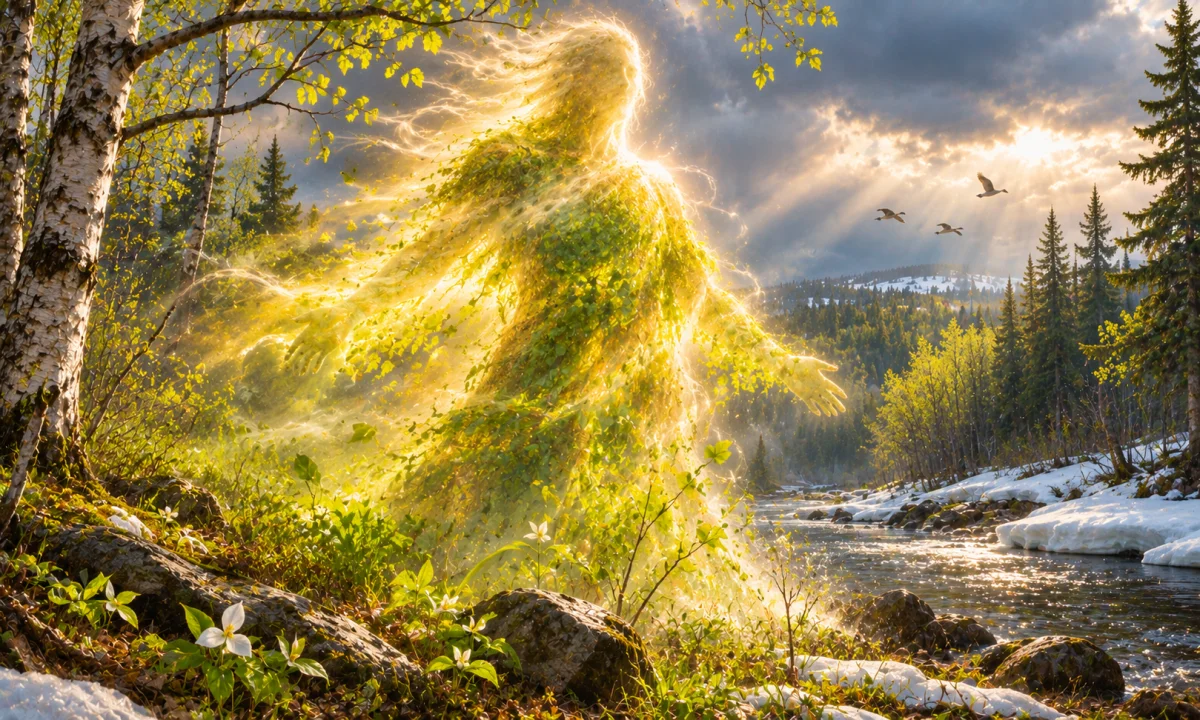
Nipinoukhe is an obscure name associated with Abenaki or, more broadly, Wabanaki traditional belief. It is usually presented in modern reference works as the name of a female water spirit, but the evidence for a single, well-defined being is limited. Spellings, descriptions and even the precise cultural attribution vary, and many popular summaries repeat one another without identifying a clearly documented traditional narrative.
Cultural setting
The Abenaki are one of the Wabanaki peoples of northeastern North America. The Wabanaki Confederacy traditionally included the Abenaki, Penobscot, Passamaquoddy, Maliseet and Mi’kmaq, although each nation has its own language, history and bodies of traditional knowledge. Their homelands extend across parts of present-day New England and the Canadian Maritimes.
Water is central to the geography and religious imagination of this region. Rivers, lakes, coastal inlets and wetlands were routes of travel, sources of food and places with spiritual significance. Wabanaki traditions include powerful beings connected with particular landscapes, animals, weather phenomena and bodies of water. Such beings should not automatically be treated as “monsters” in the modern sense. A being might be dangerous to people, protective of a place, morally ambiguous or simply beyond ordinary human control.
The broad label Native American mythology can conceal important differences. There is no single mythology shared by all Indigenous peoples of North America, and stories belonging to one Wabanaki nation should not be assigned to every neighbouring nation. The term “Abenaki mythology” is itself a broad modern label for traditions associated with Abenaki-speaking communities and their historical relatives.
The name and its uncertain identity
Nipinoukhe is not a widely documented figure comparable in surviving literature to Gluskabe, the major culture hero of several Wabanaki traditions. The name appears in modern lists and encyclopedic treatments of legendary beings, where it is commonly classified as an Abenaki water spirit or water woman. Those accounts are not consistent enough to establish a complete traditional profile.
Several problems affect the interpretation of the name:
- Indigenous names were recorded by outsiders using European spelling systems that did not always represent the original pronunciation accurately.
- A word may have more than one spelling when it is written in English or French, or when it is transcribed from different Abenaki languages and dialects.
- A name may refer to a local being, a descriptive term, a story character or a translated concept rather than to a standardized mythological “species.”
- Later reference books and websites sometimes preserve an attractive description without recording where that description originated.
For these reasons, Nipinoukhe is best treated as an uncertain and poorly documented traditional figure, not as a character with a universally accepted biography. The spelling itself should not be assumed to provide a secure translation, and a confident etymology cannot be given without a reliable linguistic and cultural source.
Reported classification as a water spirit
Where Nipinoukhe is discussed, it is generally classified as a female or feminine water being. Some modern descriptions portray her as a dangerous spirit associated with rivers or other bodies of water. These accounts often place her in the same broad category as water women, lake beings and other supernatural figures who may attract, threaten or mislead human travellers.
That classification should be expressed cautiously. There is no stable body of widely attested stories establishing one appearance, one habitat or one set of powers. In particular, familiar details sometimes attached to Nipinoukhe—such as long hair, extraordinary beauty, seduction, drowning or a specific animal form—should not automatically be treated as securely preserved Abenaki tradition. They may derive from later retellings, comparison with other water spirits or unsourced modern compilation.
Nor should the figure be forced into a European category such as “mermaid,” “siren” or “river nymph.” Those labels can be useful as rough comparisons for readers, but they carry assumptions from Greek, European and modern fantasy traditions. A Wabanaki water being belongs within its own cultural setting, where relationships with land, water, animals and spiritual power do not necessarily follow the narrative patterns of European folklore.
Possible roles and symbolism
If the water-spirit classification is accepted as a cautious description rather than a complete definition, Nipinoukhe can be considered in relation to several recurring themes in Indigenous storytelling from the Northeast. Water may mark a boundary between the familiar human world and places where ordinary rules no longer apply. A story involving a water being can therefore express danger, respect for the natural world, the consequences of careless behaviour or the limits of human knowledge.
Such interpretations must remain general. There is not enough secure evidence to assign Nipinoukhe a single moral lesson or symbolic function. She should not automatically be described as an embodiment of death, sexuality, femininity or nature. Those interpretations are common in modern mythological commentary, but they can project modern categories onto a tradition whose original context is no longer recoverable from the name alone.
It is also important not to assume that a dangerous spirit is necessarily evil. In many Indigenous traditions, supernatural beings may be powerful and hazardous without fitting a simple good-versus-evil scheme. A being associated with water might punish disrespect, defend a particular place or pose a threat because humans have entered a domain that is not theirs. The meaning would depend on the specific story and the community in which it was told.
Stories and narrative evidence
No single, widely recognized cycle of Nipinoukhe stories is securely established in the accessible historical record. There is no generally accepted account of her origin, family, home, conflict with a hero or relationship with Gluskabe. Claims that provide a detailed appearance and a fixed sequence of adventures should therefore be checked carefully rather than repeated as settled fact.
This absence of a well-known written narrative does not prove that no community told stories involving the name. Indigenous traditions were transmitted primarily through oral performance, instruction and community relationships, not through the publication of a standardized mythology. A local story might also have been recorded under a different spelling, translated descriptively or omitted from collections made by outsiders.
Written documentation is especially uneven for northeastern Indigenous traditions. Missionaries, colonial officials, ethnographers and collectors often recorded stories according to their own interests and categories. They could misunderstand a language, remove ceremonial context or treat a living tradition as a catalogue of “superstitions.” Later writers sometimes detached names from the original narratives and presented them as entries in a universal dictionary of monsters. These processes make it difficult to determine whether every modern reference to Nipinoukhe reflects an independent traditional record.
Distinguishing Nipinoukhe from other water beings
Nipinoukhe should not be merged with every Indigenous water monster or water woman from northeastern North America. Wabanaki and neighbouring Algonquian-speaking peoples have traditions concerning many kinds of supernatural beings, but similar themes do not establish identical identities.
She is also distinct from the Underwater Panther, a powerful being known in several Indigenous traditions farther west and south. The Underwater Panther is not an Abenaki equivalent of Nipinoukhe, and its attributes cannot be transferred to her. Likewise, Nipinoukhe should not be equated with the mermaid of European folklore or with the siren of Greek tradition merely because modern descriptions may portray a water-dwelling female figure.
Nor is there a sound basis for identifying Nipinoukhe with every regional lake monster. A lake monster is usually described as an animal-like creature, often reptilian or serpentine, whereas Nipinoukhe is generally classified in modern accounts as a spirit with a human or feminine aspect. Even that distinction remains provisional because the surviving descriptions are inconsistent.
Relationship to Abenaki religious tradition
It is misleading to imagine Abenaki religion as a closed bestiary in which every spirit has a fixed place and a neatly defined power. Traditional religious knowledge includes relationships among human communities, ancestors, animals, places and other-than-human persons. Stories may teach appropriate conduct, explain features of the landscape or preserve knowledge about encounters with spiritual forces.
The word “spirit” can also be too broad. English-language collectors have often used it to translate different Indigenous concepts, and a translation may lose distinctions present in the original language. A figure called a water spirit in an English reference work may not have been understood by the original storytellers as a separate supernatural “species.” It may instead have been a particular person, inhabitant or power connected with a place.
Because Nipinoukhe is so sparsely documented, it is more responsible to describe the figure’s reported association than to place her within a detailed religious hierarchy. The available evidence supports a cautious connection with Abenaki or Wabanaki water lore, but it does not support a definitive account of worship, ritual, offerings or a universal role in Abenaki belief.
Modern reception
Nipinoukhe’s presence today appears to come largely from modern encyclopedic listings, folklore databases and retellings of legendary creatures. In these settings, a brief and uncertain reference can acquire a more elaborate identity: a beautiful woman, a lure for travellers, a guardian of a lake or a deadly supernatural seductress. Such developments may be imaginative adaptations rather than evidence of an ancient, standardized tradition.
Modern fantasy, games and online mythology collections often prefer concise character profiles with a defined appearance, alignment and set of powers. That format can make an obscure name easier to use, but it can also erase uncertainty and imply a level of documentation that does not exist. A responsible adaptation should identify invented elements as creative additions and should avoid presenting a generalized “Native American” background in place of a specific Abenaki or Wabanaki context.
Nipinoukhe is therefore best approached as a poorly documented name associated with Abenaki or Wabanaki water-spirit tradition. The association is worth recording, but the gaps in the evidence are part of the subject itself. Claims about her appearance, behaviour, translation and stories should remain explicitly qualified unless they can be tied to a clearly identified Indigenous tradition or historical record.