WORLD
WORLD
Ngurunderi
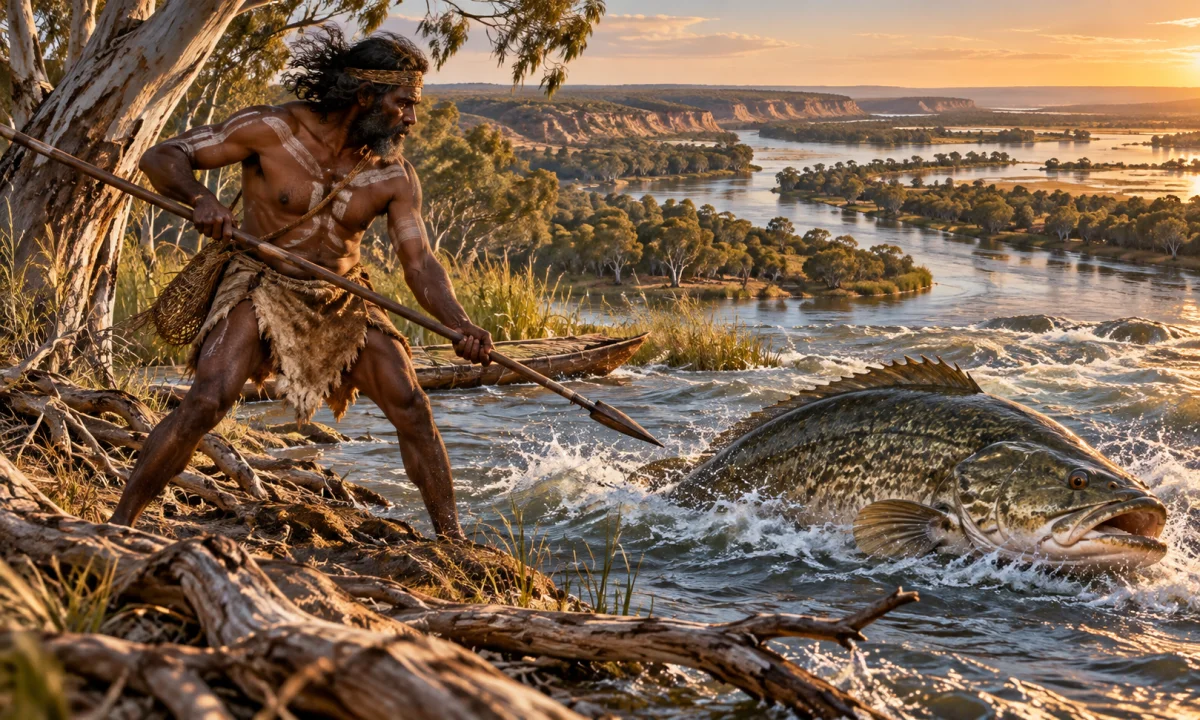
Ngurunderi is a major ancestral being of the Ngarrindjeri peoples of South Australia. His traditions are associated especially with the lower Murray River, the Coorong, Lake Alexandrina, Lake Albert, Encounter Bay and the coastal country around the mouth of the Murray. In Ngarrindjeri religious tradition, Ngurunderi is not simply a hero from a distant age. He is a Dreaming ancestor whose journeys helped form the land, establish relationships between people and places, and provide foundations for law, ceremony and cultural knowledge.
The name is written in several ways, including Ngurunderi, Ngurunderi and forms influenced by older colonial spellings of Ngarrindjeri language. English-language accounts have also used the historical name “Narrinyeri” for the people now generally known as Ngarrindjeri. Spellings and details vary because the traditions come from an oral culture with different regional, family and ceremonial versions, and because early European observers recorded Indigenous names using inconsistent systems.
Ngarrindjeri cultural setting
Ngurunderi belongs to the cultural world of the Ngarrindjeri, whose traditional country includes a complex network of waterways, wetlands, lakes, islands, coastal inlets and sea country in what is now South Australia. The lower Murray and the Coorong are not merely geographical settings in these traditions. They are living cultural landscapes in which animals, ancestral beings, places, people and moral responsibilities are connected.
The English word Dreaming is commonly used to describe the ancestral and sacred dimensions of Aboriginal Australian religious traditions, although it does not translate every meaning carried by Indigenous terms. Dreaming traditions concern the formation of the world, the ordering of society, the origins of species and places, and continuing relationships between ancestral powers and living communities. They are not treated simply as fictional stories or as accounts of a vanished prehistoric period.
In Ngarrindjeri tradition, ancestral beings such as Ngurunderi travelled through country, interacted with other beings, named places, created landforms and established patterns of conduct. Their actions remain present in the landscape. A river bend, island, rock, fish species or ceremonial place may therefore be understood not only through its physical appearance but also through the ancestral events associated with it.
Much of the surviving written information about Ngurunderi was recorded by missionaries, settlers, anthropologists and other outsiders during the nineteenth and twentieth centuries. These records can preserve valuable information, but they are not neutral transcripts of Ngarrindjeri religion. Early observers often misunderstood Aboriginal categories, translated names inaccurately, omitted restricted material or rearranged oral accounts according to European ideas of mythology. Contemporary Ngarrindjeri knowledge holders continue to maintain, interpret and protect their own traditions.
Name and identity
Ngurunderi is best described as an ancestral creator and cultural hero, rather than as a god in the sense used for figures in many ancient European religions. The word “creator” can also be misleading if it suggests a single act of making the universe from nothing. Ngurunderi’s creative work is usually represented through movement and action: travelling through country, pursuing, confronting or transforming other beings, shaping waterways and establishing significant places.
He is sometimes called an ancestor because Ngarrindjeri people trace cultural, spiritual and territorial relationships through the actions of beings such as Ngurunderi. At the same time, he is more than an ordinary human ancestor. He possesses extraordinary powers, moves between human and non-human realms, and leaves permanent marks upon the country. His identity therefore combines roles that modern categories often separate: ancestor, creator, law-giver, culture hero and sacred being.
There is no single universally fixed version of every episode associated with him. Some accounts differ in the names of his companions, the order of events, the places visited and the meaning assigned to particular sites. Certain knowledge may also be intended for particular people, ceremonies or contexts rather than for unrestricted public retelling. A general account should therefore not be treated as a complete statement of Ngarrindjeri religious knowledge.
The journey along the Murray
One of the best-known cycles tells of Ngurunderi travelling through the Murray region and the country toward the sea. A central episode concerns a huge fish, often identified as a Murray cod and known in some accounts as Ponde. The fish is not merely an animal in a hunting tale. Its movement is linked to the formation of the Murray River and to the shaping of the waterways through which Ngarrindjeri life has long been organised.
In commonly circulated versions, Ngurunderi pursued or hunted the giant fish. When he tried to spear it, Ponde escaped and travelled through the country. The fish’s path produced or enlarged the winding course of the Murray, creating bends, channels and connected waters. Ngurunderi continued the pursuit toward the lower river and the lakes. The precise sequence varies among accounts, and versions intended for public explanation may condense a longer body of place-based knowledge.
This episode illustrates a characteristic feature of Aboriginal Australian ancestral narratives: a landscape is explained through relationships and events rather than through an abstract description of geology. The river is at once a physical waterway, a route of ancestral travel, a habitat for important species and a record of Ngurunderi’s actions. Its cultural meaning cannot be separated from the responsibilities that people have toward the river and its living systems.
Ngurunderi is also associated with the creation or formation of other places around the lower Murray, the lakes and the Coorong. In different retellings, features of the landscape result from spears, camps, movements, struggles or other actions by the ancestral beings. Islands, lagoons, sand formations and coastal sites may consequently carry names and stories that identify them as evidence of the ancestral journey.
The wives and the coastal journey
Another important part of the Ngurunderi cycle concerns his wives. Public accounts commonly describe Ngurunderi as pursuing two wives as he travelled through the country. Their names and the details of their relationship are not consistent across all published versions; names such as Nepeli or closely related spellings appear in some accounts, while other records differ. It is safer to regard these names as variant forms within a complex oral tradition rather than to assume that one printed version is definitive.
The pursuit story links domestic relationships with the creation of significant places. Ngurunderi’s movement after his wives takes him through a chain of locations associated with the Murray mouth, the Coorong and the coast. The events may include conflict, separation, transformation and the establishment of places that remain important to Ngarrindjeri people. The story should not be reduced to a simple tale of marital jealousy or adventure. Its meanings include kinship, obligation, territorial knowledge and the consequences of actions within a social and sacred world.
Some versions connect the wives with islands or other coastal features after Ngurunderi’s pursuit. Other versions emphasise different episodes and relationships. Because public retellings often combine material from several informants, apparent contradictions may reflect regional traditions, differences in the purpose of the account or the removal of ceremonial context by early collectors.
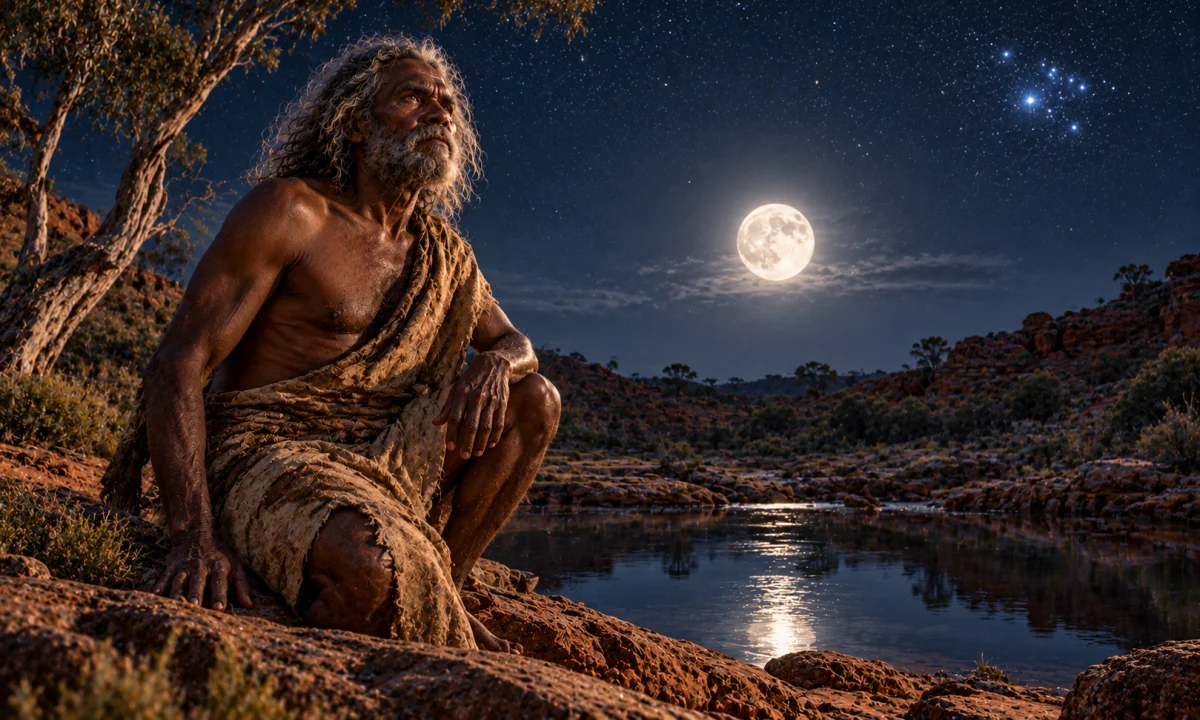
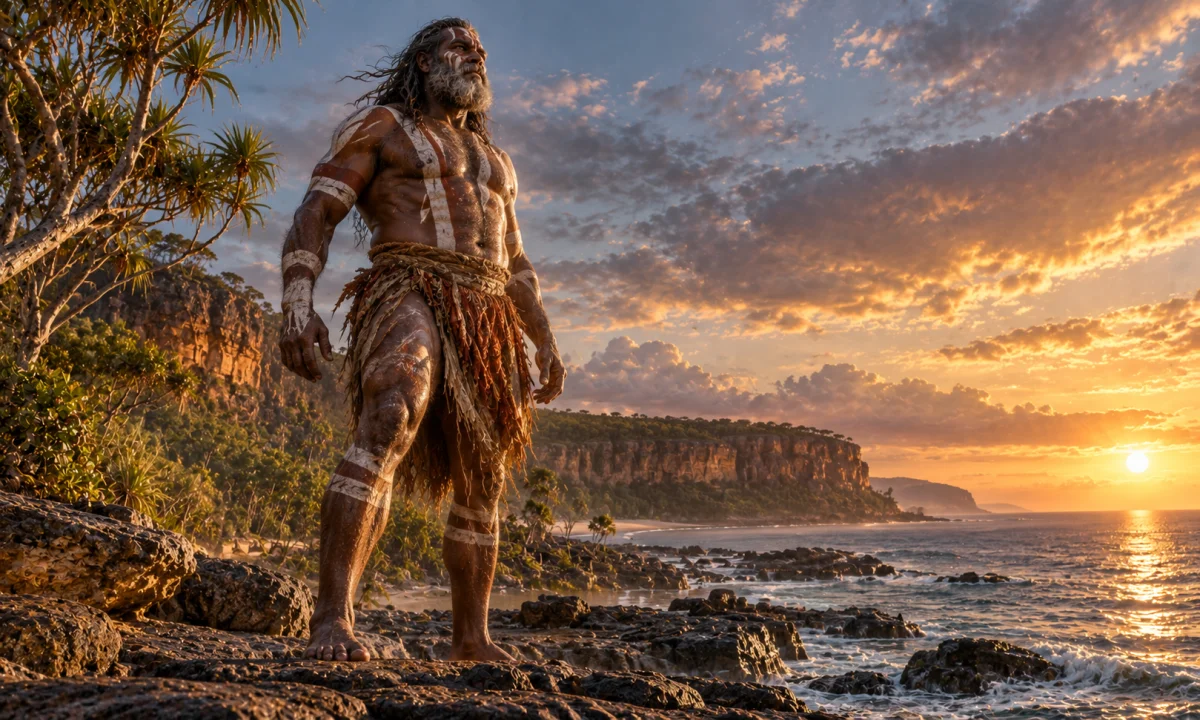
Ngurunderi’s journey eventually reaches the southern coast. He is associated with places around Encounter Bay and Victor Harbor, although the significance of individual sites should be understood through Ngarrindjeri cultural authority rather than through a generalized map of “mythological locations.” In some accounts, Ngurunderi leaves the ordinary human world by rising into the sky or entering another realm. The ending is variously connected with celestial features, ancestral continuation and the ongoing presence of the Dreaming.
Creation, law and the living landscape
Ngurunderi’s importance does not depend only on the number of places attributed to him. His stories express a way of understanding country in which land and society are inseparable. The ancestral journey establishes connections between water, animals, people, travel routes and ceremonial responsibilities. A place can be sacred because of what happened there, because of the being connected with it, and because of the duties that arise from that connection.
The giant fish episode also reflects the importance of aquatic environments to Ngarrindjeri life. Fish, birds, reeds, shellfish and other resources are not simply background elements in the stories. They are part of a network of relationships that includes knowledge about seasons, movement through wetlands, appropriate harvesting and care for particular habitats. The narrative gives cultural depth to the waterways and helps communicate why they require respect.
As an ancestral law-giving figure, Ngurunderi may be discussed alongside broader Ngarrindjeri understandings of proper conduct, kinship and ceremonial order. This does not mean that every social rule can be attributed to him personally, or that published accounts provide a complete code of Ngarrindjeri law. Rather, his journey is one part of a larger religious and cultural system in which ancestral actions establish precedents and obligations.
The landscape itself functions as a form of memory. Knowledge can be carried by a place name, a visible landform, a river course or a story associated with travel. Remembering Ngurunderi is therefore not only an act of recalling a character. It is also a way of recognising Ngarrindjeri connections to country and the continuing authority of cultural knowledge.
Sources, recording and interpretation
European records of Ngurunderi’s traditions were produced under colonial conditions. Missionaries and settlers often used their own religious vocabulary when describing Aboriginal beliefs, sometimes classifying ancestral beings as “gods,” “devils,” “spirits” or “heroes.” These labels can obscure the distinctive character of Ngarrindjeri traditions. Later researchers sometimes compared Ngurunderi with creator figures from other societies, but such comparisons are useful only when they do not erase local meanings.
Written accounts also vary because oral traditions are performed in particular contexts. A public explanation for visitors is not necessarily the same as a ceremonial account, a teaching given within a family or a narrative connected with a restricted site. Retellings may be shortened, translated, adapted for children or reorganised for educational purposes. Differences between accounts do not automatically show that the tradition is unreliable; they may reveal the diversity and contextual nature of oral knowledge.
Modern scholarship and cultural education increasingly recognise the importance of Ngarrindjeri voices in interpreting Ngurunderi. Community authority matters especially when stories concern sacred places, restricted knowledge, ancestral remains, cultural property or relationships between living communities and country. Public versions can communicate broad themes, but they cannot substitute for the full body of Ngarrindjeri knowledge.
Ngurunderi and similar figures
Ngurunderi should not be merged with other Aboriginal Australian creator or culture heroes simply because they also travel through the landscape or shape the world. Aboriginal Australia contains many distinct cultural traditions, each belonging to particular peoples and countries. Figures such as Baiame, Bunjil, Daramulum, Tiddalik and the Rainbow Serpent belong to different cultural contexts, even when popular summaries describe them using similar words such as “creator” or “spirit.”
Ngurunderi is specifically associated with Ngarrindjeri country and traditions of the lower Murray, the Coorong and adjacent coastal regions. He is also distinct from Tiddalik, the water-holding trickster or frog figure found in traditions from other parts of Australia and widely circulated in children’s books. Similar themes of water, animals and landscape do not indicate that the two beings are the same or that their stories share a single origin.
Continuing significance
Ngurunderi remains relevant because his traditions connect cultural identity with the health and protection of country. The Murray mouth, the Coorong and the lakes associated with his journey have faced major environmental pressures, including altered water flows, drought, salinity and habitat loss. For Ngarrindjeri people, concern for these places is not only an environmental or economic issue. It also involves the protection of ancestral landscapes and the responsibilities carried through cultural law.
Ngurunderi is represented in some contemporary educational programs, cultural interpretation projects, public art and tourism connected with South Australia. These forms can help non-Indigenous audiences recognise the depth of Ngarrindjeri history and the significance of the lower Murray landscape. They are modern presentations, however, and should not be confused with the full religious tradition or treated as permission to disclose knowledge that remains culturally restricted.
His enduring presence lies in the relationship between story and country. The river, lakes, wetlands and coast associated with Ngurunderi are not empty settings for an old legend. They are places where ancestral action, community identity, ecological knowledge and living cultural responsibility continue to meet.