WORLD
WORLD
Multultu
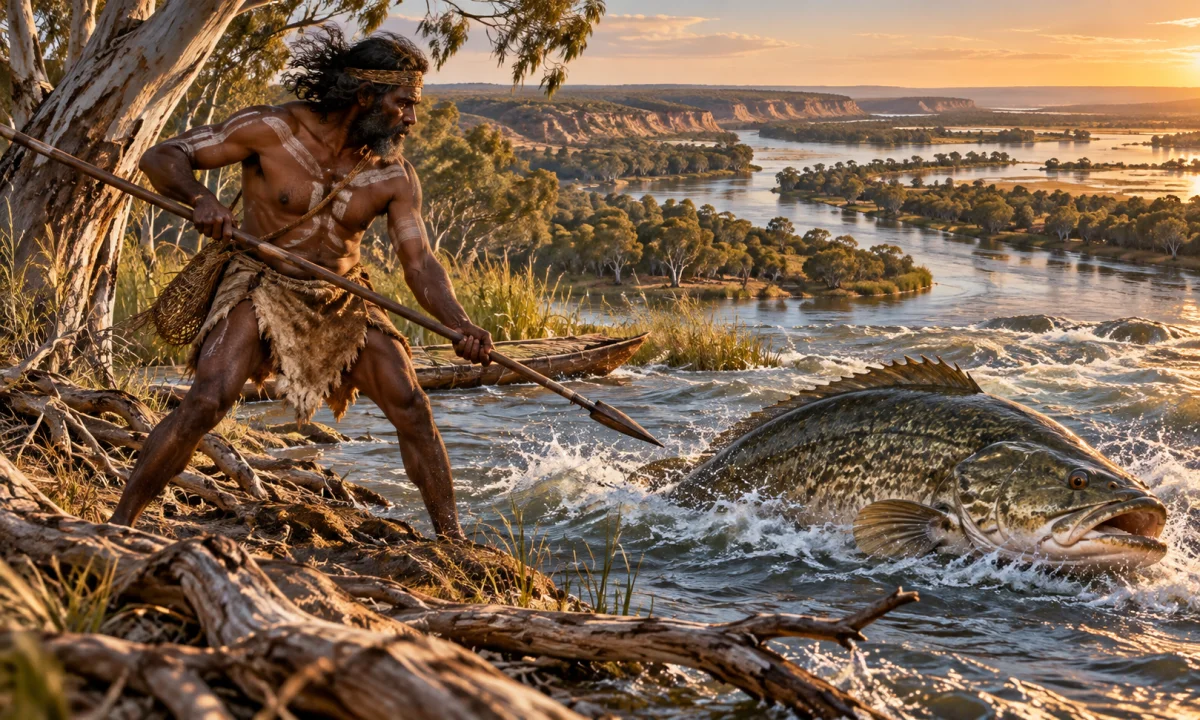
Multultu is a name associated in some modern references with a dangerous creature of Australian Aboriginal tradition, usually described as a water-dwelling monster. Its identity is uncertain, however. Unlike widely documented figures such as the Rainbow Serpent, Tiddalik or the bunyip, Multultu is not a single, clearly established being in the published records of Aboriginal religious traditions. The name appears in uneven secondary accounts, and descriptions differ considerably between sources.
Origins and cultural setting
“Australian Aboriginal mythology” is a broad modern label covering the diverse religious traditions of hundreds of Aboriginal nations and language groups. These traditions have their own names, laws, ancestral beings, ceremonial systems and relationships to particular landscapes. A creature reported under one name in a particular region should not automatically be treated as part of a universal Aboriginal mythology.
Aboriginal religious knowledge is traditionally transmitted through oral teaching, ceremony, performance, art and relationships to Country. Stories are not merely entertainment or explanations of natural phenomena. They may express responsibilities to ancestral places, rules governing conduct, kinship obligations, seasonal knowledge and the continuing presence of ancestral powers. European collectors often recorded only fragments of this knowledge, sometimes using their own categories—such as “monster”, “spirit” or “devil”—for beings whose significance was more complex.
The surviving written record is therefore uneven. Many accounts were collected long after first contact, translated through unfamiliar languages, or detached from the communities and places in which they had meaning. A name may also have been respelled by different writers, confused with another word, or circulated through later encyclopaedias without a clear connection to an identifiable community tradition.
Name and identity
The spelling Multultu is not securely standardised. Some references may use similar-looking forms, but similarity of spelling does not prove that the names refer to the same being. Australian Aboriginal languages often have sound systems and spelling conventions that differ from English, and older records frequently represent local words inconsistently.
For this reason, Multultu is best treated cautiously as a name or label found in limited accounts rather than as a uniformly defined mythological character. There is no reliable basis for assigning the figure to every Aboriginal people, to Australia as a whole, or to one specific religious system without identifying the original community and source.
In general descriptions, Multultu is classified as a water monster or dangerous aquatic spirit. Such a classification may be useful as a broad description, but it should not be mistaken for an Indigenous category. Aboriginal traditions distinguish beings according to local cosmology, ancestral authority and relationships with Country, not necessarily according to the European folklore division between “monster”, “spirit” and “animal”.
Reported appearance
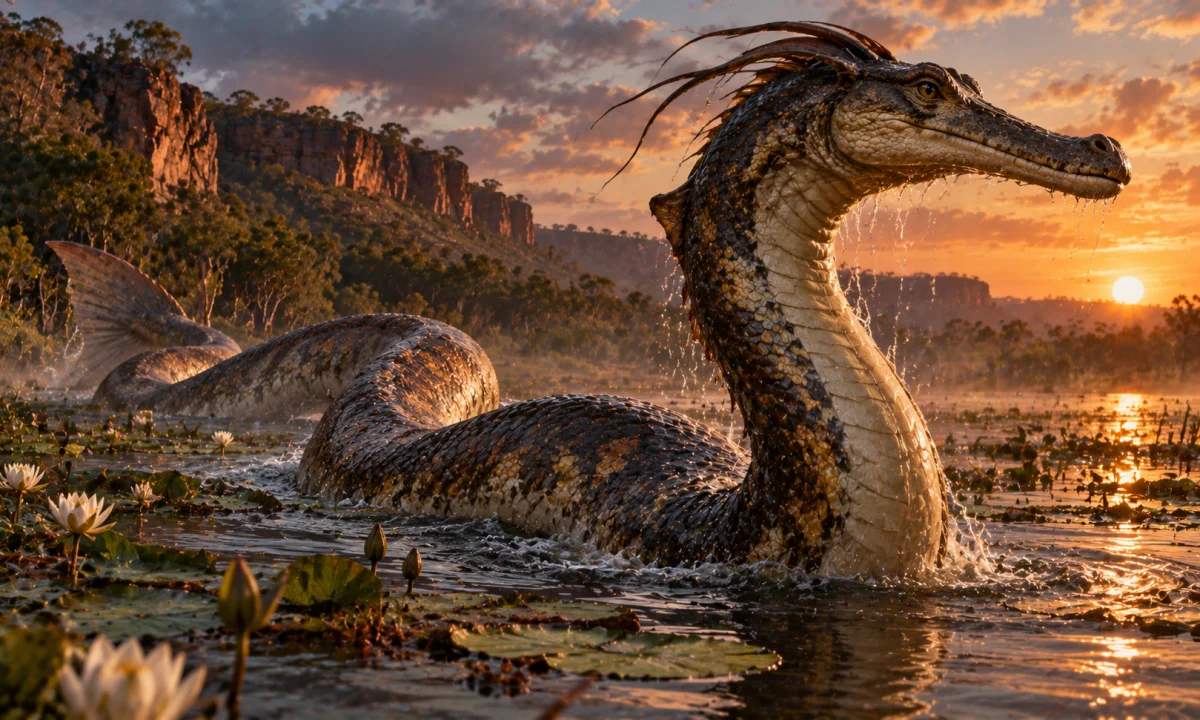
Descriptions of Multultu are inconsistent. The figure is commonly presented in modern summaries as a large, frightening creature associated with water, sometimes with a serpentine or reptilian form. Other descriptions are less specific and speak simply of a predatory being that inhabits rivers, lagoons, swamps or other bodies of water.
Because the available accounts do not agree, details such as scales, limbs, horns, a human face or a particular body length should not be treated as established attributes. Illustrations found in modern books or on websites may represent an artist’s interpretation rather than a traditional description. There is also no securely documented canonical image of Multultu comparable to a recognised ceremonial design or a consistently recorded ancestral figure.
The association with water is significant even when the precise form is uncertain. Rivers, billabongs, waterholes and wetlands are vital sites in Aboriginal life and law. They may be sources of drinking water, food and travel, while also being places connected with ancestral events and restrictions. A dangerous being connected with such a place can express both the practical hazards of water and the cultural obligations governing access to it.
Role and reported behaviour
Secondary accounts generally portray Multultu as hostile to humans. It is said to lurk in or near water and to threaten people who approach. Some modern retellings describe it as attacking or devouring people; others give no specific behaviour beyond presenting it as a creature to be feared.
These motifs resemble those found in many traditions around the world, where dangerous beings inhabit places that require caution. Yet resemblance does not establish a direct relationship between Multultu and a better-known figure. Nor does it show that every story about a mysterious water creature is an account of Multultu. Without a community-specific narrative, it is not possible to state confidently whether the being functioned as a guardian, a punisher, a predator, an explanation for accidents, or some combination of these roles.
It is also important not to assume that a threatening being was regarded as fictional in the modern sense. In many Indigenous religious contexts, ancestral and spiritual beings are part of a living relationship with Country. A story connected with a hazardous waterhole may carry practical warnings, ceremonial significance and moral meaning at the same time.
Stories and variants
No single, widely attested cycle of stories about Multultu is available in the standard English-language record. Published descriptions tend to be brief catalogue entries rather than complete narratives tied to a named Aboriginal nation, language group, storyteller or place. As a result, there is no securely established genealogy, set of companions, origin account or sequence of adventures that can be presented as canonical.
Some retellings may have expanded a short description into a more elaborate monster story. This process is common in popular treatments of folklore: a creature first mentioned in a regional account can acquire a fixed appearance, powers and habits through later repetition. Once these additions have been copied by several sources, they may appear traditional even when their origin is relatively recent.
Claims linking Multultu to a particular river, region or Aboriginal people should therefore be checked carefully. A regional association may be genuine, but it should not be repeated without reliable evidence. The absence of a detailed published account does not prove that no local tradition exists; it may reflect restricted cultural knowledge, limited documentation, different spelling, or the failure of earlier collectors to record the material accurately.
Interpretation and cultural significance
Multultu’s reported connection with waterways can be understood within the wider importance of water in Aboriginal Australian cultures. Country is not an empty setting for stories. It is a network of living places, ancestral actions, responsibilities and law. Water sources may be protected by rules concerning when people can approach them, who may use them, what may be taken, and how knowledge of the place is passed on.
A warning about a dangerous water being can consequently have several layers. It may discourage children or travellers from entering deep or secluded water, especially where drowning, crocodiles, unstable banks or sudden currents pose real risks. It may mark a place as spiritually significant. It may communicate social rules about respecting elders, observing ceremony or avoiding restricted sites. The modern category “water monster” reduces these different functions to a single image of physical danger.
There is a further interpretive problem in the use of the word “mythology”. In everyday English, “myth” can suggest an untrue story. In the study of religion and traditional cultures, mythology usually means a body of sacred or culturally authoritative narratives. When the evidence for Multultu is fragmentary, it is especially important not to dismiss the tradition as a simple monster tale or to treat it as a primitive version of a cryptid report.
Multultu and the bunyip
Multultu is sometimes compared with the bunyip, another water-associated being known through Aboriginal traditions and later Australian folklore. The comparison is understandable, since both names are presented in some English sources as referring to dangerous creatures connected with inland waters. They should not, however, be automatically identified.
Bunyip is itself a complex term. It has been recorded in different regions and contexts, and European descriptions of the bunyip varied widely. The word became prominent in colonial newspapers, popular literature and later Australian culture, where it was often detached from the specific Aboriginal traditions in which related beliefs were recorded. Multultu may have been grouped with the bunyip because of this broad resemblance, but resemblance alone does not establish that it is a regional name for the same being.
Nor should Multultu be merged with the Rainbow Serpent. Rainbow Serpent traditions occur under many different names and forms across Aboriginal Australia, but they are generally concerned with ancestral power, creation, water, fertility, law and the shaping of Country. A dangerous aquatic creature in a modern catalogue is not automatically a Rainbow Serpent, and treating all serpent-like beings as versions of one figure erases important cultural differences.
Documentation and uncertainty
The principal difficulty surrounding Multultu is not a lack of imaginative descriptions but a lack of secure, culturally contextualised documentation. A responsible account should distinguish between:
- traditions documented within a particular Aboriginal community;
- early colonial reports whose language and interpretation may be unreliable;
- later folklore collections that combine material from different regions;
- modern encyclopaedia entries and websites that repeat one another; and
- artistic or fictional portrayals created for contemporary audiences.
Where a source does not identify the language group, location, original spelling or circumstances of collection, its claims should be treated as provisional. This is especially important for lesser-known names. A short entry can preserve a genuine local term, but it can also result from a transcription error, a mistranslation or an unsourced repetition that gradually acquired the appearance of authority.
Accordingly, statements about Multultu’s exact habitat, physical form, powers and stories require qualification. The safest description is that the name is associated in some secondary accounts with a frightening water-dwelling being, while the figure’s precise Aboriginal origin and traditional identity remain uncertain.
Modern reception
Multultu has little established presence in mainstream Australian popular culture compared with the bunyip, Tiddalik or Rainbow Serpent. Where it appears today, it is more likely to be found in lists of legendary creatures, cryptid-themed material, fantasy writing, games or illustrated folklore collections. These treatments may give the being a dramatic fixed design or a detailed set of abilities that cannot be shown to come from a documented Aboriginal tradition.
Modern creators can draw inspiration from Indigenous mythology, but presenting an uncertain or locally specific figure as a generic Australian monster can flatten the diversity of Aboriginal cultures. Responsible adaptation should identify the limits of the evidence, avoid claiming that one version represents all Aboriginal Australians, and distinguish newly created fantasy from living cultural tradition.
Multultu is therefore most accurately approached as a poorly documented and variably described name associated with a dangerous aquatic being, rather than as a fully defined pan-Australian deity or monster. Its uncertainty is part of the historical record: it reflects the fragmentary nature of colonial documentation and the risks of separating names from the communities, languages and places that gave them meaning.