WORLD
WORLD
Mudungkala
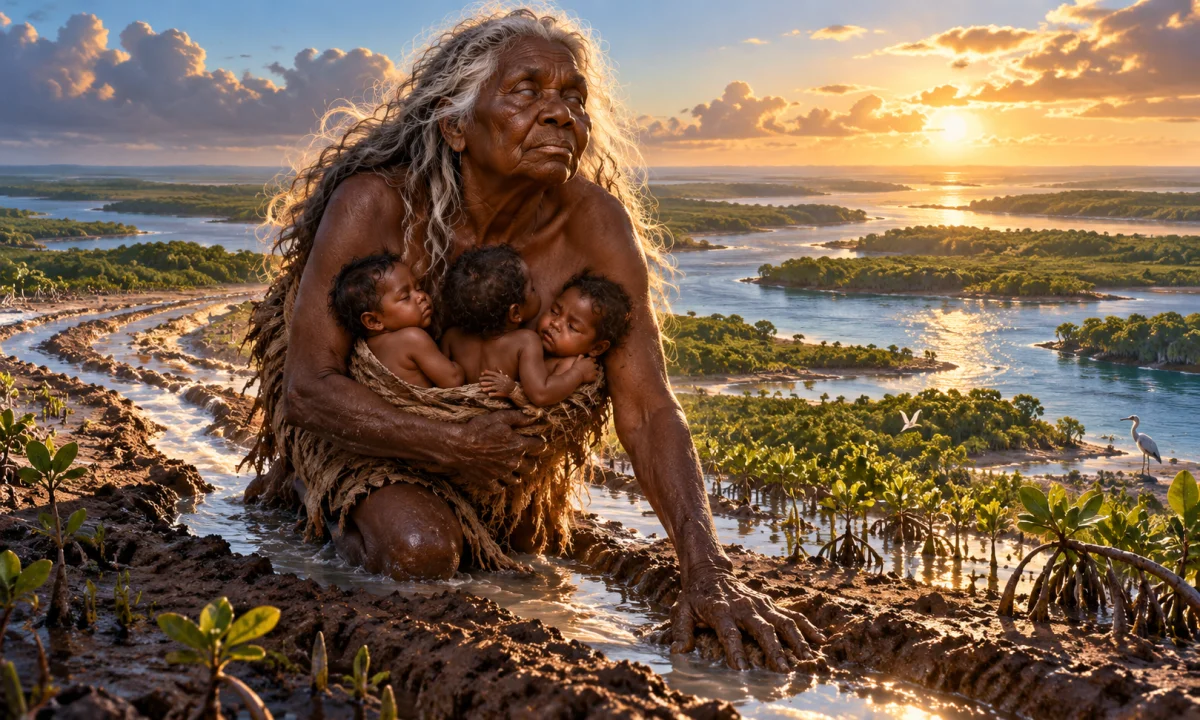
Mudungkala is an ancestral being in the traditions of the Tiwi people of northern Australia. The Tiwi live primarily on Melville Island and Bathurst Island, in the Apsley Strait region north of Darwin in the Northern Territory. In widely recorded versions of Tiwi creation tradition, Mudungkala is an old woman who emerged from the sea carrying three babies. As she moved across the country, her journey shaped the islands, their waterways and other features of the landscape.
Mudungkala is sometimes described in English as a creator or earth mother. Such labels can be useful as brief comparisons, but they should not obscure her specifically Tiwi identity. She is not simply an Australian equivalent of a goddess from another religious system. Her significance belongs to Tiwi relationships among ancestral beings, people, country, law, ceremony and the continuing presence of the Dreaming.
Tiwi cultural setting
The Tiwi Islands are formed mainly by Melville Island, Bathurst Island and smaller neighbouring islands. Tiwi country includes beaches, open forest, wetlands, rivers, creeks and tidal waters. These places are not understood merely as physical scenery. They are connected with ancestral actions and with the responsibilities of living people.
Tiwi traditions describe the actions of ancestral beings as establishing the character of the world and the patterns of life within it. The English word Dreaming is often used to translate or discuss related Aboriginal concepts, although no single English word fully represents the meanings involved. The Dreaming can refer to ancestral events, sacred law, origins, continuing spiritual realities and the relationships that connect people with particular places.
Within this setting, Mudungkala is associated especially with the formation of Tiwi country. Her story is therefore not only an account of how land came into existence. It also expresses why particular places matter and how landscape, ancestry and social identity are connected. Knowledge of such traditions may be communicated differently according to age, kinship, ceremonial status and local cultural authority.
Name and identity
The name is generally written Mudungkala in English-language accounts of Tiwi tradition. Aboriginal languages have sounds and grammatical features that do not always correspond neatly to English spelling systems, so the spelling of Indigenous names may vary between records. A variation in spelling does not necessarily indicate a different being, but similar-looking names should not automatically be treated as interchangeable.
Mudungkala is usually identified as a female ancestral figure and as an old woman. The word “old” in this context should not be read simply as a sign of weakness or insignificance. Elders and ancestral elders may possess authority, knowledge and creative power. Her age, blindness and method of movement form part of the traditional image through which her relationship to country is remembered.
It is also important to distinguish between an ancestral being in Tiwi religious tradition and the Western category of “mythological character”. “Myth” can suggest a fictional tale, whereas Tiwi ancestral narratives may carry obligations, sacred significance and continuing truth for the people who inherit them. For that reason, Mudungkala is more accurately discussed as a Tiwi ancestral figure than as a character in a detached storybook pantheon.
The journey of Mudungkala
In the best-known form of the narrative, Mudungkala came from the sea as an old blind woman. She carried three babies in dilly bags, the woven containers traditionally made from plant fibres and used in many Aboriginal societies. The babies are an important part of the story, although accounts differ in how explicitly they identify them with the origins of Tiwi people, ancestral groups or later social divisions.
Mudungkala moved across the land rather than travelling like an ordinary person. Her passage left marks on the country. In commonly recorded descriptions, the Tiwi Islands, waterways, swamps and other landscape features took shape through her movement. The story thus presents the land as the result of an ancestral journey. Country is not an empty surface on which human history later occurred; its form already carries the presence and work of the ancestor.
Some retellings describe Mudungkala as crawling because she was blind and felt her way across the country. Others focus more generally on her travelling or moving through the landscape. Such differences may result from translation, the purpose of a particular account, or the fact that Indigenous traditions are transmitted through multiple forms rather than through one fixed canonical text.
At the end of her journey, Mudungkala is commonly said to have returned to or disappeared into the sea. The sea is not merely a boundary around the islands in this account. It is part of the ancestral geography through which Mudungkala arrived, travelled and departed. Her movement links marine and terrestrial environments and places the Tiwi Islands within a wider living country.
The three babies
The three babies carried by Mudungkala are among the most recognisable features of her story. Their presence connects the shaping of the land with the beginnings of human life and community. In some explanations, they are associated with the first Tiwi people or with ancestral groups whose descendants inhabit the islands. Other accounts leave their identity less specific.
It is unwise to force every version into a single genealogy. Aboriginal traditions may contain knowledge that is shared publicly alongside knowledge reserved for particular cultural contexts. A short account recorded for outsiders may also simplify relationships that are more complex in Tiwi oral tradition. The babies should therefore be understood as part of Mudungkala’s creative and ancestral role without assuming that every published retelling gives them the same names, descendants or social functions.
Their presence also shows that creation in this tradition is not limited to the making of physical terrain. The formation of country and the emergence of people belong to the same ancestral process. Human communities are related to land through descent, story, ceremony and responsibility rather than through a purely symbolic association.
Attributes and symbolic significance
- Ancestral woman: Mudungkala is represented as an old woman whose authority comes from her ancestral status and creative action.
- Bearer of children: The babies in her dilly bags connect her with the beginnings of Tiwi human life and social continuity.
- Shaper of country: Her movement is associated with the formation of the Tiwi Islands and with features such as waterways, wetlands and channels.
- Traveller between sea and land: Her arrival from and return to the sea expresses the close relationship between coastal, marine and terrestrial environments.
- Embodied ancestral power: She changes the world through physical movement rather than through an abstract act of creation detached from place.
Her blindness has sometimes been interpreted by outsiders as a symbol of limitation. That interpretation is not necessarily appropriate. In the story, blindness does not prevent Mudungkala from shaping the country. She knows and makes the land through touch and movement, and her actions demonstrate that ordinary physical sight is not the only form of knowledge. The precise significance of her blindness belongs to Tiwi cultural interpretation and should not be reduced to a universal symbolic meaning.
Mudungkala’s journey also supports a distinctly relational understanding of landscape. A creek, swamp or island may be understood through its physical characteristics, but it can also be connected with ancestral activity, law and obligations. The story provides a way of remembering that country has a history and that people are accountable to it.
Relationship to other Tiwi ancestral traditions
Tiwi religious traditions include many ancestral beings and important narratives. Mudungkala should not be merged with other figures simply because they also appear in stories of origins or transformation. One well-known Tiwi tradition concerns Purukapali and Japara, whose actions are associated with the coming of death and with important explanations of human mortality. That narrative is distinct from the account of Mudungkala’s journey, even though both belong to the broader body of Tiwi ancestral knowledge.
Similarly, Mudungkala should not automatically be identified with every female creator, ancestral mother or earth-shaping being found elsewhere in Australia. Aboriginal peoples do not share one single mythology. Each language group and cultural community has its own histories, names, laws and relationships to country. Similar themes—ancestral journeys, the creation of land, the arrival of children or the transformation of natural features—do not make the beings involved the same.
Nor should Mudungkala be confused with a generic “Mother Earth” figure. That phrase comes from a broad comparative and popular vocabulary. It can point toward her association with life and landscape, but it may conceal the specific Tiwi places, relationships and cultural responsibilities that give her story its meaning.
Sources and transmission of the tradition
Knowledge of Mudungkala has been preserved through Tiwi oral tradition, ceremonial practice, relationships to country and the work of Tiwi cultural custodians. Accounts have also been written down by missionaries, anthropologists, museum workers and other visitors. These records are valuable, but they are not identical to the tradition itself. They may reflect the interests, language limitations and circumstances of the person who recorded them.
There is no single universally authorised written version comparable to a canonical scripture. Different tellings may vary in detail, emphasis and the degree of information they disclose. Some versions concentrate on Mudungkala’s route; others emphasise the babies, the formation of the islands or the continuing relationship between ancestral events and Tiwi life.
This variation is not evidence that the tradition is unreliable. Oral traditions can remain authoritative while being expressed in different forms and contexts. At the same time, an outsider should not treat every retelling as equally complete or assume that a publicly available account includes all ceremonial knowledge. Restrictions on sacred information are part of the cultural setting in which such traditions exist.
Cultural significance
Mudungkala’s importance lies in the way her story joins several kinds of origin together. She is linked with the making of country, the arrival of children, the ordering of community and the continuing identity of the Tiwi people. The narrative offers a model of belonging in which people are not separate from the landscape but are bound to it through ancestral history.
The story also challenges a narrow division between nature and culture. Islands, creeks and wetlands are simultaneously geographical features and traces of ancestral action. The human community is simultaneously a social population and part of a sacred history. This kind of relationship helps explain why knowledge of country can involve practical, moral, genealogical and ceremonial dimensions at once.
For Tiwi people, representations of ancestral figures may therefore carry responsibilities beyond artistic decoration. The right to tell, paint or perform particular stories can be connected with kinship, country and cultural authority. Public descriptions should respect the distinction between information shared for general understanding and knowledge that remains restricted.
Mudungkala in contemporary Tiwi art and public culture
Mudungkala is represented in contemporary Tiwi painting, carving and other artistic practices. Tiwi artists have continued to engage with ancestral subjects while working in modern media and in changing social circumstances. A depiction of Mudungkala may refer to her journey, the landscape she shaped, the babies she carried or the artist’s own relationship to Tiwi country.
Such artworks should not be treated as illustrations of one fixed ancient scene. Contemporary Indigenous art can preserve cultural knowledge, assert connection to country, communicate identity and develop new visual forms at the same time. The meaning of a particular work depends on the artist, the community, the stated subject and the cultural context in which it is made.
Mudungkala has not become a major figure in global popular culture in the way that some Greek, Norse or Egyptian deities have. When she appears in general-interest writing, museum interpretation or educational material, the main concern remains accurate presentation of Tiwi tradition. Retellings that turn her into a generic fantasy “goddess” or detach her from the Tiwi Islands risk replacing a living cultural tradition with an invented universal character.