WORLD
WORLD
Mórrígan
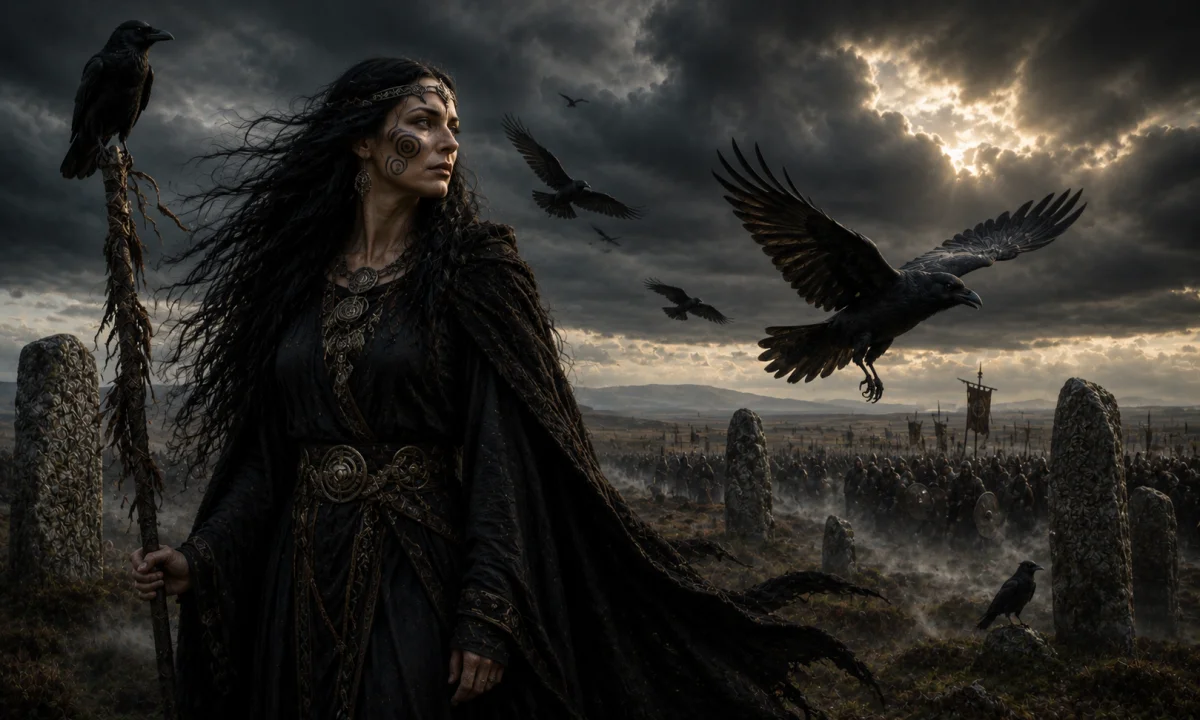
Mórrígan is a powerful and enigmatic figure in Irish mythology, especially in stories about war, kingship, prophecy and the fate of communities. Her name is often written Morrígan or Mórrígan, and medieval Irish texts present her in more than one way. She may appear as a single supernatural woman, a shape-shifting battle figure, or a member of a group of closely related goddesses whose names and identities sometimes overlap.
Although modern descriptions often call her a “goddess of death” or a “war goddess,” those labels are useful only if treated cautiously. The surviving sources connect her with battle, foreknowledge, sovereignty, territory, fertility and the destruction or protection of armies. They do not provide a single, consistent biography or a fixed list of powers. Much of what is known comes from medieval Christian-era manuscripts preserving older Irish stories, and the scribes and storytellers did not always use the same names in the same way.
Origins and cultural setting
The Mórrígan belongs to the mythological world of medieval Irish literature, particularly the stories concerning the Tuatha Dé Danann, the supernatural people who are portrayed as rulers of Ireland before the arrival of the Milesians. These narratives were written down between the Middle Ages and the early modern period, although many of their themes and characters probably developed through earlier oral traditions. The manuscripts therefore preserve valuable evidence about Irish mythology, but they are not direct records from pre-Christian Ireland.
Irish myth was not organised around one official religious system with universally agreed doctrines. Names, genealogies and narrative roles could shift between texts. A figure described as a goddess in one context might be presented as a supernatural woman, a queen, a warrior or a prophetic being in another. The Mórrígan is especially difficult to classify because she stands at the intersection of several traditional concerns: the success of rulers, the violence of warfare, the fertility of land and cattle, and the foretelling of disaster.
She appears most prominently in the Táin Bó Cúailnge, or Cattle Raid of Cooley, the central epic of the Ulster Cycle. She is also associated with stories about the Tuatha Dé Danann, including the battle narratives known as Cath Maige Tuired, or The Battle of Moytura. These texts do not always agree about her relationships, titles or companions. As a result, interpretations should distinguish what a particular story says from later attempts to construct one unified goddess.
The name and the question of identity
The spelling Mórrígan reflects a modern scholarly convention based on Old Irish forms, while Morrígan is also widely used. The meaning of the name remains disputed. It has often been interpreted as “Great Queen,” deriving from elements associated with greatness and queenhood. Another traditional interpretation connects it with a “phantom queen” or supernatural queen. Neither translation completely settles the figure’s character, and the precise history of the name is debated.
Medieval texts also use related forms such as Morrígu. In some passages, the name appears to identify one individual; in others, it is connected with a group of female supernatural beings. This has led scholars to ask whether the Mórrígan was originally a single goddess whose identity later expanded, a title shared by several beings, or a literary fusion of related traditions. There is no certain answer.
The most common associated names are Badb, Macha and Nemain. Some texts treat these figures as sisters or as a group of warlike supernatural women, while others make the Mórrígan one member of a triad. In modern writing, the names are frequently combined into a standard “triple goddess,” but the medieval evidence is not uniform enough to support one definitive arrangement.
Badb is an important figure in her own right. Her name is associated with battle and may be connected with a crow or raven-like battle omen, although the precise meaning and development of the name are complex. Macha is also the name of several distinct figures in Irish tradition, including the woman whose suffering explains the curse placed on the men of Ulster. Nemain appears as a terrifying battle figure in some texts. These beings may overlap with the Mórrígan in certain traditions, but they should not automatically be treated as interchangeable.
Appearance and powers
The Mórrígan does not have one fixed appearance. She can appear as a beautiful woman, an old woman, an animal or a bird. Her shape-shifting is not merely decorative: it allows her to cross boundaries between human and supernatural worlds, to influence combat without being recognised, and to reveal the hidden consequences of human decisions.
Her most famous animal forms in the Táin Bó Cúailnge include a heifer, an eel and a wolf. She also appears in connection with a dark bird or crow after the death of the hero Cú Chulainn. Modern popular culture often depicts her specifically as a raven, but the medieval material more commonly refers to a crow or battle bird. The distinction is not always simple in translation, and “raven” is often used broadly in modern retellings.
She possesses prophetic knowledge, particularly knowledge of conflict, defeat and death. Prophecy in Irish myth is not always a simple prediction of an unalterable future. It can be a warning, a declaration of power or a description of what war will bring. The Mórrígan’s speech often has this unsettling quality: she identifies the violence already developing within a community and gives it a supernatural voice.
Her powers also include manipulation of the battlefield. She can frighten warriors, change shape, injure opponents and support one side in a conflict. Yet she is not simply a commander who leads an army in the manner of a human queen. Her influence is more ambiguous. She may assist a champion, oppose him, provoke him or expose the limits of his courage.
The Mórrígan and Cú Chulainn
The most important relationship in her surviving stories is with Cú Chulainn, the principal hero of the Ulster Cycle. Their encounters show that the Mórrígan is not simply a personification of warfare. She also tests heroic identity, sexual confidence, loyalty and the relationship between individual courage and collective catastrophe.
Before a major phase of the cattle raid, she approaches Cú Chulainn in the form of a woman and offers him her love and assistance. He rejects her, apparently believing that he can win the conflict by his own strength. She then warns him that her hostility will make his struggle more difficult. The encounter is sometimes interpreted as a conflict between the hero and a supernatural embodiment of sovereignty or fate, but the text does not offer one explicit explanation.
After Cú Chulainn refuses her, the Mórrígan attacks him through several animal forms. As an eel, she entangles his legs; as a wolf, she frightens the cattle; and as a heifer, she leads a stampede. Cú Chulainn defeats or wounds her in each form, although he does not initially recognise his opponent. These episodes emphasise his physical skill while also showing that his victories may carry consequences he does not understand.
Later, the Mórrígan appears as an old woman milking a cow. She has three injuries corresponding to the wounds Cú Chulainn inflicted on her animal forms. He accepts milk from her and blesses her, unintentionally helping to heal her. When she reveals her identity, he understands that the apparently ordinary encounter was part of a supernatural conflict. The episode turns a violent struggle into an exchange involving recognition, healing and the dangerous consequences of refusing to acknowledge an otherworldly power.
Another well-known scene occurs when Cú Chulainn is approaching his final battle. He sees a mysterious woman washing bloody clothing beside a river, a prophetic image of the death that awaits him. In some interpretations, this figure is linked with the Mórrígan; in others, the washer at the ford belongs to a wider Irish tradition of supernatural death omens and should not be identified automatically with her. The association is strong in later retellings, but the exact identity depends on the version and interpretation of the story.
After Cú Chulainn’s death, a crow settles on his shoulder. This image has become one of the most recognisable symbols associated with the Mórrígan and with the aftermath of battle. The story’s emphasis is not that she personally kills the hero in a straightforward duel. Rather, the bird marks the completion of a fate shaped by war, pride and the hero’s refusal to retreat from an impossible challenge.
Association with the Tuatha Dé Danann
In the Cath Maige Tuired narratives, the Mórrígan is connected with the Tuatha Dé Danann and their struggle against rival supernatural peoples. In one episode, she meets the Dagda, a leading figure of the Tuatha Dé Danann, near Samhain. Their encounter has been interpreted as both sexual and political, since the two figures discuss the coming battle and the resources needed for victory.
The Dagda and the Mórrígan are sometimes described in later summaries as a divine couple, but this should not be treated as a stable marriage equivalent to relationships in classical mythology. The surviving stories give them a significant encounter and associate them with the fate of the Tuatha Dé Danann, but the details of their relationship vary.
In the battle stories, the Mórrígan uses prophecy, intimidation and supernatural power to support the Tuatha Dé Danann. She may also appear as a figure who predicts the ruin of enemies and proclaims the results of war. Her role is therefore connected not only with individual combat but with the survival, sovereignty and future of a people.
Some later passages associate her with the death of the Fomorians or with the spreading of news after battle. These episodes reinforce her connection with victory and destruction, but they do not create a complete, consistent mythological biography. The Mórrígan is better understood as a recurring supernatural power than as a character whose life story unfolds in a single continuous sequence.
War, sovereignty and the land
The Mórrígan’s connection with warfare is clear, but war in Irish mythology is linked to wider questions of rule and territory. A ruler’s success is not only a military matter: it reflects whether the land and its supernatural powers recognise that ruler. Female figures in Irish tradition can embody sovereignty, sometimes appearing as an apparently undesirable or threatening woman whose acceptance or transformation reveals the legitimacy of a king.
The Mórrígan is not identical with every sovereignty figure, and the sources do not consistently present her as the literal personification of Ireland. Nevertheless, her role shares important features with sovereignty traditions. She evaluates warriors, offers or withholds support, and appears at moments when the authority of a hero or people is being tested. Her sexuality, hostility and prophetic speech can therefore have political as well as personal meaning.
She is also linked with cattle, an important measure of wealth in early Irish society. The central conflict of the Táin concerns the capture of a prized bull, and the Mórrígan’s animal transformations occur within this struggle over livestock and prestige. Her relationship to cattle suggests that her significance extends beyond death and battle into the economic and reproductive foundations of society.
For this reason, the title “goddess of death” is too narrow. Death is certainly present in her stories, especially through prophecy and the crow at the battlefield. Yet she also represents the forces that determine whether a campaign succeeds, whether a champion is protected or opposed, and whether a community’s claim to power can endure.
The triple figure and disputed interpretations
Modern discussions often describe the Mórrígan as a triple goddess made up of the Mórrígan, Badb and Macha, sometimes adding Nemain or replacing one of the others. This formulation is based on real relationships among the names in medieval texts, but it can give a false impression of complete agreement. Different passages use different groupings, and the figures do not always perform identical roles.
The number three is important in Irish myth and may express plurality, emphasis or the division of related powers. It does not necessarily mean that one goddess has three permanent personalities. Some scholars interpret the group as a literary and religious complex of battle goddesses; others emphasise that the identities were originally separate and only partly merged in surviving texts.
It is therefore safest to describe the Mórrígan as a figure whose identity overlaps with those of Badb, Macha and Nemain in some traditions, while retaining distinctions where a story makes them. Calling every crow-associated woman in Irish myth “the Mórrígan” obscures the variety of the sources.
Later reception and modern culture
Interest in the Mórrígan has grown considerably in modern literature, fantasy, games, comics and religious movements inspired by Celtic traditions. She is often portrayed as a powerful independent warrior, a queen of ravens, or a single unified goddess ruling over death and battle. These images draw on genuine features of Irish mythology, especially her shape-shifting, prophetic power and association with warfare.
Modern adaptations frequently make her more morally straightforward than the medieval stories do. She may become a heroic protector, an evil war deity, or a symbol of female empowerment. Such interpretations can be meaningful as creative or devotional responses, but they are not identical to the evidence of the medieval texts. The traditional Mórrígan is more troubling and unpredictable: she can desire, threaten, deceive, heal, warn and destroy, often without fitting neatly into categories of good and evil.
Contemporary Pagan practitioners may honour the Mórrígan as a goddess, sometimes alongside Badb, Macha or other figures. These practices belong to modern religious reconstruction and personal spirituality rather than to a continuously documented ancient cult. The distinction matters because the surviving Irish literature does not preserve a complete ritual system dedicated to the Mórrígan.
Across both traditional narratives and modern interpretations, her enduring power comes from her refusal to remain confined to one role. She is a battle presence and a prophet, a shape-shifter and a political force, a threat to heroes and a participant in the survival of supernatural peoples. Her stories make war into more than a contest of weapons: it becomes a test of sovereignty, identity, pride and the limits of human control.