WORLD
WORLD
Miralaldu
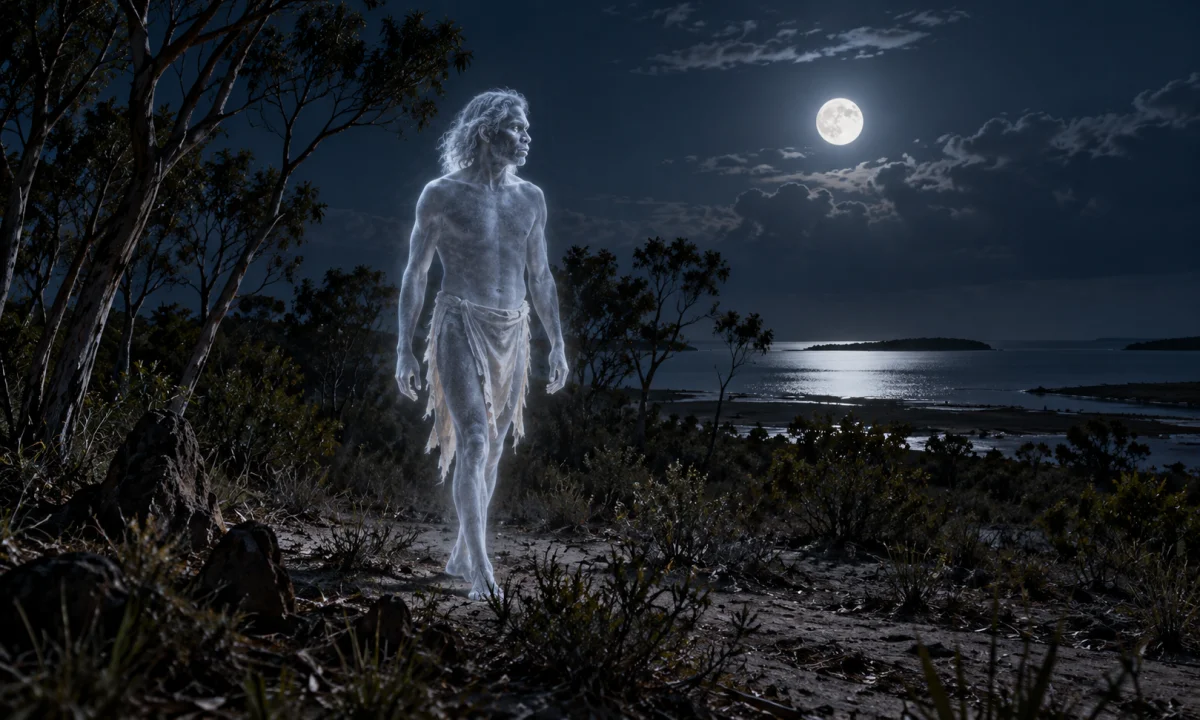
Miralaldu is a little-known name associated with Australian Aboriginal mythology and is usually described in modern English-language compilations as a water spirit or dangerous aquatic being. The available information is extremely limited, however. There is no widely established, pan-Aboriginal tradition concerning Miralaldu, and the name cannot safely be assigned to every Aboriginal culture in Australia. Its spelling, pronunciation, local origin and precise characteristics are uncertain.
That uncertainty is important. Aboriginal Australia contains hundreds of distinct cultural and linguistic traditions, each with its own sacred geography, ancestral beings, ceremonial systems and storytelling practices. A figure recorded under an English spelling may represent a local name, a missionary or ethnographer’s transcription, a later retelling, or a confusion with another water-associated being. Miralaldu should therefore be treated as a poorly documented traditional name rather than as a universally recognised Aboriginal deity or monster.
Origins and cultural setting
Traditional Aboriginal religious life does not divide neatly into the categories commonly used in European mythology. Ancestral beings may be connected with particular rivers, hills, animals, stars, winds or ceremonies while also shaping law, morality and the landscape. A being described in English as a “spirit” or “monster” may have a much more specific cultural status in the community where the tradition belongs.
Water has profound significance across many Aboriginal Australian cultures. Rivers, billabongs, springs, lagoons, coastal waters and seasonal floodplains can be associated with ancestral journeys, creation events, restricted knowledge and obligations to care for Country. Dangerous water beings are consequently not simply imaginary predators. Stories about them may communicate rules concerning where people may travel, when children may approach water, how visitors should behave, and which places require ceremony or permission.
It would be misleading to infer that every Aboriginal tradition contains the same water spirit under different names. Some traditions speak of ancestral serpents or other beings responsible for waterways; others describe dangerous creatures, spirits of the dead, guardians of sacred places or beings connected with particular local events. Similar functions do not prove a common origin.
The name Miralaldu
The spelling Miralaldu is not supported by a broadly agreed pronunciation or etymology. English sources that use the name do not consistently provide a language, community, place or original oral account. Without that information, the meaning of the name cannot be translated confidently, and attempts to break it into supposed Aboriginal words would be speculative.
Aboriginal languages are not a single language family with one shared vocabulary. A name that appears similar to a word from one language may have no connection with that word, and the spelling conventions used by early writers often failed to represent sounds accurately. Names could also change as stories moved between speakers, interpreters and printed collections.
For these reasons, Miralaldu should not be presented as an Australian-wide name. The most responsible description is that it is a rare or weakly documented name appearing in some secondary accounts of Aboriginal mythology, where it is generally associated with water and danger. The original community tradition, if one exists in a recoverable form, has not been securely identified in the commonly available record.
Classification and reported nature
Modern summaries usually place Miralaldu among water spirits or aquatic beings. The descriptions are too inconsistent or too brief to establish a detailed physical form. There is no secure basis for claiming that Miralaldu was universally imagined as a serpent, humanoid, fish, reptile or giant animal.
Likewise, the surviving descriptions do not establish a complete set of powers. The safest interpretation is that the being’s connection with water implies danger, uncertainty or a warning against entering particular waters. Some modern retellings may describe an aquatic creature that attacks or drags people beneath the surface, but such details should not automatically be treated as elements of an ancient or locally verified narrative.
A water-associated being may serve several roles at once:
- Guardian of a place: a presence connected with a pool, river, lake, spring or coastal site that should be approached with respect.
- Enforcer of conduct: a figure used in teaching children and others not to ignore restrictions or venture into dangerous water.
- Explanation of danger: a traditional way of giving meaning to drownings, disappearances, sudden currents, deep holes or other hazards.
- Marker of cultural knowledge: a name linked to a particular Country and to stories that may not be intended for unrestricted public retelling.
These possible functions are general features of water traditions and should not be mistaken for a documented biography of Miralaldu. The available material does not provide a reliable account of the being’s family, origin, gender, dwelling place or relationship with a creator ancestor.
Stories and traditional evidence
No single, widely recognised narrative about Miralaldu can be securely summarised. There is no well-established cycle of stories comparable in public documentation to some traditions concerning the Rainbow Serpent or Tiddalik. In particular, the name is not accompanied by a consistently recorded creation story, hero encounter, song cycle or ceremonial account that would allow its role to be reconstructed with confidence.
This absence should not be taken to mean that the name has no cultural value. Aboriginal knowledge has often been transmitted orally, through custodianship and participation in Country rather than through texts intended for general publication. Some knowledge is restricted by age, kinship, initiation, gender or ceremonial responsibility. A name may therefore survive in an incomplete outside record because the relevant tradition was never written down, because it was recorded without its context, or because cultural custodians chose not to disclose further information.
There is also a historical problem with early written accounts. European collectors frequently grouped distinct traditions under broad labels such as “Aboriginal mythology” and sometimes changed names to fit English spelling. A story from one community could later be printed as though it represented an entire continent. Later compilers sometimes repeated short entries without identifying their original informant or location. Once detached from Country and language, a local being could appear to be a standard figure of Australian mythology even when the evidence did not support that conclusion.
Water beings and the danger of comparison
Miralaldu is sometimes liable to be compared with the bunyip, the best-known water monster in Australian popular culture. This comparison is understandable but not sufficient. “Bunyip” is an English spelling associated with several historical accounts and with a range of Aboriginal words and local traditions. The term has also developed a large modern folklore of its own, often presenting the bunyip as a generic swamp monster.
Miralaldu should not automatically be called a bunyip or treated as another name for one. The two names have different documentary histories, and the available evidence does not establish that they refer to the same being. A water spirit from a particular Aboriginal tradition may have a religious and social meaning that is lost when it is absorbed into the broad English category of “bunyip”.
Nor should Miralaldu be merged with other water-associated figures such as the Muldjewangk, a dangerous being associated in some South Australian traditions with the Murray River and nearby waters. The Muldjewangk has its own name, regional associations and recorded stories. Similar descriptions of aquatic danger do not demonstrate identity or kinship.
The same caution applies to the Rainbow Serpent, which is not simply a large water monster. Rainbow Serpent traditions vary across communities, but the beings involved are often ancestral powers connected with creation, fertility, rain, law and the formation of the landscape. Reducing every water-related Aboriginal figure to a serpent or “monster” imposes an outside pattern on diverse traditions.
Interpretation and cultural significance
At the level of comparative folklore, Miralaldu can be understood as part of a broad human pattern in which water is both life-giving and dangerous. Stories about beings beneath the surface make invisible hazards memorable and can encode practical knowledge about currents, deep water, seasonal change and appropriate behaviour.
In an Aboriginal cultural context, however, practical warning is only one possible dimension. A water place may be spiritually powerful because of ancestral activity, and access to it may be governed by law rather than by fear alone. A being associated with such a place might be a guardian, an owner, an ancestor or a manifestation of a wider force. The English label “monster” can therefore be misleading, especially when it suggests a creature whose only purpose is to attack people.
The lack of detailed public information also illustrates the limits of treating oral traditions as collections of freely available myths. Knowledge is not necessarily separated into “religion,” “folklore” and “fiction” in the same way as it is in modern reference books. Stories may carry responsibilities toward Country and community. A respectful account should distinguish what is actually documented from what has been inferred by later writers.
Modern reception
Miralaldu has little visible presence in major modern popular culture. It is not a prominent figure in Australian film, television, literature or games, and there is no widely standardised modern image of it. Its appearances are more often found in lists of mythical creatures, brief encyclopaedic entries or online compilations that provide little information about language or community origin.
Such lists can preserve unusual names, but they can also create a misleading impression of certainty. A short entry may turn a tentative classification into a fixed identity, add physical details not present in the earliest record, or place a local figure under the general heading of “Australian Aboriginal mythology”. Readers should therefore distinguish between a traditional account connected with an identifiable Aboriginal community and a later summary whose source and wording are unclear.
Miralaldu is best presented as a rare and uncertainly documented Aboriginal Australian water-associated name. Its significance, if connected with a specific living or historical tradition, would depend on that tradition’s language, Country and cultural custodians. Until those details are established, claims about its appearance, powers, stories or exact origin should remain qualified rather than being presented as settled mythology.