WORLD
WORLD
Mangar-kunjer-kunja
Mangar-kunjer-kunja is a figure associated in modern English-language reference works with Australian Aboriginal mythology, especially with traditions attributed to the Arrernte peoples of Central Australia. The name is commonly connected with an ancestral being described as lizard-like, sexually or physically dual in form, and involved in the creation or ordering of human life. The available descriptions are brief and vary considerably, however. They should not be treated as a single, universally shared Aboriginal doctrine or as a complete account of Arrernte religious tradition.
Cultural setting
Mangar-kunjer-kunja is usually discussed in connection with the Aboriginal concept often rendered in English as the Dreaming or Dreamtime. These English terms can be misleading if understood simply as a distant mythological age. In many Aboriginal Australian traditions, ancestral events are understood as foundational realities that continue to shape people, places, law, ceremonial responsibilities, kinship and relations with the natural world.
The Dreaming is not one religion with a single pantheon. Aboriginal Australia contains hundreds of distinct language groups and many local cultural traditions. Ancestral beings, sacred places and ceremonial narratives belong to particular communities and territories. A figure reported under one name should therefore be assigned to a specific tradition only when the evidence supports that attribution.
In general, ancestral beings in Australian Aboriginal traditions are not equivalent to “gods” in the narrow sense familiar from Greek, Roman or Norse mythology. Some created landscapes, species or people; some established laws and ceremonies; others are associated with particular animals, geographical features or social responsibilities. The English category deity is sometimes used for convenience, but it can obscure the continuing and place-based character of Aboriginal ancestral traditions.
Name and identity
The spelling Mangar-kunjer-kunja is not necessarily a standardized transcription across all records. Hyphens, capitalization and vowel forms may differ in secondary sources. The name has also been circulated through general mythology dictionaries and online lists, where a short description may be repeated without the linguistic or ethnographic context of the original tradition.
The meaning of the name is not securely established in widely available English-language material. It is therefore unsafe to translate it as the name of a particular animal, object or abstract power without evidence from speakers or specialist linguistic research. Claims that assign a precise literal meaning should be treated cautiously.
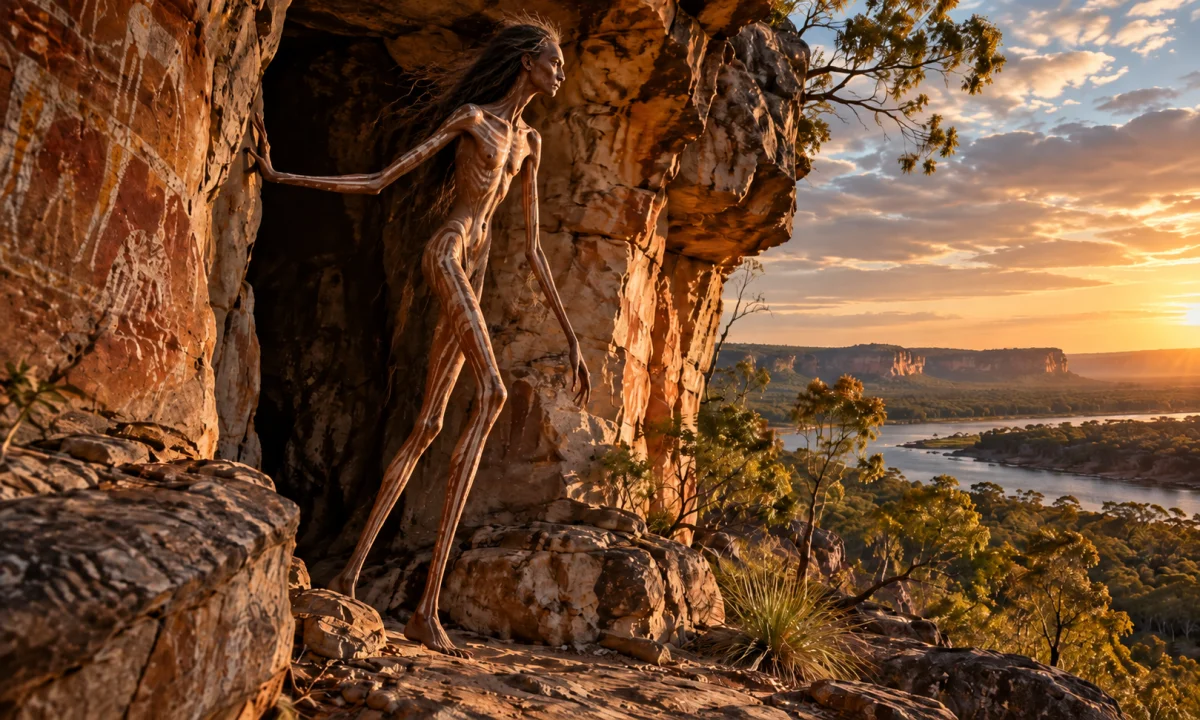
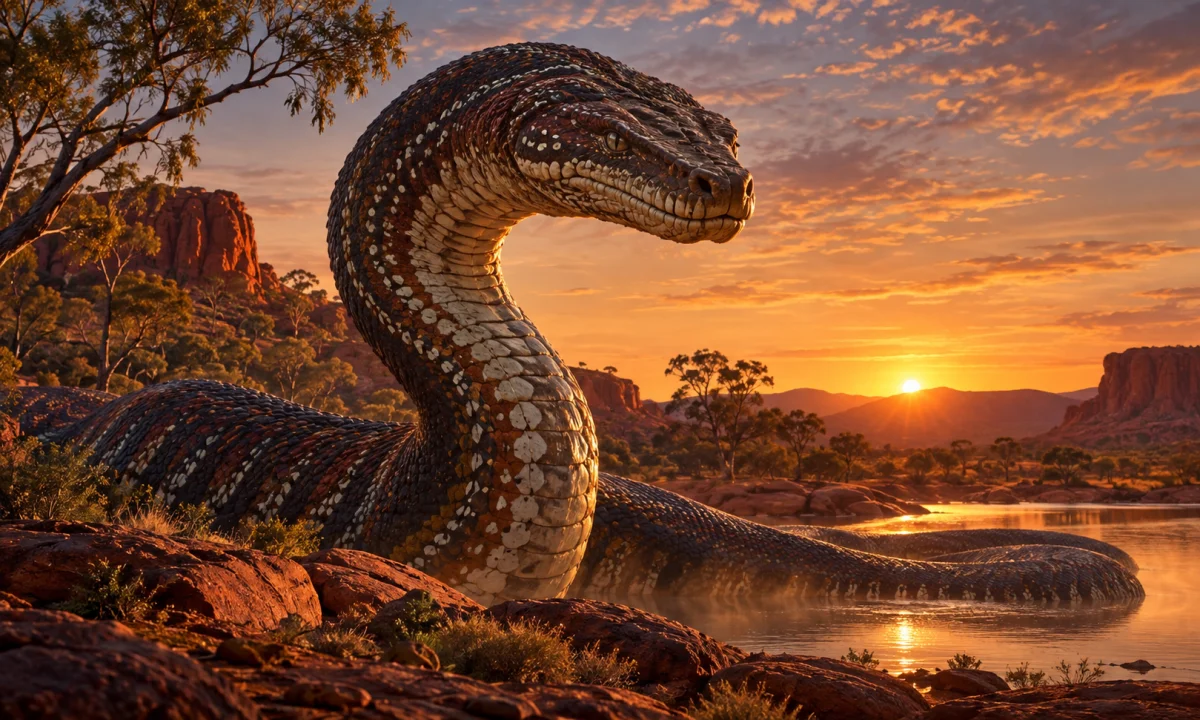
Descriptions of Mangar-kunjer-kunja often call the figure a lizard-like creator or a hermaphroditic lizard being. These labels may reflect the way a traditional account was summarized in English rather than an exact equivalent of the figure’s identity in the source culture. “Hermaphroditic” is an older biological term and can sound inappropriate or reductive when applied to a sacred being. “Androgynous,” “sexually dual” or “possessing characteristics associated with more than one gender” may be less misleading in general discussion, although none of these expressions should be assumed to reproduce Indigenous categories of gender or personhood exactly.
Attributes and role
The most consistent modern descriptions connect Mangar-kunjer-kunja with the origin of human beings. In these accounts, the being is presented as a creator or culture-bearing ancestor who brings humans into the world and helps establish the conditions under which they can live. Some summaries also say that the figure taught humans forms of proper conduct or social life.
Because the surviving descriptions are so compressed, it is difficult to determine which details belong to a particular traditional narrative and which are later paraphrases. There is no reliable basis for constructing a large list of powers, symbols or personal relationships around Mangar-kunjer-kunja. The figure should not automatically be assigned control over every aspect of nature, death, fertility, animals or weather merely because creator beings elsewhere in Aboriginal Australia may have such associations.
The lizard-like form is significant in the sense that animal characteristics are common among ancestral figures in Australian Aboriginal traditions. An ancestor may appear as an animal, a person, a combination of both, or a being whose form changes according to the episode and the place involved. Such descriptions do not necessarily imply that the figure was understood as an ordinary lizard or as an animal deity in a simple European sense.
A creator’s importance in this setting would also be broader than the act of making human bodies. Creation narratives commonly explain how landscapes acquired their form, how people became connected to country, and why particular obligations exist. Yet no detailed account of Mangar-kunjer-kunja’s geography, journeys, companions or ceremonial laws can be stated confidently from the limited descriptions commonly available under this name.
Creation and human life
Short reference entries frequently state that Mangar-kunjer-kunja created the first humans. Some versions describe the being as bringing humanity into existence; others imply that the figure shaped, organized or instructed the first people. These formulations may represent different interpretations of the same broad theme, or they may have been simplified from distinct local accounts.
It is important not to present this as a single canonical story with a fixed sequence of events. Aboriginal oral traditions are not usually preserved as one authoritative written scripture. Narratives can be tied to particular sites, custodians, ceremonies, languages and permissions concerning who may hear or repeat them. A published summary may omit precisely the elements that give a story its religious and social meaning.
In a general interpretive sense, the human-creation role places Mangar-kunjer-kunja among ancestral figures concerned with the relationship between humanity and the rest of the living world. The figure’s reported dual or non-binary bodily character may also have encouraged later writers to interpret Mangar-kunjer-kunja as a symbol of generative completeness or the union of complementary qualities. Such interpretations are possible, but they are scholarly or modern readings unless specifically grounded in Indigenous explanation.
Tradition, evidence and uncertainty
Information about Mangar-kunjer-kunja is much less extensive than information about some better-known figures, such as the Rainbow Serpent, Baiame, Bunjil or the Wondjina. The name appears most often in brief English-language compilations rather than in a large body of readily identifiable primary documentation. That limited record creates several difficulties.
- The exact community or language context may be omitted when the name is repeated in general reference material.
- Different spellings may represent transcription choices, editorial alterations or attempts to reproduce sounds from an Aboriginal language.
- A description such as “god” or “lizard deity” may be a European classification rather than an Indigenous category.
- Details about gender, creation and instruction may have been shortened or rearranged in translation.
- A general mythology list may not distinguish between a locally specific ancestor and a figure known across a much wider region.
These uncertainties do not make the figure unimportant or unreal within the tradition in which the name belongs. They do mean that responsible accounts should avoid inventing a genealogy, a set of adventures or an elaborate theology that the evidence does not support. The absence of extensive published detail is also not evidence that the traditional knowledge itself was simple or undeveloped; it may reflect the limits of recording, translation, publication and cultural access.
Religious and cultural significance
When Mangar-kunjer-kunja is identified as a creator ancestor, the central significance lies in the relationship between origins and obligation. In Aboriginal religious systems, stories of ancestral beings can explain why people belong to particular country, how they should behave towards relatives and other beings, and which responsibilities are inherited or ritually maintained.
This is different from treating mythology as a collection of entertaining tales from a vanished past. For many Aboriginal communities, ancestral law and connection to country remain living matters. Sacred knowledge can be restricted, and not every narrative is intended for public retelling. A short public description should therefore be understood as partial rather than as a replacement for community-held knowledge.
The reported dual-gender or dual-sex character of Mangar-kunjer-kunja may be relevant to interpretations of creation, social balance or the relationship between different forms of life. Nevertheless, modern readers should not automatically use the figure as proof of a particular contemporary gender system, nor should they impose modern categories of transgender identity, intersexuality or sexual orientation upon an Indigenous sacred being without guidance from the relevant community.
Distinction from other Aboriginal figures
Mangar-kunjer-kunja should not be merged with the Rainbow Serpent, even though both may be described loosely as creator beings. The Rainbow Serpent is a widespread but highly varied complex of traditions found under many local names and with different regional meanings. A lizard-like human creator identified by the name Mangar-kunjer-kunja belongs to a different line of description and should not be treated as another name for the Rainbow Serpent.
The figure should also be distinguished from Darwin-area or northern Australian beings whose names are sometimes rendered with similar sounds in English. Aboriginal names can resemble one another when they are written using an unfamiliar alphabet, but phonetic similarity alone does not establish identity, shared origin or a common story.
Nor should Mangar-kunjer-kunja be confused with the many Aboriginal ancestral beings described in popular sources as “lizard men,” “lizard spirits” or “reptile gods.” Those labels may refer to entirely different traditions, languages and places. The animal form of an ancestor is not sufficient evidence that two figures are related.
Later reception
Mangar-kunjer-kunja has had little clearly documented presence in major modern popular-culture franchises compared with figures such as the Rainbow Serpent or the bunyip. The name is more often encountered in online mythology databases, lists of Aboriginal deities and general discussions of world mythology. Such contexts can increase recognition while also stripping away the local setting that gives an ancestral figure its meaning.
Modern retellings should preserve the distinction between a traditional Indigenous figure and an invented fantasy character based upon it. A fictional work may freely create new powers, companions, quests or visual designs, but those additions should not be presented as ancient Aboriginal facts. In particular, an attractive “lizard god” character with a fully developed mythology may be a contemporary invention assembled from a very small traditional description.
The most careful understanding of Mangar-kunjer-kunja is therefore modest but meaningful: the name refers to a creator or ancestral figure reported in connection with Aboriginal Australian tradition, commonly described as lizard-like and possessing a sexually dual or androgynous nature. The figure’s exact linguistic setting, narrative details and religious interpretation remain uncertain in widely available sources, and should be approached with respect for the local communities whose traditions cannot be reduced to a short mythology entry.