WORLD
WORLD
Mahu-fatu-rau
Mahu-fatu-rau is an obscure name associated with Polynesian religious tradition. It is preserved mainly in older records of Polynesian mythology rather than in a widely circulated body of traditional stories. The surviving evidence is too limited to support a complete biography, fixed genealogy or universally agreed classification. In some compilations, the name is connected with stones or rocks, but the precise nature of the figure and the community in which the name was originally used are not securely established.
Origins and cultural setting
Polynesian mythology does not represent a single, uniform religion. The peoples of the eastern, central and western Pacific shared related languages and some broad mythic themes, yet each island group developed its own gods, sacred places, priestly traditions and stories. A deity known by one name in one island society might be unknown, renamed or understood differently elsewhere.
This regional diversity is especially important in the case of Mahu-fatu-rau. The name is not comparable, in terms of documentation or popular recognition, with major Polynesian figures such as Māui, Tāne, Tangaroa, Rongo or Tū. It appears in the type of antiquarian and ethnographic record in which compilers sometimes preserved lists of local gods, sacred names and descriptive epithets without recording the rituals or narratives connected with them.
Many Polynesian traditions were transmitted orally. Their preservation depended on specialists such as priests, genealogists, navigators and custodians of particular temples or sacred districts. When these traditions were later written down, the record could be affected by unfamiliar pronunciation, inconsistent spelling, translation choices and the interests of the recorder. A short entry in a nineteenth-century compilation may therefore preserve a genuine traditional name while revealing very little about how worshippers understood it.
The name Mahu-fatu-rau
The spelling Mahu-fatu-rau reflects an older way of writing a Polynesian name with its elements separated by hyphens. Other spellings may occur in historical records, and the name should not automatically be treated as a standardized modern form. Polynesian languages often have closely related vocabulary, but the meaning and pronunciation of a word can vary considerably from one island group to another.
The element fatu, or a related form, commonly has meanings connected with a stone, rock or hard substance in several Polynesian languages. The element rau can have more than one meaning, including “leaf,” “many” or “hundred,” depending on language and context. These similarities make a rock-related interpretation possible, but they do not by themselves prove the meaning of the complete name. A personal name, divine title or place-name may preserve an older expression whose original sense is no longer obvious.
Mahu is equally uncertain in this compound. It may be a personal or divine name, an epithet or a word whose meaning differs among Polynesian languages. It should not be assumed that every element of the name was understood separately by the people who used it. For this reason, translations such as “Mahu of the many stones” or “Mahu of the hundred rocks” are interpretive renderings rather than securely established traditional titles.
Identity and classification
Mahu-fatu-rau is generally treated as a minor or poorly documented Polynesian deity, rather than as a hero, ancestor or legendary monster. Even that classification should be used cautiously. Older European-language works often applied the word “god” broadly to divine beings, local spirits, ancestral powers and sacred personifications. A name listed as a god may originally have belonged to a narrower category of supernatural being.
No reliable surviving account establishes whether Mahu-fatu-rau was conceived as an independent deity, an aspect of another god, a guardian associated with a particular location or a title used in ritual speech. There is also no secure evidence for a standard family relationship with major Polynesian gods. Claims that place Mahu-fatu-rau in a single pan-Polynesian genealogy should therefore be regarded as speculative unless they are supported by a specific island tradition.
The name may have referred to a power associated with stones, rocky terrain or sacred stone objects. Polynesian religious practice frequently gave importance to material objects and places. Stones could mark a marae or other sacred site, serve as memorials, represent a god, or be regarded as the dwelling place of a spiritual power. Nevertheless, the existence of such practices across Polynesia does not prove that Mahu-fatu-rau had one particular stone-related function.
Possible association with rocks and stones
The most cautious interpretation of Mahu-fatu-rau links the name with stone or rock imagery. This interpretation rests primarily on the vocabulary of the compound and on the wider role of stones in Polynesian religious life. Rock formations, boulders and carved or selected stones could be tied to origin stories, territorial claims, ancestral memory and the presence of divine power.
In island environments, stone was also connected with practical and sacred activity. Stone tools, house foundations, fishing equipment, agricultural boundaries and temple structures formed part of everyday life. A sacred stone could be valued not because it was an abstract symbol, but because a god, ancestor or historical event was believed to be present through it. A name containing a word for stone might consequently describe a deity’s dwelling, appearance, cult object, domain or origin.
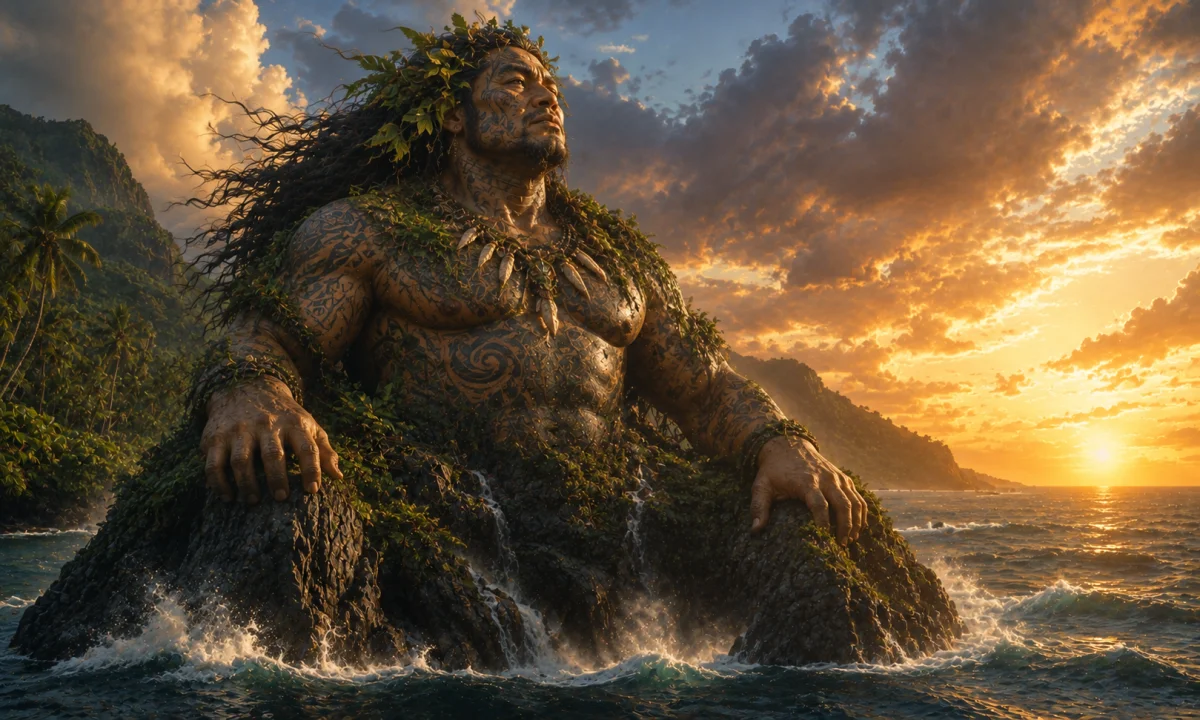
There is no dependable description of Mahu-fatu-rau’s physical appearance. The figure should not be illustrated as a giant made of rock, a humanoid spirit covered in stones or a monster guarding a cave unless such details are explicitly tied to a documented local tradition. Those images may be visually appealing, but they belong to modern invention or general fantasy rather than to securely preserved information about Mahu-fatu-rau.
Stories and relationships
No widely attested cycle of myths centres on Mahu-fatu-rau. The surviving material does not provide a stable account of a birth, marriage, conflict, journey or act of creation. There is likewise no firm basis for assigning the figure a spouse, parent, child or enemy drawn from the better-known Polynesian pantheons.
This absence of narrative should not be interpreted as evidence that the figure was unimportant to the people who used the name. Polynesian religious knowledge was often local and specialized. A sacred name could be meaningful within a temple, district, chiefly lineage or ritual context without becoming part of a long public myth. Written records also tended to preserve dramatic stories more readily than brief liturgical names or the practical details of worship.
It is possible that Mahu-fatu-rau was recorded without the surrounding explanation that would have made the name intelligible. A compiler might hear a divine name from an informant, translate it according to a dictionary, and place it in a catalogue. The catalogue would then survive while the ritual setting, pronunciation and associated oral knowledge disappeared. This is one reason why isolated mythological names require more caution than famous figures supported by numerous independent traditions.
Religious significance in a Polynesian context
Polynesian concepts of divinity generally did not divide the world into a simple opposition between “nature” and “religion.” Ocean currents, winds, forests, reefs, volcanic landscapes, cultivated plants, ancestors and celestial bodies could all be involved in systems of sacred relationship. A being associated with stone might therefore have had significance extending beyond geology.
Stone could express permanence, ancestry and authority. A durable rock contrasted with the movement of the sea and the vulnerability of human life. Sacred stones might preserve the mana, or spiritual efficacy, of a god or ancestor; however, mana itself is a broad and culturally variable concept, not a special power that can automatically be assigned to every Polynesian deity. The word has different histories and applications across the Pacific, and general definitions can obscure local meanings.
If Mahu-fatu-rau was connected with stones, the association may have concerned protection, territorial boundaries, a temple site, a particular rock formation or a ritual object. It might also have been metaphorical, referring to strength, endurance or a large number of sacred things. The available evidence does not allow one of these possibilities to be selected with confidence.
Uncertainty in the surviving record
The name’s obscurity creates several problems for interpretation. First, its original island affiliation is not consistently clear in general reference works. Secondly, older transcriptions may not preserve vowel length, glottal stops or other pronunciation features that can distinguish words in Polynesian languages. Thirdly, a recorder may have combined a personal name with a descriptive phrase or divided a single word into parts according to the conventions of a European language.
Translation can introduce further uncertainty. Polynesian terms often have several related meanings, and the same written form may represent different words in different languages. A literal translation of fatu or rau may therefore produce a plausible phrase without recovering the name’s traditional significance. Linguistic resemblance is useful evidence, but it is not a substitute for an oral explanation from the relevant community.
For these reasons, descriptions of Mahu-fatu-rau should distinguish between three levels of information:
- Documented: the name has been preserved in records associated with Polynesian mythology or religion.
- Plausible: the name may contain elements associated with stone, rock or multiplicity in related Polynesian languages.
- Unconfirmed: a detailed appearance, mythology, genealogy, cult centre or specific supernatural power.
Distinction from similar names
Mahu-fatu-rau should not be confused with Mahuika, the Māori fire goddess or ancestral figure associated in later tradition with the origin of fire. The names share the opening sequence mahu in some spellings, but no reliable evidence makes Mahu-fatu-rau another name for Mahuika.
It should also be distinguished from māhū, a term used in parts of eastern Polynesia, including Tahiti and Hawai‘i, for culturally recognized gender-diverse people. The term has important modern and historical cultural meanings, but its resemblance to the first element of Mahu-fatu-rau does not establish a connection between them. A divine name preserved in an old mythology catalogue cannot be interpreted through the modern social meaning of a similar-looking word without evidence from the relevant language and tradition.
Nor should Mahu-fatu-rau be merged with Māui. Māui is a major Polynesian culture hero whose stories vary widely but commonly include episodes involving fishing up land, obtaining fire or attempting to overcome death. Mahu-fatu-rau has no comparable body of widely documented narratives, and the similarity of a syllable is not evidence of identity.
Later reception
Mahu-fatu-rau has not become a prominent figure in contemporary international popular culture. It does not have a stable modern image comparable to those of Māui, Pele or Tangaroa. When the name appears in modern lists of Polynesian gods, it is often presented without the uncertainty surrounding its documentation. Such lists can give the impression of a fully developed mythological character even when the underlying record preserves only a name and a tentative gloss.
Modern fantasy, games and online mythology sites may expand obscure names into characters with invented powers, visual designs or genealogies. These adaptations can introduce a traditional name to new audiences, but their details should not be treated as evidence for ancient Polynesian belief. A responsible portrayal would acknowledge the limited record and avoid presenting an imagined rock deity, guardian or elemental monster as an authenticated traditional figure.
Mahu-fatu-rau is therefore best approached as a rare and uncertainly documented Polynesian sacred name. Its possible connection with stone imagery offers a useful point of interpretation, especially in light of the importance of sacred places and material objects in many Pacific traditions. The lack of surviving stories, however, remains central to the subject: what can be said with confidence is considerably narrower than the elaborate profiles often created for better-attested Polynesian gods.