WORLD
WORLD
Kotihaltija
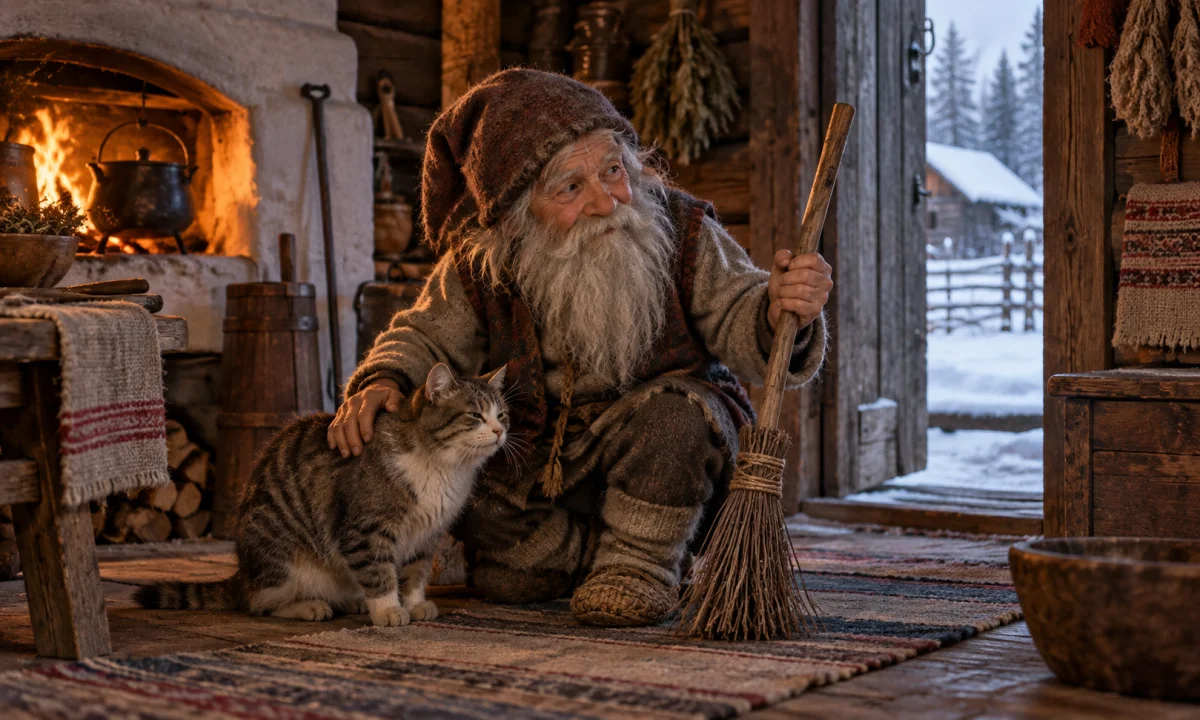
Kotihaltija is a Finnish household spirit associated with the protection, prosperity and proper running of a home. The name is usually understood as “the guardian of the home” or “the household spirit”: koti means “home”, while haltija is a being that possesses, governs or oversees a place. Kotihaltija belongs to the broad Finnish tradition of haltijat, local supernatural beings connected with homes, buildings, natural places and human activities.
It is important, however, not to treat kotihaltija as a single character with one fixed appearance, biography or set of adventures. Finnish vernacular religion was strongly regional, and household-spirit beliefs could vary from one parish, family or cultural area to another. In some contexts, kotihaltija is a general descriptive term for a guardian of the home. In others, similar beliefs are expressed through the word tonttu, especially kotitonttu, literally “house tonttu”. The two terms may overlap, but they do not always refer to exactly the same tradition.
Meaning of the name
The Finnish word haltija has a wide range of meanings. In traditional belief, a haltija may be the supernatural master, guardian or spirit of a particular place. Such beings could be associated with a house, forest, waterway, hill, sauna, barn or other location. The word can therefore describe a relationship between a spirit and the place under its care rather than a single species of creature.
Kotihaltija combines koti, “home”, with haltija. Depending on context, it can be translated as “household guardian”, “home spirit”, “house spirit” or “guardian spirit of the home”. Older Finnish spelling may use haltia rather than haltija. The spelling difference does not necessarily indicate two different beings.
Modern Finnish also uses related expressions such as kodinhaltija and kotitonttu. The first is close in meaning to “guardian of the home”, while the second places the being within the Finnish tradition of tontut. English-language accounts sometimes translate all of these terms as “house elf”, but that translation can be misleading. The Finnish beings were not originally identical to the small, cheerful elves of modern Christmas imagery or fantasy fiction.
Finnish household belief
Traditional Finnish rural life centred on the household as both a social community and an economic unit. A home included much more than a dwelling house. It could involve a yard, storage buildings, a stable, a barn, a sauna, fields, animals, tools and a shared supply of food and firewood. The well-being of the household depended on maintaining good relationships among family members, animals, neighbours and the unseen powers associated with the property.
Within this setting, a household spirit represented the character and continuing fortune of the home. A kotihaltija might be imagined as protecting the household from disorder, watching over its prosperity or reacting to the behaviour of the people who lived there. The spirit was not necessarily worshipped in the formal sense. Respect, courtesy and observance were more characteristic than an organised cult with temples or priests.
Household-spirit beliefs also provided a way of explaining events that affected domestic life. Unexpected prosperity, repeated bad luck, noises in a building, the disappearance of small objects or disturbances among animals could be interpreted through the presence or displeasure of a local supernatural guardian. Such interpretations were part of a broader system of vernacular belief rather than a separate religion with a uniform doctrine.
Sources and the problem of reconstruction
There is no single ancient Finnish book that presents kotihaltija as a fully developed mythological character. Knowledge of Finnish household spirits comes mainly from folklore collections, ethnographic records, local descriptions, oral accounts and later discussions of vernacular religion. Much of this material was recorded in the nineteenth and early twentieth centuries, although the beliefs themselves were older and continued to change over time.
These records must be read carefully. Folklore collectors often grouped related beings under broad categories, and informants could use local words differently. A spirit remembered as a haltija in one area might be called a tonttu in another. Some accounts describe a distinct personality; others speak more generally about the unseen presence or luck of a household. Later writers, encyclopaedias and popular retellings have sometimes made these varied traditions appear more uniform than they were.
The label “Finnish mythology” can also suggest a system comparable to the mythology of classical Greece, with clearly defined gods and a common cycle of stories. Finnish traditional religion did include major mythic figures, heroic poetry and beliefs about supernatural beings, but local spirits often belonged to everyday practice rather than to a single national pantheon. Kotihaltija is best understood in that local and domestic context.
Role and responsibilities
The central role of a kotihaltija was to be connected with the welfare of the home. Its responsibilities could include guarding the dwelling, preserving household luck and observing whether the inhabitants behaved properly. The spirit’s presence expressed the idea that a home was not merely a physical building. It possessed a history, a character and a form of continuity that demanded care.
A household spirit could be associated with:
- the safety and prosperity of the family;
- the condition of the dwelling and its domestic spaces;
- the success of household work and the preservation of supplies;
- the well-being of livestock and other valuable animals;
- the maintenance of good order and respectful behaviour; and
- the connection between the present household and the people who had lived there before.
These functions should not be treated as an unchanging list of supernatural powers. They describe recurring themes in household-spirit traditions, not rules that applied everywhere. In some stories, the spirit is helpful and protective. In others, it may be troublesome, easily offended or capable of leaving a household that has been neglected or treated badly.
Behaviour, gifts and respect
Accounts of household beings often reflect a principle of reciprocity. A home that is orderly, respectful and properly maintained may receive good fortune, while carelessness, greed or rudeness may bring trouble. This does not mean that every Finnish family followed the same ritual practices. Rather, it shows how supernatural belief could reinforce practical and moral expectations within the household.
In traditions concerning domestic spirits, offerings or small acts of respect might involve food, drink or the careful observance of customary rules. It is not safe to assign one universal offering to every kotihaltija, because practices varied by region and by the particular spirit involved. A custom associated with a barn spirit, sauna spirit or house spirit should not automatically be presented as a rule for all household guardians.
The spirit’s supposed reactions could also be expressed through stories about household luck. A poorly treated building might become “unlucky”, while a carefully maintained home could be said to possess a good guardian. In this sense, kotihaltija symbolised the invisible consequences of domestic conduct: hospitality, cleanliness, diligence, restraint and respect for inherited custom.
Appearance and character
Kotihaltija has no universally accepted physical form. In traditional belief, the spirit might remain unseen, reveal itself through sounds or disturbances, or appear in a human-like shape. Descriptions of household beings can include an old man, a small person, a shadowy figure or an otherwise ordinary-looking presence. These forms are local and contextual rather than defining features of the being.
The modern image of a small, bearded creature in a pointed cap is particularly associated with the later visual tradition of the tonttu and with Christmas culture. It should not automatically be projected backward onto every kotihaltija. Traditional Finnish spirits were often more ambiguous and less visually standardised. Their importance lay in their relationship with a place and a household, not in a fixed fantasy species or costume.
Nor was the kotihaltija necessarily morally good in the modern sense. A guardian spirit could be protective toward the household while still being demanding, unpredictable or dangerous when offended. Like many local spirits in European folklore, it occupied a reciprocal relationship with humans: assistance was possible, but neglect and disrespect carried risks.
Relationship to the tonttu tradition
The closest and most frequent source of confusion is the Finnish tonttu. In contemporary Finnish, tonttu commonly evokes the Christmas elf, but the word also belongs to older traditions of spirits connected with buildings and domestic places. Terms such as kotitonttu, saunatonttu and riihitonttu refer to beings associated respectively with the home, sauna and threshing barn.
A kotitonttu can therefore perform a role very similar to that attributed to a kotihaltija. Both may protect a household, influence its luck and respond to how people behave. Nevertheless, haltija is a broader category word, while tonttu refers to a particular family of traditional household and place spirits whose later history became closely linked to Christmas customs.
Other building spirits should also be kept distinct where the tradition makes a distinction. A saunatonttu is associated with the sauna and its rules, while a riihitonttu is connected with the threshing barn or drying house. A stable or barn could likewise have its own guardian in local belief. These figures may overlap in function, especially because all belong to a wider world of Finnish place spirits, but they are not simply interchangeable names for one standard being.
Household, ancestors and place
Some interpretations connect household-spirit traditions with the memory of earlier inhabitants and ancestors. A home was inherited, rebuilt and occupied by successive generations, and stories about its guardian could express continuity between those generations. In some European traditions, house spirits are explicitly treated as ancestral beings; in Finnish material, however, the relationship is not uniform enough to identify every kotihaltija as the spirit of a dead family member.
The safer interpretation is that kotihaltija belongs to a field of beliefs in which household, land, ancestry and luck could intersect. The guardian was tied to the place, but the character of that place was shaped by the people who lived there. A spirit might be remembered as an old inhabitant, a supernatural owner, a protector of the building or simply the unseen power of the household. These possibilities should not be collapsed into one fixed origin story.
Cultural significance
Kotihaltija reflects the importance of the home as a moral and economic centre in traditional Finnish society. It gives symbolic form to the responsibilities involved in maintaining a household: caring for buildings, animals and food; respecting inherited practices; and ensuring that individual behaviour does not damage the wider family group.
The figure also illustrates a characteristic feature of folklore: supernatural beings often occupy the boundary between the familiar and the unknown. The home is a place of safety, but it contains darkness, fire, silence, hidden corners and unpredictable sounds. A household guardian makes that uncertainty meaningful. It can protect the dwelling, but it can also remind inhabitants that domestic order is never entirely guaranteed.
Because Finnish vernacular belief was regionally diverse, kotihaltija is more useful as a term for a recurring cultural idea than as the name of one universally defined mythological person. Its significance lies in the relationship between a household and the unseen forces believed to inhabit, protect or judge it.
Later reception and modern usage
In modern Finland, household spirits are encountered through folklore studies, literature, children’s stories, seasonal customs, museum interpretation and popular images of Finnish tontut. The Christmas elf has become especially prominent, and this figure is often friendly, miniature and associated with gift-giving. That modern image draws on older Nordic and European elf traditions but does not preserve every feature of the traditional kotihaltija.
Contemporary fantasy may also turn kotihaltija into a clearly defined magical character with standard powers, a distinctive costume or an elaborate genealogy. Such portrayals can be creative adaptations, but they should be distinguished from the older evidence. Traditional accounts present a variable household guardian whose identity depends on local language, custom and setting, not a single fictional species with a fixed profile.
For that reason, kotihaltija is best approached as a Finnish concept of domestic guardianship: a spirit of the home whose presence links household fortune with care, order, memory and respect for place. Its many names and overlapping forms are not flaws in the tradition; they are evidence of the local, practical and changing nature of Finnish folklore.