WORLD
WORLD
Irusan
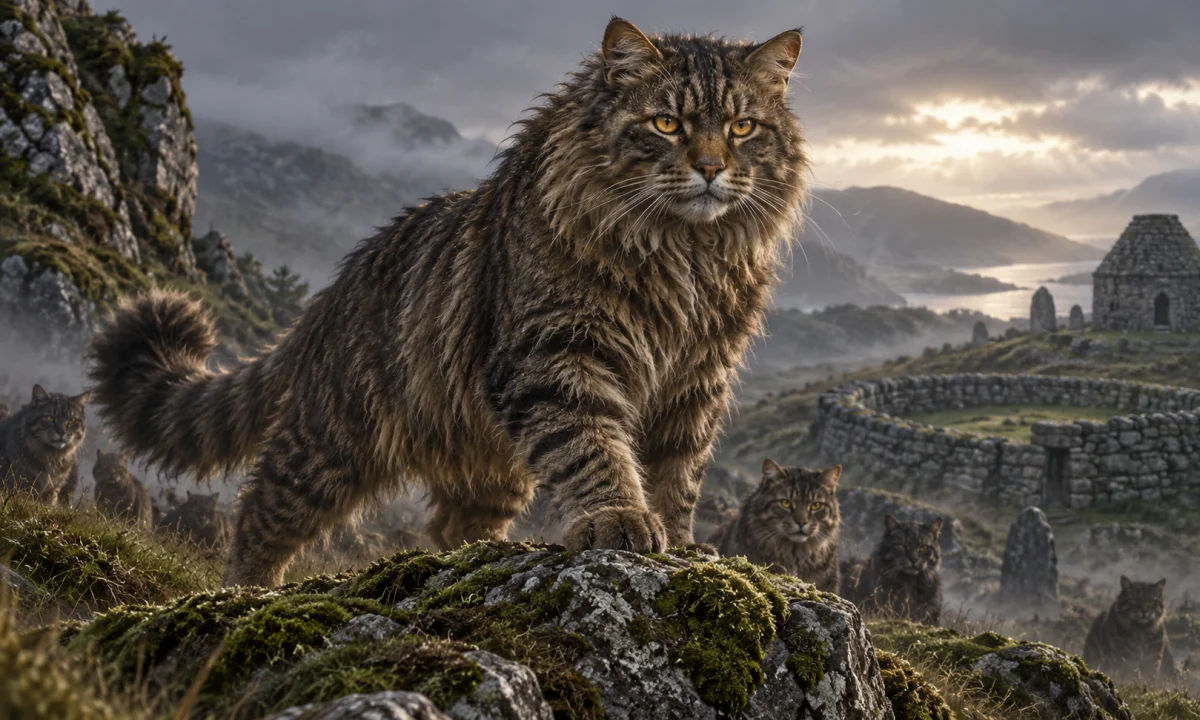
Irusan is a legendary cat associated with Irish folklore and with the tradition of the King of the Cats. He is generally described in later retellings as an unusually large or powerful cat who rules over other cats. Unlike figures such as Lugh, the Dagda or the Morrígan, Irusan is not a major god or hero of the medieval Irish mythological cycles. His identity belongs chiefly to folklore, local legend and later literary retelling, and the surviving accounts do not form a single consistent biography.
Origins and cultural setting
Irish tradition contains many stories in which animals possess their own societies, languages, rulers and forms of knowledge. Cats are especially suitable for this kind of tale because they live alongside humans while remaining independent and difficult to understand. Their nocturnal habits, silent movement and apparent ability to appear and disappear made them natural subjects for stories about hidden worlds.
The idea of a king of the cats appears in Irish folktales in several forms. People may overhear cats speaking about human events, discover that cats recognise one another as members of an organised community, or learn that an apparently ordinary household cat has a secret royal identity. In some versions, the king is connected with a particular cave, town or countryside. In others, he appears only briefly as an immense and threatening animal.
Irusan belongs to this broad folklore tradition rather than to a clearly defined religious cult. There is no secure evidence that he was worshipped as a deity, received offerings in a formal Irish religious system or possessed a fixed place in pre-Christian mythology. His importance comes from storytelling: he represents the unsettling possibility that familiar animals have a hidden kingdom operating beyond human sight.
The name Irusan
The name Irusan is not supported by a universally accepted meaning or spelling. It occurs chiefly in English-language accounts of the Irish King of the Cats, and different retellings may alter the form of the name or omit it altogether. The available material does not establish a single ancient Irish text in which Irusan is presented with a complete genealogy, title and set of adventures.
For that reason, proposed explanations of the name should be treated cautiously. It is unsafe to assign it a definite translation or to claim that it was the standard name for an ancient Irish cat god. The name may preserve a local or folkloric form, may have been reshaped in transmission, or may have become established through modern retellings. Its uncertain wording is part of the history of the tradition rather than a problem that can be solved by inventing a fixed etymology.
Identity and classification
Irusan is best classified as a legendary animal ruler or folkloric king, not as a member of the Tuatha Dé Danann or one of the principal beings of the Ulster, Fenian or Mythological Cycles. Irish mythology is often used as a broad label for many kinds of traditional material, but the distinction between medieval literary mythology and later oral folklore remains important.
The title “King of the Cats” also does not necessarily identify one universal character. A folktale may use the title as a role that can be filled by different cats in different places. One version may give the king a personal name such as Irusan, while another simply refers to “the king of the cats.” Local storytellers could adapt the character to suit the setting, the behaviour expected of cats or the moral purpose of the tale.
Some modern accounts describe Irusan as the king of every cat in Ireland. That is a reasonable summary of his legendary status, but it should not be confused with evidence for a formal pan-Irish mythology. The folklore does not provide a stable political structure, sacred law or complete account of how the feline kingdom operates.
Appearance and powers
The most persistent feature associated with Irusan is his extraordinary size. He is commonly portrayed as a cat far larger than an ordinary domestic animal, sometimes with the proportions of a large dog, calf or other substantial creature. The exact comparison varies, and not every retelling gives a physical measurement. His size serves an immediate storytelling purpose: a normal cat becomes frightening when enlarged beyond the boundaries of ordinary experience.
Irusan is also associated with qualities commonly attributed to mysterious cats in European folklore:
- Secrecy: he belongs to a hidden society that humans are not normally meant to observe.
- Intelligence: he understands speech, plans actions and may know more about human affairs than people realise.
- Authority: other cats recognise him as a ruler or superior.
- Night-time movement: his world is most active after dark, when ordinary human authority is weaker.
- Threatening strength: his physical power makes an encounter dangerous even when he appears calm.
Some retellings give him a dark coat, while others concentrate only on his enormous size. There is no universally established description of his colour, markings, crown or clothing. Illustrations and online summaries sometimes standardise these details, but artistic repetition should not be mistaken for an ancient tradition.
Stories of the King of the Cats
The stories connected with Irusan are part of a wider folktale pattern rather than a single canonical myth. A human character may hear cats speaking in a way that reveals their social organisation. The cats may discuss a death, a journey, a change of kingship or an event that has not yet happened among humans. The listener then realises that cats possess knowledge and relationships hidden from their owners.
In narratives involving an especially powerful King of the Cats, the discovery can lead to fear or confrontation. The enormous cat may appear near a dwelling, in a cave or at the edge of a settlement. The human witnesses are forced to reconsider the assumption that domestic animals are harmless property. The cat king may retreat, attack, or remain an ominous presence whose authority is never fully explained.
Because these accounts circulated through oral and popular forms, details vary considerably. A tale may focus on the danger of spying on supernatural beings; another may be comic, presenting cats as if they were a rival human community with their own politics and ceremonies. Some versions use the king to explain why cats behave strangely after a death or why a household animal seems to understand a conversation.
There is no reliable basis for presenting one particular adventure as Irusan’s definitive story. Claims that he had a fixed enemy, a named consort, a permanent residence or a precise death should be checked against the individual version in which they occur. Such details may belong to one local legend or modern retelling rather than to the whole tradition.
Caves, local legends and place associations
Stories of a giant or royal cat are sometimes connected with caves and other liminal places. A cave is an effective setting for a King of the Cats because it lies between the familiar human landscape and an unseen underworld. It can suggest a royal hall, a lair or an entrance to a territory where ordinary rules no longer apply.
Irish caves frequently accumulate legends involving animals, hidden treasure, saints, warriors and supernatural inhabitants. A local association with Irusan does not by itself prove that the figure originated at that site. Place legends often develop through repeated storytelling, tourism, antiquarian writing and the desire to give a memorable explanation for an unusual natural feature.
The same caution applies to claims that Irusan ruled from one specific location throughout Ireland. A local tradition may strongly associate the cat king with a cave or district, while another account places the story elsewhere. These differences are normal in folklore and should not automatically be treated as contradictions within a single written mythology.
Cats in Irish belief and folklore
Cats appear in Irish tradition with a range of meanings. They can be ordinary household animals, uncanny observers, guardians of secret places or creatures connected with the otherworld. Their independence gives them an ambiguous position: humans live with them, but cannot command them in the same way as working animals.
Medieval Irish literature also contains animal transformations, monstrous creatures and beings with animal characteristics. These examples show that animals could carry symbolic and narrative importance, but they do not establish Irusan as an ancient religious figure. A named cat in later folklore should not automatically be traced back to a pre-Christian god simply because cats appear in older Irish literature.
Irusan’s role is therefore best understood through the folklore idea of animal otherness. He is familiar enough to belong to the household world, yet strange enough to represent a society beyond human control. The contrast produces both humour and unease. A cat that ignores its owner may be merely behaving like a cat; in a folktale, the same behaviour can reveal royal rank or supernatural knowledge.
Irusan and the cat sídhe
Irusan is sometimes confused with the cat sídhe, usually anglicised as fairy cat. The two subjects are related through Irish ideas about uncanny cats, but they are not identical.
The cat sídhe is a folkloric supernatural cat associated with the sídhe, the fairy people or otherworldly beings of Gaelic tradition. In some accounts it is a large black cat with a distinctive marking, while in others it is simply a fairy creature in feline form. The cat sídhe belongs to a broader category of otherworld beings and does not require a royal identity.
Irusan, by contrast, is specifically linked with the King of the Cats motif. He is usually treated as an individual legendary ruler, although the evidence for a stable traditional biography is limited. A retelling may combine the two ideas, especially when it depicts Irusan as an enormous, magical or otherworldly cat, but that combination should be identified as an adaptation rather than assumed to be an original equivalence.
Distinction from the Scottish Cat-sìth
Irusan is also sometimes merged with the Scottish Cat-sìth, a fairy cat from Scottish Gaelic folklore. The Cat-sìth is commonly described as a large black cat with a white mark on its chest and is associated with beliefs about death, funerals and the supernatural. Although Irish and Scottish Gaelic traditions share linguistic and cultural history, the Cat-sìth is not simply another name for Irusan.
Names for supernatural cats can be blended in modern writing because both traditions feature large, mysterious feline beings. This does not mean that every giant cat in Celtic folklore is one character. The Irish King of the Cats, the cat sídhe and the Scottish Cat-sìth should be kept distinct unless a particular storyteller deliberately combines them.
Symbolism and interpretation
Irusan can be interpreted as a figure of hidden social order. Human beings tend to assume that they are the dominant inhabitants of the domestic world, yet the King of the Cats reverses that assumption. Cats may appear to serve people while secretly recognising their own ruler, customs and loyalties.
The legend also plays with the boundary between the ordinary and the supernatural. No transformation is required for a cat to become uncanny. Its normal habits—watching silently, moving at night and refusing to obey—already seem mysterious. Enlarging the animal or giving it a royal title turns everyday strangeness into a complete alternative society.
As a folklore figure, Irusan is less a character with a moral doctrine than a memorable image: the possibility that an apparently familiar creature belongs to a world humans can glimpse but never govern. His power comes from uncertainty, and attempts to define every feature of him risk losing the very ambiguity that gives the story its force.
Later reception
Irusan has attracted renewed attention through illustrated folklore collections, websites about Irish legends, fantasy writing and popular discussions of mythical cats. Modern representations may give him a standard appearance, a detailed kingdom, magical abilities or a place among a larger group of Celtic creatures. These additions can be imaginative and useful for storytelling, but they do not necessarily reflect a documented traditional account.
In contemporary fantasy, Irusan may be presented as a guardian, monster, shapeshifter or noble supernatural animal. Such portrayals belong to modern popular culture unless they can be tied to a specific older version of the legend. The traditional figure remains more elusive: a named or unnamed King of the Cats whose enormous presence expresses the old folkloric idea that animals may possess a secret life of their own.