WORLD
WORLD
Ilaheva

Ilaheva is a little-known name associated with Polynesian mythology, but its identity and traditional role are not securely established. Some modern mythology references describe Ilaheva as a female sea deity or as a companion of the great Polynesian god Tangaloa, also known in different islands as Tangaroa or Ta‘aroa. However, these descriptions are not consistent across Polynesian traditions, and a complete, widely attested myth cycle about Ilaheva has not been identified.
The uncertainty surrounding Ilaheva is important. “Polynesian mythology” does not describe a single uniform religion. It refers to the many related but distinct traditions of societies spread across the central and eastern Pacific, including Tonga, Samoa, the Cook Islands, Tahiti, the Tuamotu Archipelago, the Marquesas, Aotearoa New Zealand, Hawai‘i and other island groups. Names, genealogies, divine functions and stories changed from place to place. A figure recorded under one name in a modern list cannot automatically be treated as a pan-Polynesian goddess.
The status of Ilaheva in Polynesian tradition
Available references to Ilaheva are sparse. The name appears chiefly in modern summaries and comparative lists of Polynesian deities rather than in a large body of well-known traditional narratives. These summaries sometimes give Ilaheva a connection with the sea, fertility or a divine household associated with Tangaloa. The details vary, and it is not clear that all such descriptions derive from the same island tradition.
There is no generally accepted account of Ilaheva’s parentage, residence, appearance or major exploits. Nor is there a stable consensus about whether she should be classified as a high goddess, an ancestral spirit, a local deity or a figure produced by a modern attempt to systematise scattered oral traditions. Consequently, claims about her should be presented cautiously rather than as settled facts.
The spelling itself may also be uncertain. Polynesian languages use different sound systems and writing conventions, and names were often written down by outsiders using varying orthographies. A name recorded in one form could have been altered through transcription, translation or comparison with a similar name from another island. At present, Ilaheva should be treated as an uncertain or poorly documented mythological name, not as a clearly defined deity recognised throughout Polynesia.
Cultural setting
To understand why a sea association is plausible, it is necessary to consider the religious world of Polynesian societies. The ocean was not merely a geographical barrier. It was a source of food, a route of migration, a field of voyaging and a realm inhabited by powerful beings. Islands, reefs, currents, winds and deep water could all possess spiritual significance. Deities and ancestors were often understood through relationships with particular places, communities and chiefly genealogies.
Polynesian religious traditions commonly describe interactions among gods, ancestors, culture heroes and other supernatural beings. These categories were not always sharply separated in the way modern categories distinguish “god,” “spirit” and “hero.” A being could have sacred status in one setting and appear as an ancestral or local figure in another. Religious authority was also connected with tapu, sacred restriction, ritual expertise, chiefly descent and the maintenance of proper relationships between humans, gods and the natural world.
Sea deities occupied especially important positions in many island traditions. Tangaloa or Tangaroa is one of the best-known examples, although the name and character of this figure differ substantially among Polynesian cultures. In some traditions Tangaloa is a creator or supreme god; in others he is a major oceanic deity, a god associated with fishing, a divine ancestor or one member of a larger pantheon. The presence of a sea goddess named Ilaheva in a modern list may therefore reflect an attempt to place her within this broader oceanic religious pattern, but the connection cannot be assumed to have the same meaning everywhere.
Name and classification
The name Ilaheva has no universally accepted translation in English. It should not be given a confident meaning unless the relevant language, spelling and original context are known. Translating a Polynesian divine name by breaking it into apparently familiar sounds can be misleading, especially when the recorded form may reflect an outsider’s transcription.
Likewise, the label “goddess” requires some qualification. English-language writers frequently use “god” and “goddess” for convenience, but Polynesian concepts of sacred beings do not always correspond exactly to European ideas of individual, anthropomorphic deities. A traditional figure may be understood through genealogy, locality, natural phenomena, ritual power or ancestral presence rather than through a fixed mythological personality.
Some reference works classify Ilaheva as a sea goddess. Others associate her more generally with female fertility or with the divine family of Tangaloa. These classifications may represent different interpretations, spelling problems or the merging of information from separate communities. There is not enough secure evidence to choose one of these descriptions as definitive.
Possible association with Tangaloa
The most frequently repeated claim about Ilaheva is that she is connected with Tangaloa. In some retellings, she is described as a consort or female counterpart of this major oceanic deity. Such a relationship would fit a familiar pattern in mythological summaries, in which a prominent male creator or sea god is paired with a female power representing the ocean, fertility or generative life.
That pattern, however, should not be mistaken for proof of a single ancient Polynesian story. Tangaloa himself has many different identities. In Samoan traditions, Tagaloa appears in important creation narratives. In Tongan traditions, Tangaloa is associated with powerful divine ancestors and creative acts. In Tahitian and related eastern Polynesian traditions, Ta‘aroa has a distinctive creation history. The relationships attributed to a figure bearing this name cannot automatically be transferred from one island society to another.
No broadly established narrative explains how Ilaheva and Tangaloa met, what domains they shared or what children they had. Statements that present her as definitively Tangaloa’s wife or as the mother of a particular hero should therefore be treated as source-dependent rather than universally traditional. They may preserve a local account, a secondary interpretation or a later compilation, but the evidence is insufficient to generalise them across Polynesia.
Attributes and symbolic meaning
If the sea-goddess description is used, Ilaheva may be interpreted symbolically through the central importance of the ocean in Polynesian life. The sea provided fish and shellfish, connected distant islands and made long-distance settlement possible. It could also bring storms, shipwreck, isolation and death. A supernatural being associated with the sea might therefore embody both nourishment and danger rather than a single simple quality.
Female divine figures in Polynesian traditions are sometimes linked with fertility, birth, land, water, sexuality, death or the continuity of genealogy. These associations do not necessarily indicate that every female deity was a “fertility goddess” in the narrow modern sense. Fertility could refer to human reproduction, the productivity of gardens, the abundance of the sea or the renewal of a community. If Ilaheva was connected with fertility in one tradition, the term may have referred to this wider network of generative powers.
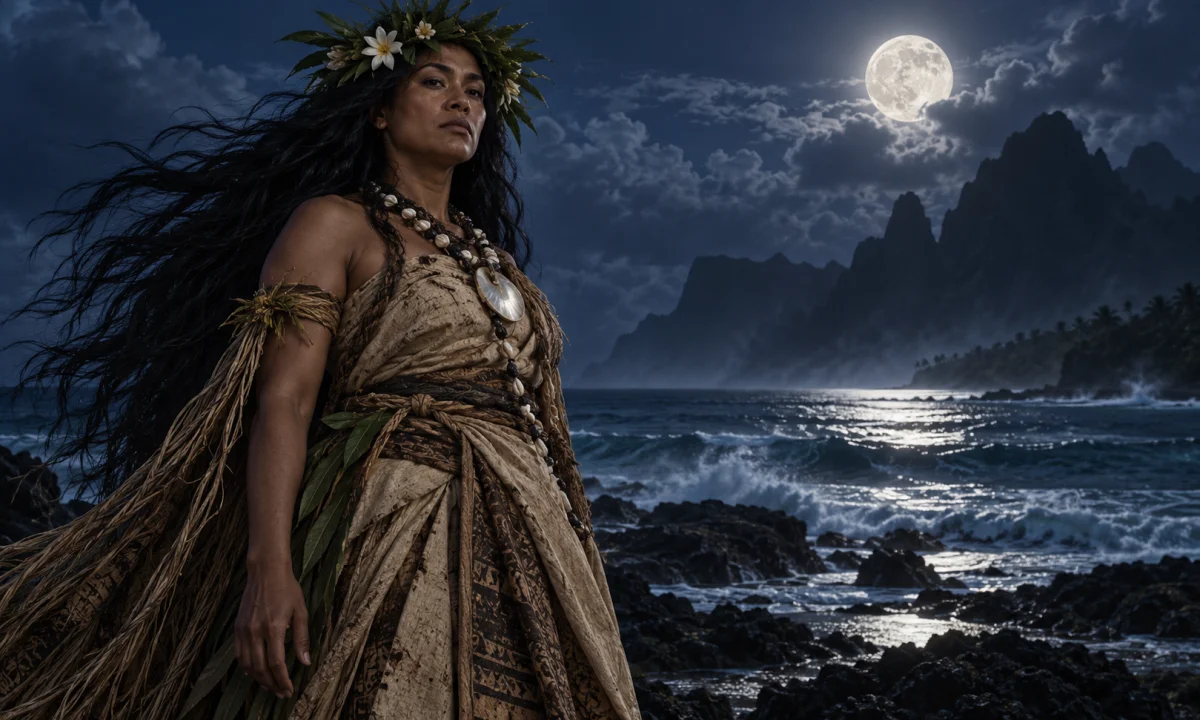
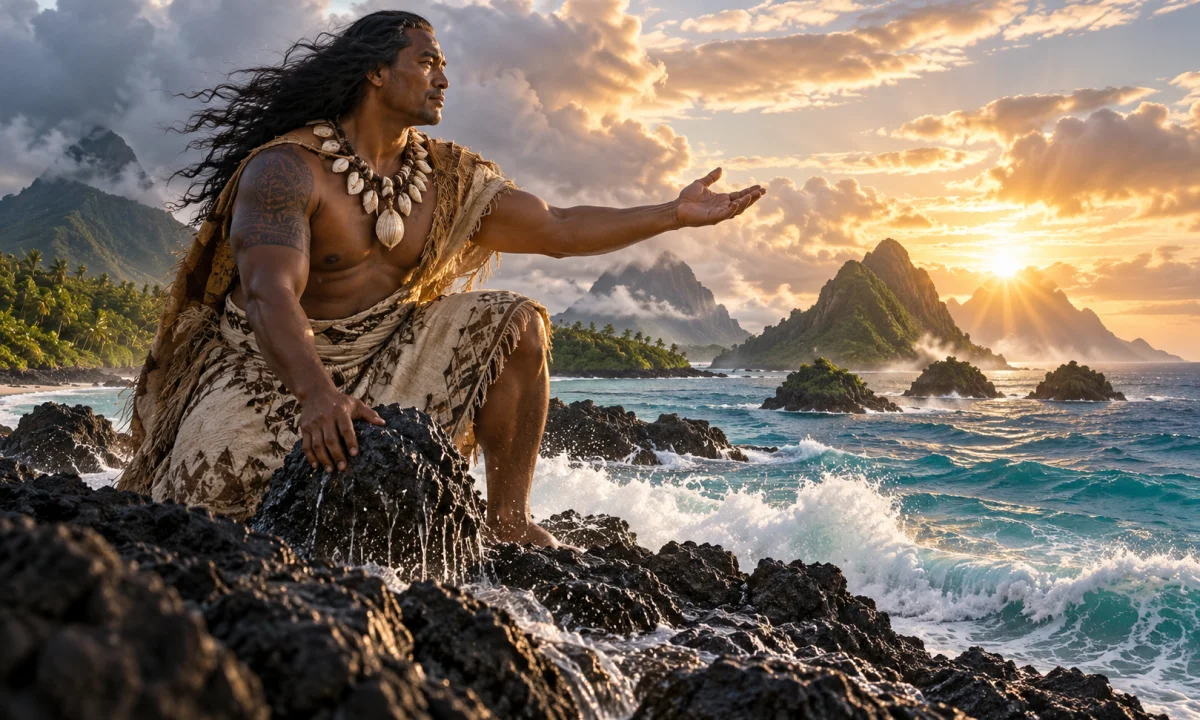
There is no secure traditional description of Ilaheva’s physical appearance. Images showing her as a mermaid, a woman rising from waves, a crowned ocean queen or a conventionally beautiful Polynesian goddess should not be presented as ancient iconography. Such forms are modern artistic inventions unless tied to a clearly documented local tradition.
Stories and variants
A defining feature of Polynesian mythology is variation. Stories were transmitted orally, performed, adapted and connected to specific places or chiefly lines. A narrative could have several versions without one being an incorrect copy of another. Genealogies could also serve religious, political and territorial purposes, linking a community to gods and ancestors.
For Ilaheva, the problem is more fundamental: surviving records do not provide a substantial, consistent cycle of stories from which a set of standard episodes can be reconstructed. There is no securely established tale of her creation, a conflict with another deity, a voyage across the ocean or a transformation into a natural feature that can be confidently attributed to all Polynesian communities.
Occasional web pages and unsourced mythology compilations may attach additional powers, relatives or adventures to her. These details should be approached carefully. Repetition across modern websites does not demonstrate antiquity, and a claim may circulate widely after being copied from one brief modern entry. The absence of a well-preserved narrative does not prove that no local story ever existed, but it does mean that invented or weakly supported details should not be treated as historical tradition.
Sources and the problem of documentation
Much of what is known about Polynesian mythology comes from oral knowledge recorded after European contact. Missionaries, colonial officials, travellers and later ethnographers wrote down names and narratives using the languages and categories available to them. Some records are invaluable, but they are not neutral transcripts of an unchanged prehistoric religion. Informants may have selected particular versions, translators may have altered meanings and Christian assumptions sometimes influenced the way local beings were described.
Many traditional religious practices were also disrupted by conversion, colonial rule and the suppression of ceremonies. In other cases, knowledge remained within families, ritual communities or local specialists and was not published. A poorly documented name may therefore reflect incomplete preservation rather than a figure that was wholly invented. At the same time, the gaps in the record make it unsafe to reconstruct a detailed mythology from a name alone.
Modern classifications can create further confusion by grouping names from widely separated islands under the single heading “Polynesian.” Comparative mythology can reveal shared linguistic or religious patterns, but similarity does not erase local differences. A responsible account must distinguish a figure directly recorded in a particular tradition from an interpretation made by a later compiler.
Distinguishing Ilaheva from related figures
Ilaheva should not be automatically identified with better-documented Polynesian female figures such as Hina, Sina, Papahānaumoku or Hine-nui-te-pō. These beings belong to different island traditions and have their own histories, although names and functions sometimes overlap between cultures.
- Hina is a widespread and highly varied name for female supernatural figures, often associated in different traditions with the moon, weaving, sexuality, creation, the sea or ancestral power. Not every Hina is the same being, and Ilaheva should not be treated as simply another name for Hina.
- Sina appears in several Samoan and other western Polynesian stories, sometimes as a heroine, ancestral woman or supernatural figure. Similarity between a sea-related Sina story and a sea-goddess description does not establish an identity with Ilaheva.
- Papahānaumoku is an important Hawaiian earth mother associated with the birth or emergence of the Hawaiian Islands in certain traditions. She is not a general Polynesian equivalent of Ilaheva.
- Hine-nui-te-pō is a major Māori figure associated with death and the underworld. Her role and cultural setting are distinct from the uncertain sea association attributed to Ilaheva.
Nor should Ilaheva be confused with Tangaloa, Tangaroa or Ta‘aroa. Those names refer to major male deities or ancestral powers in several Polynesian traditions, though their precise roles vary. A possible relationship between Ilaheva and one form of Tangaloa is not evidence that she is another name for him.
Interpretation and cultural significance
Ilaheva’s main significance today lies in the questions she raises about how Polynesian traditions are recorded and represented. A short entry in a mythology list can give the impression of a complete, universally recognised goddess even when the underlying evidence is fragmentary. Treating uncertainty openly is therefore part of respecting the cultures from which these names come.
The name may preserve a local tradition, a variant spelling or a forgotten strand of oral knowledge. It may also reflect a modern synthesis that combined sea symbolism, female divine imagery and the widespread importance of Tangaloa. Without a traceable traditional context, it is not possible to determine which explanation is correct.
For that reason, Ilaheva is best described as a poorly documented Polynesian mythological name, possibly associated in modern accounts with the sea and with Tangaloa. Her status, origin, attributes and stories remain uncertain, and claims beyond those limited associations require specific evidence from an identifiable island tradition.
Ilaheva in modern culture
Ilaheva has no prominent, widely recognised role in modern film, literature, games or popular religious practice comparable to figures such as Māui, Pele or Tangaroa. When she appears in contemporary material, she is more likely to be presented as a general Polynesian sea goddess than as a character drawn from a detailed, documented mythological cycle.
Modern fantasy may give Ilaheva invented powers, costumes, symbols or family relationships. Such portrayals can be creative interpretations, but they should be labelled as modern fiction rather than presented as evidence for ancient Polynesian belief. The distinction is especially important for obscure names, since fictional additions can quickly be repeated as if they were traditional attributes.