WORLD
WORLD
Furcas
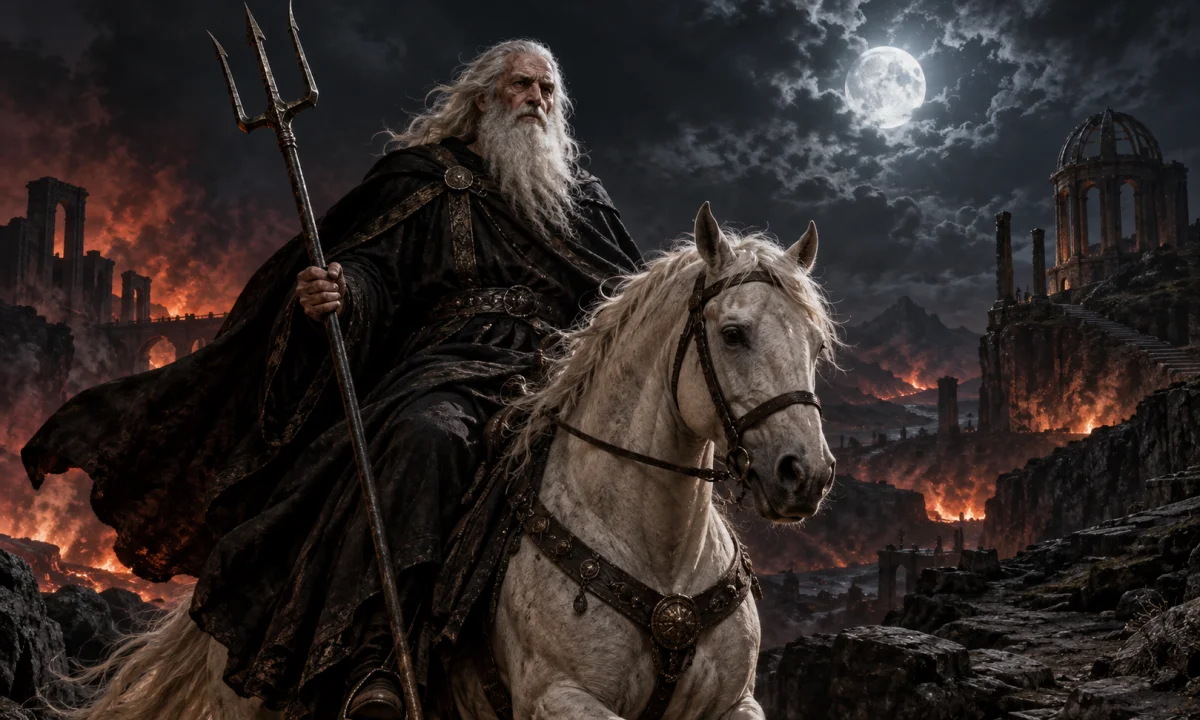
Furcas is a demon listed in the early modern tradition of Western ceremonial magic, especially the catalogues of spirits associated with the Ars Goetia. In the standard ordering of that work, he is the fiftieth spirit and is described as a knight who rides a pale horse and carries a sharp weapon. His attributed office is the teaching of several intellectual, divinatory and magical arts. Unlike figures from ancient mythology or demons named in the Bible, Furcas belongs to the learned grimoire tradition of Christian Europe.
Origins in the grimoire tradition
Furcas appears in a family of demonological catalogues that developed through the circulation of Latin and vernacular magical texts during the sixteenth and seventeenth centuries. The best-known setting for his description is the Ars Goetia, the first part of the work commonly called the Lesser Key of Solomon. That larger collection survives in manuscripts and printed editions with variations in spelling, arrangement and wording.
The Ars Goetia presents a hierarchy of spirits that a ritual magician is instructed to summon and command through divine names, prayers, seals, conjurations and prescribed ritual procedures. Furcas is one entry in this catalogue. The text does not present him as a figure from an independent mythology with a cycle of stories, a temple cult or a long-standing popular religion. His identity is primarily textual: he is known through descriptions repeated and adapted in magical books.
Related material can be found in earlier demonological lists associated with Johann Weyer’s Pseudomonarchia Daemonum, a catalogue connected with sixteenth-century discussions of demons and magical deception. The relationship between such catalogues is not simple. Names, ranks, offices and descriptions were copied, rearranged or modified as texts passed between authors and manuscripts. Furcas therefore belongs to a tradition of textual transmission rather than to a single, fixed canonical account.
These works emerged within a European Christian intellectual environment that treated magic as a dangerous or illicit attempt to deal with spirits. Their authors combined biblical language, medieval demonology, astrological ideas, names drawn from Hebrew and other languages, and material from earlier magical traditions. The presence of Furcas in a grimoire should not be taken as evidence that he was worshipped in antiquity or that he originated in a pre-Christian religion.
Name and classification
The name is usually written Furcas, although Forcas and other small spelling variations occur in related texts and editions. Spelling was not always stable in manuscript culture, particularly when unfamiliar names were copied by hand or transferred between languages.
In the Ars Goetia, Furcas is classified as a knight. This is a rank within the work’s invented or systematised infernal hierarchy. It should not be confused with the social and military institution of knighthood in medieval Europe. The catalogue also assigns him command over twenty legions of spirits, a formula used for many of the listed beings. “Legion” in this setting is a conventional measure of infernal authority, not a historically documented army.
The meaning and origin of the name are uncertain. Some readers have connected “Furcas” with Latin words such as furca, meaning a fork or forked object, and by extension an instrument associated in some contexts with punishment. Such proposals remain interpretive rather than established etymologies. The surviving grimoire descriptions do not explain the name, and there is no secure evidence that it derives from a particular ancient deity or pre-Christian spirit.
Appearance and traditional attributes
The standard description portrays Furcas as a knight riding a pale horse and holding a sharp weapon. The brief image is one of the most recognisable features associated with him. The text does not provide a detailed biography, a complete physical description or a developed narrative about his origins.
The pale horse may suggest an imposing, mobile or martial figure, but the grimoire does not offer a symbolic explanation. Interpretations connecting the horse with death, plague, conquest or apocalyptic imagery belong to later commentary or comparison, not to an explicit statement about Furcas in the catalogue itself. A pale horse naturally invites comparison with other religious and literary images, but similarity of imagery does not establish identity or shared origin.
Likewise, the weapon is described only as sharp. It is often imagined in modern illustrations as a sword or other blade, but the traditional wording does not necessarily specify one particular type of weapon. Artistic representations may therefore vary considerably. Some show an armoured rider, while others emphasise the supernatural or demonic aspects of the figure.
Furcas’s rank as a knight and his weapon give him a martial appearance, yet his assigned function is largely intellectual. The contrast between a mounted warrior and a teacher of scholarly arts is characteristic of grimoire catalogues, which frequently combine social titles, animal forms, military imagery and specialised offices without explaining how these elements fit together.
The arts taught by Furcas
Furcas is said to teach philosophy, astronomy, rhetoric, logic, chiromancy and pyromancy, or the arts associated with those subjects. The list is significant because it brings together disciplines that early modern readers might have regarded as scholarly, practical, divinatory or magical.
- Philosophy referred broadly to the study of knowledge, nature, morality and the structure of reality. In the period of the grimoires, it was not sharply separated from theology, natural philosophy or metaphysical speculation.
- Astronomy involved the mathematical and observational study of the heavens. In early modern magical culture, astronomy was closely connected with astrology, although the two subjects were not exactly identical.
- Rhetoric concerned persuasive and effective speech, including the organisation and presentation of arguments.
- Logic concerned methods of reasoning, categorisation and the evaluation of arguments.
- Chiromancy means divination by examining the lines and features of the hand, commonly known as palmistry.
- Pyromancy refers to forms of divination involving fire, flames or the appearance of burning materials.
The list should not be read as evidence that Furcas founded these disciplines or that historical scholars believed every teacher of them to be demonic. Rather, the catalogue assigns him knowledge of subjects that its authors considered useful to a magician or intellectually connected with occult practice. The wording also reflects an older educational world in which “arts” could include formal reasoning, celestial studies and methods of divination.
His office is sometimes paraphrased as teaching these subjects “in all their parts.” This suggests comprehensive instruction within the logic of the grimoire, although the text does not provide lessons, doctrines or examples of what Furcas supposedly taught. There is no surviving body of philosophical writing attributed to him.
Role within ceremonial magic
Within the ritual framework of the Ars Goetia, Furcas is not primarily presented as a tempter in a theological story or as the ruler of a particular natural domain. He is a summoned spirit with a defined area of expertise. A practitioner seeking knowledge of the listed arts might therefore regard him as an appropriate spirit to address, at least according to the logic of the catalogue.
The grimoires generally place the magician in a commanding relationship to the spirits. Ritual authority is established through divine names, sacred words, threats, petitions and formal constraints. This structure differs from devotional religion, in which a worshipper normally honours a deity or saint through prayer, offerings or communal observance. It also differs from folklore, where a being may be encountered in stories, local beliefs or popular customs without belonging to a formal ritual hierarchy.
There is no well-documented historical tradition of widespread public worship devoted specifically to Furcas. References to him come mainly from occult manuscripts, printed demonological books and later esoteric interpretations. Individual practitioners in later periods may have developed personal approaches to the spirit, but such practices should not be projected backward into ancient or medieval popular religion without evidence.
Stories and relationships
Furcas has few narrative episodes. The catalogue gives a description, rank, appearance, number of legions and professional office, but it does not recount battles, family relationships, acts of betrayal or encounters with named heroes. He is therefore unlike legendary demons and spirits whose identities are preserved through extensive folklore.
He is also not presented as the servant, offspring or consort of a particular god or demon. The hierarchy in which he appears is administrative and classificatory rather than genealogical. Ranks such as king, prince, duke, marquis, president and knight organise the entries, but they do not create a consistent infernal family tree.
Different editions may vary in punctuation, translation and the precise spelling of his name. Some versions may also alter the wording of the arts he teaches. These differences do not necessarily indicate separate beings. They often reflect the normal instability of texts copied and edited over time. At the same time, a substantially different description should not automatically be treated as an authentic hidden aspect of Furcas; it may come from a later author’s invention or reinterpretation.
Interpretation and cultural significance
Furcas illustrates how early modern demonological books transformed knowledge into a supernatural classification system. Subjects that belonged to education, public speaking, reasoning or divination were assigned to a spirit with a formal title and a place in an infernal catalogue. This arrangement reflects contemporary anxieties about forbidden knowledge: learning could be admired as a sign of civilisation while also being condemned when obtained through illicit dealings with spirits.
His combination of martial imagery and scholarly instruction is especially revealing. The knight on horseback evokes authority, mobility and force, while the office of teacher suggests mastery through knowledge. Furcas can therefore be interpreted as an emblem of knowledge presented as dangerous when pursued outside accepted religious or social boundaries. This is a modern scholarly reading of the image, not a stated doctrine from the grimoire.
The inclusion of chiromancy and pyromancy alongside philosophy and logic also shows that historical categories of knowledge do not map neatly onto modern academic divisions. Early modern occult culture could place observation of nature, formal reasoning, astrology and divination within a connected intellectual landscape. The list should be understood in that historical context rather than judged as though it were a modern university curriculum.
Furcas and similar names
Furcas is sometimes confused with Furfur, another spirit in the Ars Goetia. The names resemble one another, but the entries describe different beings. Furfur is assigned the rank of earl and is associated with a winged or deer-like appearance in standard descriptions, while Furcas is a knight on a pale horse and is associated with teaching the listed arts.
The name may also be confused with unrelated uses of words derived from Latin furca, including terms for forks, forked structures or instruments of punishment. A possible linguistic resemblance does not prove that Furcas was originally a deity connected with such objects. Nor should he be identified with figures from other religious traditions merely because they ride horses, carry weapons or possess knowledge.
Later occult and popular reception
Furcas continued to attract attention through nineteenth- and twentieth-century occult revivals, when European magicians, writers and artists revisited the older grimoires. Later occult authors sometimes reorganised the spirits, designed new illustrations, assigned additional symbolism or treated the catalogue as a system of psychological and magical archetypes. These interpretations vary widely and should be distinguished from the short description preserved in the earlier texts.
In contemporary popular culture, Furcas may appear in fantasy fiction, role-playing games, digital games and other works that draw on demonological names. Such adaptations commonly expand his personality, powers, alliances or appearance for narrative purposes. A version of Furcas portrayed as a major warrior, a unique boss character or a fully developed teacher belongs to modern fiction unless it can be traced to the traditional grimoire material.
The traditional Furcas remains a comparatively brief and specialised figure: a knightly spirit in a Western ceremonial-magical catalogue, mounted on a pale horse, armed with a sharp weapon and credited with teaching a range of intellectual and divinatory arts. His importance lies less in a body of legends than in what his entry reveals about the classification of forbidden knowledge in early modern demonology.