WORLD
WORLD
Focalor
Focalor is a demon described in early modern European demonological literature, most famously in the Ars Goetia, the first section of the Lesser Key of Solomon. He is presented as a powerful duke of Hell associated with the sea, violent winds, drowning and the destruction of ships. His name, spelling and exact place in demonological tradition vary between sources, and there is no reliable evidence that Focalor was an ancient god or a figure of pre-Christian mythology.
Origins in European demonology
Focalor belongs to the tradition of learned ceremonial magic that developed in Europe during the late medieval and early modern periods. This literature arranged demons into hierarchies resembling earthly courts and armies, assigning them titles such as king, prince, marquis, president and duke. These rankings were not part of a single universally accepted religious system. They varied from manuscript to manuscript and reflected the interests of individual occult writers and compilers.
The best-known account of Focalor appears in the Ars Goetia, a seventeenth-century grimoire concerned with the invocation and control of spirits. The Ars Goetia forms part of the larger work commonly called the Lesser Key of Solomon, which survives in manuscripts from the seventeenth century and draws on older magical and demonological material. The work presents a catalogue of spirits, their titles, appearances, powers and supposed numbers of subordinate spirits.
Focalor also appears in earlier demonological cataloguing associated with Johann Weyer’s Pseudomonarchia Daemonum, published in 1563. In that tradition, the name is generally written Forcalor rather than Focalor. The descriptions are closely related: the spirit has a human form with griffin-like wings, commands the winds and seas, and is said to destroy men and ships. The resemblance between the entries indicates that the later Goetic account belongs to a continuing textual tradition rather than representing an entirely new invention.
Name and spelling
The most familiar modern spelling is Focalor, but Forcalor is an important variant. Other minor spellings may occur in later editions, translations or occult reference works. There is no securely established etymology for the name. Attempts to connect it with particular ancient languages or with named deities should be treated cautiously unless supported by historical evidence.
The similarity between Focalor and names from other mythological or religious traditions has sometimes encouraged speculative explanations. Such resemblances do not, by themselves, prove that the demon originated as a sea god, a storm deity or a transformed pagan figure. The surviving evidence places Focalor most securely within European demonological catalogues, where the names of spirits were often copied, altered or reorganised over time.
Classification and rank
In the Ars Goetia, Focalor is described as a duke, one of the higher-ranking spirits in the infernal hierarchy used by the grimoire. He is assigned command over thirty legions of spirits. The number is part of the catalogue’s system of classification and should not be understood as evidence for a historical army or a fixed doctrine shared by all demonological traditions.
His title connects him with the aristocratic imagery common in grimoires. A duke was not necessarily understood in exactly the same way as a Christian theological category such as a fallen angel. The Goetic hierarchy combines courtly, military and bureaucratic language, creating an ordered supernatural society. Focalor’s rank therefore tells readers how the grimoire positions him within its catalogue, but it does not establish a universal place for him in Christian demonology.
Focalor is sometimes called a spirit of the air in modern occult discussions because the Ars Goetia includes broader associations between certain spirits and elemental or directional powers. However, the clearest traditional descriptions of Focalor emphasise the wind and sea rather than assigning him a fully developed elemental identity. Later occult systems may classify him differently or add correspondences not found in the earliest descriptions.
Appearance
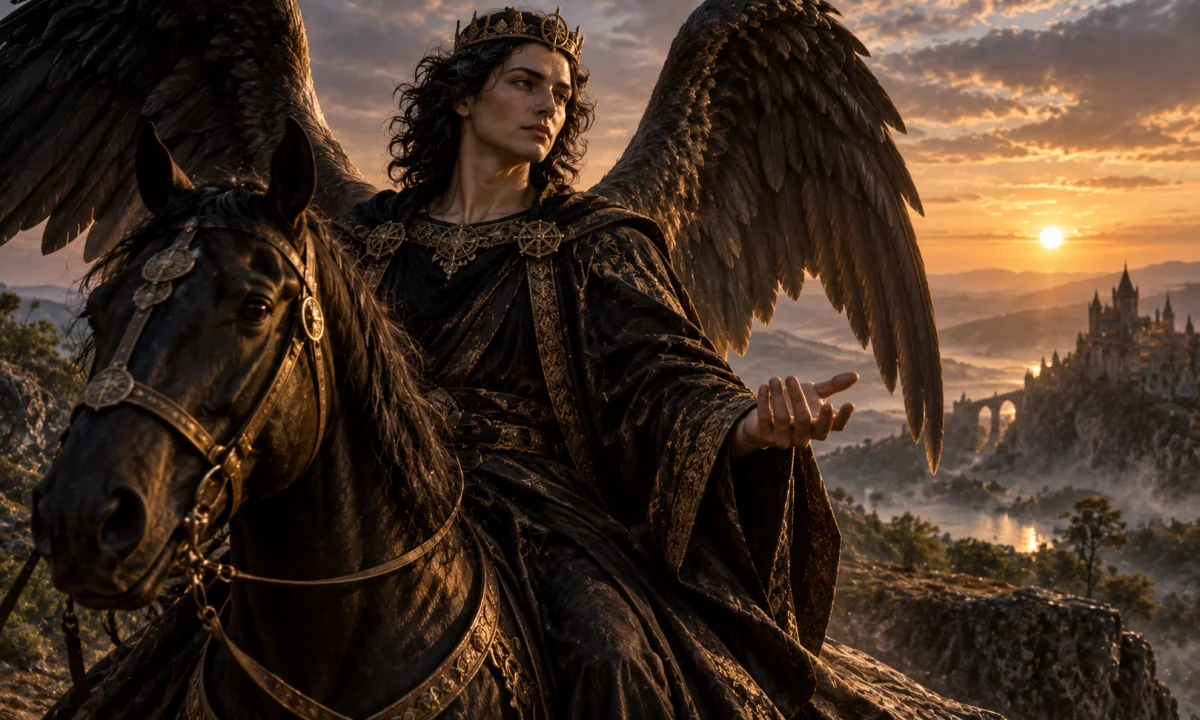
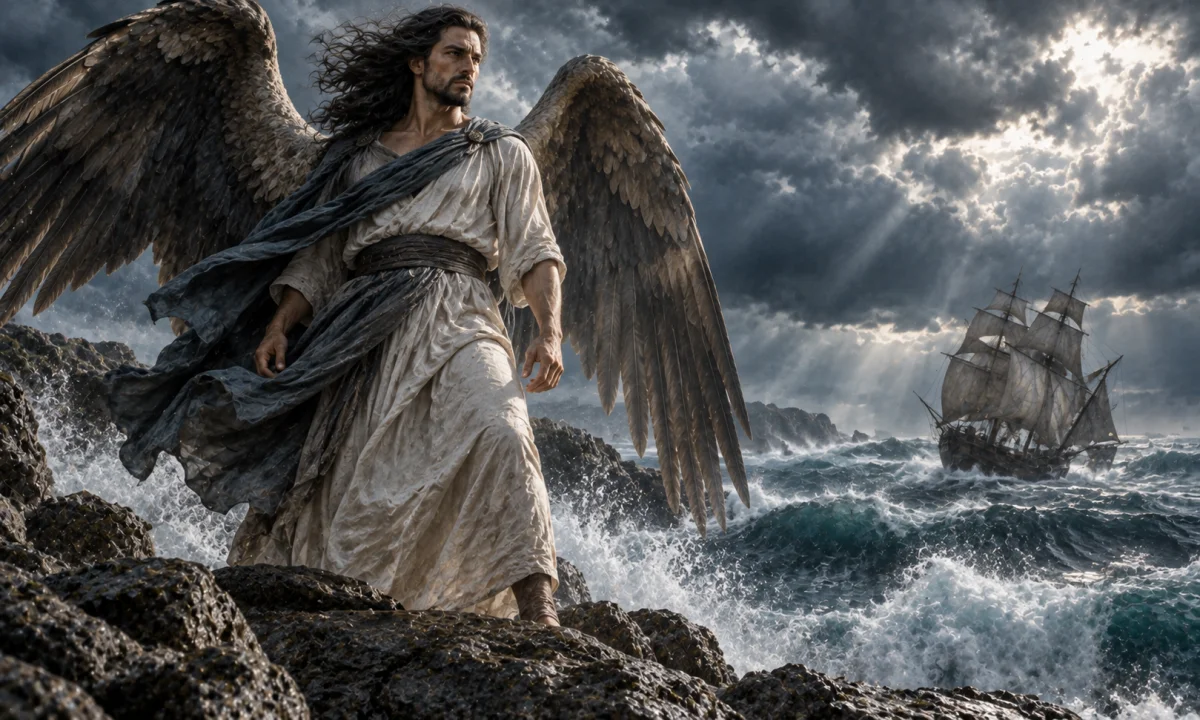
Focalor is said to appear in the form of a human figure with wings like those of a griffin. The description does not provide a detailed portrait, colour scheme or set of distinctive physical features. The griffin-like wings are the central visual feature, linking him to a creature that combines the body or characteristics of a lion with the head and wings of an eagle.
In classical and medieval art, griffins could symbolise strength, vigilance, ferocity and guardianship. Their presence in Focalor’s description may contribute to an image of a powerful aerial being, but the grimoire does not explain the symbolism. It would be speculative to claim that the wings preserve a direct connection to a particular ancient griffin cult or deity.
The combination of human form and animal-like wings is common in European representations of angels, demons and spirits. It allows the figure to appear recognisably intelligent and personal while also signalling a supernatural nature. In Focalor’s case, the wings are especially appropriate to his association with wind, storms and movement through the air.
Powers over sea and wind
Focalor’s principal powers are destructive. The traditional descriptions say that he can kill men, drown people, overturn ships and command the winds and seas. His sphere is therefore maritime danger rather than disease, temptation, wealth or secret knowledge. The imagery reflects the real hazards faced by sailors and coastal communities in an age when ships were vulnerable to storms, currents, reefs and military attack.
The wording also connects Focalor with the destruction of warships. His power is not limited to individual drowning; it extends to the overturning of ships used in warfare. This gives him a broader role as a force capable of disrupting travel, commerce and military power. The demon’s danger lies in the instability of the natural world, particularly when the sea becomes violent and uncontrollable.
Despite this destructive character, the Goetic account includes an important qualification: Focalor is said not to harm a person or thing when commanded by the practitioner conducting the ritual. This statement belongs to the grimoire’s framework of magical authority. It does not make Focalor benevolent. Rather, it presents the spirit as dangerous but subject, under the right ritual conditions, to the authority claimed by the operator.
The text does not give a separate mythology explaining how Focalor acquired these powers. There is no extended story of his birth, rebellion, family, kingdom or relationship with a sea god. His identity is primarily functional: the catalogue tells the reader what he looks like, what rank he holds and what he is believed to be capable of doing.
The hope of returning to the “seventh throne”
One of the more unusual details in Focalor’s entry is the claim that he hopes to return to the seventh throne after one thousand years. The text immediately dismisses this hope as vain. This brief statement has generated later speculation, but the source does not explain what the seventh throne is, who occupies it or why Focalor believes he could return there.
The phrase may evoke Christian ideas about fallen angels, heavenly ranks and the loss of an earlier position. Yet the wording does not provide enough information to identify Focalor confidently as a named angel from biblical or apocryphal tradition. It is safer to regard the statement as part of the grimoire’s distinctive myth-making language, possibly influenced by broader Christian ideas about rebellion, punishment and the desire to recover a lost place.
Nor does the one-thousand-year period correspond to a clearly defined doctrine shared across Christian theology. It is a symbolic or literary detail within the catalogue rather than a historically documented prediction. Later writers sometimes treat it as evidence of a more elaborate backstory, but the original description gives no further narrative.
Focalor and the problem of ancient origins
Focalor is occasionally presented in modern occult or popular writing as an ancient sea demon. That description goes beyond what the main historical sources establish. The surviving textual evidence for Focalor comes from European demonological works of the sixteenth and seventeenth centuries, not from a known ancient religious cult or a continuous pre-Christian tradition.
His marine powers may invite comparison with older sea-related beings, including storm spirits, water demons and deities of shipwreck. Such comparisons can be useful when discussing recurring mythological themes, but they do not demonstrate identity. A demon who drowns sailors is not automatically a transformed version of a particular sea god. Similar functions can arise independently because storms and shipwrecks are widespread human experiences.
Focalor should also not be confused with the many water spirits found in European folklore. Mermaids, river beings, lake monsters and storm spirits belong to different regional traditions and often have their own stories, customs and symbolic meanings. Focalor is a literary demon of a learned grimoire, not a general name for a traditional European water spirit.
Relationship to Christian demonology
Focalor exists within a Christian-influenced demonological environment, but he is not a major figure in the Bible or in the central doctrines of mainstream Christianity. The Bible does not provide a canonical account of a demon named Focalor or Forcalor. His rank and powers come from later magical literature rather than from a universally recognised Christian scripture.
Early modern demonologists often combined biblical language, medieval legends, classical imagery, astrological ideas and material from earlier magical books. Their catalogues were not uniform, and authors did not always agree about the identity or status of individual spirits. Focalor’s griffin-like form and command of natural forces reflect this mixed cultural environment.
For religious readers, the figure may be understood as an example of the period’s attempt to organise evil spirits into a hierarchy. For historians of religion, Focalor is more usefully examined as a product of textual transmission, occult classification and early modern ideas about supernatural causation. These approaches need not be treated as identical: theological belief, historical analysis and modern esoteric practice ask different questions of the same material.
Stories and traditional role
Focalor has no substantial cycle of legends comparable to the stories of Lucifer, Beelzebub or the demons of biblical and medieval narrative. His traditional role is contained in a short catalogue entry rather than in a body of folklore. The most significant elements are his rank, appearance, maritime powers, thirty legions and frustrated hope of returning to a former throne.
This lack of narrative is important. Later encyclopaedias, novels and games may provide Focalor with a personality, motives, allies or a detailed biography, but those additions should not be mistaken for material found in the older demonological sources. The historical Focalor is defined by a compact set of attributes rather than by a long-standing popular tradition.
Distinction from similar names
Forcalor is the main historical spelling variant and generally refers to the same Goetic demon. The difference reflects the transmission and editing of demonological texts rather than evidence for two clearly separate beings. Nevertheless, individual modern authors may use the spellings inconsistently, so the surrounding description should be checked before assuming that every occurrence refers to the same tradition.
Focalor should not be identified with a generic “demon of the ocean,” nor with every winged spirit associated with storms. His specific profile comes from the Goetic catalogue. He is also distinct from figures in ancient Mediterranean religion who ruled the sea, such as Poseidon or Neptune. Those were major divine figures with extensive cults, myths and religious histories; Focalor is a demonological duke described in early modern occult literature.
Later reception and popular culture
Focalor’s name has been reused in modern occult manuals, demonology reference works, fantasy fiction, role-playing games and digital media. These adaptations commonly expand the brief traditional description by giving him a personal history, a visual design, elemental abilities or a role in a larger supernatural setting. Such portrayals draw on the Goetic name and maritime associations but are creative interpretations rather than additional evidence about the historical tradition.
A notable source of possible confusion is Focalors, a fictional character in the video game Genshin Impact. Focalors is presented within that game’s invented mythology as a deity connected with Fontaine and the Hydro element. The spelling, setting and role differ substantially from the demon Focalor of the Ars Goetia. A resemblance between the names does not make the two figures the same, and the game’s character should be discussed as modern popular culture rather than as a continuation of the older demonological record.
In modern esoteric practice, Focalor may be approached symbolically as an image of uncontrollable nature, maritime danger, destructive authority or the fear of losing one’s place. Those interpretations can be meaningful within contemporary occult systems, but they should be distinguished from the comparatively limited claims made by the early sources. Historically, Focalor remains a winged demonic duke whose imagined power over wind and sea places him among the most distinctly maritime figures in the Goetic catalogue.