WORLD
WORLD
Fe’e
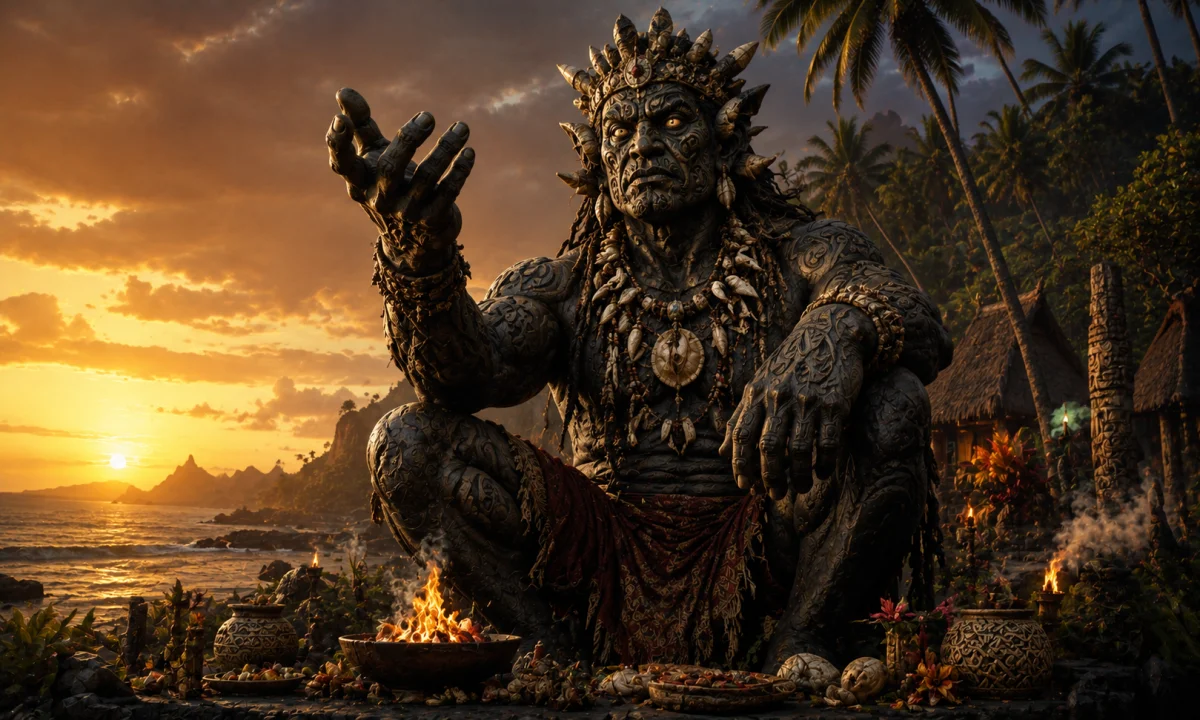
Fe’e is a Polynesian name associated primarily with the octopus, especially in Samoan tradition and in related languages of the central Pacific. Depending on the source, Fe’e may refer simply to an octopus, to a remarkably large or dangerous sea creature, or to a named being in a traditional story. It is therefore safer to treat Fe’e not as one uniformly defined pan-Polynesian god, but as a figure whose meaning changes according to island, language, storyteller and source.
Origins and cultural setting
Polynesian societies developed in close relationship with the ocean. Fishing, voyaging, reef knowledge and the reading of currents were central to life across the region. Sea animals consequently appear in origin narratives, family traditions, proverbs, ritual language and stories about encounters between humans and powerful beings. The octopus was especially suitable for such stories: it could hide among rocks, change colour, move in several directions and seize objects or people with its strong arms.
In Samoa, fe’e is the ordinary word for an octopus, although spelling and pronunciation may be represented differently in older English-language records. The word is related to forms found in other Polynesian languages. Tongan has feke, while other Polynesian languages use related terms for the same animal. These linguistic similarities reflect a wider Polynesian vocabulary, but they do not prove that every figure called Fe’e belongs to one shared myth.
Traditional knowledge about Fe’e was transmitted mainly through oral performance. Stories could be retold by chiefs, elders, expert navigators, families and village storytellers, with details changing over time. Early written descriptions were generally recorded by missionaries, colonial officials, travellers or ethnographers. Such records are valuable, but they do not preserve a complete or unaltered system of belief. They may also translate a local animal name as though it were the proper name of a single supernatural character.
Name and identity
The spelling Fe’e is commonly used when the word is presented in a Samoan context. The apostrophe represents a glottal stop, a sound that can distinguish words in Samoan and other Polynesian languages. Older sources may omit the mark or use variant spellings because nineteenth-century writers did not always record Polynesian pronunciation consistently.
The most important qualification is that Fe’e is not always a personal name. In many contexts it simply means “octopus.” A story may describe a giant fe’e without claiming that the creature is a god or belongs to a named divine family. In other contexts, particularly in retellings made for a wider audience, the creature is capitalised and treated as a distinct mythological being.
Some modern summaries call Fe’e an octopus deity or sea god. That description should be used carefully. There is no single, universally accepted Polynesian theology in which Fe’e has the same rank, genealogy and responsibilities throughout the region. The available evidence more securely supports an association with the octopus as a powerful marine creature than a uniform identification as a major god.
Appearance and powers
When Fe’e is imagined as a supernatural or monstrous octopus, its most obvious feature is enormous size. It may be pictured as larger and more dangerous than an ordinary reef animal, with long arms capable of gripping a canoe, obstructing a passage or dragging a person beneath the water. Such descriptions express the dangers of the sea rather than providing a fixed anatomical portrait.
Fe’e’s strength is usually connected with the qualities people observe in real octopuses. Its arms suggest exceptional grasping power; its ability to disappear among rocks suggests concealment; and its colour-changing skin can be understood as a sign of transformation or deception. An octopus can also occupy narrow crevices that appear inaccessible to larger animals, making it an effective figure for hidden power.
In a symbolic reading, Fe’e belongs to the boundary between the familiar and the unknown. Reef pools, channels, caves and deep water were productive places, but they could also be dangerous. A giant octopus embodies the ocean’s capacity to provide food and to resist human control. It may therefore appear as an adversary, a guardian or simply an awe-inspiring inhabitant of the marine world.
Claims that Fe’e always has magical powers such as shapeshifting, control over storms or command of all sea creatures go beyond what can safely be said of the figure as a whole. Some individual legends may give an octopus extraordinary abilities, but these details should not automatically be treated as universal attributes.
Fe’e in Samoan tradition
Samoan oral tradition contains many accounts of relationships between people, animals, ancestral beings and powerful figures. In that setting, an octopus may function as a monster in a cautionary story, an obstacle in a hero’s journey or a sign of the dangerous agency of the sea. The creature’s role depends on the particular narrative rather than on a fixed mythological job.
English-language accounts sometimes describe Fe’e as a primordial or divine being connected with Tagaloa, a major creator and sky or ocean deity in Samoan traditions. Such claims are not equally supported by all Samoan sources, and genealogies differ between local traditions and written collections. Tagaloa itself is a name with variants and different religious profiles across Polynesia. A relationship reported in one account should therefore not be presented as a universal rule.
Similarly, stories that make Fe’e a guardian of a place or a particular community should be understood in their local setting. Polynesian traditions often attach spiritual importance to reefs, rocks, pools, islands and passages. A being connected with one location may not have the same significance elsewhere, even when the same word is used.
Stories, motifs and local variants
There is no single canonical “myth of Fe’e” comparable to a written epic with a stable sequence of episodes. Instead, the figure is associated with recurring story patterns.
- The sea monster: A large octopus threatens people travelling by canoe or entering a dangerous marine place. The story emphasises caution, courage and knowledge of the sea.
- The hidden inhabitant: Fe’e remains concealed in a cave, reef or deep pool until a person disturbs its territory. Its sudden appearance turns an ordinary landscape into a spiritually charged place.
- The adversary of a hero: A skilled voyager, culture hero or warrior must evade, defeat or outwit the octopus. In these narratives, intelligence and practical knowledge may be as important as physical strength.
- The guardian: The creature protects a place, object, boundary or community. Its frightening nature can serve as a warning against trespass or disrespect.
- The extraordinary animal: The octopus is simply presented as unusually large, clever or elusive, without being classified as a god. This form may belong more properly to folklore and marvel tales than to formal religious mythology.
These motifs are not interchangeable versions of one story. They represent ways in which an octopus can operate within Polynesian storytelling. A local tale may combine several of them, while another may contain none of them. Names, relationships, locations and outcomes should be checked against the particular tradition in which a story was recorded.
Religious and cultural significance
Calling Fe’e a “monster” can be misleading if the word suggests a purely evil creature. In many traditional cultures, dangerous beings are not necessarily moral villains. They may mark the limits of safe human behaviour, protect a sacred place or embody forces that must be approached with respect. A giant octopus can be frightening without being wicked in a Christian or modern fantasy sense.
The figure also reflects the importance of marine expertise. Polynesian communities possessed detailed knowledge of reefs, tides, fish, shellfish and seasonal conditions. Stories about sea beings were not merely imaginary alternatives to practical knowledge. They could coexist with observation and help express rules about where people should go, what they should take and how they should behave in a dangerous environment.
Fe’e can also represent the ocean’s ambiguity. The same sea that supports travel and supplies food can isolate communities, destroy canoes and conceal hazards. The octopus, with its combination of intelligence, camouflage and physical strength, gives that ambiguity a memorable form.
Fe’e and related octopus figures
Octopus beings occur widely in Oceanian folklore, but similar animals do not automatically indicate identical characters. In Māori traditions, for example, Te Wheke-o-Muturangi is a famous giant octopus associated with the navigator and hero Kupe in later recorded traditions. The Māori word wheke means octopus, and the story belongs to a different cultural and linguistic setting from Samoan accounts of Fe’e.
In Tonga, the related word feke may appear in descriptions of octopuses or marine creatures. It should not be silently changed into the Samoan name Fe’e, nor should every Tongan reference to a feke be assumed to describe the same supernatural being. Across Polynesia, related words often preserve an ancient linguistic connection while acquiring distinct local meanings.
Fe’e should also be distinguished from named ocean deities such as Tangaroa or Tagaloa and from the Māori deity or divine figure often called Kanaloa in Hawaiian tradition. These figures can be associated with the sea, but they are not simply alternate names for an octopus. Nor is every modern image of an octopus-headed Polynesian god evidence of an indigenous tradition.
Sources and interpretation
Knowledge of Fe’e comes through a mixture of oral tradition, language, local storytelling and written documentation. Oral traditions are not “less real” because they were not originally written, but they are difficult to reduce to a single definitive version. A story’s authority may depend on the community, family or place in which it is told.
Written records must be read with attention to their purpose. A missionary might organise local beings according to categories such as “god,” “devil” or “superstition.” A collector might combine stories from different informants. A later popular writer might turn an ordinary word for octopus into the name of a universal sea monster. These processes can make a flexible traditional figure appear more uniform than the evidence allows.
For that reason, the most responsible description of Fe’e is layered. At the linguistic level, it is chiefly a Polynesian term for an octopus, particularly in Samoan usage. At the folkloric level, it can denote a giant, dangerous or uncanny octopus in local stories. At the religious level, some accounts may connect such a being with sacred places or divine genealogies, but those connections vary and should not be generalised. The category “octopus god” is consequently a convenient modern label, not a complete definition of every traditional use of the name.
Later reception and popular culture
Fe’e has had less fixed representation in global popular culture than better-known Polynesian figures such as Maui or Pele. When the name appears in modern fantasy, games, online mythology lists or illustrated retellings, it is often expanded into a fully developed sea deity with standard powers, enemies and symbolism. Those creative treatments may be inspired by Polynesian ideas, but they are modern adaptations rather than proof of a single ancient character.
Modern writers and artists can use Fe’e respectfully by identifying the cultural setting, preserving the difference between the Samoan word and a supernatural proper name, and acknowledging variation between island traditions. Treating every Polynesian octopus story as one myth erases the regional diversity that gives the figure its meaning. Fe’e is best understood through that diversity: as a word, an animal, a possible guardian or adversary, and a powerful image of the living ocean.