WORLD
WORLD
Dantalion
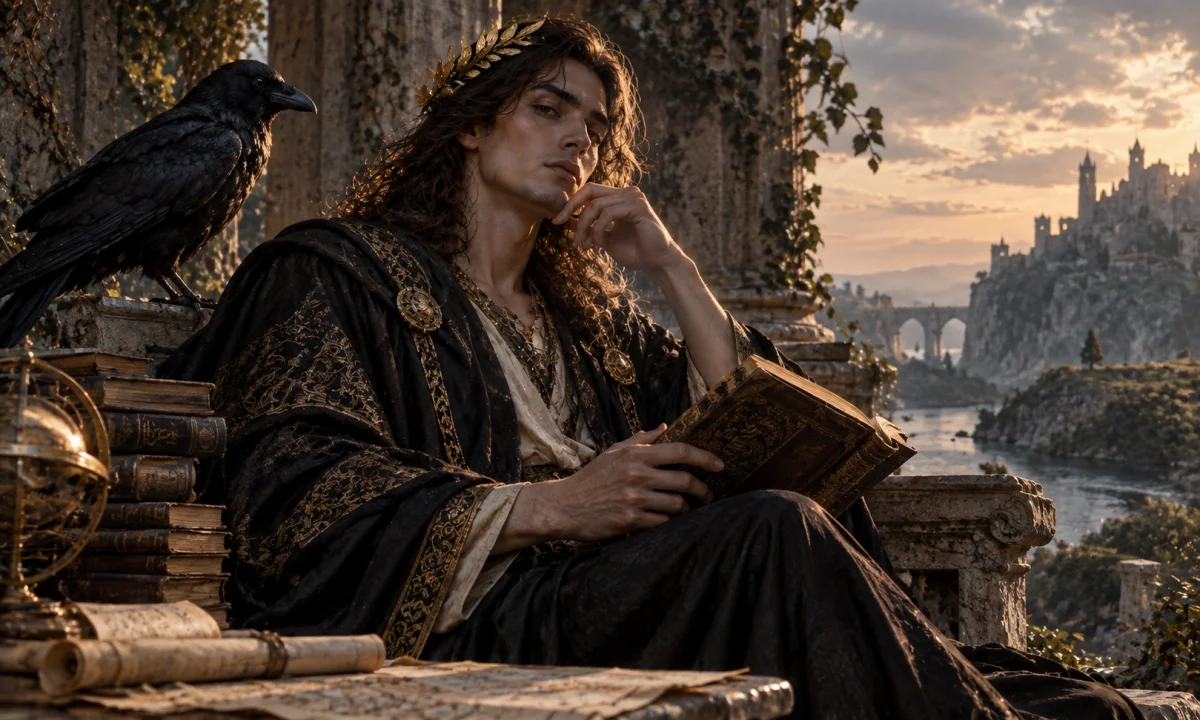
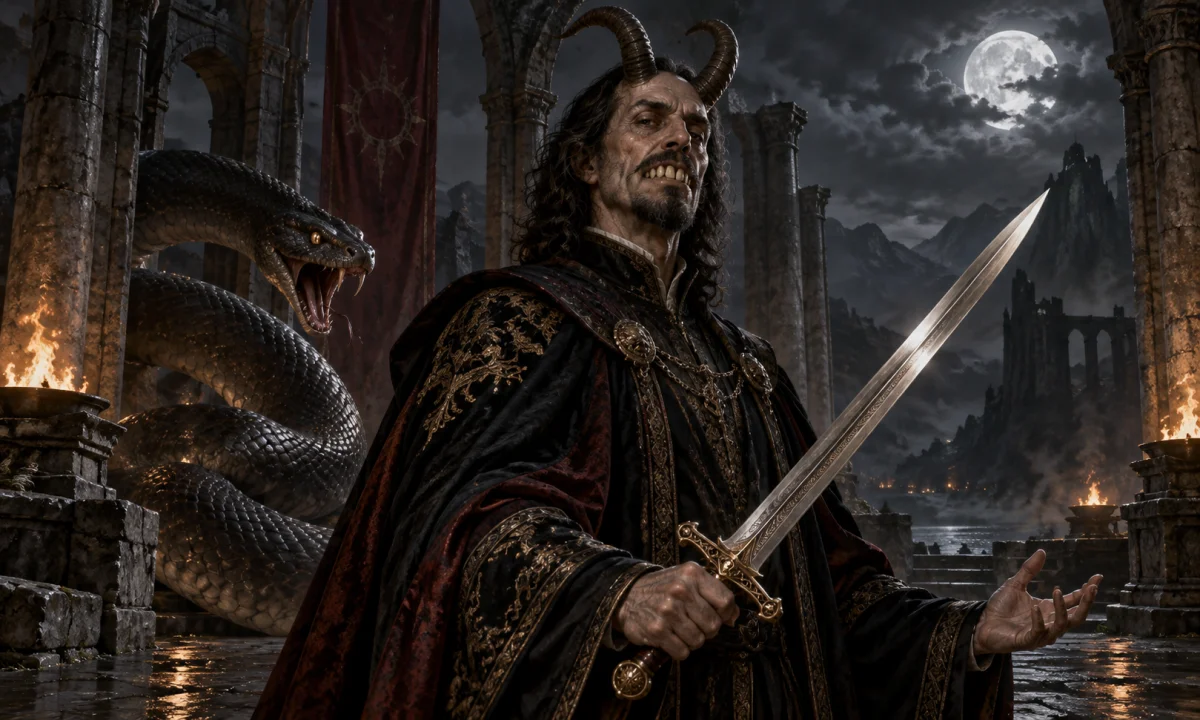
Dantalion is a demon listed in the Ars Goetia, the first section of the early modern grimoire known as the Lesser Key of Solomon. He is described as a powerful duke who appears with many human faces and carries a book. Within the catalogue’s Christian demonological framework, Dantalion is associated with knowledge, hidden thoughts, persuasion, emotional influence and the revelation of secret counsel. He belongs to the literary tradition of European ceremonial magic rather than to a clearly documented ancient mythology or an independent popular folklore tradition.
Origins in European demonology
The best-known account of Dantalion comes from the Ars Goetia, a text preserved in manuscripts and printed editions associated with the Lesser Key of Solomon. The work took shape in the early modern period, although many of its names, descriptions and classifications draw on older traditions of Christian demonology, magical books and lists of spirits. The Ars Goetia presents seventy-two spirits, each assigned a rank, a number of subordinate legions and particular abilities.
Dantalion appears near the end of that sequence as the seventy-first spirit. He is given the title of Great Duke and is said to command thirty-six legions of spirits. These military numbers belong to the catalogue’s system of infernal hierarchy. They should not be treated as evidence for a literal, historically documented organization of demons; rather, they reflect the structure and language of European magical literature, which often represented spirits as rulers, officers or nobles arranged in a court.
The description of Dantalion is also found, in related form, in Johann Weyer’s Pseudomonarchia Daemonum, a sixteenth-century work that catalogued demons within a Christian critique of magic. The wording and ordering vary between versions, as they do throughout the transmission of goetic texts. The Ars Goetia is not a single ancient document preserved unchanged from antiquity. It is part of a manuscript and print tradition in which material was copied, rearranged, edited and sometimes altered.
Name and identity
The name is commonly spelled Dantalion, but Dantalian and other minor variants can be found in occult editions and later writings. No universally accepted ancient etymology explains the name. It has sometimes been compared with names from other demonological catalogues, but such comparisons do not establish that Dantalion originated as a deity or spirit in an earlier, separate religion.
Dantalion should therefore be understood primarily as a figure of early modern Christian demonology and ceremonial magic. The catalogue gives him a distinct identity, rank and set of powers, but it does not provide a substantial narrative mythology. Unlike figures such as Lucifer, Asmodeus or Beelzebub, Dantalion has no extensive body of biblical, theological or folkloric stories attached to him. His character is defined mainly by a compact entry in a magical catalogue.
The use of the title “duke” reflects the political and social vocabulary of the period in which these texts circulated. Demonological writers frequently organized spirits according to ranks familiar from earthly courts and military institutions. These titles were not necessarily intended to describe a consistent theology shared by all Christian authorities. Different grimoires use different hierarchies, names and offices.
Appearance and many faces
Dantalion is said to appear in the form of a man with many countenances, including the faces of men and women. He is also described as holding a book in his right hand. This is the central visual image associated with him in the goetic tradition.
The text does not give a detailed physical description of every face or explain how the faces are arranged. Later artists and occult writers have consequently interpreted the image in different ways. Dantalion may be shown with a cluster of faces, a head covered in distinct human visages or a single figure whose features continually change. These artistic forms are interpretations rather than fixed details established by the original catalogue.
The many faces can be read symbolically as an image of human variety, shifting identity and psychological multiplicity. In the context of the text itself, however, the feature has a more practical function: it marks Dantalion as a spirit connected with the minds, appearances and inner lives of people. The faces also suggest that he can represent or reveal different individuals.
The book in his hand links him with learning, instruction and concealed knowledge. It is not identified by a title, and the text does not state that it is a biblical book, a grimoire or a record of souls. Images that give the book a particular name or supernatural content belong to later artistic and occult elaboration.
Attributed powers
The Ars Goetia attributes several related abilities to Dantalion:
- He teaches all arts and sciences.
- He can declare secret counsel.
- He knows the thoughts of other people.
- He can change or influence thoughts.
- He can cause love.
- He can show the likeness of any person.
These powers place Dantalion at the intersection of knowledge, perception and influence. He is not described mainly as a destroyer, tempter or guardian of treasure. His sphere is more concerned with what people know, think, feel and reveal. The text’s wording suggests both an ability to disclose hidden information and an ability to interfere with the mental or emotional states of others.
The phrase “all arts and sciences” should be read in its historical context. In early modern occult literature, “arts” and “sciences” could refer broadly to learned disciplines, practical skills and systems of knowledge. It does not necessarily mean that Dantalion represents modern scientific research or possesses a specific body of technical expertise. The claim is part of a conventional catalogue style in which a spirit is assigned a broad domain of mastery.
His power to know and alter thoughts gives him a particularly psychological character. The description does not present a theory of mind in the modern scientific sense. Instead, it reflects a world in which spirits were imagined as capable of perceiving hidden intentions, disclosing private counsel and producing changes in affection or judgment. The ability to “cause love” similarly belongs to the magical vocabulary of influence and attraction, not to a distinct ancient love cult centred on Dantalion.
The significance of the book
The book carried by Dantalion reinforces his association with learning and secret knowledge. In European religious and magical symbolism, books could represent divine revelation, forbidden wisdom, legal authority, memory or occult instruction. The catalogue does not explain which of these meanings is intended, and the image should not be assigned a single definitive interpretation.
Within the Ars Goetia, the book also helps distinguish Dantalion from spirits whose powers are framed primarily in terms of warfare, wealth, healing or prophecy. He is presented as a learned and intellectually oriented figure. His knowledge is nevertheless morally ambiguous in the text’s Christian setting: the ability to obtain hidden counsel or alter another person’s thoughts can be used for benevolent, manipulative or coercive purposes.
This ambiguity is typical of goetic catalogues. They list abilities rather than offering sustained ethical discussions of how those abilities should be understood. The surrounding religious culture generally treated the invocation of demons as illicit, dangerous or spiritually corrupting, even when magical texts described the spirits as useful sources of knowledge or assistance.
Dantalion in the context of Christian demonology
Christian demonology developed through the classification and interpretation of spirits believed to oppose God, tempt human beings or operate within a fallen supernatural order. Its writers drew on biblical passages, late antique and medieval theology, legends about spirits, magical traditions and learned speculation. The resulting catalogues were not uniform. A name could appear in one text but not another, and a spirit’s rank or powers could change across versions.
Dantalion is a good example of a figure whose identity is primarily textual. There is no strong evidence that he was worshipped as a pre-Christian god under this name, nor that he originated in a well-documented local folklore tradition. Assertions that connect him directly to an ancient pantheon, a particular historical cult or a specific non-European deity require evidence that the surviving goetic texts themselves do not provide.
The designation “demon” also needs historical care. In modern speech, the word can mean any supernatural monster or malicious spirit. In Christian theological contexts, it has more specific implications and may refer to a spirit understood as hostile to God or associated with demonic powers. The Ars Goetia uses a hierarchical and operational vocabulary, but its classifications do not represent a universally accepted Christian doctrine.
Stories and relationships
Dantalion has no major narrative cycle in which he takes part in a sequence of adventures, conflicts or family relationships. The surviving goetic entry is essentially descriptive. It names his rank, number of legions, appearance and powers, but it does not tell a story about his origin, deeds or relationship to Satan, Lucifer or other famous demons.
For this reason, claims that Dantalion is a son, servant, rival or close associate of another demon should be treated cautiously. Some later occult systems may place him within expanded infernal genealogies or assign him additional titles, but these arrangements are not consistently present in the older catalogue tradition. The original entry does not provide a detailed biography or a stable network of relationships.
Similarly, Dantalion should not be confused with every figure whose name resembles his. Similar spellings in later books may result from copying, transliteration or editorial preference rather than from separate historical identities. A later author may also use the name in a new symbolic system without preserving the exact classification found in the Ars Goetia.
Interpretation and cultural significance
Dantalion’s most distinctive theme is the unstable boundary between knowledge and control. To know another person’s thoughts can appear as a form of insight, but the power to change those thoughts introduces the possibility of manipulation. To cause love can be imagined as emotional healing or connection, yet it can also imply the removal of another person’s freedom. The catalogue therefore presents intellectual and emotional influence as powers with serious moral consequences.
The many faces deepen this theme. They can suggest empathy with many kinds of people, but they can also evoke disguise, impersonation and the loss of a single stable identity. Dantalion’s ability to show the likeness of any person connects the visual motif with questions of representation: whether an image reveals someone, imitates them or replaces them.
From a historical perspective, the figure reflects early modern interest in hidden knowledge, private counsel and the classification of supernatural forces. Magical catalogues often transformed abstract concerns—knowledge, desire, secrecy and persuasion—into named spirits with recognizable offices. Dantalion’s entry gives a supernatural personality to forms of influence that are difficult to observe directly but powerful in human relationships.
Modern readers may also approach Dantalion psychologically, treating the many faces as a metaphor for different identities, perspectives or mental states. Such readings can be meaningful as modern interpretations, but they should not be presented as the original meaning of the goetic text. The historical source gives an occult description within a demonological system; psychological symbolism is a later interpretive framework.
Later occult and popular reception
Since the nineteenth century, occult publishers and practitioners have reprinted, reorganized and reinterpreted the spirits of the Ars Goetia. Dantalion has consequently appeared in systems that emphasize meditation, symbolism, personal transformation or ritual practice rather than the specifically Christian condemnation of demonic conjuration. These later approaches vary considerably and should not be assumed to preserve a single continuous tradition.
His striking appearance has also made him suitable for modern visual media, including illustrations, games, novels, music and online occult fiction. In popular culture he may be portrayed as a shapeshifter, a master of forbidden knowledge, a manipulator of memories or a powerful romantic spirit. Such traits may be inspired by the traditional entry, especially its references to faces, thoughts and love, but they are expansions rather than details established by the historical source.
Dantalion is therefore best identified as a late-ranking duke of the goetic demon catalogue: a many-faced, book-bearing spirit associated with learning, secret counsel, mental influence, love and likeness. His importance lies less in an extensive ancient mythology than in the compact but suggestive combination of powers preserved in early modern demonological literature.