WORLD
WORLD
Botis
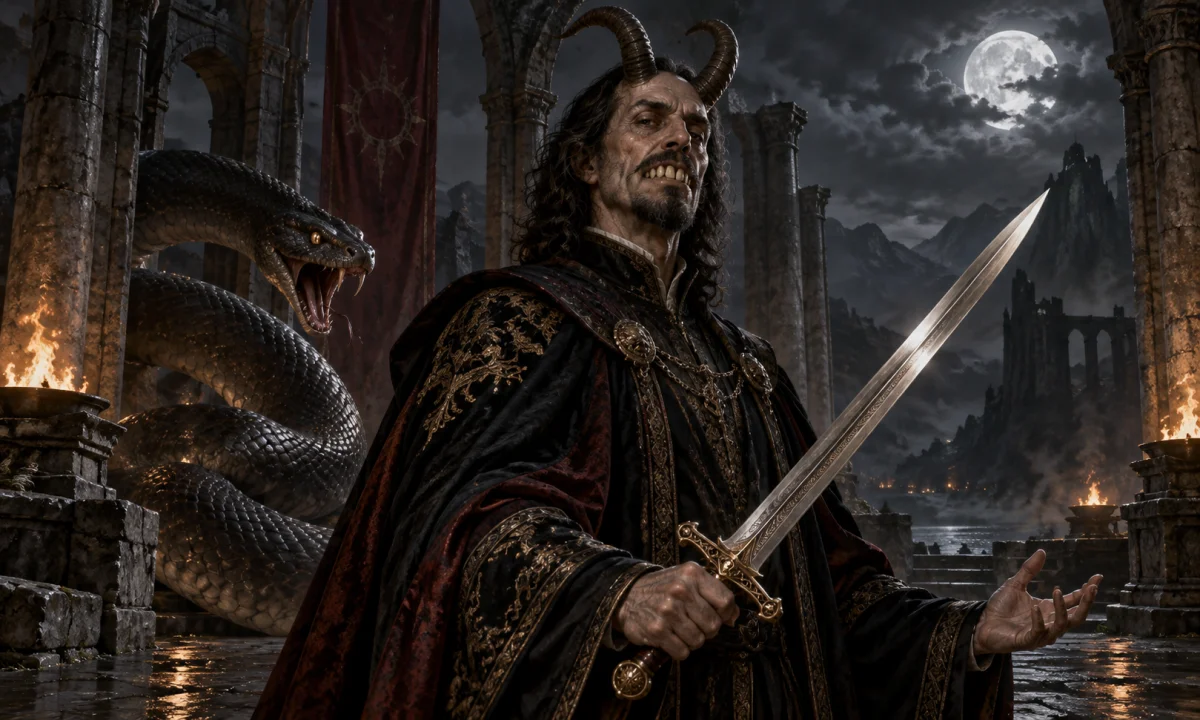
Botis is a demon described in the early modern European grimoire tradition, especially in the catalogue of spirits known as the Ars Goetia. He is listed as the seventeenth spirit and is given the titles of both a President and an Earl. His most distinctive form is that of an ugly viper, although he can appear as a horned human figure carrying a sword. In the hierarchy of ceremonial magic, Botis is associated with truthful knowledge of past and future events and with the reconciliation of enemies.
Botis in the grimoire tradition
Botis belongs to the group of spirits catalogued in the Ars Goetia, the first section of the Lemegeton, or Key of Solomon the Lesser. These works are part of the European ritual-magic and demonological literature that took shape through the medieval and early modern periods. They present lists of spirits, their ranks, appearances, powers, numbers of subordinate spirits, and the seals or signs associated with them.
The Ars Goetia is not a sacred scripture of a single ancient religion. It is a manual of ceremonial magic that draws on several strands of earlier material, including Christian demonology, magical traditions, astrological ideas, and older catalogues of spirits. Its system of kings, dukes, princes, marquises, presidents, and earls reflects a magical reworking of European courtly and political structures. Botis’s title therefore belongs to the administrative language of the grimoire rather than to a known ancient religious pantheon.
Descriptions of Botis also appear in closely related demonological catalogues, including material associated with Johann Weyer’s Pseudomonarchia Daemonum. The wording and ordering can vary between manuscripts, editions, and translations. For that reason, details presented in one version should not automatically be treated as features shared by every account of Botis.
Name and identity
The name is usually written Botis, but variant spellings occur in the manuscript and printed traditions. Forms such as Botis and Botis with minor orthographic differences reflect the unstable spelling practices of early modern texts and later translators. A secure ancient meaning for the name has not been established.
There is no reliable evidence that Botis was a demon worshipped under this name in the religions of ancient Mesopotamia, Egypt, Greece, or Rome. Nor is he a named figure in the Bible. His identifiable historical setting is the learned grimoire tradition of Christian Europe, where demonological lists classified spirits according to their supposed offices and magical functions.
Botis should therefore be distinguished from figures whose names or imagery may sound similar. A serpent appearance does not make him an ancient serpent deity, a dragon, or a specific biblical tempter. Likewise, his title as an earl does not indicate a historical nobleman or a spirit from documented medieval folklore. The surviving descriptions define him primarily as a grimoire spirit.
Appearance
Botis is first described as appearing in the form of an ugly viper. The viper is not merely a decorative detail: it establishes his initial identity as a dangerous and nonhuman spirit. In European Christian symbolism, serpents could suggest treachery, hidden knowledge, temptation, danger, or the power of evil. The grimoire description does not, however, provide a developed myth explaining why Botis takes this form.
When Botis assumes a human shape, the description becomes markedly more elaborate. He is said to display large or prominent teeth and to have two horns on his head. He also carries a sharp sword. This hybrid image combines a human figure with unmistakable signs of monstrosity. The teeth preserve something of the viper’s threatening character, while the horns and weapon place him within the visual language commonly used by European demonology to represent dangerous spirits.
The texts do not provide a consistent portrait in the modern artistic sense. They do not specify his clothing, skin colour, age, voice, precise bodily proportions, or surroundings. Many detailed illustrations found in later occult books, websites, games, and artworks are interpretations rather than features recorded in the earliest descriptions.
Titles and place in the hierarchy
Botis is called both a President and an Earl. These titles are unusual because most spirits in the catalogue are assigned one principal rank, although the hierarchy is not perfectly consistent. A president appears to occupy an important governing position, while an earl belongs to a noble or aristocratic order. The combination may represent the accumulation of descriptions from different catalogues or a later attempt to preserve variant traditions within one entry.
In the usual ordering of the Ars Goetia, Botis governs sixty legions. A legion is a numerical unit used by the grimoire to describe the spirits supposedly under the command of a higher-ranking demon. These numbers are part of the catalogue’s internal structure. They should not be treated as historical evidence for an actual supernatural army or as a feature independently confirmed by religious tradition.
Botis’s rank gives him a place in the ceremonial system, but it does not establish a genealogy. The available descriptions do not identify his parents, consort, children, former angelic status, or alliances with other demons. Later writers sometimes arrange the spirits into elaborate infernal bureaucracies, but such expansions should be kept separate from the brief statements found in the older catalogues.
Powers and functions
The principal abilities attributed to Botis are forms of knowledge and mediation. He is said to answer truthfully about things past and things to come. This makes him a spirit of divination or occult disclosure. The wording does not explain whether his knowledge is supposed to be complete, symbolic, conditional, or dependent on the ritualist’s questions. It simply assigns him the function of revealing information across time.
Botis is also said to reconcile friends and foes. This places him among spirits associated with communication, negotiation, and the repair of hostile relationships. The phrase may be understood as a claim that he can restore friendship between people who have quarrelled, or persuade enemies to make peace. It does not mean that Botis is portrayed as benevolent. In the demonological framework of the grimoires, a spirit may possess a useful or socially desirable power while still being classified as a demon.
The combination of prophecy and reconciliation gives Botis a somewhat different profile from spirits whose descriptions focus on wealth, sexual attraction, disease, violence, treasure, or military success. His functions concern hidden knowledge and human relationships. Even so, the entry is very short, and it does not contain stories demonstrating these powers or explaining their limits.
Important stories and relationships
Botis has no substantial surviving cycle of myths comparable to the stories of figures such as Lucifer, Lilith, or the demons of biblical and late antique literature. The grimoire entry is essentially a catalogue notice rather than a narrative. It describes his form, rank, abilities, and number of legions, but it does not recount a creation story, a fall from heaven, a conflict with a named saint, or a famous encounter with a human magician.
He is not consistently linked to a particular demonological family. Although the catalogue places him among many other spirits, neighbouring entries do not establish a personal relationship with him. Similarities between Botis and other serpent-shaped or horned spirits are best treated as shared imagery rather than proof of common identity.
The absence of narrative is significant. A modern fictional treatment may give Botis a detailed personality, origin, motivation, or network of alliances, but those elements are not supplied by the core grimoire description. The traditional record is narrow and formal: Botis is a high-ranking spirit with a viper form, a horned human form, a sword, prophetic abilities, and a role in reconciliation.
Religious and cultural context
Early modern Christian demonology commonly treated magical spirits as demons, even when their reported powers involved knowledge, healing, protection, or reconciliation. This classification reflected a theological concern about the source of supernatural power. From that perspective, seeking information or assistance from a spirit through ritual could be condemned as illicit magic, regardless of whether the requested result appeared harmless.
The grimoires should also be read as products of learned culture rather than as straightforward records of popular belief. Their authors and copyists drew on Latin books, biblical terminology, angelic and demonic names, astrological correspondences, and ritual practices. Some material may have circulated among clerics, scholars, physicians, magicians, or collectors of occult manuscripts. The exact authorship and development of the texts are complex, and no single person can be treated as the undisputed creator of the entire system.
Botis’s mixed form reflects this environment. The viper connects him with the long-standing European association between serpents and danger or forbidden knowledge. His horns and sword belong to the visual vocabulary of demonized spirits and supernatural rulers. His aristocratic title reflects the tendency to organize invisible beings according to human institutions. These features reveal how the grimoire tradition classified and imagined spirits, but they do not prove that Botis originated in a much older serpent cult.
Botis and similar figures
Botis is sometimes confused with other goetic spirits because many entries share common elements: animal forms, human transformations, weapons, horns, noble titles, and powers involving knowledge. The similarities are real, but they do not erase the distinctions between the individual entries.
- Botis and Buer: Buer is another spirit in the Ars Goetia, but he has a different name, rank, appearance, and set of attributed abilities. Buer is especially associated in the grimoire tradition with philosophy, logic, herbs, and healing, whereas Botis is linked with prophecy and reconciliation.
- Botis and Bathin: Bathin is also represented in a form combining human and animal features, but his traditional description and powers differ. Bathin is associated with transporting people or objects and with knowledge of herbs and precious stones, not specifically with reconciling enemies.
- Botis and biblical serpents: Botis is not identical with the serpent of Eden, Leviathan, or any single serpent mentioned in biblical literature. The shared serpent imagery reflects broad symbolic associations rather than a documented identity.
- Botis and horned deities: The horns in his human form do not make him a version of Pan, Cernunnos, or another horned deity. Those figures belong to different religious and cultural traditions, and the grimoires do not identify Botis with them.
Interpretation and symbolism
Botis can be interpreted as a figure built around the tension between threatening appearance and useful function. His viper form, teeth, horns, and sword present him as dangerous, yet his named powers involve truthful information and the ending of conflict. This contrast is common in demonological literature, where spirits may be morally suspect while still being assigned precise services.
The sword may symbolize authority, enforcement, or the ability to cut through disputes, although the texts do not explicitly explain its meaning. In the context of reconciliation, it can be read as an image of power used to compel or establish agreement rather than as evidence that Botis is chiefly a warrior. Such interpretations are scholarly or symbolic readings, not additional facts recorded in the grimoire.
The combination of past and future knowledge also reflects a recurring human desire to overcome uncertainty. A spirit who can reveal what has happened and what may happen occupies a powerful position in a magical system. Yet the grimoires offer no independent method for verifying the truth of the information attributed to Botis. His supposed reliability is part of the traditional claim made about him, not a historically demonstrated ability.
Later reception
Botis remains known primarily through occult reference works, discussions of ceremonial magic, and modern catalogues of the Ars Goetia. Artists and writers often emphasize his serpent body, horned human appearance, teeth, and sword because these features create a strong visual design. Some modern depictions make him more monstrous, regal, or physically elaborate than the brief traditional entry warrants.
He may also appear in contemporary fantasy, role-playing games, novels, music, digital art, and other forms of popular culture. In these settings, Botis can be transformed into a villain, a summonable entity, a prophetic adviser, or a guardian of forbidden knowledge. Such portrayals belong to modern fiction and should not be confused with the limited description preserved in early modern demonological literature.
The most securely traditional image of Botis is therefore a grimoire spirit with two contrasting manifestations: an ugly viper and a horned, toothy human figure armed with a sharp sword. Within the catalogue’s hierarchy he is both President and Earl, commands sixty legions, reveals information about the past and future, and is said to reconcile those who are at odds.