WORLD
WORLD
Bathin
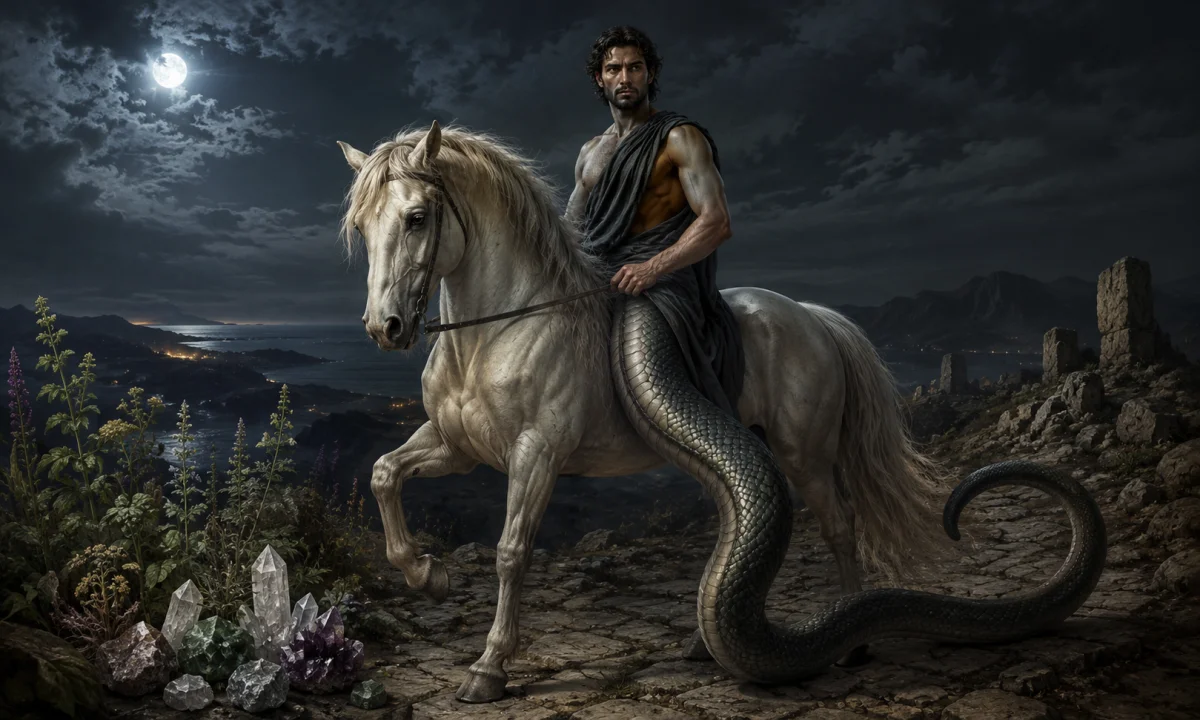
Bathin is a demon of early modern European grimoire tradition, best known from the Ars Goetia, the first part of the Lesser Key of Solomon. He is usually listed as the eighteenth spirit and classified as a Duke. His standard description combines a human body, a serpent’s tail and a pale horse. Bathin is also associated with knowledge of herbs and precious stones, and with the sudden transportation of people from one country to another.
Origins in grimoire tradition
Bathin does not belong to the demonology of the Bible, nor is he a prominent figure in ancient Jewish, Christian or Islamic religious tradition. His surviving profile comes from European magical literature, especially texts that catalog spirits believed to be summoned, questioned or commanded through ritual procedures. These works are generally associated with learned occultism rather than with a single continuous popular folklore tradition.
The most familiar account appears in the Ars Goetia, a seventeenth-century compilation transmitted in manuscripts and later printed editions. The Ars Goetia presents a hierarchy of spirits with titles, names, seals, numbers of subordinate spirits and descriptions of their appearances or abilities. Its material draws on earlier demonological and magical writings, including catalogues that circulated before the compilation of the Lesser Key of Solomon.
An earlier related description occurs under a variant form of Bathin’s name in Johann Weyer’s Pseudomonarchia Daemonum, a sixteenth-century demonological work. The wording and arrangement are not identical in every transmission, but the central features remain recognizable: a powerful duke with a serpent’s tail, riding a pale horse, possessing knowledge of herbs and precious stones, and transporting people between distant places. These similarities indicate that Bathin’s profile developed through the copying and adaptation of grimoire material rather than through a large body of independent myths.
Name and variant spellings
The name is commonly written Bathin, but early texts and later editions preserve several forms, including Bathym, Bathim, Mathim and Marthim. Spelling was not standardized in the manuscript culture from which these catalogues emerged. Names could be altered by scribal copying, translation, typesetting or editorial decisions, so variant spellings do not necessarily indicate separate demons.
The precise origin and meaning of the name are uncertain. Attempts to derive it from Hebrew, Arabic, Greek or other ancient languages have been proposed in occult and scholarly discussions, but no universally accepted etymology establishes Bathin as a survival of a particular ancient deity or spirit. The safest description is that Bathin is a name shaped by the transmission of European demonological texts.
Some writers use Bathin and Bathym interchangeably, while others preserve the spellings as they appear in particular editions. The form Bathin is now the most familiar in English-language occult reference works, largely because of its prominence in printed versions of the Ars Goetia.
Rank and classification
In the Ars Goetia, Bathin is described as a mighty Duke. This title belongs to the hierarchical system used by the grimoire and should not be confused with a universally recognized religious classification. The catalogue assigns different spirits ranks such as kings, dukes, princes, marquises, presidents and earls, reflecting the political and military vocabulary of European society.
Bathin is said to command thirty legions of spirits. A legion in this setting is not a historical military unit or a count that can be independently verified. It is part of the numerical and administrative structure of the grimoire, in which spirits are imagined as belonging to organized supernatural forces. Different manuscripts and editions can vary in wording, seals and presentation, but the number thirty is the figure most commonly associated with Bathin.
His rank places him among the more powerful spirits in the catalogue, yet the text gives him no extensive biography. Bathin is not presented as the ruler of a named kingdom, the parent of other demons or the protagonist of a narrative episode. His identity is defined primarily by his title, appearance and attributed abilities.
Appearance
Bathin’s traditional appearance is unusually specific. He is described as a strong or powerful man with a serpent’s tail, seated upon a pale-coloured horse. The combination of human, serpentine and equine features gives him a composite form typical of grimoire demonology, where spirits often appear as hybrids rather than as beings with a single stable animal shape.
The description does not provide a detailed account of his face, clothing, weapons or surroundings. Later illustrations frequently add these elements, but such additions belong to artistic interpretation rather than to the concise verbal profile of the early catalogues. Images may portray Bathin as a horned warrior, a skeletal rider, a richly dressed nobleman or a heavily armoured demon. These visual choices should not be treated as fixed features of the original tradition.
The pale horse is especially important because it is one of Bathin’s distinguishing attributes. It should not automatically be identified with the pale horse of the Book of Revelation. Both belong to different textual contexts, and the grimoire description does not establish that Bathin is the biblical horseman or that the two figures are related. The shared colour and equine imagery can encourage modern comparisons, but they do not amount to an established identity.
Abilities and associations
Knowledge of herbs and precious stones
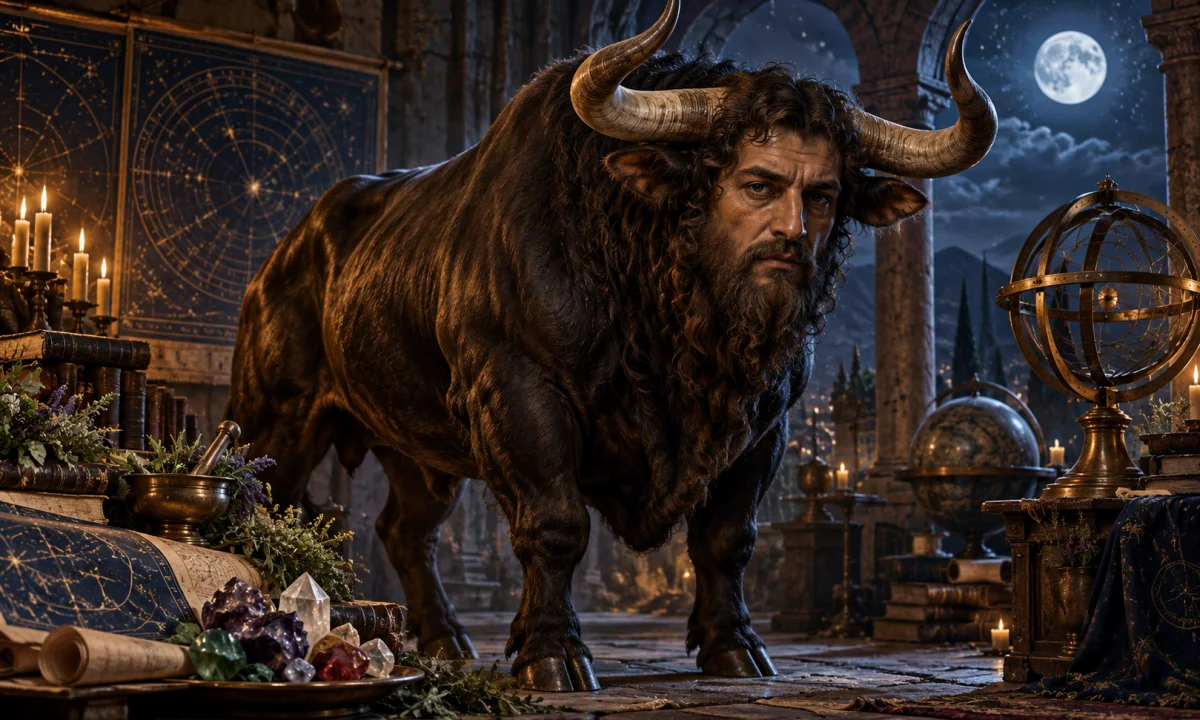
Bathin is credited with knowing the virtues of herbs and precious stones. In the language of early modern occultism, “virtues” refers to the supposed powers, qualities or effects attributed to natural substances. Such beliefs formed part of the period’s broader traditions of natural magic, astrology, medicine and lapidary lore.
This association does not make Bathin a healing god or a patron of herbalism in an established religious sense. The grimoire simply assigns him specialized knowledge. His connection with plants and stones reflects a world in which natural objects were often believed to possess hidden correspondences and spiritual influences. Herbs could be associated with planetary powers, bodily treatments or ritual uses, while gemstones might be linked with protection, health, status or astrological forces.
Modern descriptions sometimes expand this brief association into a complete system of occult medicine or crystal magic attributed to Bathin. Those elaborations are later interpretations. The older catalogue does not provide a detailed list of plants, minerals or specific remedies connected with him.
Transportation between countries
Bathin’s other major ability is the power to transport people suddenly from one country to another. This is one of the clearest and most distinctive features of his profile. It links him with rapid movement, distant travel and the crossing of geographical boundaries.
The text does not explain whether this movement occurs through flight, teleportation, magical roads, spirit transport or some other mechanism. Modern readers often describe the power as teleportation, but that term belongs to later vocabulary. In its original context, the claim functions as a concise statement of supernatural mobility rather than as a developed account of how the power operates.
Bathin’s travelling ability also complements his horse imagery. The horse is a conventional symbol of speed, journeying and movement, while the serpent’s form can suggest an ability to cross boundaries between different realms. These symbolic interpretations are plausible readings, but the grimoire itself does not explain what the hybrid body means.
Stories and relationships
Bathin has no substantial cycle of myths comparable to the stories of figures such as Lucifer, Beelzebub, Lilith or the fallen angels. The Ars Goetia gives him a catalogue entry rather than a narrative. It does not recount his origin, a rebellion against heaven, a conflict with a named saint or a relationship with another demon.
There is also no firmly established consort, family, rival or master associated with Bathin in the principal descriptions. Because demonological catalogues often place spirits within a hierarchy, later occult writers may interpret Bathin as a subordinate of a higher infernal ruler. Such arrangements depend on the particular system being used and should not be presented as part of a universally consistent mythology.
His entry includes a magical seal, as do many of the spirits in the Ars Goetia. The seal is a ritual sign intended, within the grimoire’s system, to identify or constrain the spirit during ceremonial operations. Designs can vary between manuscripts, printed editions and modern reproductions. The seal is therefore part of the history of Solomonic magic, not evidence of an ancient emblem preserved unchanged from antiquity.
Religious and cultural context
Bathin belongs to the tradition commonly called Solomonic magic, a body of ceremonial literature attributed pseudonymously to King Solomon. The attribution is legendary rather than historical. There is no reliable evidence that the historical Solomon wrote the Ars Goetia or personally commanded the spirits listed in it.
Solomonic texts emerged through a complex mixture of Christian demonology, Jewish and Arabic magical traditions, medieval spirit catalogues, astrology, ritual prayer and Renaissance occult philosophy. Their authors and readers often understood the spirits through a Christian framework in which demons were dangerous entities that could nevertheless be compelled by divine names, angelic authority and properly performed rituals.
This setting differs from a simple “pantheon” of demons. Bathin was not worshipped as a major deity by a known ancient culture, and the catalogue does not describe an ordinary devotional cult dedicated to him. His role is functional and ritual: he is a named spirit with a rank, a seal and particular powers within a system of ceremonial invocation.
It is also important to distinguish historical belief from modern classification. A contemporary reference may call Bathin a “demon of travel,” a “demon of herbs” or a “spirit of transformation.” These labels can be useful summaries of his assigned powers, but they are interpretive descriptions, not titles preserved in a distinct ancient religion.
Interpretation and symbolism
Bathin’s attributes can be read as a set of connected themes. His horse represents speed and passage; his ability to move people between countries suggests mastery over distance; and his knowledge of herbs and stones places him among spirits associated with hidden properties of the natural world. The serpent’s tail adds an image of otherness and transformation.
These interpretations remain tentative because the source offers no symbolic commentary. Early modern grimoires often list appearances and powers without explaining why a spirit has a particular form. A serpent may evoke danger, wisdom, deceit or renewal depending on the reader’s cultural framework. A pale horse may suggest strangeness, death, travel or simply a memorable visual marker. None of these meanings can be assigned to Bathin with complete certainty.
Bathin can also be understood as an example of how occult catalogues organize knowledge. His entry joins botany, mineral lore, geography and ritual hierarchy in a single supernatural persona. Rather than embodying one clearly defined moral vice, he represents a cluster of specialized capabilities. This makes him different from demonological figures whose primary identity is based on temptation, punishment or opposition to a particular virtue.
Distinction from similar figures
Bathin should not be confused with Batin, a term that can have unrelated meanings in other linguistic, religious or esoteric contexts. Similar spelling alone does not demonstrate that these names refer to the same being. Nor should Bathin be automatically equated with any serpent deity, horse spirit or underworld figure from ancient mythology.
He is also distinct from the biblical horsemen, including the rider associated with a pale horse in Revelation. Bathin’s pale horse is an attribute in a later European grimoire catalogue, whereas the biblical imagery belongs to an apocalyptic vision with a different narrative and theological setting.
Bathin is not the same as a generic incubus, succubus, familiar spirit or folkloric shapeshifter. Those categories describe broader types of supernatural being, while Bathin is a named spirit within a particular demonological hierarchy. He may share hybrid or magical features with other beings, but the name and catalogue entry give him a distinct textual identity.
Later reception
Bathin became more widely known through nineteenth-century demonological dictionaries, occult publications and later editions of the Ars Goetia. These works helped standardize certain spellings, images and summaries, while also encouraging artists and writers to expand the brief catalogue description into a more dramatic character.
In modern occult practice, Bathin may be approached as a spirit connected with travel, rapid change, herbal knowledge, minerals or crossing boundaries. Such practices represent contemporary reinterpretations of the grimoire material. They should be distinguished from documented historical worship and from the limited claims made by the early texts themselves.
Bathin occasionally appears in fantasy fiction, games, comics and other popular media, where he may be portrayed as a warrior, mounted demon, traveller or keeper of occult knowledge. These adaptations often alter his appearance, personality and powers for narrative purposes. A fictional version may therefore bear only a loose relationship to the Bathin described in early modern demonology.