WORLD
WORLD
Belphegor
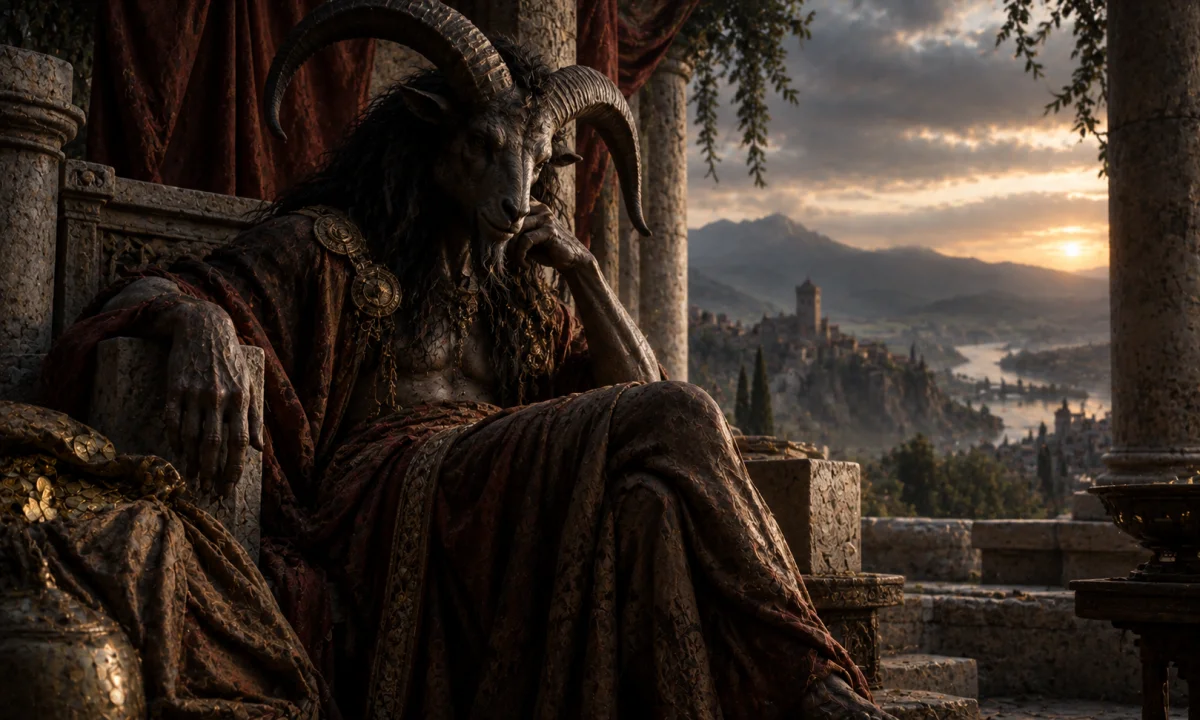
Belphegor is a demon of Christian demonology whose name ultimately derives from Baal-Peor, a deity or cult title mentioned in the Hebrew Bible. The figure known in later European demonology is not simply identical with the ancient god. Instead, Belphegor developed through a long process in which a biblical rival deity was reinterpreted in Jewish and Christian religious writing, medieval speculation, early modern demonological catalogues and later popular culture.
Origins in Baal-Peor
The earliest background to Belphegor appears in the biblical traditions concerning Baal-Peor. The name is usually understood as “Baal of Peor,” although the precise meaning and geographical reference of “Peor” remain uncertain. Baal was a Northwest Semitic title meaning “lord” or “master,” and it could be applied to more than one local deity. It was not necessarily the personal name of a single universal god.
In the Book of Numbers, the Israelites are described as becoming involved with the worship of Baal-Peor while encamped near Moab. The account presents this as a serious act of apostasy: some Israelites participate in sacrifices and religious feasting associated with the foreign cult and incur divine punishment. Related references occur in Deuteronomy, the Book of Joshua, Hosea and the Psalms. These passages portray Baal-Peor as a forbidden foreign power rather than as a demon with the detailed personality later assigned to Belphegor.
The biblical narrative does not describe Baal-Peor with horns, wings, a fixed physical form or a specific supernatural office. It also does not call the figure Belphegor in the form familiar from later European demonology. The connection was made through the Latin form of the name and through the Christian tendency to classify gods opposed to Israel’s God as demons or demonic idols.
The name and its spelling
Belphegor is one of several spellings used in European languages. Beelphegor reflects the Latin form found in the Vulgate Bible, while Belphégor, Belfegor and Belfagor appear in French, Italian and other traditions. The spelling Baal-Peor is generally preferred when referring to the biblical deity or cult rather than to the later demon.
The relationship between Baal-Peor and Belphegor is therefore historical and interpretive, not a simple record of one unchanged being. The later name was shaped by transliteration, pronunciation and Christian demonological usage. In some accounts, Belphegor is treated as the same being as Baal-Peor; in others, the ancient deity is merely regarded as the origin or earlier identity of a demon.
The meaning of the second element, “Peor,” is disputed. It may refer to a place, a mountain or a local cultic designation. Some ancient and later interpreters associated it with ideas of opening or exposure, but these explanations are not equally accepted by modern scholars. The uncertain etymology is important because many later stories about Belphegor’s bodily functions and appearance were built around interpretations that may be polemical rather than historical.
Jewish and Christian interpretations
Rabbinic discussions gave Baal-Peor a particularly degrading reputation. A passage in the Babylonian Talmud describes the worship of Peor in connection with acts of defecation before the idol. This tradition may preserve or reinterpret a hostile Jewish explanation of the cult’s name or ritual. It should not be confused with the biblical account, which mentions participation in sacrifices and sexual relations with Moabite women but does not describe the specific act found in the rabbinic discussion.
For Christian writers, the ancient god of Peor became part of a wider pattern. Pagan gods were frequently reclassified as demons, especially when biblical texts presented their worship as spiritually dangerous. Over time, the name passed from a reference to an ancient cult into demonological lists that attempted to organize the inhabitants of Hell according to ranks, powers and moral vices.
There was no single universally accepted Christian doctrine about Belphegor. Demonological handbooks, sermons, encyclopaedias and works of religious polemic often disagreed about his rank and attributes. Some placed him among the great princes or dukes of Hell; others treated him as a more narrowly defined spirit. These systems were products of particular authors and periods, not a consistent teaching shared by all Christian churches.
Belphegor in early modern demonology
Belphegor became more recognizable as an individual demon in late medieval and early modern European writing. Demonological catalogues attributed to him powers involving invention, discovery, wealth and temptation. In several versions, he offers ingenious devices or useful discoveries to human beings, but his gifts are morally dangerous or ultimately deceptive.
Some accounts describe him as taking the form of a beautiful woman. This motif belongs to the broader demonological idea that spirits can disguise themselves in attractive human forms in order to seduce, manipulate or corrupt people. It does not come from the biblical story of Baal-Peor. Other catalogues assign him a rank such as duke, but the number of spirits under his command and the details of his authority vary from one classification to another.
A particularly influential early modern interpretation connected Belphegor with sloth, one of the seven deadly sins. In the system associated with the German theologian Peter Binsfeld, each major demon was linked with a particular vice, and Belphegor was commonly assigned sloth. This association helped establish his later reputation as a demon of laziness, procrastination and the refusal to make productive use of one’s abilities.
That association should not be projected backward into the ancient biblical material. Nothing in the account of Baal-Peor identifies the deity with laziness. The link between Belphegor and sloth belongs to a later moral taxonomy in which demons personify patterns of sinful behavior. Even within demonological literature, the classification was not the only one available.
Appearance and characteristic imagery
Belphegor has no single traditional appearance. Early references to Baal-Peor provide no reliable portrait, and demonological writers differed in how they imagined the later figure. He may appear as a handsome human being, a monstrous spirit or a figure combining human and animal features. In modern illustrations, he is often given horns, claws, a tail or other conventional signs of demonic identity, but these features are not a stable part of his oldest tradition.
The most distinctive later image shows Belphegor seated on a privy or associated with excrement. This imagery reflects the rabbinic account of the worship of Peor and the tendency of Christian polemic to represent rival religious practices as obscene. It was reinforced by later European demonological and folkloric representations. The toilet image is therefore best understood as a product of religious mockery, inherited interpretation and artistic convention rather than as a securely documented feature of an ancient cult statue.
Another recurring theme is the contrast between cleverness and idleness. Belphegor may inspire inventions while also representing the temptation to avoid meaningful labour. A person may possess intelligence, wealth or technical skill but use those advantages for vanity, comfort or corruption. In this moral reading, the demon’s gifts are not necessarily useless; their danger lies in the desires and habits they encourage.
Roles and powers in later lore
- Inventive knowledge: Belphegor is sometimes said to reveal inventions, practical devices or ingenious solutions.
- Material temptation: He can represent the promise of easy wealth, luxury and success without discipline or ethical responsibility.
- Seduction: Some demonological descriptions give him an attractive human form, especially that of a woman, to lure or deceive people.
- Sloth: In the moral hierarchy associated with the seven deadly sins, he personifies idleness, apathy and wasted potential.
- Degradation: Scatological imagery links him with the humiliating and impure aspects attributed to the worship of Peor in hostile religious accounts.
These attributes should be treated as layers of tradition rather than as a single biography. A catalogue that calls Belphegor a spirit of invention may have little interest in the toilet imagery, while a moral writer focusing on sloth may barely mention Baal-Peor. The figure’s identity is composite because it was assembled by different authors for different religious and literary purposes.
Belphegor in literature
One of the best-known literary treatments is Belfagor arcidiavolo, an early sixteenth-century Italian tale by Niccolò Machiavelli. In the story, the devils debate whether marriage causes more misery for men than Hell does. Belfagor is sent into the human world to investigate and takes a wife, but domestic conflict, financial pressure and social embarrassment drive him to abandon the experiment.
Machiavelli’s Belfagor is not a straightforward presentation of church doctrine or a transcription of ancient mythology. The tale uses a demon as a satirical observer of human society, particularly marriage, debt, reputation and self-deception. Its importance lies in showing how the name had entered European literary culture, where it could be used for comedy and social criticism as well as religious warning.
In later French and Italian writing, the name continued to appear in stories, dictionaries of demons and works of fantastical literature. The spelling often changed according to language, and the character could be presented as a devil, an archdevil, a tempter or a comic supernatural visitor. These literary figures should not automatically be treated as evidence for the beliefs of earlier religious communities.
Distinction from similar figures
Baal and Baal-Peor
Baal is a title used for several ancient Northwest Semitic deities and divine figures. Baal-Peor is a particular biblical designation associated with the region of Peor. Belphegor is the later demonological form of this name or its Latinized development. Treating every reference to Baal as a reference to Belphegor is historically inaccurate.
Beelzebub
Beelzebub is a different figure whose name is associated in the Hebrew Bible and the New Testament with a deity of Ekron and, later, with a powerful demon or ruler of demons. The similar sound of Beel- in Beelzebub and Beelphegor can cause confusion, but the names have separate biblical backgrounds. Later demonological systems sometimes place both among the chief spirits of Hell, yet that shared status does not make them the same being.
Belial
Belial began as a Hebrew term connected with worthlessness, wickedness or lawlessness before becoming a named demonic figure in later Jewish and Christian writings. Belial and Belphegor are distinct names with different origins. Their resemblance in English spelling is coincidental rather than evidence of a traditional relationship.
Cultural significance
Belphegor illustrates how religious identities can change when one tradition describes another tradition’s deity as a hostile power. The ancient figure behind Baal-Peor belonged to a particular biblical controversy about loyalty, worship and relations between Israel and neighboring peoples. The later demon embodied different concerns: sexual temptation, degrading impurity, material greed, deceptive innovation and the spiritual dangers of idleness.
His association with invention is especially revealing. Early modern writers could regard new knowledge as both admirable and suspicious when it promised power without moral improvement. Belphegor thus became a warning that cleverness and technical ability do not guarantee wisdom. In the tradition connecting him with sloth, the threat is not ignorance but the refusal to act, create or take responsibility.
Belphegor in modern popular culture
Modern fiction, games, comics and television often use Belphegor as a named demon because the character combines a recognizable religious pedigree with flexible supernatural themes. Contemporary versions may portray him as a lord of Hell, an embodiment of laziness, a seductive spirit or a monster associated with corruption. Such portrayals frequently borrow the name, the seven-sins association or the grotesque toilet imagery while inventing new personalities, powers and relationships.
These adaptations are part of modern fantasy rather than evidence of a unified ancient belief. The traditional material is better understood as a sequence of transformations: Baal-Peor in biblical polemic, Peor in rabbinic interpretation, Beelphegor in Christian demonology, Belphegor or Belfagor in early modern literature, and a versatile demonic character in contemporary entertainment.