WORLD

Bamapana
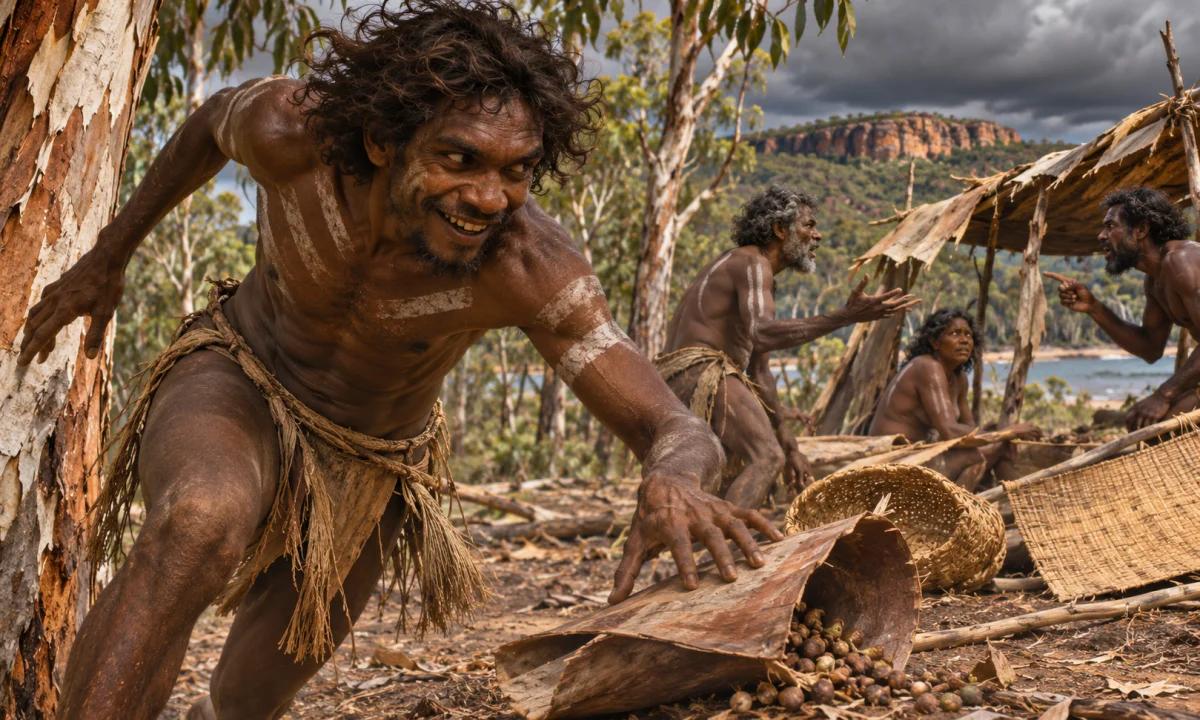
Bamapana is a figure associated with the traditional stories of Aboriginal peoples in northern Australia, especially the Yolngu cultural world of Arnhem Land in the Northern Territory. He is commonly described in English-language references as a disruptive or troublesome ancestral being, sometimes called a trickster. His actions are connected with quarrels, jealousy, sexual disorder and conflict between people. However, Bamapana should not be treated as a character from one single, universally fixed “Aboriginal mythology.” Aboriginal Australia contains many distinct cultural traditions, languages and systems of ancestral knowledge, and accounts of Bamapana vary according to the community, storyteller and source.
Cultural setting
Yolngu traditions come from northeastern Arnhem Land, a region whose Indigenous communities maintain numerous languages, clan identities, ceremonial practices and ancestral narratives. In Yolngu thought, ancestral beings are not simply fictional characters belonging to a distant mythological age. Their journeys and actions explain relationships between people, places, animals, plants, laws and ceremonies. The period often translated into English as the Dreaming is better understood as an enduring sacred order rather than merely a time that existed before history.
Stories about ancestral beings may therefore have several dimensions at once. They can explain why a landscape has a particular form, establish obligations between clans, preserve knowledge about marriage and kinship, or provide material for ceremony and teaching. A figure who behaves badly may embody more than personal wickedness. His conduct can illustrate the destructive consequences of breaking social rules, mishandling desire or creating division within a community.
English descriptions of Bamapana generally come from ethnographic records, studies of Yolngu culture and later reference works that condense oral traditions. Such records do not provide a complete or neutral transcript of the traditions from which they derive. Names may be written in different ways, and a short summary can remove the ceremonial, linguistic and local context that gives a story its full meaning. Knowledge of particular sacred narratives may also be restricted according to age, gender, kinship or ceremonial status.
Name and identity
The spelling Bamapana is the form most often encountered in general English-language discussions. Alternative spellings may occur when writers represent Yolngu sounds through different orthographies. A spelling variation does not necessarily indicate a different being, but similar-looking names should not automatically be assumed to refer to the same figure. The precise meaning and pronunciation of the name should be established through the relevant Yolngu language and community rather than guessed from English.
Bamapana is usually classified as a trickster-like ancestral figure or a malevolent troublemaker. These labels are useful shorthand, but they are not exact equivalents for an Aboriginal category. “Trickster” is a comparative term developed in the study of mythology. It can suggest a humorous, clever or boundary-crossing character, whereas accounts of Bamapana often emphasise the harmful effects of his behaviour: discord, suspicion and social disruption.
Nor should Bamapana be casually described as an “Aboriginal devil.” Aboriginal traditions do not share one universal equivalent of the Christian Devil, and the word can impose an inappropriate theological framework. Bamapana’s significance lies in his place within particular ancestral and social narratives, not in a general opposition between a single evil being and a universal God.
Character and role
In commonly circulated accounts, Bamapana is associated with conflict and disharmony. He is the kind of figure whose conduct unsettles relationships that should be governed by kinship obligations and customary law. Stories connected with him may involve jealousy, improper sexual behaviour, rivalry or deliberate provocation. The details are not consistent in every retelling, but his general narrative function is relatively clear: he introduces disorder into human or ancestral society.
This role gives Bamapana an important contrast with ancestral figures whose actions establish country, law and proper relationships. Rather than founding a stable order, he exposes what happens when people give way to selfish impulses or disregard obligations to others. A story about him can thus operate as a warning. It may show that sexual jealousy does not remain a private matter, or that an individual’s actions can damage an entire network of families and ceremonial relationships.
His troublemaking should not be confused with harmless comic mischief. Some trickster figures in world mythology are culture heroes who steal fire, defeat monsters or use deception to benefit humanity. Bamapana is not consistently presented in that way. His deception and transgression are more often linked with quarrels and social damage than with the gift of a useful invention or the creation of a new institution.
At the same time, describing him as simply “evil” can be misleading. Traditional narratives often use morally disruptive beings to explore the boundaries of acceptable conduct. A character may be dangerous, ridiculous, sexually transgressive or socially destructive without belonging to a neatly defined category of absolute evil. Bamapana’s importance comes from the consequences of his behaviour and from the lessons embedded in the story, rather than from a complete biography or fixed list of supernatural powers.
Stories and relationships
There is no single canonical Bamapana story that can be presented as the definitive version for all Yolngu communities. Oral traditions are transmitted through performance, teaching and relationships to country, and different accounts may highlight different episodes. Published summaries often reduce a complex cycle of narratives to a sentence or two, making it difficult to determine which details belong to a particular local tradition and which have been added by later compilers.
Some general accounts connect Bamapana with disputes involving marriage, sexual conduct and the breakdown of trust between men and women. In these versions, the narrative interest lies less in spectacular battles than in the social consequences of his actions. His behaviour creates antagonism, and the resulting conflict demonstrates the importance of regulated relationships and respect for kinship rules.
References to Bamapana sometimes appear alongside discussions of other Yolngu ancestral beings, including figures connected with the creation of landscapes, the movement of ancestral groups and the establishment of ceremonial knowledge. This does not mean that all such beings belong to one continuous adventure story. Yolngu ancestral narratives are connected through country, kinship and law, but they may be taught in distinct contexts and by people with different rights to tell them.
Care is especially necessary when comparing Bamapana with the Wawilak or Wawalag Sisters traditions and with the Rainbow Serpent known in some Yolngu accounts as Yurlunggur. These are major and widely discussed Yolngu narratives, but Bamapana should not be inserted into them merely because they come from the same broad cultural region. A figure mentioned in one local account may not have a role in another, and an association made by a modern summary may obscure important distinctions between separate ceremonial traditions.
Symbolism and social meaning
Bamapana can be understood as a figure of social fracture. His stories draw attention to the fact that a community is held together by obligations, restraint and knowledge of one’s relationships. Desire, jealousy and resentment are not represented as isolated emotions. When they are acted upon without regard for law, they can affect families, clans and the wider community.
The figure also illustrates the way Aboriginal ancestral narratives can combine moral teaching with social explanation. A story may not state a rule in the form of an abstract command. Instead, it shows what follows when a rule is broken. The narrative makes conduct memorable by giving it a character, a sequence of events and consequences that can be related to particular places or customary responsibilities.
In this respect, Bamapana belongs to a wider pattern found in many mythological traditions: a disruptive being reveals the value of order by violating it. Comparisons with tricksters from other cultures can be helpful only if they remain limited. The resemblance is structural, not proof that Aboriginal traditions share the same ideas as African, American, European or Asian mythologies. Yolngu understandings of country, kinship and ancestral authority provide the essential context.
The stories also resist a simple division between “myth” and “social reality.” For many Indigenous Australians, ancestral law is part of the living structure of the world. Narrative, ceremony, art, language and customary practice can all carry related knowledge. A figure such as Bamapana therefore has significance beyond entertainment or moral fable. The story may participate in a living system of identity and responsibility, even when a short English summary presents it as folklore.
Sources, transmission and uncertainty
Much of the information available to general readers about Bamapana is indirect. It may come from an anthropologist’s description, a dictionary of mythology, a museum interpretation or a modern retelling based on earlier records. These forms of publication differ greatly in purpose and authority. A concise reference entry can identify the figure’s broad role, but it usually cannot represent the full range of Yolngu knowledge connected with him.
For that reason, claims about Bamapana’s appearance, genealogy, dwelling place or supernatural abilities should be treated cautiously. General sources do not consistently preserve such details, and adding familiar mythological features would risk inventing a character that is not supported by the tradition. Bamapana is best recognised for his narrative and social function rather than for a standard visual form.
It is also important to distinguish a traditional account from a modern classification. “Australian Aboriginal mythology” is a broad comparative heading used by outsiders. It groups together hundreds of Aboriginal nations and language communities whose traditions are not interchangeable. Bamapana’s association with the Yolngu cultural sphere should therefore remain central, while claims that he represents all Aboriginal Australians should be rejected.
Distinguishing Bamapana from similar figures
- Bamapana and the general trickster: Bamapana is often called a trickster because he disrupts social order, but “trickster” is a comparative label, not necessarily a Yolngu religious category. His role is more strongly associated with discord and harmful transgression than with comic ingenuity or culture-making.
- Bamapana and the Devil: Bamapana is not simply an Aboriginal equivalent of the Christian Devil. The two belong to different religious systems, and Christian ideas of Satan should not be used to define him.
- Bamapana and the Rainbow Serpent: He should not be merged with Rainbow Serpent traditions. Rainbow Serpent beings have many names and forms across Australia, but Bamapana is generally described as a human-like or ancestral troublemaker rather than as a serpent creator.
- Bamapana and other Yolngu ancestors: Sharing the same regional cultural setting does not make Bamapana interchangeable with the Wawilak Sisters, Yurlunggur, Djang’kawu or other ancestral figures. Each belongs to particular narrative, ceremonial and kinship contexts.
Later representation
Bamapana has appeared mainly in reference works, educational discussions and comparative treatments of Australian Indigenous mythology rather than in a large body of internationally recognised popular fiction. When he is presented outside Yolngu cultural contexts, he is often reduced to the label “trickster” or “evil spirit.” Such descriptions can make the figure easier to classify, but they may also remove the relationships between ancestral story, country, law and community.
Responsible modern presentation should therefore identify Bamapana’s Yolngu context, acknowledge variation between sources and avoid treating a short published description as a complete account of sacred knowledge. The most reliable understanding comes from recognising both his remembered role as a disruptive ancestral figure and the limits of the information preserved in general English-language summaries.