WORLD

Andromalius

Andromalius is a demon listed as the seventy-second and final spirit in the Ars Goetia, the first section of the seventeenth-century grimoire known as the Lesser Key of Solomon. In that text, he is described as a great earl who appears in human form while holding a large serpent. His stated powers concern theft, hidden wrongdoing, secret dealings and the recovery of stolen property. Andromalius belongs to the tradition of European Christian demonology and ceremonial magic, rather than to an independently documented ancient religion or mythology.
Origins in the Goetic tradition
The main surviving description of Andromalius comes from the Ars Goetia, a manual of ritual magic concerned with seventy-two spirits. The work presents these beings as subordinate entities that may be summoned, questioned and commanded by a magician using divine names, ritual preparations, protective circles and other ceremonial procedures. Its framework reflects the religious world of early modern Europe, in which biblical language, Christian angelology, demonology, astrology and older magical materials were combined.
The Lesser Key of Solomon is not a text written by the biblical King Solomon. It is a pseudonymous compilation preserved in manuscripts from the seventeenth century, although some of its lists, descriptions and ritual elements draw on earlier European traditions. The Ars Goetia has links with earlier demonological catalogues, especially the lists associated with Johann Weyer’s Pseudomonarchia Daemonum, but the relationship is not identical for every spirit. Andromalius is principally known through the later Goetic catalogue, and there is no secure evidence that he was a deity or demon of an ancient Near Eastern, Greek or Roman cult.
As with many names in grimoires, Andromalius should not automatically be treated as a figure with a continuous history extending back to antiquity. The catalogue gives him a name, rank, appearance, seal and set of functions, but it does not preserve a developed mythology comparable to the stories of major gods, biblical figures or heroes. Most of what can be said about him derives from this relatively brief ritual description and from later interpretations of it.
Name and identity
The spelling Andromalius is the standard English form used in discussions of the Ars Goetia, although spellings can vary between manuscripts, editions and modern occult references. The name’s original meaning is uncertain. Proposed explanations sometimes attempt to connect it with Greek, Latin, Hebrew or other linguistic elements, but no etymology has achieved a generally accepted status.
The name should not be confused with Andromeda, the princess of Greek mythology, or with unrelated names that happen to contain the elements andro- or -malius. There is also no established traditional relationship between Andromalius and serpent-bearing gods or spirits from other cultures. The serpent in his description is part of his Goetic iconography, not evidence of a shared origin with every serpent-associated being in world mythology.
Within the catalogue, Andromalius is identified as a great earl. This is a title from European aristocratic language rather than a claim that he was once a historical nobleman. Goetic ranks, including kings, princes, dukes, marquises, counts and earls, provide a structure for the spirit catalogue. They may suggest status and authority within the imagined hierarchy of the grimoire, but the text does not offer a consistent political system or biography for all its spirits.
Appearance and iconography
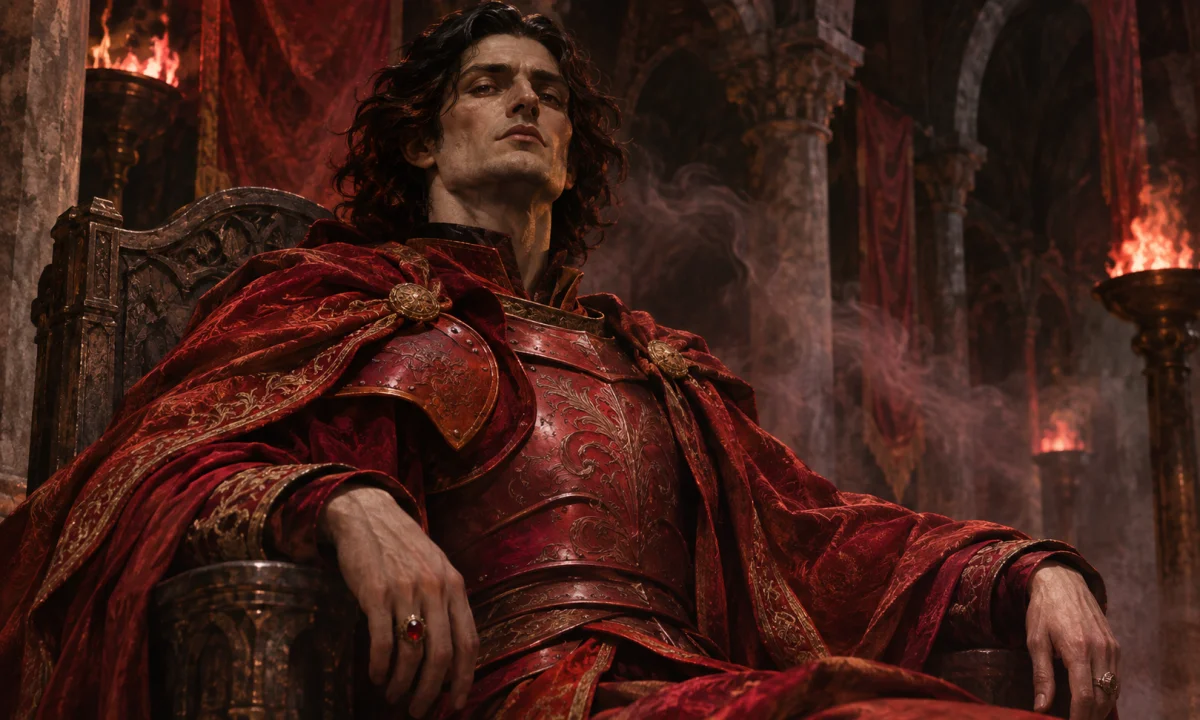
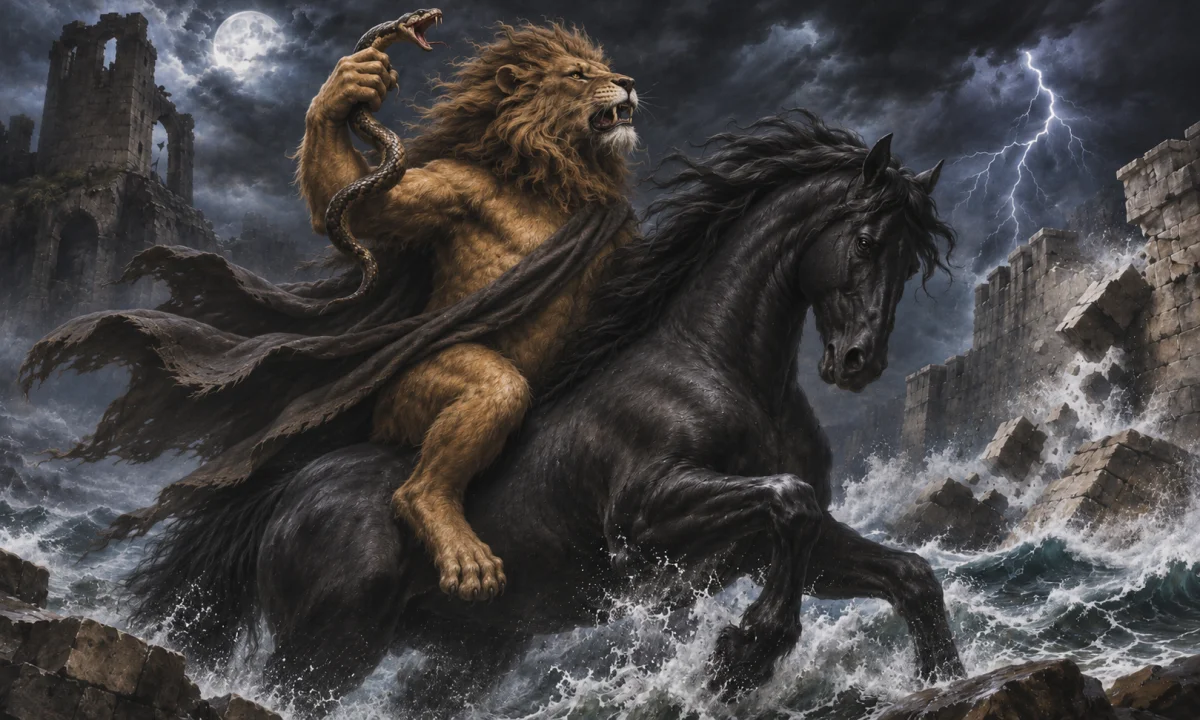
Andromalius is said to appear in the form of a man holding a large serpent. The description is notably concise. It does not provide a personal history, a place of origin, a genealogy or a detailed account of his clothing and facial features. Some later illustrations and occult publications elaborate on the basic image, but those artistic additions should be distinguished from the short description in the grimoire itself.
The human form may have been intended to make the spirit recognizable within a ritual vision, while the serpent supplies a striking emblem of danger, secrecy and concealed knowledge. Serpents have carried many different meanings across religious and mythological traditions: wisdom, healing, renewal, temptation, protection, fertility and poisonous threat are all possible associations. The Ars Goetia does not explain which meaning its author or compilers intended for Andromalius.
It is therefore safer to describe the serpent as an important feature of his representation than to assign it a single fixed symbolism. A modern reader might connect it with hidden paths, watchfulness or the exposure of concealed wrongdoing, but these are interpretations rather than explicit statements from the source.
Functions and powers
Andromalius’s principal office is connected with the recovery of stolen goods and the identification of thieves. The description also attributes to him the ability to reveal wickedness, secret dealings and actions carried out covertly. He is further associated with punishing thieves and other wrongdoers, as well as with discovering hidden treasures.
These functions make him unusual among the Goetic spirits. Many entries in the catalogue emphasize love, wealth, eloquence, military success, knowledge, invisibility or the creation of illusions. Andromalius instead has a strongly investigative and punitive profile. His role resembles that of a supernatural detector: he is invoked in the text not simply to obtain something desirable, but to expose a concealed offence and restore property that has been taken.
His powers should be understood within the moral and legal concerns of early modern society. Theft, fraud, secret agreements and hidden treasure were practical anxieties, especially in a period when legal investigation was limited and travel, commerce and property disputes could be difficult to regulate. A spirit who could identify a thief or recover missing possessions addressed fears that were both material and moral.
The text’s language also reflects the assumption that occult ritual could provide access to hidden knowledge. Andromalius is not merely a destructive demon. He is presented as a specialist whose supposed authority can be directed toward uncovering wrongdoing. Nevertheless, his association with punishment places him within a broader demonological framework in which supernatural power is dangerous and must be controlled through ritual authority.
Place in the seventy-two spirits
Andromalius is numbered 72 in the commonly circulated order of the Ars Goetia. His position as the final entry has encouraged later occult writers to give him special significance, but the source does not clearly state that the last number makes him more powerful or more important than the other spirits. The number is primarily a feature of the catalogue’s organization.
His title as an earl also belongs to the catalogue’s classification system. It should not be confused with the ranks of angels in Christian theology. The Ars Goetia presents its spirits as demons or infernal entities, while arranging them according to titles borrowed from human and courtly hierarchies. These ranks do not correspond directly to the choirs of angels described by theologians such as Pseudo-Dionysius.
The phrase “demon” itself has a complicated history. In ancient Greek, daimōn could refer broadly to a divine or supernatural power and did not always mean an evil being. In Christian demonology, however, demons generally became associated with hostile or fallen spiritual forces. Andromalius belongs to this later Christianized and magical use of demonological language.
Ritual context
The Ars Goetia does not present Andromalius as a figure to be approached through ordinary prayer or public worship. He is part of a system of ceremonial summoning. The magician is instructed to use ritual names, signs, a protective circle and other formal procedures intended to establish authority over the spirit and prevent harm.
Each spirit in the catalogue is traditionally associated with a seal or sigil. These designs function as identifying marks within the grimoire’s ritual system. The seal commonly reproduced for Andromalius belongs to the manuscript and printed occult tradition, but its exact form may differ between editions. There is no evidence that it is an ancient emblem used by a historical cult devoted to Andromalius.
Modern readers may encounter instructions for working with Andromalius in books and online occult communities. Such practices represent contemporary forms of ceremonial magic, reconstruction, personal spirituality or symbolic meditation. They should not be presented as an uninterrupted continuation of an ancient Andromalius religion, because no such continuous religious tradition is documented.
Interpretation and cultural significance
Andromalius can be interpreted as a supernatural personification of investigation, restitution and the exposure of concealed misconduct. His powers reflect a desire to make hidden actions visible and to restore an order disturbed by theft. In this sense, he occupies a narrow but recognizable place in demonological imagination: the dangerous spirit who is nevertheless assigned a function that appears to support justice.
This apparent tension is characteristic of grimoires. The moral status of a spirit is not always expressed only through the task attributed to it. A demon may be described as capable of revealing truth, teaching knowledge or recovering property without becoming a benevolent being in the theological sense. The ritual magician’s relationship with such a spirit is framed as one of command and constraint, not friendship or devotion.
The serpent adds another layer of ambiguity. It may suggest secrecy and threat, but it can also evoke the idea of something hidden beneath the surface. Because the source offers no interpretation, the image has remained open to later symbolic readings. Occult practitioners may treat the serpent as a sign of vigilance, transformation or concealed information, while artists may use it primarily to make the figure visually distinctive.
Andromalius and similar figures
Andromalius is sometimes compared with beings whose roles involve justice, punishment or the recovery of stolen property. Such comparisons can be useful at the level of theme, but they do not establish identity. He is not the same figure as a divine judge, an angel of retribution, a folkloric treasure guardian or a heroic detective.
He should also be distinguished from St. Michael, who is portrayed in Christian tradition as an archangel and defender against evil. Both may be associated in later interpretation with the defeat of wrongdoing, but they belong to fundamentally different religious frameworks. Andromalius is a demon in a grimoire’s ritual catalogue; Michael is a central angelic figure in Jewish, Christian and Islamic traditions, with important differences among those traditions.
Nor should Andromalius be equated with the many serpent spirits found in African, Asian, European and Indigenous mythologies. A shared visual feature does not prove a shared origin. Serpent symbolism is widespread because snakes are powerful, dangerous and familiar animals, and because their shedding and hidden movements readily invite symbolic interpretation.
Later reception and popular culture
Andromalius has had a smaller presence in popular culture than prominent Goetic figures such as Lucifer, Paimon, Asmodeus or Bael. He nevertheless appears in modern occult reference works, digital catalogues of demons, fantasy fiction, role-playing games and occasional visual art. These adaptations often expand his appearance, personality and powers beyond the brief description preserved in the Ars Goetia.
When modern fiction portrays Andromalius as a master thief, detective, serpent lord or antihero, those traits should be understood as creative developments rather than established elements of the older tradition. The traditional record gives him a specific cluster of functions—recovering stolen goods, exposing hidden wrongdoing, punishing thieves and revealing concealed treasure—but provides little narrative material from which to construct a full character.
His enduring interest lies precisely in that narrow description. Unlike demons with elaborate legends, Andromalius survives mainly as a name, an image and a set of assigned powers within a particular early modern magical catalogue. His identity is therefore best understood through the history of grimoires and European demonology, while later symbolic and fictional interpretations remain distinct from the limited source tradition.