WORLD
WORLD
Andras
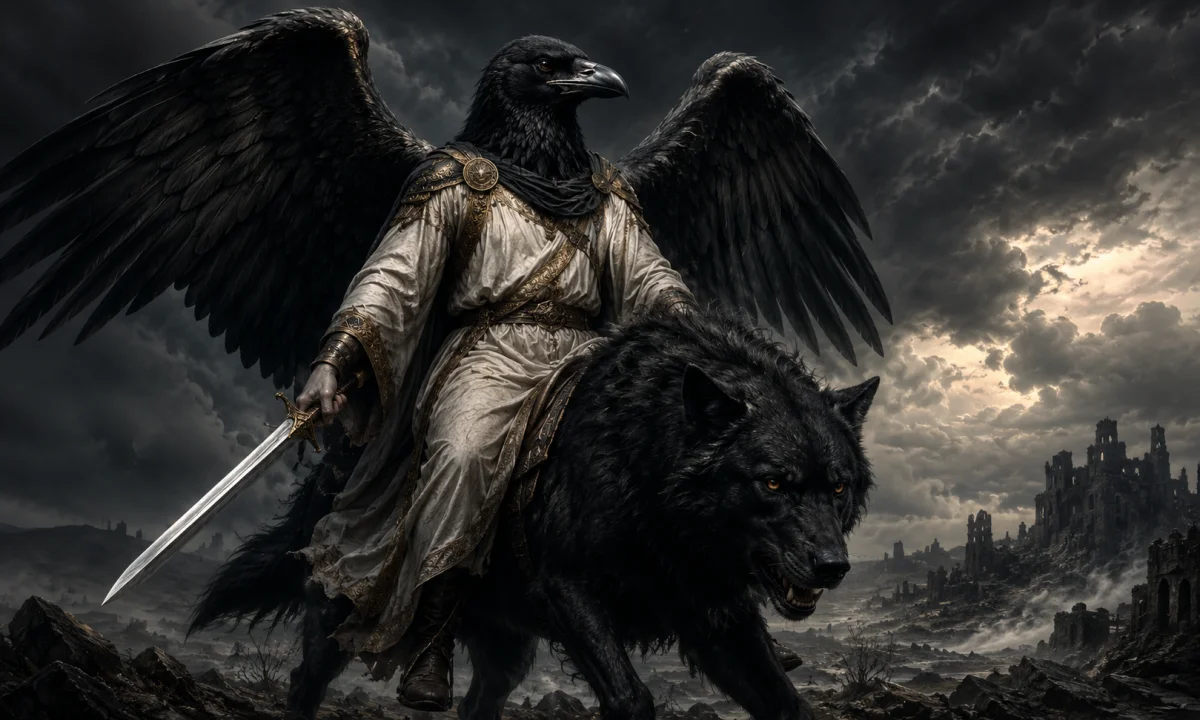
Andras is a demon described in early modern Western European grimoires, especially the Ars Goetia, the first part of the Lesser Key of Solomon. He is presented as a powerful marquis of Hell who appears with the body of an angel, the head of a black raven, a sharp sword, and a black wolf as his mount. His stated function is to create discord, while the texts also warn that he may kill the magician and the magician’s assistants if he is approached carelessly.
Andras in the Grimoire Tradition
Andras belongs to the system of demonological beings found in the so-called Solomonic grimoires. These works are not ancient pagan scriptures or universally recognised religious texts. They are products of a later European tradition of ritual magic, shaped by Christian theology, biblical imagery, astrology, ceremonial practice, and earlier manuals of spirits.
The best-known account appears in the Ars Goetia, a text transmitted in manuscripts and printed editions associated with the seventeenth century. The work presents seventy-two spirits, each assigned a rank, a seal, a number of infernal legions, and particular abilities. Andras is listed as the sixty-third spirit and is identified as a great marquis.
The Ars Goetia is part of a larger collection commonly called the Lesser Key of Solomon, or Lemegeton Clavicula Salomonis. The collection attributes its magical authority to Solomon, the biblical king traditionally associated with wisdom and command over spirits. Modern historical scholarship generally treats that attribution as legendary rather than evidence that Solomon wrote or practised the rituals described in the surviving manuscripts.
An earlier related catalogue appears in Johann Weyer’s Pseudomonarchia Daemonum, published in 1577. Its description of Andras is closely related to the later Goetic account, although the wording and ordering of spirits vary between texts. These similarities show that Andras was part of a developing literary tradition rather than a figure preserved through one single, unchanged revelation.
Name and Identity
The name is usually written Andras, although spelling can vary in manuscripts and modern editions. Its precise origin is uncertain. There is no secure evidence connecting the grimoire demon directly to a known deity or demon from ancient Mesopotamian, Egyptian, Greek, Roman, Jewish, or Christian tradition.
The name may resemble personal names found in different languages. For example, András is the Hungarian form of Andrew, ultimately related to the Greek name Andreas. That resemblance does not establish a connection between the Hungarian personal name and the demon in the grimoires. Names in magical catalogues were often copied, altered, transliterated, or reshaped by scribes, and a convincing etymology for Andras has not been established.
It is also important not to merge Andras with other similarly named spirits. Andrealphus, Andromalius, and Andromalius belong to the same broad Goetic catalogue but are distinct figures with different descriptions and functions. Similar spelling alone does not demonstrate shared identity, origin, or mythology.
Rank and Classification
In the Ars Goetia, Andras is described as a marquis, or marquess, of Hell. The title belongs to an aristocratic hierarchy that the grimoire applies to its spirits. It is not a rank found in the Bible, and it should not be assumed to represent a consistent hierarchy shared by all forms of Christian demonology.
Andras is said to command thirty legions of spirits. The number is part of the catalogue’s standard format, in which many spirits are assigned groups of infernal troops. Such numbers function as elements of the grimoire’s ritual and bureaucratic imagery. They are not supported by independent historical evidence for an actual supernatural army.
The term “demon” also requires cultural context. In Christian theological writing, demons are commonly understood as hostile or fallen spiritual beings opposed to God. In ceremonial grimoires, however, they are also arranged like officials in a court, with titles, seals, offices, and legions. This reflects the concerns of the texts’ authors and compilers: the invisible world is imagined as a dangerous but administratively ordered realm that a trained magician might attempt to control through divine names, ritual boundaries, and formal commands.
Appearance
Andras has one of the most memorable composite forms in the Goetic tradition. The description presents him as follows:
- an angelic or human-shaped figure;
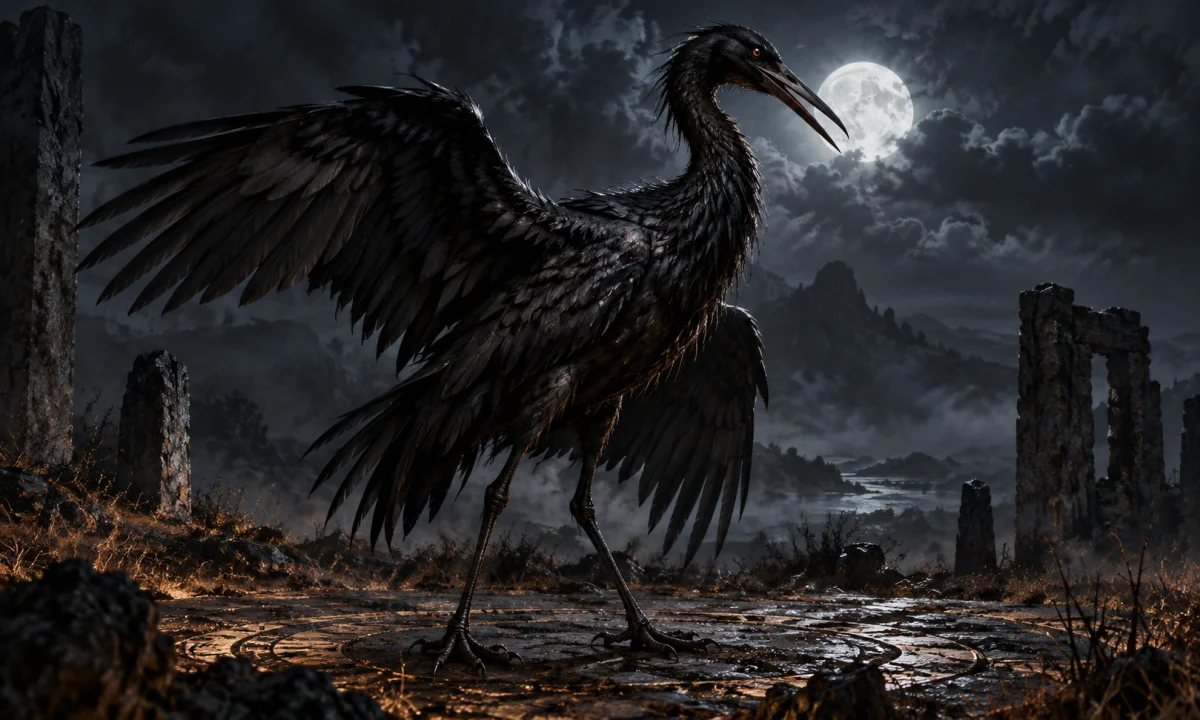
- a head resembling that of a black raven or black night-raven;
- a strong black wolf serving as his mount; and
- a sharp sword held and brandished in his hand.
The wording differs slightly between editions, but the essential image remains consistent. Andras is not simply a raven, a wolf, or a winged demon. He is a hybrid figure combining an apparently angelic body with animal features and a weapon associated with violence, judgement, and conflict.
The black raven-like head gives the figure an especially ominous character. Ravens have long carried varied meanings in European and Near Eastern traditions. They can be associated with death, battlefields, prophecy, wilderness, carrion, intelligence, or divine provision, depending on the culture and story. The Goetic description does not explain why Andras has a raven’s head, so interpretations should remain tentative. The feature may have been intended to make him visibly alien, threatening, and difficult to confuse with a benevolent angel.
The wolf reinforces the impression of danger and predation. Wolves appear in folklore as symbols of the wild, enemies of livestock, companions of warriors, or figures connected with transformation and the boundary between civilisation and wilderness. In Andras’s case, the text gives no independent wolf mythology or narrative. The animal functions primarily as part of his emblematic appearance and as a vehicle for his threatening presence.
The sword is more directly connected with his stated office. A sword can symbolise authority, punishment, warfare, and the cutting of bonds. Since Andras is said to sow discord and to threaten those who summon him, the weapon makes his role physically immediate: conflict is not merely an abstract influence but something that may become violent.
Abilities and Office
The principal office assigned to Andras is to sow discord. The phrase is brief and open to interpretation. It may refer to provoking quarrels, damaging alliances, turning people against one another, or intensifying existing disputes. Unlike some spirits in the Goetic catalogue, Andras is not primarily described as teaching a craft, revealing treasure, discovering hidden things, or influencing love.
His power is therefore social and destructive. He represents the breaking of trust and cooperation rather than the acquisition of knowledge or material success. Discord can begin with suspicion, resentment, rivalry, or miscommunication, and the concise grimoire description leaves room for readers to imagine all of these forms.
The account also contains an unusually direct warning. Andras may kill the magician and the assistants if care is not taken. This warning distinguishes him from spirits whose descriptions focus almost entirely on what they can provide. In the logic of the grimoire, Andras is not a compliant servant who can be treated casually. His danger is part of his identity, and the threat may extend to the people performing or supporting the ritual.
That warning can be read in several ways. Within the religious worldview of Christian demonology, it expresses the danger of deliberately dealing with a hostile spirit. Within the literary structure of the grimoire, it heightens drama and establishes Andras as particularly fierce. From a historical perspective, it also reflects a broader pattern in magical manuals: rituals are surrounded by rules, precautions, divine authority, and threats of punishment because the texts portray contact with spirits as hazardous and morally dangerous.
Stories and Relationships
Andras has no extensive cycle of myths, family relationships, battles, or origin stories. The surviving grimoire descriptions are catalogue entries rather than narratives. They identify his rank, appearance, office, and number of legions, but they do not explain how he became a demon, who created him, or how he relates personally to Satan, Lucifer, Solomon, or other named spirits.
Some later occult writers may place Andras within larger systems of infernal hierarchy, but these arrangements should not be mistaken for a single ancient tradition. Different authors reorganised the spirits, changed their titles, altered their seals, or supplied new interpretations. A later classification can therefore tell us about the interests of that author or occult movement rather than about an original mythology of Andras.
The absence of narrative is significant. Andras is known mainly through description and function, not through legendary episodes. Claims that he has a detailed biography, a fixed consort, a particular birthplace, or a defined role in an infernal war generally come from later invention, modern occult elaboration, or confusion with other figures unless they can be tied to a specific historical text.
Symbolism and Interpretation
Andras can be interpreted as a concentrated image of dangerous conflict. His raven-like head suggests an ominous, watchful, or death-associated presence; his wolf suggests predatory force and the wild; his sword suggests direct violence; and his office of sowing discord connects these visual elements to social breakdown.
Yet symbolic interpretations should be distinguished from statements made by the original texts. The grimoires do not provide a formal explanation of the raven, wolf, or sword. The associations belong partly to later readers and to wider traditions of animal symbolism. It is reasonable to discuss possible meanings, but not to present one modern interpretation as an established doctrine.
Andras also illustrates the way grimoire demons combine familiar categories. He has an angelic form, but the form is distorted by an animal head. He belongs to an aristocratic court, yet he acts as a violent force. He is assigned an administrative office, but that office is the destruction of social harmony. These contrasts make him typical of a demonological literature that often gives hostile beings an ordered, quasi-bureaucratic identity.
From the perspective of religious history, the figure reflects the Christian demonological imagination of early modern Europe more clearly than it preserves an independent pre-Christian cult. The description appears within a system that seeks to place spirits under ritual command while maintaining that divine authority ultimately stands above them. Andras is thus both a supernatural adversary and a component of a technical magical catalogue.
Andras and Similar Figures
Confusion is especially likely because several Goetic names begin with “Andr-” or contain similar combinations of letters. Andras should be kept separate from the following spirits:
- Andrealphus, a marquis associated in the Ars Goetia with geometry, astronomy, and the transformation of human forms into birds.
- Andromalius, a great earl described as a figure who reveals thefts and hidden wrongdoing, and who is associated with recovering stolen goods.
- Marchosias, another marquis whose appearance and abilities differ substantially from those assigned to Andras.
Nor should Andras be automatically identified with a raven god, a werewolf, or a folkloric devil merely because his description includes a raven-like head and a wolf. Animal-headed beings occur in many religious and mythological traditions, but resemblance does not prove historical borrowing. Andras’s documented identity comes from the early modern grimoire tradition, not from a continuous mythology shared with every animal-associated spirit.
Historical and Modern Reception
For much of their history, texts such as the Ars Goetia circulated in restricted manuscript and occult contexts rather than as popular mythology. Their readership included people interested in ritual magic, astrology, angelology, demonology, and learned esoteric traditions. The names and descriptions later became more widely available through printed editions and twentieth-century occult publishing.
In modern popular culture, Andras may appear in horror fiction, role-playing games, metal and gothic imagery, occult-themed novels, comics, films, or video games. Such works often emphasise the raven head, black wolf, sword, or power over discord. They may also give him a personality, biography, alliances, and powers far more detailed than the historical sources provide.
Those adaptations can be creative interpretations, but they are not evidence of an older Andras mythology. A modern character named Andras may borrow only the name or visual design while changing the figure’s rank, motives, gender, abilities, and relationship to other demons. The historical Andras remains a comparatively concise grimoire spirit: a marquis of Hell, mounted on a black wolf, armed with a sword, associated with discord, and accompanied by a serious warning of lethal danger.