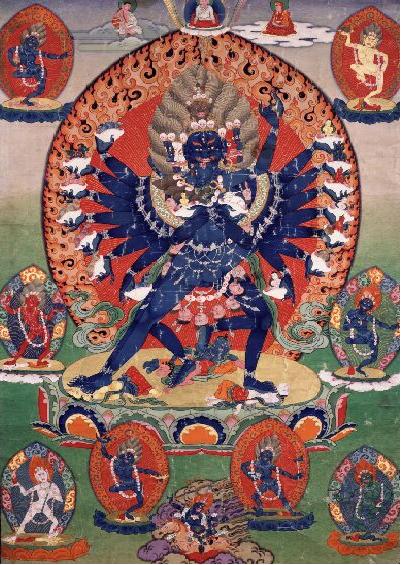
Hevajra is a significant figure in Buddhist mythology, particularly within the Tantric traditions of Vajrayana Buddhism. Hevajra is often depicted as a powerful deity embodying the principles of wisdom and compassion. His imagery is rich and complex, making him a fascinating subject for study. The essence of Hevajra revolves around the idea of transformation and the union of opposites, which are central themes in Tantric practices. His figure serves as a guide for practitioners seeking to understand the deeper aspects of their spiritual journey.
Origins of Hevajra
The origins of Hevajra can be traced back to ancient Indian texts and traditions. Hevajra appears in various Tantric scriptures, notably in the Hevajra Tantra, which is one of the foundational texts of the Vajrayana tradition. This text outlines the rituals and meditative practices associated with Hevajra. The Hevajra Tantra presents Hevajra as a form of Vajrasattva, the embodiment of enlightenment, and it emphasizes the importance of ritual and visualization in achieving spiritual goals.
 Hayagriva
In the Hevajra Tantra, Hevajra is described as having multiple faces and arms, symbolizing his ability to transcend ordinary perceptions of reality. Each of his forms represents different aspects of the cosmic reality and the union of wisdom and method. The complexity of his form reflects the multifaceted nature of existence and the various paths one can take in the pursuit of enlightenment. This representation serves as a reminder that the spiritual journey is not linear but rather a rich tapestry of experiences.
Symbolism of Hevajra
Hevajra is rich in symbolism, which is essential for understanding his role within Buddhist mythology. His various forms and attributes carry deep meanings that practitioners meditate upon. For instance, Hevajra is often depicted with a blue skin, representing the vastness of the sky and the infinite nature of the universe. This color also signifies his connection to the spiritual realm and the idea of transcendence over the mundane world.
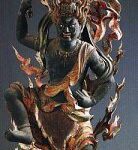 Izusan Gongen
Additionally, Hevajra’s multiple heads and arms symbolize his ability to perceive and respond to the needs of all beings. Each face represents a different aspect of wisdom, while his arms signify the various methods available to reach enlightenment. This multiplicity highlights the idea that there are many paths to spiritual awakening, and each individual’s journey is unique. Furthermore, Hevajra is often depicted with a consort, representing the union of wisdom and compassion, which is a crucial aspect of Tantric practice.
Hevajra in Tantric Practices
Hevajra plays a central role in many Tantric practices aimed at achieving enlightenment. Practitioners often engage in rituals that involve visualization of Hevajra, chanting mantras, and performing specific mudras or hand gestures. These practices are designed to help individuals connect with Hevajra’s energy and embody his qualities in their own lives. The visualization of Hevajra is particularly important, as it allows practitioners to cultivate a deeper understanding of their own nature and the nature of reality.
One common practice is the Hevajra Sadhana, which is a series of rituals and meditations that focus on invoking Hevajra’s presence. This practice often includes offerings, prayers, and the recitation of specific mantras associated with Hevajra. The aim is to establish a profound connection with this deity, allowing practitioners to access the wisdom and compassion that Hevajra embodies. Through these rituals, practitioners seek to transform their own consciousness and attain a state of enlightenment.
 Hariti
Hevajra’s Consort
In many depictions, Hevajra is shown with a consort, who is often identified as Nairatmya. This figure represents the union of wisdom and method, a core principle in Tantric Buddhism. Nairatmya is typically portrayed as a fierce and powerful goddess, embodying the qualities of emptiness and the ultimate nature of reality. Together, Hevajra and Nairatmya symbolize the integration of male and female energies, which is essential for achieving spiritual balance.
The relationship between Hevajra and Nairatmya is not merely romantic; it is deeply spiritual and represents the interdependence of wisdom and compassion. In Tantric practices, invoking both Hevajra and Nairatmya allows practitioners to engage with the full spectrum of spiritual qualities necessary for enlightenment. This union serves as a reminder that true wisdom cannot be attained without compassion, and vice versa. Their dynamic together reflects the idea that the spiritual path requires both insight and action.
Hevajra in Art and Iconography
Hevajra’s representation in art and iconography is incredibly rich and diverse. He is often depicted in a variety of forms, each conveying different aspects of his nature. Traditional Tibetan thangka paintings frequently illustrate Hevajra surrounded by a vibrant mandala, emphasizing his role as a central figure in the spiritual cosmos. These images are not only visually striking but also serve as tools for meditation and contemplation.
In many artworks, Hevajra is shown in a dynamic posture, often dancing or moving with energy. This portrayal reflects the idea of movement and transformation, key themes in Tantric practice. The intricate details in his depictions, such as the various implements he holds, each have specific meanings that contribute to the overall narrative of his power and significance. For instance, Hevajra may be depicted holding a vajra or a bell, symbols of the union of wisdom and method.
Hevajra’s Influence on Tibetan Buddhism
Hevajra has had a profound influence on the development of Tibetan Buddhism. His teachings and practices have been integrated into various schools of Tibetan thought, particularly within the Kagyu and Nyingma traditions. The Hevajra Tantra has been a foundational text for many practitioners, guiding them in their spiritual practices and rituals. The emphasis on the union of wisdom and compassion, as embodied by Hevajra and Nairatmya, has shaped the way many Tibetan Buddhists approach their spiritual paths.
The ritual practices associated with Hevajra have also contributed to the rich tapestry of Tibetan Buddhist ceremonies. Many monks and practitioners engage in elaborate rituals that honor Hevajra, invoking his presence and blessings. These ceremonies often include chanting, offerings, and intricate mandala constructions, all aimed at cultivating a deeper connection with Hevajra’s energy. The rituals are seen as a way to align oneself with the transformative powers of Hevajra, facilitating personal and communal spiritual growth.
Hevajra in Contemporary Practice
In contemporary Buddhism, the figure of Hevajra continues to be relevant for practitioners around the world. Many modern Buddhist communities incorporate Hevajra’s teachings into their practices, recognizing the importance of wisdom and compassion in daily life. The principles embodied by Hevajra are seen as timeless and applicable to the challenges faced by individuals in the modern world. Practitioners often find inspiration in Hevajra’s story and the transformative potential it represents.
Moreover, the visual representations of Hevajra have gained popularity in various forms of spiritual art and meditation practices. Many individuals are drawn to the vibrant imagery associated with Hevajra, using it as a focal point for meditation. This engagement with Hevajra’s iconography serves not only as a means of connection but also as a way to explore the deeper aspects of one’s own consciousness. The teachings of Hevajra continue to resonate, providing guidance for those seeking spiritual growth in an increasingly complex world.
Hevajra represents a profound aspect of Buddhist mythology and spirituality. His teachings and practices offer valuable insights into the nature of reality and the spiritual journey. Through the exploration of Hevajra’s symbolism, rituals, and influence, practitioners can deepen their understanding of themselves and their connection to the universe. Hevajra serves as a guiding light for those on the path to enlightenment, embodying the transformative power of wisdom and compassion.