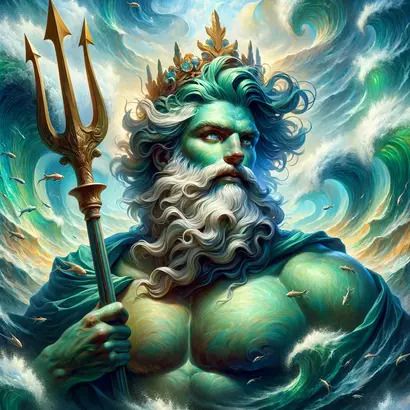
In Greek mythology, Poseidon is one of the most important deities, known as the god of the sea, earthquakes, and horses. He is a prominent figure in various myths and stories, often depicted with a trident, a three-pronged spear that symbolizes his power over the oceans. Poseidon is the brother of Zeus, the king of the gods, and Hades, the god of the underworld. Each of these brothers governs different realms, with Poseidon ruling over the vast waters of the Earth. His domain includes not only the oceans but also rivers, lakes, and all bodies of water.
The Origins of Poseidon
Poseidon was born to the Titans Cronus and Rhea. According to mythology, Cronus feared that one of his children would overthrow him, so he swallowed each of them at birth. However, Rhea managed to save Poseidon by hiding him in a cave on the island of Crete. When he grew up, Poseidon joined his siblings in overthrowing Cronus. After the defeat of their father, the three brothers drew lots to determine their realms. Zeus took the sky, Hades received the underworld, and Poseidon became the ruler of the sea.
 Enyo
EnyoPoseidon’s character is often associated with the unpredictable nature of the ocean. He was known to be both a benevolent god who provided sailors with safe passage and a vengeful deity who could unleash storms and earthquakes. This duality reflects the characteristics of the sea itself, which can be calm and nurturing one moment and fierce and destructive the next. As a result, sailors often prayed to Poseidon for protection and guidance while at sea.
Poseidon’s Symbols and Attributes
One of the most recognizable symbols of Poseidon is his trident. This powerful weapon not only represents his dominion over the sea but also his ability to cause earthquakes. In many myths, Poseidon uses his trident to strike the ground, creating tremors and shaking the earth. The trident is often depicted in art and literature as a symbol of strength and authority. It is said that Poseidon could also create new islands and calm storms with this mighty tool.
In addition to the trident, Poseidon is often associated with horses. According to some myths, he is credited with creating the first horse. This connection to horses is significant, as they were a vital part of ancient Greek culture, especially in warfare and transportation. Poseidon’s horses were often depicted as wild and untamed, reflecting the unpredictable nature of the sea. In some stories, he is said to have raced against other gods, showcasing his speed and agility.
 Eos
EosPoseidon in Mythology
Poseidon appears in numerous myths and stories throughout Greek mythology. One of the most famous tales involving Poseidon is the contest for the city of Athens. Both Poseidon and Athena, the goddess of wisdom, wanted to be the patron deity of the city. To win the favor of the citizens, Poseidon struck the ground with his trident, creating a saltwater spring. However, Athena offered an olive tree, which was seen as more beneficial for the people. Ultimately, the citizens chose Athena, and Poseidon’s anger led to his wrath against the city.
Another well-known myth featuring Poseidon is the story of the Trojan War. In this tale, Poseidon played a significant role in supporting the Greeks. He was initially angered by the Trojans because they had not honored him properly. As a result, he sent a sea monster, known as the Cetus, to terrorize the city of Troy. This act was meant to punish the Trojans and demonstrate Poseidon’s power. The Greeks ultimately used the famous Trojan Horse to infiltrate the city, but Poseidon’s influence was felt throughout the war.
Worship and Temples
Poseidon was widely worshipped in ancient Greece, particularly in coastal regions where the sea played a vital role in daily life. Many cities had temples dedicated to him, where people would offer sacrifices and prayers for safe voyages and bountiful catches. One of the most famous temples dedicated to Poseidon is located at Sounion, a promontory overlooking the Aegean Sea. This temple was built in the 5th century BCE and remains a popular tourist attraction today.
 Epaphus
Festivals in honor of Poseidon were held throughout the year, with the most significant being the Panathenaea in Athens. This festival included athletic competitions, musical contests, and various other events to celebrate the gods. Sailors and fishermen would often make offerings before setting out to sea, hoping to gain Poseidon’s favor and avoid storms or shipwrecks. The rituals performed at these temples were essential in maintaining a good relationship between the people and the god of the sea.
Poseidon’s Family and Relationships
Poseidon had many relationships with other deities and mortals, resulting in numerous offspring. His most famous consort was Amphitrite, a sea goddess who became his wife. Together, they had several children, including Triton, a merman who served as Poseidon’s messenger. Triton is often depicted as a handsome young man with a fishtail, holding a conch shell that he uses to calm the seas or summon storms.
In addition to his marriage to Amphitrite, Poseidon had many affairs with mortal women, resulting in various mythological figures. One of his notable offspring was Theseus, a hero known for his strength and adventures, including slaying the Minotaur. Poseidon also fathered the Cyclops, Polyphemus, who is famous for his encounter with Odysseus in Homer’s “Odyssey.” These relationships highlight Poseidon’s complex character and the many ways he interacted with both gods and mortals.
The Legacy of Poseidon
Poseidon’s legacy continues to be felt in modern culture. His stories and attributes have inspired countless works of art, literature, and popular media. From movies to books, the figure of Poseidon remains a powerful symbol of the sea and its mysteries. Many people still associate the ocean with the qualities that Poseidon embodies—strength, unpredictability, and beauty.
In addition to popular culture, Poseidon has also influenced language and expressions. Phrases such as “the wrath of Poseidon” evoke the idea of the sea’s power and the dangers of sailing. His presence in ancient texts, such as Homer’s “Iliad” and “Odyssey,” ensures that his character remains a significant part of Greek mythology studies. Scholars continue to explore his myths, revealing insights into ancient Greek culture and the human relationship with nature.
As a central figure in Greek mythology, Poseidon embodies the complexities of nature and human emotion. His tales reflect the ancient Greeks’ understanding of the sea as both a life-giving force and a source of danger. The worship of Poseidon, his symbols, and his many myths contribute to his enduring legacy as one of the most important gods in the Greek pantheon. The stories of Poseidon continue to resonate with people today, reminding us of the power and beauty of the natural world.