WORLD
WORLD
Waang
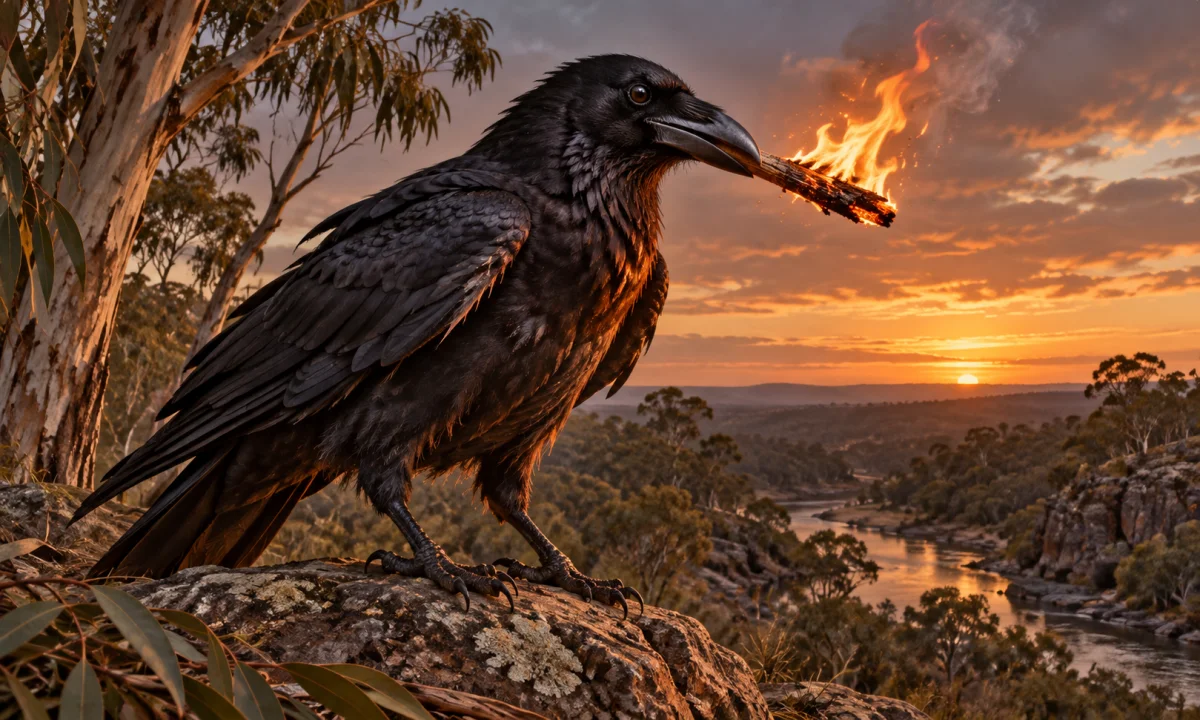
Waang is a name associated with a crow or raven ancestral being in some Aboriginal traditions of southeastern Australia. The spelling Waang is especially encountered in material connected with Kulin-speaking peoples of Victoria, although related forms include Waa, Wah and other local spellings. These names should not automatically be treated as evidence of one single figure shared by every Aboriginal nation. Aboriginal Australia contains hundreds of distinct language groups, each with its own traditions, laws, ceremonial knowledge and naming systems.
Origins and cultural setting
Waang belongs to a religious and cultural world in which ancestral beings shaped the land, established relationships between people and places, and provided models for correct behaviour. English-language writers have often called such beings “mythological characters”, but that description can be misleading if it suggests that the stories are merely imaginary entertainment. In many Aboriginal traditions, ancestral narratives explain the continuing presence of sacred places, animals, waterways, laws and kinship responsibilities.
In traditions associated with the Kulin peoples of central and southeastern Victoria, the crow is one of the important ancestral animal figures. Kulin is a collective term used for related language groups, including the Woi-wurrung, Bunurong, Taungurung, Dja Dja Wurrung and Wathaurong peoples. Their traditions are related in some respects but are not identical. A story told under the name Waang in one community may have a different emphasis, sequence or pronunciation in another.
Knowledge of Waang has been transmitted primarily through oral tradition, cultural teaching, ceremony, art and continuing relationships with Country. Some accounts were recorded by missionaries, settlers, folklorists and later researchers, often in English or in imperfect representations of Indigenous languages. Such records can preserve valuable information, but they may also simplify a complex tradition, remove ceremonial context or combine material from different communities. For that reason, no single published version should be regarded as a complete or universally authoritative account.
Name and identity
Waang is commonly glossed in English as “crow”. In other contexts, the related form Waa is used. The spelling of Aboriginal words in older records was not standardized, and the same sound could be written in several ways by English-speaking observers. Contemporary Indigenous organisations, elders and language revitalisation projects may prefer a particular spelling for a particular language and community.
The English word “crow” can also conceal an important zoological issue. Australian Aboriginal languages classify birds according to their behaviour, appearance, habitat and cultural significance, not according to the taxonomic categories used by modern European science. A bird translated as a crow may sometimes be described by English speakers as a raven or another member of the crow family. It is therefore safer to retain the traditional name rather than assume that every Waang tradition refers to one scientifically defined species.
Waang is generally presented as an ancestral crow being, rather than simply an ordinary bird. Depending on the tradition, the figure may act as a creator, culture hero, trickster, transformer or powerful ancestor. These categories are modern attempts to describe overlapping roles. They should not be taken as exact Indigenous equivalents of the European ideas of “god”, “spirit” or “hero”.
Appearance and characteristics
Waang is usually represented in avian form as a crow, with dark plumage, a strong beak and the alert, intelligent character commonly associated with corvids. Artistic representations may show the bird realistically or give it human-like qualities. In oral narratives, Waang can speak, reason, desire, deceive, compete, travel and interact with other ancestral beings. The movement between animal and human behaviour is not necessarily a transformation in the narrow sense; ancestral beings may possess several forms or capacities at once.
The figure is often associated with intelligence and resourcefulness. Waang can observe opportunities, devise plans and use other beings to achieve a goal. These qualities make the crow an effective trickster figure, but “trickster” should be used carefully. In European folklore the trickster is often chiefly a comic rule-breaker. In Aboriginal traditions, a clever ancestor may also be involved in the establishment of law, the distribution of essential resources or the explanation of why the world has its present form.
Waang’s behaviour is not always admirable. Stories may portray the crow as greedy, jealous, boastful or disruptive. Such qualities can explain why a bird has particular habits, why it calls or scavenges, or why relations between different ancestral beings became strained. At the same time, the character’s cleverness can be necessary for the acquisition of knowledge or the survival of a community. The moral meaning depends on the narrative and the cultural context in which it is told.
Waang and the origin of fire
One of the best-known themes connected with crow ancestors in southeastern Australian traditions is the acquisition or transmission of fire. In versions recorded from Aboriginal communities, fire may be held or guarded by women or by other beings, and Waang seeks to obtain it for the wider community. The details vary substantially. Some accounts describe the crow attempting to trick the guardians; others emphasise the difficulty of bringing fire from one place to another or explain how fire became available to human beings.
These narratives should not be reduced to a simple “fire myth”. Fire is a practical technology, a source of warmth and cooking, a means of managing vegetation and a major element of cultural life on Country. Aboriginal fire practices have long involved detailed knowledge of seasons, plants, animals and weather. A story about the control or sharing of fire can therefore concern social obligations, access to resources, cooperation and the consequences of selfishness as well as the physical origin of flame.
In some retellings, the crow’s actions result in the spread of fire and help explain aspects of the bird’s appearance or behaviour. In others, the focus falls on the women who possess fire and on the relationship between male and female powers. The existence of a familiar motif does not mean that every community tells the same story. A version collected in one region should not be presented as the definitive story of all Aboriginal peoples or of every figure called Waang.
Relationships with other ancestral beings
Waang is often discussed alongside Bunjil, the eagle or eaglehawk ancestral being prominent in several Kulin traditions. Bunjil is widely described in public accounts as a powerful creator and law-giving ancestor, while Waa or Waang is frequently associated with the crow. Their relationship may be represented as cooperation, rivalry or opposition, depending on the source and the community tradition.
It is tempting to turn this pairing into a fixed opposition between good and evil, light and darkness, or order and chaos. That interpretation is usually too simple. Animal moieties and ancestral relationships can express systems of kinship, social organisation and reciprocal responsibility rather than a moral battle between two absolute forces. Moreover, the meanings attached to Bunjil and Waang are not identical in every Kulin-speaking community.
Some public retellings connect the crow with stories of conflict, punishment or transformation involving Bunjil and other ancestors. These accounts may explain the crow’s black colouring, its distinctive call or its place in the landscape. Because the surviving versions are uneven and sometimes combine material from separate sources, it is important to identify the community and language tradition whenever a particular episode is being discussed.
Role as a trickster and culture hero
Waang’s trickster qualities are closely linked to the crow’s observed behaviour. Crows are attentive, adaptable and capable of exploiting changes in their environment. Their calls, group behaviour and tendency to investigate human activity have made them compelling subjects of Aboriginal observation and storytelling. An ancestral crow can consequently represent both valuable intelligence and dangerous opportunism.
Stories of this kind often carry more than one meaning. A character may break a rule and create a benefit for others, yet still suffer consequences for acting selfishly. A clever plan may succeed in the short term while producing disorder later. Such narrative patterns encourage listeners to consider the difference between intelligence and wisdom, and between obtaining something for oneself and fulfilling obligations to a community.
Waang’s actions may also account for features of the natural world. Aboriginal ancestral narratives frequently connect behaviour, landscape and law rather than separating “nature” from “culture”. The crow’s calls, colour, movements or relations with other animals may be understood through a story that also teaches people how to behave. This does not make the narrative a primitive scientific explanation. It is part of a broader intellectual and spiritual system in which ecological knowledge, ethics, history and sacred geography are interwoven.
Regional variation and limits of comparison
There is no single Aboriginal mythology. The word “Aboriginal” covers many peoples and traditions, and a crow figure found in Victoria should not automatically be identified with every crow ancestor elsewhere in Australia. Other language groups have their own names for crows, ravens and ancestral beings, together with their own stories about fire, creation, death and law.
Nor should Waang be confused with every Aboriginal figure whose name has been translated as “crow”. A similar animal role may arise independently in different regions, while similar spellings may reflect unrelated languages. Accurate identification requires attention to the language, Country, community and source associated with the name.
The same caution applies to gender and classification. Some English-language summaries call the crow a male ancestor, while other accounts do not foreground gender or use gendered terms in the same way. A label such as “god” may also distort the figure’s role by implying a distant supernatural ruler. “Ancestor” or “ancestral being” is often more appropriate, though even those terms cannot capture every local meaning.
Cultural significance today
Waang remains relevant through continuing Aboriginal connections to Country, language renewal, art, education and cultural practice. Contemporary Aboriginal artists and storytellers may use the crow as a sign of identity, intelligence, memory, survival or responsibility to place. These works are not merely illustrations of a frozen ancient mythology. They can be part of living cultures in which ancestral knowledge is interpreted and expressed according to community authority and present circumstances.
Public retellings require care because some traditional knowledge is restricted, ceremonial or appropriate only for particular people. Widely circulated summaries may omit those boundaries and present sacred material as freely available folklore. Respectful discussion distinguishes between information intentionally shared for a public audience and knowledge that belongs within specific cultural contexts.
Waang has not become a major universal figure in global popular culture in the way that some Greek, Norse or Egyptian beings have. When the name appears in books, exhibitions, tourism material or educational media, it is important that modern representations do not detach the crow from the peoples and Countries to which particular traditions belong. A fantasy character called Waang, or a generic raven used as a symbol of darkness, should not be treated as a faithful continuation of Aboriginal tradition without evidence of a genuine cultural connection.
For these reasons, Waang is best understood not as a single fixed “crow god”, but as a name associated with regionally grounded ancestral traditions in which the crow may be a powerful, intelligent, troublesome and culturally significant being. The most accurate accounts preserve the name’s variation, recognise the authority of the communities concerned and avoid separating the bird’s stories from the land, law and relationships that give them meaning.