WORLD
WORLD
Unelanuki
Unelanuki is a name used in some English-language accounts for the Cherokee creator or supreme power, more commonly written as Unelanvhi or Unelanvhi in scholarly and cultural discussions. The name is associated with the making and ordering of the world, although spelling, pronunciation, translation and the figure’s description vary considerably between sources. Cherokee traditions are not contained in one canonical scripture, and stories about creation and sacred powers differ according to community, storyteller and period of recording.
Origins and cultural setting
The Cherokee are an Indigenous people whose historic homeland includes parts of the southern Appalachian region, especially areas now within Tennessee, North Carolina, Georgia and Alabama. Cherokee religious traditions developed within a complex understanding of relationships between people, animals, plants, places, celestial bodies and unseen powers. Sacred narratives were not simply collections of entertaining myths. They could explain why the world has its present form, how humans became part of it, and what kinds of conduct maintain balance within it.
Many Cherokee narratives were preserved through oral transmission. During the nineteenth and early twentieth centuries, ethnographers, missionaries and other outsiders recorded stories from Cherokee speakers and cultural authorities. These records are valuable, but they do not represent a single, complete or perfectly neutral account of Cherokee religion. Translation into English could also encourage Christian readers to interpret a Cherokee creator as equivalent to the Christian God, even when the original concepts did not correspond exactly.
For that reason, Unelanuki should not automatically be treated as a conventional “god” in the European mythological sense. The figure is often described as a creator, ordering power or supreme being, but the surviving accounts do not present a single standardized biography, personality or set of adventures. Some narratives mention a creator directly, while others focus on animals, the first people, the sun, or the shaping of the earth without giving the creator a prominent speaking role.
Name and spelling
Unelanuki is a variant form found mainly in English-language retellings. Other romanizations include Unelanvhi and closely related spellings. Cherokee is written in its own syllabary as well as in Roman transliteration, and different writers have represented Cherokee sounds in different ways. A spelling ending in -uki may therefore appear alongside forms ending in -vhi or a similar sequence.
The precise meaning of the name is not presented consistently in English sources. It is frequently glossed as “Creator,” “Maker,” or “the Apportioner.” The last translation reflects an understanding of the being as one who assigns or arranges the parts of the cosmos. Such glosses should be treated as interpretive translations rather than as universally agreed definitions.
Unelanuki is not necessarily a separate figure from Unelanvhi merely because the spelling differs. In many modern summaries, the two names refer to the same Cherokee creator figure. At the same time, a spelling found in a popular retelling does not by itself establish that it is an authentic traditional form. Cherokee words have often been copied from one English account to another, sometimes with altered pronunciation or unsupported explanations.
Unelanuki as creator and cosmic power
When Unelanuki is identified in Cherokee creation traditions, the figure is associated with the existence and arrangement of the world rather than with a human-like family drama. The creator may be understood as the power responsible for bringing the earth, living beings and the order of nature into being. In this role, Unelanuki stands at the beginning of the cosmos, but is not always portrayed as a character who repeatedly intervenes in later events.
Cherokee creation narratives often begin with the earth surrounded by water or with the world in an unfinished condition. Animals and other beings participate in discovering or forming a place where life can exist. In versions of the earth-diver story, a small diving creature descends beneath the water and brings up mud. That mud expands into land. The story is sometimes linked with the water beetle, although the animal involved and the details of the episode vary among retellings.
Another well-known part of the creation cycle concerns a great bird or buzzard flying over the newly formed land. As the bird grows tired, the beating of its wings is said to create valleys and mountains. In this account, landscape is not merely scenery: mountains and valleys are connected to the actions of living beings and to the transformation of an earlier, less settled world.
Some versions say that the creator placed the sun in the sky or established its movement. Other narratives explain the sun’s position through a story involving the first people and the need to regulate heat and light. These episodes are not always explicitly attributed to Unelanuki in the same way. It is therefore better to describe them as parts of a broader Cherokee creation complex than to claim that every detail belongs to one fixed myth about a single deity.
Attributes and appearance
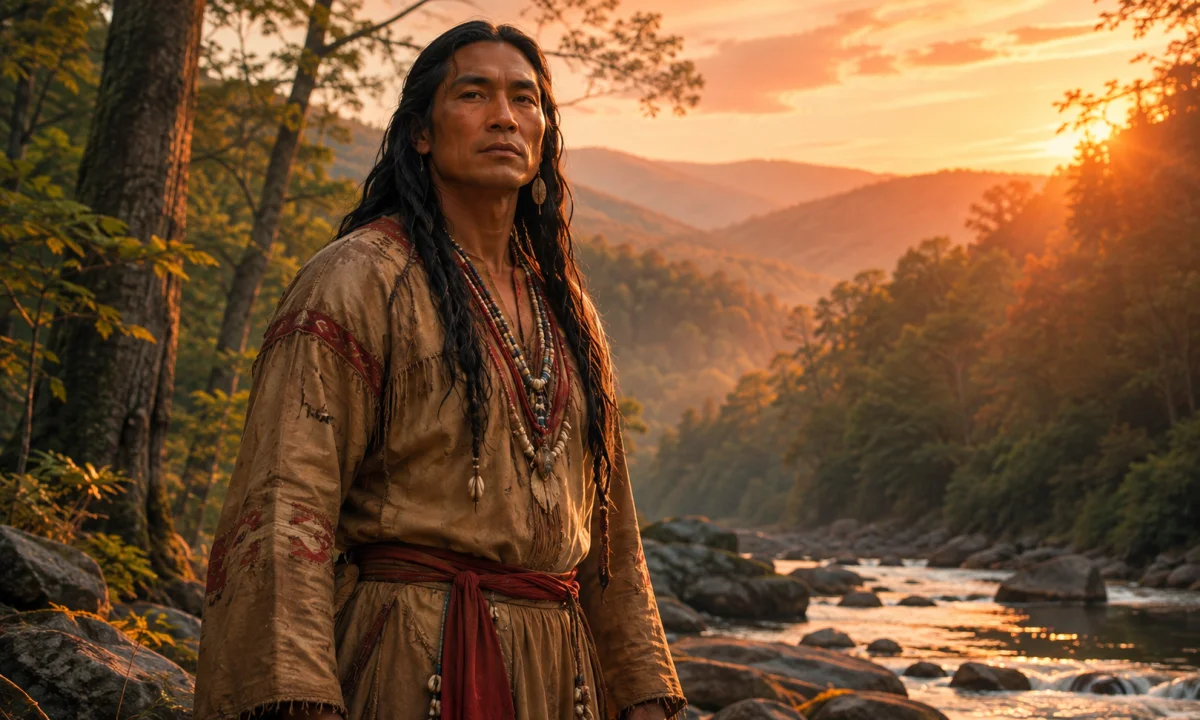
Traditional descriptions do not give Unelanuki a stable physical appearance comparable to the images of many classical gods. The creator is often treated as non-human, invisible or beyond ordinary representation. English-language illustrations that show Unelanuki as a robed man, an elderly sage or a warrior are artistic inventions or generalized fantasy images, not established Cherokee iconography.
The absence of a fixed appearance is significant. A creator understood as a spiritual or ordering power does not require a human body, costume or set of visual symbols. Some accounts use personal language because English grammar makes it difficult to speak about a being without using pronouns. That grammatical choice should not be mistaken for evidence that Cherokee tradition consistently imagined Unelanuki as a human-shaped male deity.
The figure’s most important attributes are therefore conceptual. Unelanuki is associated with creation, arrangement, order and the conditions that allow the world to exist. These attributes differ from the powers of more specialized beings or natural forces. The sun, animals, disease spirits and other sacred entities may have their own roles and stories; they should not automatically be treated as forms or servants of Unelanuki.
Creation stories and their variations
The world emerging from water
A recurring Cherokee creation motif presents a world that is not yet ready for human habitation. Water covers the surface, and animals investigate what lies below. A small creature succeeds in reaching the bottom and carries mud upward. The mud spreads to form the earth. This episode emphasizes cooperation, persistence and the importance of beings that might appear weak or insignificant when judged by human standards.
In some retellings, the earth is suspended or supported in a larger cosmic structure, and its stability depends on relationships among the upper world, the earth and the waters below. Such descriptions should not be combined into one rigid map of Cherokee cosmology, because accounts differ in the number of worlds, their arrangement and the beings associated with them. The idea of a layered universe is widespread in recorded Cherokee narratives, but its expression is not identical in every source.
The shaping of the landscape
The story of the great bird explains the irregular shape of the land. When the bird flies low, its wings produce depressions and raised places. In this way, mountains and valleys are connected to movement, breath and the activity of a living creature. Some modern retellings assign the bird’s mission directly to Unelanuki, while others tell the episode without making the creator an active participant.
This distinction matters because the Cherokee narrative tradition frequently gives animals agency and intelligence. Animals are not merely tools used by a distant creator. They can be discoverers, advisers, culture heroes and teachers. Presenting every animal in a creation story as an instrument of Unelanuki can flatten the narrative’s emphasis on the relationships among different kinds of beings.
Light, heat and the sun
Stories about the sun describe the practical and moral problem of too much or too little light. The sun may be placed too near the earth, causing excessive heat, or too far away, creating cold and darkness. Other episodes explain why people cannot approach the sun or why daylight follows a regular path. These accounts express the importance of balance in the natural world.
Because the sun has a prominent role in Cherokee sacred narratives, some sources have treated it as a manifestation or dwelling place of the creator. That interpretation is not universal. The sun may instead be a distinct sacred being or a powerful element within the created order. Unelanuki and the sun should not be merged without recognizing that different traditions describe their relationship differently.
Relationship to Cherokee religious life
Cherokee religious thought has traditionally placed strong emphasis on proper relationships and the responsible use of spiritual power. Rituals, medicine practices, observances connected with the seasons and respect for animals all formed part of a wider religious world. The creator’s importance lies not only in having made the world, but also in the order that connects humans with the rest of existence.
Older English accounts sometimes describe Cherokee religion as if it had one supreme god above a collection of lesser gods. That structure may reflect European theological categories more than Cherokee ones. Cherokee sacred beings and powers do not always fit neatly into the categories “god,” “spirit,” “demon” or “mythological creature.” A figure may be powerful, localized, dangerous, helpful, ancestral or associated with a natural phenomenon without belonging to a fixed hierarchy.
Unelanuki is also not best understood as a moral judge in the same sense as the deity of some monotheistic traditions. The surviving accounts do not provide a universally accepted doctrine of sin, punishment and salvation centered on this figure. The creator’s significance is more often connected with the existence and arrangement of the world than with a detailed system of eternal reward and punishment.
Sources, transmission and interpretation
The most widely circulated descriptions of Cherokee mythology come from written records made after generations of cultural disruption, forced removal and missionary activity. The destruction of communities and the suppression of Indigenous languages and ceremonies affected what could be recorded and how it was presented. Some traditional knowledge was kept within Cherokee families and ceremonial communities rather than shared with outsiders.
Written collections may preserve genuine narratives while still reflecting the recorder’s choices. A storyteller may have adapted a story for an English-speaking audience, combined details from different tellers, or used a Christian term such as “God” to make a Cherokee concept understandable. Modern websites sometimes simplify these records further, turning a complex creator tradition into a character with a fixed appearance, a list of powers and a neatly defined mythology.
Responsible descriptions therefore use qualified language. It is reasonable to say that Unelanuki is a name associated with the Cherokee creator. It is less reliable to claim that every Cherokee community has always used that exact spelling, that the being has one universally accepted appearance, or that all Cherokee creation stories follow one sequence.
Distinction from similar figures
Unelanuki should not be confused with Kanati, a culture hero and ancestral figure in Cherokee stories, or with Selu, the Corn Mother. Kanati and Selu belong to important narratives about hunting, agriculture, food and the origins of cultural life, but they are not simply alternate names for the creator. Their stories operate at a different level from accounts of the formation of the cosmos.
Unelanuki should also be distinguished from the sun and from animal beings such as the great buzzard or the water-diving creature in creation narratives. These figures may take part in the shaping of the world, yet participation does not make them manifestations of the creator. Nor should Unelanuki be equated automatically with figures from neighbouring Southeastern Indigenous traditions, even when those traditions contain similar earth-diver or creator motifs.
Modern reception
Unelanuki has limited presence in mainstream popular culture. The name appears chiefly in online mythology lists, comparative religion discussions, fantasy writing and generalized references to Native American creation figures. These treatments often present the figure as a clearly defined “supreme god,” an interpretation that may be convenient for modern classification but does not capture the variation of Cherokee traditions.
Contemporary interest is more responsibly directed toward Cherokee language, history, storytelling and living cultural institutions than toward treating Unelanuki as a fantasy character detached from the Cherokee people. The name belongs within the context of a living Indigenous tradition whose narratives have been transmitted through communities, languages and relationships with the land, not merely within a catalogue of interchangeable mythological deities.