WORLD
WORLD
Ew’ah

Ew’ah is a name sometimes presented in modern summaries of Cherokee mythology, but its identity is uncertain. Unlike well-attested figures such as Selu, Kanati, Uktena, Little Deer, or the Raven Mocker, Ew’ah does not have a clearly established place in the best-known recorded Cherokee narratives. Descriptions of Ew’ah as a goddess, spirit, or celestial being vary considerably, and many popular accounts provide no identifiable Cherokee-language, oral-history, or historical basis for their claims.
The problem of identifying Ew’ah
Cherokee religious traditions were preserved primarily through oral teaching, ceremonial practice, family knowledge, and community storytelling. Written records were made by outsiders, missionaries, ethnographers, and later Cherokee scholars, often using inconsistent systems for representing Cherokee words. As a result, a name can appear in several spellings, be misunderstood by a recorder, or be detached from the story and cultural setting in which it originally had meaning.
The spelling Ew’ah, including the apostrophe, should therefore not automatically be treated as an authoritative traditional form. The apostrophe may reflect an attempt to represent a sound in Cherokee, but it does not by itself establish a figure’s identity or importance. Cherokee is written today in a standardized syllabary as well as in different romanization systems, while older English-language records used a variety of spellings.
There is no single, universally recognized Cherokee account that defines Ew’ah’s appearance, powers, genealogy, or role. Some recent websites and popular mythology lists describe Ew’ah as a Cherokee goddess, sometimes associating the name with the moon, night, nature, or the feminine principle. These descriptions are not consistent with one another, and they should be treated as modern attributions rather than as securely documented elements of Cherokee tradition.
Cherokee religious and cultural setting
Understanding the uncertainty around Ew’ah requires some knowledge of Cherokee cosmology. Traditional Cherokee thought does not always divide the supernatural world into a fixed pantheon of gods and goddesses in the manner familiar from classical Greek or Roman mythology. Cherokee stories describe powerful beings, animals, ancestral figures, celestial bodies, spirits, monsters, and forces connected with health, danger, food, weather, and ceremonial life.
These beings do not all belong to the same category. Some are benevolent or helpful, some are dangerous, and others may act in ways that are neither simply good nor evil. A figure’s importance may depend on a particular story, ceremony, clan tradition, or place rather than on membership in a formal divine family.
Cherokee traditions also place strong emphasis on relationships between humans, animals, plants, and the wider cosmos. The origin of cultivated food, the proper treatment of game animals, illness, dreams, ritual power, and the movement of the sun and moon can all be connected within a broader religious understanding. A name encountered in isolation may consequently be difficult to classify. It might refer to a spirit, a personal name, a local tradition, a mistranscription, or a character whose significance was not preserved in widely circulated English texts.
Possible classifications
Modern descriptions commonly label Ew’ah a goddess, but that classification is not securely established. The word “goddess” can impose an external model on Cherokee traditions, especially when a female supernatural figure is removed from her original narrative context. A more cautious description is “a figure attributed to Cherokee mythology in some modern sources.” This wording acknowledges the name without presenting uncertain material as established tradition.
Several different identities have been attached to Ew’ah in secondary accounts:
- Some portray Ew’ah as a lunar or night-associated being.
- Others connect the name with nature, the earth, or seasonal change.
- Some list Ew’ah among Cherokee deities without assigning a specific story or function.
- A few accounts give the figure a highly elaborate personality and mythology, but these details are often repeated without a traceable traditional context.
Because these interpretations conflict, none should be treated as definitive. In particular, there is no reliable basis for combining every moon, nature, fertility, or feminine attribute found online into one traditional Cherokee character named Ew’ah.
Attributes and appearance
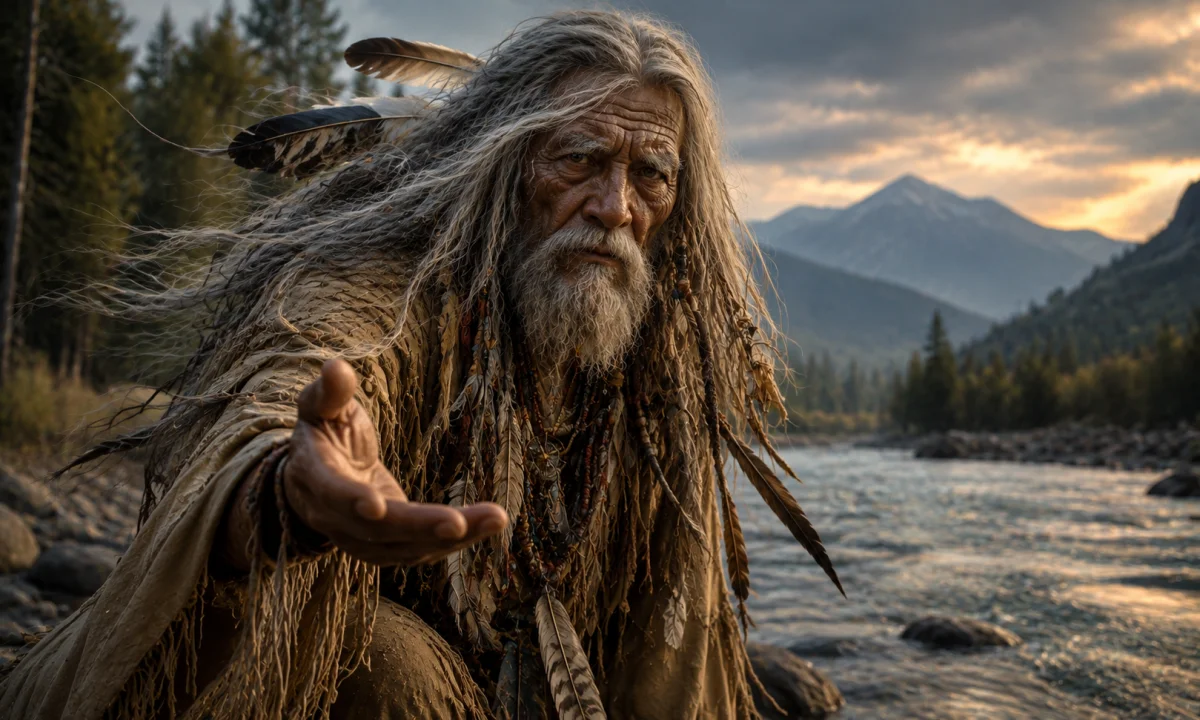
No stable traditional description of Ew’ah’s appearance is widely documented. Images of a young woman surrounded by moonlight, flowers, stars, or forest animals belong mainly to modern artistic convention. They may be effective visual interpretations, but they should not be presented as evidence of Cherokee belief.
The same caution applies to claims that Ew’ah possesses particular powers. Statements that she controls the moon, governs fertility, protects animals, guides dreams, or rules the seasons are sometimes repeated in popular summaries, yet there is no consistent body of traditional narrative supporting all of these functions. Such traits may have been inferred from broad themes in Cherokee cosmology or assembled from unrelated traditions.
Cherokee stories do contain important female figures and powerful beings associated with food, celestial bodies, transformation, and the natural world. Their existence, however, does not validate an unverified identification of Ew’ah with any one of them.
Relationship to better-documented Cherokee figures
Selu
Selu, often called Corn Mother, is one of the best-known female figures in Cherokee origin traditions. She is associated with corn and the sustaining power of cultivated food. In stories about Selu and her husband Kanati, the actions of their sons lead to the revelation of how corn can be obtained and grown. Selu’s story is concerned with food, sacrifice, transformation, and the obligations that sustain human life.
Because Selu is a powerful female figure connected with nature and nourishment, modern writers sometimes place other uncertain “goddesses” beside her or treat them as equivalent. There is no good reason to identify Ew’ah with Selu. They should remain separate unless a specific Cherokee source demonstrates otherwise.
The Sun and the Moon
Cherokee stories personify celestial bodies, particularly the Sun and Moon, but these figures do not necessarily correspond to the male-and-female deity pairs found in other mythological systems. In a well-known story, the Sun’s heat becomes difficult for human beings to endure, and people develop a plan involving her daughter. The narrative reflects questions of distance, heat, illness, death, and the relationship between human communities and celestial powers.
The presence of a female Sun in Cherokee tradition may have encouraged later writers to describe Ew’ah as a sun or moon goddess. Yet the names and stories of the Sun and Moon should not be replaced with Ew’ah without evidence. A general association with night or the moon in a modern list is not sufficient to establish that Ew’ah is the Cherokee Moon.
Uktena and other powerful beings
Uktena is a dangerous horned serpent associated with extraordinary power and peril. Other Cherokee traditions speak of beings such as the Tlanuwa, enormous bird-like creatures, and the Raven Mocker, a harmful supernatural being associated with death. These figures belong to narrative and religious contexts very different from the vague “goddess” descriptions attached to Ew’ah.
Similar confusion can occur when names are copied between websites. A list may place a deity, animal spirit, monster, and culture hero in the same category simply because all are supernatural figures. Cherokee tradition contains many kinds of beings, and classification matters when interpreting their stories.
Stories and surviving tradition
A major difficulty is the absence of a widely recognized cycle of stories centred on Ew’ah. There is no stable account of her origin, family, conflict, worship, or interaction with human beings that can be safely summarized as traditional Cherokee mythology. Accounts that provide a complete biography often use confident language without explaining whether the material comes from a Cherokee storyteller, a historical record, a linguistic analysis, or a modern reconstruction.
This does not prove that no Cherokee person has ever used the name or that no local tradition has included a similarly named figure. Cherokee knowledge has never been limited to the material published in English, and different communities may preserve traditions that are not represented in standard collections. The appropriate conclusion is narrower: the available, widely circulated evidence does not establish Ew’ah as a clearly defined pan-Cherokee deity.
Traditional knowledge should also not be judged solely by whether it appears in an old book. Written collections were selective and sometimes shaped by the expectations of their recorders. At the same time, a modern internet page should not be treated as proof merely because it uses Cherokee terminology or supplies an elaborate list of attributes. Both early documentation and modern retellings require careful evaluation.
Interpretation and cultural significance
Ew’ah illustrates the difficulties involved in reconstructing Indigenous religious traditions from disconnected names. A figure may acquire an apparently complete mythology through repetition: one website supplies an occupation, another adds a symbol, and later writers present the combined material as ancient tradition. Over time, invented or speculative details can become difficult to distinguish from documented belief.
The name can still be discussed meaningfully, but the discussion should preserve the difference between evidence and interpretation. It is reasonable to say that modern audiences may use Ew’ah as a symbol of the moon, feminine power, ecological balance, or the sacred natural world. It is not reasonable to state these meanings as settled Cherokee teachings without a reliable cultural source.
This distinction is especially important because Cherokee religious concepts are connected with living communities, language, ceremony, and responsibilities toward the natural world. Turning an uncertain name into a universal “goddess” can flatten that context and make Cherokee tradition resemble a conventional pantheon assembled for modern readers.
Modern reception
Ew’ah appears chiefly in contemporary mythology databases, spiritual writing, fantasy discussions, and social-media lists that seek names for a Cherokee goddess or nature spirit. These uses may draw on genuine interest in Cherokee culture, but they often provide no distinction between historical tradition and creative interpretation. The polished appearance of a description is not evidence of antiquity.
In modern fiction or artwork, Ew’ah may be reimagined as a lunar guardian, forest spirit, or embodiment of feminine nature. Such portrayals can exist as creative adaptations when they are clearly identified as modern inventions. They should not be used to establish what Cherokee people traditionally believed.
For the present, the most accurate classification of Ew’ah is therefore an uncertain or weakly documented name associated with Cherokee mythology in modern sources. Claims about a specific identity, appearance, power, or mythological family remain unverified unless supported by a clearly identified Cherokee tradition or by dependable historical and linguistic evidence.