WORLD
WORLD
Swan Maidens
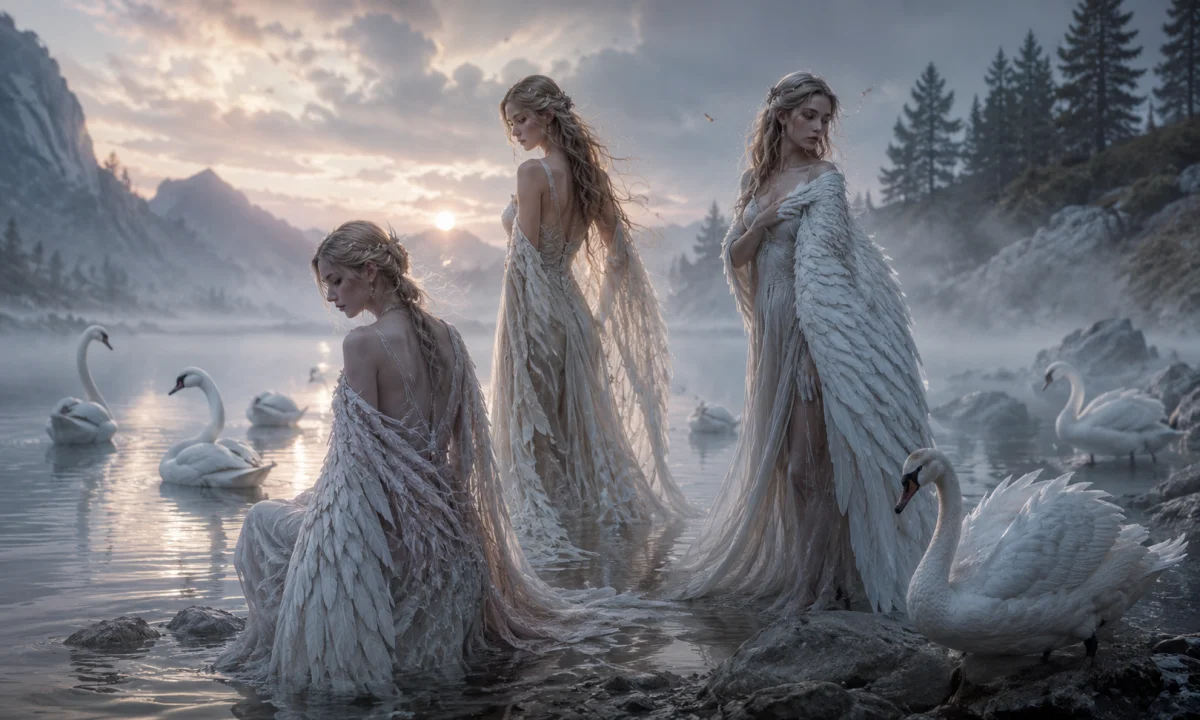
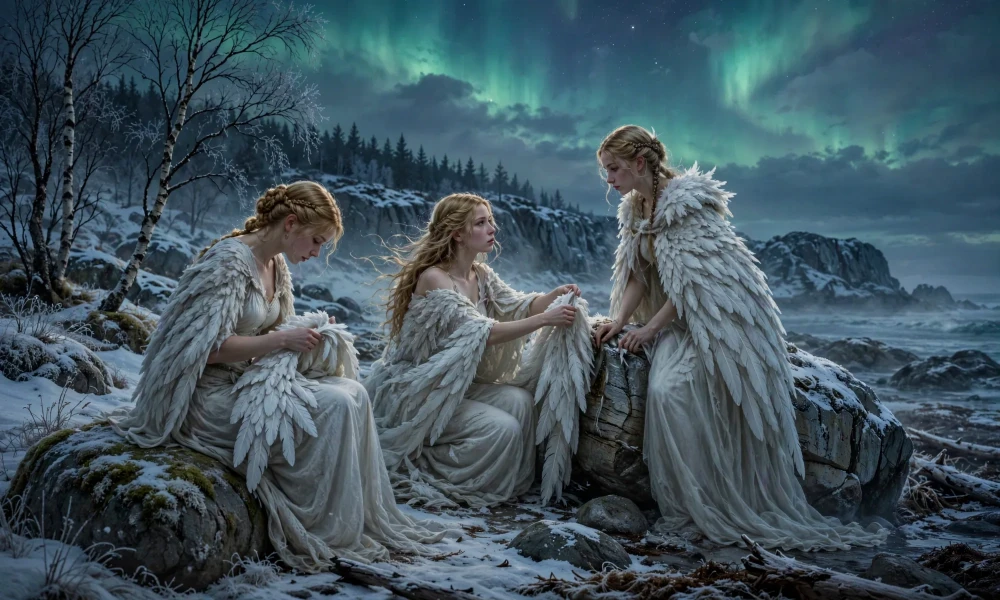
Swan maidens are a widespread figure in folklore and myth: supernatural women who can transform into swans, or who take human form after removing a feathered garment. In a Norse mythology context, the term is often used for the valkyries in swan shape, especially in stories where a woman’s bird-form is tied to enchantment, marriage, and the loss of freedom. The image is best understood as part of the wider North European tradition of shape-shifting beings, rather than as a single fixed class with one agreed origin or one canonical story.
In Old Norse sources, the most directly relevant figures are not called “swan maidens” as a formal category. Instead, the tradition includes valkyries who may appear as swan women, as well as a broader set of bird-bride or feather-robe motifs found in later folklore. Because the surviving evidence is fragmentary and varied, “swan maidens” is a useful modern label for a pattern of belief and storytelling, not a precise native term from Norse religion.
Origins and cultural setting
The Norse world of the Viking Age and the medieval Icelandic literary tradition preserved in the Poetic Edda and Prose Edda did not leave a single systematic doctrine about swan maidens. What survives instead are poems, myths, heroic tales, and later prose retellings in which bird transformation, magic cloaks, and female supernatural figures appear in overlapping ways. These materials were recorded in Christian Iceland centuries after the pagan period, so the texts mix older oral tradition with later literary shaping.
Bird transformation itself has deep roots in northern European folklore. Birds can signal otherworldly travel, fate, liminality, and contact with the supernatural. Swans, in particular, carry strong associations with beauty, purity, movement between worlds, and sexual or marital symbolism. In Norse and related Germanic traditions, a swan may indicate that a woman is not fully human, or that her power depends on a concealed garment or skin.
Scholars commonly connect the swan maiden motif with a wider family of “animal bride” stories found across Eurasia. In those tales, a man steals or hides the garment that allows a supernatural woman to fly away, forcing marriage or negotiation. The Norse material does not always fit that exact pattern, but it shares important elements: transformation, hidden identity, and a tension between freedom and domestic life.
Name, identity, and classification
The English phrase swan maiden is a descriptive label, not a strict translation of a single Old Norse word. In Norse texts, the most important related beings are the valkyries, female figures associated with battle, death, and the selection of the slain. Some valkyries are said to wear swan shirts or bird garments, which allow them to fly. In those contexts, they can be described as swan maidens, though they remain valkyries first and foremost.
Because the evidence is uneven, it is important not to collapse all bird-women into one category. Some stories involve valkyries; others belong to later folktale traditions in Scandinavia that may have absorbed older mythic themes. In some cases, the swan maiden is a magic bride, in others a cursed woman, and in others a non-human being who enters human society temporarily. The identity and status of each figure depend on the specific source.
Another point of uncertainty is whether the swan garment should always be imagined as a feather cloak, a swan skin, or a magical dress. Different traditions use different imagery. Modern retellings often standardize the motif, but the older material is less uniform.
Appearance and powers
Swan maidens are typically imagined as beautiful women with a supernatural aura. Their swan form may be fully avian, while their human form is often strikingly graceful and otherworldly. In the Norse context, the bird-woman is not merely decorative; she is usually a figure of power and mobility. The ability to change form allows movement between landscapes, realms, or social roles.
The central power associated with swan maidens is shape-shifting. In the strongest version of the motif, the woman can become a swan by wearing a magical skin or garment and can resume human shape by removing it. This object is often the key to the story: if it is hidden, stolen, or destroyed, the woman may be trapped in human life. That theme turns transformation into a vulnerable condition rather than a simple magical talent.
In a Norse mythic setting, swan-maiden imagery also overlaps with flight and fate. Valkyries ride through the air, choose slain warriors, and serve a role between gods and humans. When they are associated with swan garments, the bird form underscores their supernatural freedom and their separation from ordinary mortal life.
Valkyries and swan-shape in Old Norse tradition
The clearest Old Norse connection appears in stories where valkyries wear swan shirts. These figures are not separate from valkyries; rather, the swan form is one of their manifestations. The best-known narrative pattern occurs in the story of the Völundarkviða and related traditions, where women associated with swans interact with human men. In that poem, three valkyries are linked to swan feathers or swan skins, and the men with whom they are involved take their bird garments, which affects the women’s freedom.
The exact relationships in such stories vary by source, and the surviving texts are not always straightforward. Some versions frame the women as valkyries resting by a lake in swan form; others emphasize marriage or captivity. What remains consistent is the idea that a female supernatural being can inhabit both a bird body and a human body, and that the garment or skin is central to the transition.
These narratives are not merely romantic. They often involve power imbalance, possession, and the consequences of crossing boundaries between worlds. A mortal man who controls the swan garment may gain a wife, but he also steps into a dangerous relationship with the supernatural. The woman’s loss of her bird-form can signify forced domesticity, while her eventual recovery of it may signal the restoration of autonomy.
Relation to the valkyries
Valkyries are better known in Norse mythology as choosers of the slain, attendants of Odin, and sometimes as lovers or wives of heroes. The swan-maiden motif is one aspect of their broader identity in some poems and sagas. It is not accurate to say that all valkyries are swan maidens, or that all swan maidens are valkyries. Still, in Norse mythic literature, the overlap is strong enough that many modern discussions treat swan shape as one of the valkyries’ forms.
This overlap also matters for interpretation. A valkyrie in swan shape is still connected to battle, death, and elite heroic culture, whereas a folktale swan maiden may be a more general magical bride. The same visual image can carry different meanings depending on context.
Stories and narrative patterns
Several recurring story patterns appear in traditions that can be grouped under the swan maiden motif.
- The garment stolen or hidden: a man discovers supernatural women bathing or resting, takes their feather garments, and prevents them from leaving.
- The forced marriage or union: the woman remains among humans, often as a wife, while longing for her lost freedom.
- The recovered identity: the hidden garment is eventually found, and the woman departs, sometimes with children, sometimes after conflict, sometimes after a negotiated return.
- The two-world existence: the woman lives for a time as both human and non-human, highlighting the instability of identity and belonging.
In specifically Norse literary material, the swan motif is not always framed as a simple folktale about a stolen cloak. Instead, it may appear in a heroic or mythic setting where the women are already supernatural and the loss of bird garments is part of a larger story about binding, separation, and destiny. The story of Völundr is especially important because it combines craft, captivity, revenge, and the vulnerability of supernatural women in human hands.
Some later Scandinavian folk narratives preserve a more familiar swan-maiden structure, though the details vary by region and collection. Because these are later and often local traditions, they should not be presented as direct ancient Norse myth. They are better understood as descendants, cousins, or reinterpretations of older motifs.
Symbolism and interpretation
Swan maidens carry several layers of meaning in Norse and related northern traditions. The swan is a creature of water and air, and therefore an emblem of transition. A woman who can become a swan belongs to neither realm fully, which makes her a potent symbol of threshold states: between nature and culture, freedom and marriage, the wild and the domestic, the divine and the mortal.
The motif also invites reflection on gender and agency. In some readings, the hidden garment represents control over female mobility and consent. The man who steals it does not simply win a bride; he asserts power over her ability to leave. That interpretation is especially prominent in modern scholarship and literary analysis, though it is not the only possible reading. Older audiences may also have seen the motif as an explanation for extraordinary beauty, an illustration of supernatural marriage, or a narrative about the costs of crossing boundaries.
For the valkyries in particular, swan imagery may heighten their distance from ordinary human life. As beings linked to battle and death, they already occupy an in-between position. The swan adds elegance and fragility to figures who are also formidable and dangerous. This contrast is part of the enduring appeal of the motif.
Relationship to marriage and sexuality
One of the most discussed features of the swan maiden tradition is the marriage plot. The bird-woman often becomes a wife, whether by choice, coercion, or circumstance. In mythic storytelling, marriage can serve as a bridge between human and supernatural worlds. At the same time, the motif may dramatize anxieties about possession, fidelity, and the limits of ordinary domestic life.
It is important not to impose a single moral on these stories. Some versions emphasize the tragedy of separation; others focus on the dangers of violating a supernatural being’s autonomy; others treat the union as a wondrous but unstable alliance. In a Norse context, the stories can also reflect heroic values, where human men encounter women who are not fully subject to human norms.
Distinction from similar figures
Swan maidens are sometimes confused with several other beings in Norse and European tradition, but they are not the same.
- Valkyries: Some swan maidens are valkyries, but valkyries are a broader class associated with battle and the dead. Not every valkyrie is a swan maiden.
- Shieldmaidens: These are female warriors, whether historical, literary, or legendary. They are human or semi-legendary figures, not bird-women.
- Selkies: Northern seal-people from later Scottish and Irish folklore also lose a skin or covering, but they belong to a different cultural tradition.
- Feathered deities or bird forms: Some myths feature gods or spirits taking bird shape, but that does not make them swan maidens in the folktale sense.
The distinction matters because popular retellings often flatten these figures into one generalized “magic bird woman.” In source-based discussion, the cultural setting and the function of the figure should remain clear.
Historical evidence and limits of reconstruction
There is no single archaeological object or direct cult practice that proves a formal “swan maiden religion” in pre-Christian Scandinavia. The evidence comes from literature, comparative folklore, and later tradition. That means reconstruction must remain cautious. Some elements may preserve older mythic material; others may be literary inventions or later embellishments.
For that reason, the safest historical statement is that bird-women, swan imagery, and shape-shifting female supernatural beings are genuinely present in the Norse textual record, but the exact boundaries of the tradition are uncertain. Modern readers should resist turning the motif into a rigid system. The surviving sources preserve a cluster of related ideas rather than a unified doctrine.
Later reception and modern popular culture
In modern times, swan maidens have become a familiar fantasy image, often detached from their original Norse and folkloric settings. Ballet, opera, illustration, role-playing games, novels, and animated media have all used the swan-woman as a symbol of enchanted femininity. The best-known popular example is probably the broad “swan maiden” trope in fantasy art and romantic fiction, where the feathered woman is treated as a mysterious, tragic, or noble figure.
When the motif is specifically linked to Norse mythology, modern adaptations often draw on valkyries, but they may simplify the historical material. They may present all valkyries as bird-women or use the swan maiden as a generic Norse fairy-tale heroine. Such versions can be imaginative, but they should not be mistaken for ancient tradition. The older sources are narrower, stranger, and less standardized than popular culture usually suggests.
Even so, the modern popularity of the swan maiden owes much to the power of the original motif. The image of a woman who can shed a swan form, or who is bound to it, remains compelling because it expresses a tension between beauty and loss, freedom and captivity, and the human desire to possess what is by nature untamable.