WORLD
WORLD
Surt
Surt is a giant or fire-being from Norse mythology, best known as the guardian or wielder of the fires of the south and as a central figure in the destruction of the world at Ragnarök. In the surviving Old Norse sources, Surt belongs to the mythic world of giants and cosmic forces rather than to the family of the gods, and he is associated above all with fire, burning, and the final conflict between order and chaos. His name is usually rendered in modern English as Surt or Surtr.
Sources and mythic setting
Knowledge of Surt comes primarily from medieval Icelandic texts written after the conversion to Christianity, especially the Poetic Edda and the Prose Edda. These works preserve older mythic material, but they are not simple records of pre-Christian religion. They reflect oral tradition, poetic inheritance, and learned compilation, so details about Surt vary and must be treated cautiously.
In the mythological worldview of the North, the cosmos is divided among several realms and inhabited by gods, giants, elves, dwarfs, and other beings. Surt is linked to Muspell or Muspellsheimr, the fiery region at the edge of the cosmos. In some texts, the term Muspell seems to refer to both a place and the powers associated with fire and destruction. Surt stands among those powers as a threatening figure at the boundary between creation and annihilation.
Name and identity
The Old Norse name Surtr is commonly understood to mean “black” or “the black one,” though the exact history of the word has been discussed by scholars. This may seem surprising for a being linked to fire, but mythic names often work symbolically rather than literally. Blackness may evoke soot, char, or the dark shape of a figure seen against flames. Because the sources are limited, it is safer to say that the name is traditionally interpreted in this way rather than to present the meaning as certain.
Surt is not a god in the usual sense of an Æsir or Vanir deity. He is more often treated as a jötunn, the Old Norse category commonly translated as giant. Yet the giant category in Norse tradition is flexible and should not be reduced to a simple fairy-tale idea of a giant. Jötnar can be monstrous, wise, primordial, or closely entangled with the gods. Surt belongs to the destructive and cosmic side of that family of beings.
Appearance and attributes
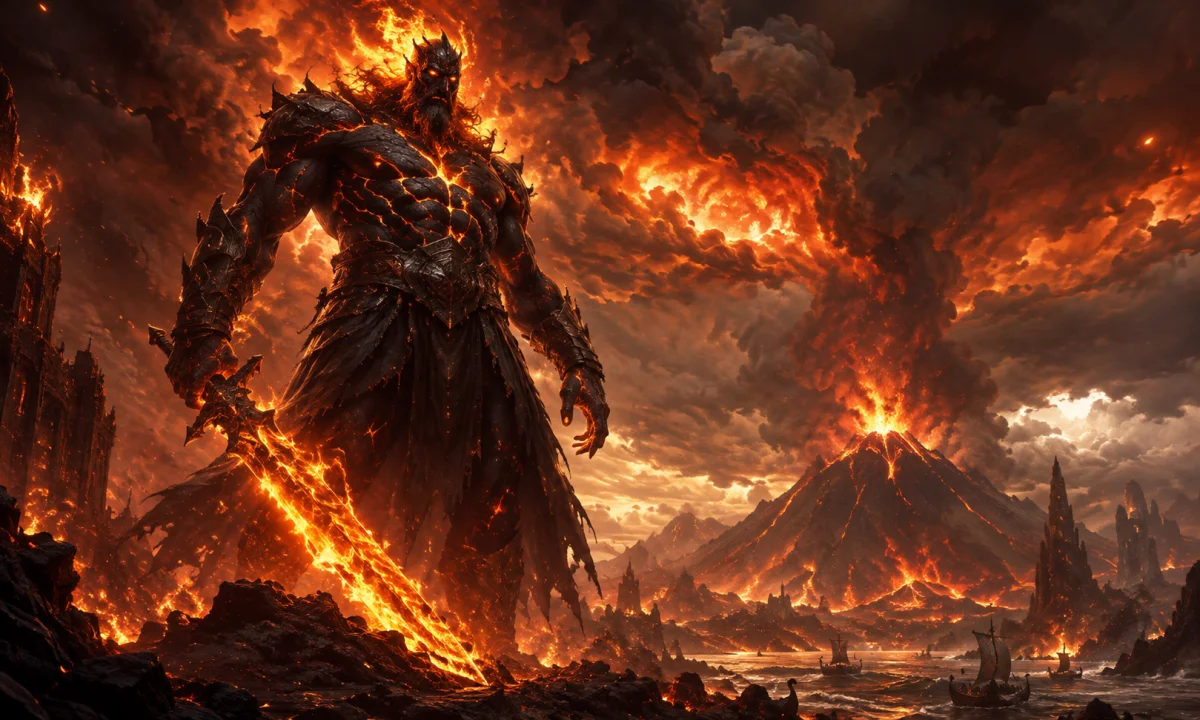
The surviving texts do not offer a detailed portrait of Surt’s body in the way later art often does. What is clear is his association with fire and his role as a bearer of a flaming sword. In the Prose Edda, he is described as coming from the south with fire, and at Ragnarök he is said to ride or lead an army from Muspell. His sword is one of the most striking features attached to him in the tradition, and later interpretations often show it as a blazing weapon capable of setting the world alight.
Surt is also associated with the idea of guarding or commanding the threshold of fiery destruction. In some readings, he is not merely a brute force but a keeper of a dangerous cosmic order: fire belongs to him, and at the end of time he releases or unleashes it. This makes him more than a simple destroyer. He is part of the structure of the mythic universe, representing a force that exists before the end and remains active at the end.
Surt in the story of Ragnarök
Surt’s most important role is at Ragnarök, the catastrophic end of the world in Norse myth. In the poem Völuspá, he appears as a major agent in the final destruction. He comes from the south with the fiery forces of Muspell, and his presence is tied to the burning of the world. The image is not merely of battle but of cosmic collapse: the heavens, earth, and social order are consumed in fire and ruin.
The Prose Edda elaborates on this role. In its account, Surt comes from the south with fire, and after the battle he will cover the earth in flames. A famous detail is that he is said to strike against the world tree or set the world on fire, though the exact wording and emphasis vary by text. The common theme is clear: Surt is the final incendiary force who brings the age of the gods to an end.
In the surviving mythic narrative, Ragnarök is not only destruction. After the burning and flooding, the world is renewed, and a new generation of beings emerges. Surt’s role belongs to the old world’s ending, not to the new world’s building. He does not appear as a creator or restorer. His significance lies in the necessary completion of a cosmic cycle.
Relations to other mythic figures
Surt’s relationship to other beings is not fully developed in the sources, but he is linked to several key figures and groups. He is associated with the fire beings of Muspell, sometimes called Muspell’s sons or followers. These may be imagined as a host of destructive beings accompanying him at Ragnarök, though the texts do not always provide clear individual identities.
He is also placed in opposition to the gods, especially Freyr. In the Prose Edda, Freyr is said to have once given away his sword, which later leaves him at a disadvantage when he fights Surt at Ragnarök. This is one of the strongest narrative connections involving Surt. Freyr and Surt meet in the final battle, and Freyr is doomed because he lacks the weapon he surrendered long before. The pairing gives Surt an important role in the structure of fate and consequence.
Some traditions and modern retellings present Surt as an enemy of Óðinn, Thor, or the gods collectively, but the specific preserved sources are more restrained. He belongs to the larger final conflict rather than being a recurring adversary in the way some mythic villains are in later storytelling.
Surt and Muspell
The link between Surt and Muspell is one of the most debated parts of his tradition. In older scholarship, Muspell was sometimes treated almost as a proper name for a being or a realm, while more recent interpretations prefer to distinguish between the place, the fire force, and the figure of Surt himself. The evidence is fragmentary, so exact conclusions are uncertain.
What can be said with confidence is that Surt belongs to the fiery south and to the power of burning. Muspell is the mythic zone that defines his origin or sphere of action. In some poems, the heat of Muspell is presented as a primeval and hostile force, older than human history and outside the ordinary world. Surt embodies that force in a personified form.
Symbolism and cultural meaning
Surt is one of the clearest figures in Norse mythology for the idea of cosmic fire as both destructive and necessary. Fire in myth is rarely only a weapon. It can also purify, transform, and mark endings. Surt’s burning of the world at Ragnarök expresses a vision in which destruction is not random but part of a larger pattern of fate.
His black or dark name, his flaming sword, and his association with the south all contribute to his symbolic power. The south in Old Norse cosmology is often linked with heat and fire, while the sword suggests an active, deliberate force rather than an impersonal natural disaster. Surt is thus both elemental and personal, both a force of nature and a mythic figure with agency.
Scholars have sometimes compared Surt to other fire or apocalypse beings in world mythology, but such comparisons should remain careful. Norse tradition gives him a particular role shaped by its own cosmology, poetic language, and eschatological ideas. He is not simply a “devil” figure, even if later Christian readers may have been tempted to interpret him in that way. The surviving sources present him as an ancient, terrible being whose function is tied to the end of one world and the beginning of another.
Texts and poetic imagery
The literary presentation of Surt is compact but powerful. Norse poetry often relies on dense images rather than extended description, and Surt benefits from that style. A few lines can convey a vast scene: fire from the south, a flaming sword, the world engulfed, the final struggle. Because the texts are allusive, much of Surt’s modern image comes from interpretation of brief passages rather than from a single full narrative.
In the Völuspá, the seeress predicts the coming of Surt and the burning of the earth. In the Prose Edda, Snorri Sturluson organizes myth into prose narrative and gives Surt a more explicit place in the sequence of Ragnarök. These accounts are related but not identical. Differences between them remind readers that Norse mythology survives in multiple literary layers, not one unified canon.
Distinctions from similar figures
Surt is sometimes confused with other beings linked to destruction, fire, or the underworld, but these should not be merged. He is not the same as Loki, even though Loki also plays a major role in Ragnarök and later popular culture often places both in the category of villains. Loki is a trickster and complicated semi-divine figure with many separate traditions; Surt is a fire giant whose role is more narrowly cosmic.
He should also not be conflated with creatures or demons from later Christian imagination. The medieval Icelandic sources were written in a Christian environment, and later readers sometimes filtered pagan figures through Christian ideas of hell and the devil. However, Surt belongs to the pre-Christian mythological world as preserved in medieval literature, not to Christian demonology.
Likewise, Surt is not simply a giant in the ordinary modern sense. The Old Norse jötunn category is broader and more mythic than that. Surt is best understood as a personification of fiery destruction within the Norse cosmic order.
Historical interpretation
Modern scholarship treats Surt as a figure whose meaning likely developed through a combination of inherited myth, poetic convention, and literary shaping. Because the evidence is limited, it is not possible to reconstruct a single original “belief” about him with certainty. He may preserve older ideas about a fiery being from the edges of the world, while his role in Ragnarök reflects the poetic and theological imagination of the medieval North.
Some scholars have noted that the final fire associated with Surt resembles apocalyptic traditions found in other cultures, though similarities do not prove direct borrowing. It may be more useful to see Surt as part of a widespread human pattern in which fire marks world-ending transformation. In the Norse case, however, the fire is tied specifically to the fate of the gods and the cyclical renewal of the cosmos.
Later reception and modern popular culture
Surt has become much more visible in modern fantasy, games, comics, and film than he was in older popular retellings. These versions often expand him into a heavily armored giant or a demonic fire lord, sometimes giving him elaborate backstories that do not appear in the medieval sources. Such portrayals can be entertaining and visually striking, but they are modern inventions rather than traditional Norse details.
In popular culture, Surt is frequently used as a symbol of apocalypse, volcanic power, or elemental evil. This makes him adaptable for fantasy settings, but it can also flatten the subtlety of the original tradition. In the old texts, Surt is not a character developed through dialogue or personality. He is a brief yet potent mythic presence, carrying the final fire that closes the age of the gods.
Modern interest in Surt often comes through broader fascination with Ragnarök. Because he is one of the last and most catastrophic figures in that sequence, he appears in discussions of end-time mythology, Norse-inspired fiction, and symbolic accounts of destruction and renewal. Even when his name is not widely known, his image as the fire-bringer at the end of the world has strongly influenced later imagination.
Key features in the tradition
- Tradition: Norse mythology, preserved mainly in medieval Icelandic texts.
- Type of being: Usually understood as a jötunn or fire giant, not an Æsir god.
- Primary association: Fire, burning, and the fiery realm of Muspell.
- Main role: A leading figure in Ragnarök and the burning of the world.
- Notable weapon: A flaming sword, especially in later textual presentation.
- Important connection: His final battle with Freyr.
- Symbolic function: Cosmic destruction, transformation, and the end of one world-order.
Why Surt matters in Norse mythology
Surt stands out because he gives a face to one of the most powerful ideas in Norse myth: that the world of the gods is finite. The myths do not imagine an endless stable order. They foresee an ending in which fire consumes even divine power. Surt is the figure through whom that ending arrives.
At the same time, his presence shows that Norse cosmology is not only about gods and heroes. It also includes ancient, inhuman forces that lie beyond the control of both gods and humans. Surt is one of the clearest embodiments of that truth: a dark fire-being at the edge of the world, waiting for the final moment when the old cosmos must burn.