WORLD
WORLD
St. Peregrine Laziosi
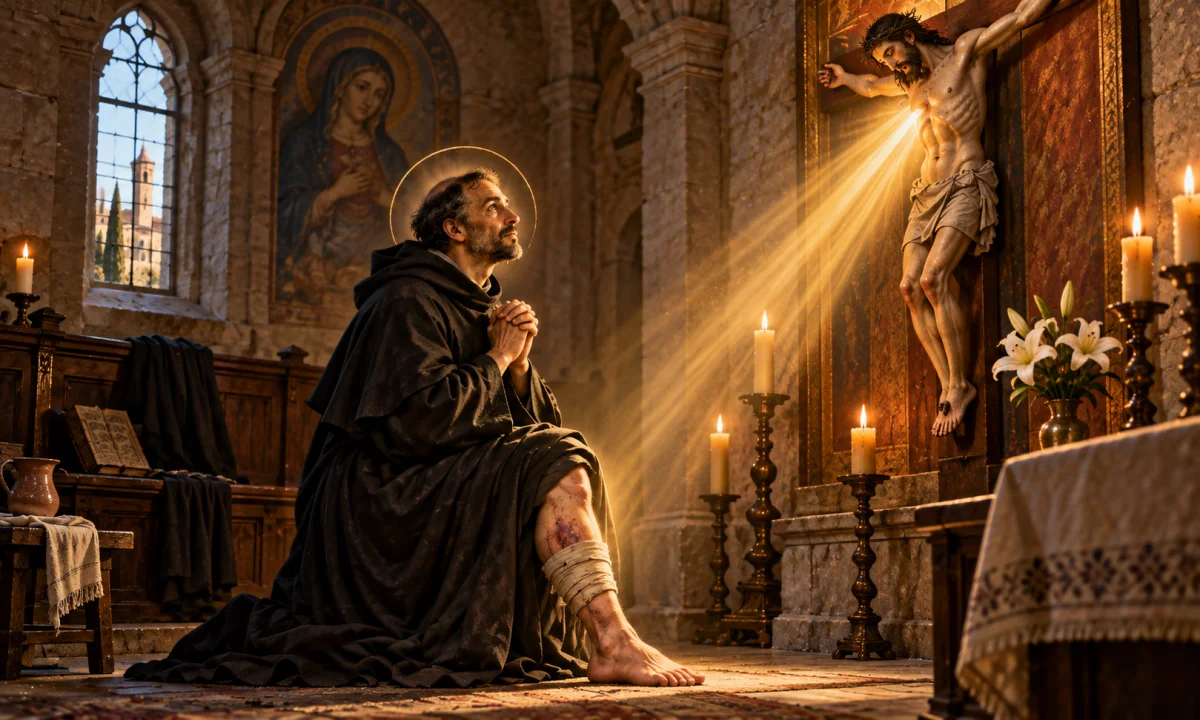
St. Peregrine Laziosi is a fourteenth-century Italian Christian saint, a member of the Order of Servants of Mary, commonly known as the Servites. He is especially associated with repentance, devotion to the Passion of Christ, and prayer for people suffering from cancer and other serious illnesses. His traditional feast is observed on 1 May. In Catholic devotion, he is often called the patron saint of cancer patients, although his reputation developed through later devotional practice rather than from a biblical or early Christian tradition.
Historical setting and religious tradition
Peregrine lived during a period of religious and political tension in medieval Italy. City-states and communes frequently divided into factions that supported either the papacy or the Holy Roman Emperor, while religious orders were expanding their pastoral, charitable, and preaching work. Forlì, in the Romagna region, was a politically active city with strong local loyalties and a history of conflict with papal authority.
The religious order with which Peregrine became associated was founded in Florence in the thirteenth century. The Servites arose from a group of laymen traditionally known as the Seven Holy Founders, who dedicated themselves to prayer, penitence, communal life, and special devotion to the Virgin Mary. The order became particularly identified with meditation on Mary's sorrows and with the compassionate care of suffering people. It received formal papal approval in the early fourteenth century, during Peregrine's lifetime.
Peregrine's life belongs to the period of the mature medieval Church, when saints were remembered through liturgical celebrations, local cults, oral accounts, biographies, and reports of miracles. As with many medieval saints, the surviving accounts combine historical information with religious interpretation. The broad outline of his life is well established within Servite tradition, while some details are preserved chiefly through hagiography—the writing of saints' lives intended to edify believers rather than to provide a modern critical biography.
Name and identity
The saint's name is generally given as Peregrine Laziosi, with Peregrinus Laziosi representing the Latin form. The family name also appears in forms such as Laziosi or Laziosi of Forlì. “Peregrine” comes from the Latin peregrinus, a word associated with a foreigner, traveler, or pilgrim. In Christian language, the idea of the pilgrim also carried spiritual meaning: human life could be understood as a journey toward God.
He should not be confused with other Christian figures named Peregrine or with the various saints and martyrs who bear the Latin name Peregrinus. Several unrelated people in Christian history have been called Peregrine, and the name itself does not indicate a family relationship. St. Peregrine Laziosi is specifically the Servite religious from Forlì who became known for his illness, healing, and ministry.
Early life and conversion
Peregrine was born in Forlì around 1260 into a prosperous family. Accounts describe him as a young man involved in the political and civic conflicts of his city. The most widely repeated story concerns a visit to Forlì by Philip Benizi, the superior general of the Servites. Philip was attempting to preach reconciliation and peace in a city opposed to papal authority.
According to the traditional account, Peregrine reacted angrily to Philip's preaching. He is said to have struck or attacked him, an act that immediately caused him remorse. Philip responded with patience rather than retaliation, and Peregrine was deeply affected by this example of forgiveness. He repented, sought reconciliation, and later entered the Servite order.
The details of the encounter are presented in devotional biographies and should not be treated as independently documented in the same way as a modern administrative record. Nevertheless, the episode expresses a central theme in Peregrine's cult: violent anger is transformed into penitence, humility, and service. His conversion is therefore remembered not merely as a change of religious affiliation but as a moral reorientation.
After joining the Servites, Peregrine was ordained a priest and served the order in the region around Forlì. Tradition remembers him as a preacher, confessor, community leader, and religious known for austerity. He is also said to have spent long periods in prayer and to have practiced forms of penance that were common in medieval religious life. He died in Forlì in 1345, although accounts differ in the precision of the details surrounding his final years.
The illness of his leg
The story most closely associated with St. Peregrine concerns a serious disease of his leg. In the traditional narrative, he developed a painful and worsening condition that was identified by physicians as cancer or as a cancer-like growth. The terminology of medieval medicine was not the same as that of modern oncology, so the diagnosis cannot be translated with complete certainty into a contemporary medical category.
As the illness progressed, the doctors concluded that amputation was necessary. Peregrine accepted this prospect, but before the operation he spent the night in prayer before an image of the crucified Christ. During this prayer, he is said to have experienced a vision in which Christ came down from the cross and touched or healed his diseased leg. The next morning, the physicians found no need for amputation because the wound or growth had disappeared.
This healing is the foundation of Peregrine's association with cancer patients. From the standpoint of Catholic devotion, it is understood as a miraculous intervention. From a historical standpoint, the account is part of the saint's hagiographical tradition, and there is no modern clinical documentation that would allow the event to be medically assessed. The distinction matters: the story is central to his religious meaning, but it should not be presented as a scientifically verified cure or as a substitute for medical care.
Images of Peregrine often emphasize the healed leg. He may be shown lifting his habit to reveal a wound or scar, kneeling before a crucifix, or displaying the affected limb. These representations make the saint immediately recognizable and connect his physical suffering with Christ's Passion.
Religious attributes and symbolism
St. Peregrine is usually depicted wearing the black habit of the Servites. The habit identifies him as a member of the order and also recalls the Servite meditation on the sorrows of the Virgin Mary. He may hold a crucifix, a book, or a lily, although the crucifix and the visible leg are more closely connected with his best-known devotional stories.
His principal symbols include:
- The crucifix: This recalls the vision in which Christ is believed to have healed his leg and represents prayerful participation in Christ's suffering.
- The diseased or wounded leg: This refers to the illness traditionally identified as cancer and to the healing associated with it.
- The Servite habit: This places him within the Order of Servants of Mary and its spirituality of penitence, compassion, and devotion to Mary's sorrows.
- The book: In some representations, it suggests his ministry as a priest, preacher, and religious teacher.
- The lily: When present, it follows a broad Christian artistic convention associating the flower with purity and religious dedication rather than with a unique event in Peregrine's life.
Peregrine's symbolism brings together bodily vulnerability and spiritual endurance. He is not traditionally presented as a saint who avoided suffering. Instead, his story emphasizes the experience of illness, the fear of losing a limb, dependence on others, and hope in the presence of Christ. This has made his devotion particularly meaningful to people who live with chronic or life-threatening disease.
Ministry and character in tradition
Servite tradition remembers Peregrine as a man of prayer, penance, and active pastoral service. His early life is portrayed as marked by anger and political hostility, while his later life is associated with reconciliation and self-discipline. This contrast gives his story a recognizable Christian pattern: conversion is shown through changed conduct rather than through words alone.
He is also remembered as a long-lived religious who continued his responsibilities despite physical weakness. Some accounts attribute extraordinary endurance and other miraculous events to him, as is common in medieval saints' biographies. Such reports belong to the devotional tradition and vary in their details. They should be distinguished from the more consistent core of his identity as a Servite priest of Forlì.
The emphasis on suffering does not mean that Christian tradition regards illness as a punishment for sin. In Peregrine's case, the moral lesson is more often connected with compassion, patience, repentance, and trust. His experience has allowed devotees to approach illness through prayer without reducing a person's worth to a diagnosis or interpreting disease as proof of spiritual failure.
Canonization and development of his cult
Peregrine's veneration began locally and was especially strong among the Servites and the people of Forlì. His body has traditionally been associated with the Basilica of San Pellegrino Laziosi in Forlì, where he remains an important focus of devotion. Local shrines and religious communities helped preserve his memory through liturgy, prayer, images, and accounts of favors received through his intercession.
He was canonized in 1726 by Pope Benedict XIII. By that time, devotion to Peregrine had already existed for centuries, but formal canonization gave his cult wider recognition within the Catholic Church. His feast day is commonly celebrated on 1 May. Particular communities and calendars may organize commemorations or devotional observances according to their own liturgical customs.
The official recognition of a saint's cult does not mean that every detail in every traditional biography has been established as a modern historical fact. Canonization concerns the Church's judgment that a person may be publicly honored as a saint, while individual stories, visions, and miracle accounts remain part of a layered tradition with varying degrees of documentary support.
Patronage of cancer patients
Peregrine's most widespread patronage is connected with cancer and other grave illnesses. People pray to him for healing, strength during treatment, acceptance in the face of uncertainty, and support for families and caregivers. He is also invoked by those facing surgery or the possibility of losing a limb, reflecting the central story of his own disease.
Parishes, hospitals, religious communities, and cancer-support groups may hold novenas or special services in his honor. A novena is a series of prayers traditionally offered over nine days, although forms of prayer dedicated to Peregrine vary considerably. Devotees may ask for his intercession while also seeking professional medical diagnosis and treatment. Within responsible Catholic practice, prayer and medical care are not required to be opposites: devotion can provide emotional and spiritual support without rejecting clinical expertise.
Images or medals of Peregrine are sometimes given to people with cancer. These objects function as signs of solidarity and prayer rather than as magical protections. His significance lies in intercession and companionship within faith, not in an automatic guarantee of recovery.
Interpretation and cultural significance
Peregrine's story is especially powerful because it joins two forms of transformation. The first is moral: a young man associated with anger and civic conflict becomes a religious devoted to service. The second is physical: a threatened amputation is followed, according to tradition, by miraculous healing. Together, these themes present the body and the character as places where change may occur.
His cult also reflects the medieval Christian importance of compassionate suffering. The Servite tradition placed strong emphasis on Mary standing near the cross, and Peregrine's devotion to the crucifix fits naturally within that spiritual world. For later generations, however, his relevance has extended beyond specifically medieval or Servite settings. He has become a familiar figure in Catholic prayer for modern patients whose experiences of diagnosis, surgery, chemotherapy, disability, and uncertainty differ greatly from medieval medicine but still involve fear and hope.
There is no major body of secular popular-culture adaptation surrounding St. Peregrine comparable to that of figures such as St. George, Joan of Arc, or St. Nicholas. His continuing presence is primarily devotional: churches, hospital chapels, prayer cards, statues, novenas, and personal acts of intercession. When modern representations show him beside medical equipment or among cancer patients, they are adaptations of his traditional patronage rather than scenes drawn from his medieval life.
Distinguishing Peregrine from other saints
The name Peregrine appears in the records and legends of several Christian saints, including martyrs and bishops from different periods. Those figures are not versions of St. Peregrine Laziosi, and their feast days, origins, and traditions are distinct. The identifying marks of the Servite saint are his connection with Forlì, the black habit of the Servite order, the encounter with Philip Benizi, the illness of his leg, and the healing associated with prayer before the crucifix.
He should also be distinguished from generic “pilgrim saints” whose names or legends involve journeys. Although the word peregrinus can mean a pilgrim or stranger, St. Peregrine Laziosi is not chiefly remembered for traveling to a famous shrine. His defining journey is the spiritual movement from youthful hostility to religious service, followed by a lifetime of prayer and compassion for the suffering.