WORLD
WORLD
Sleipnir
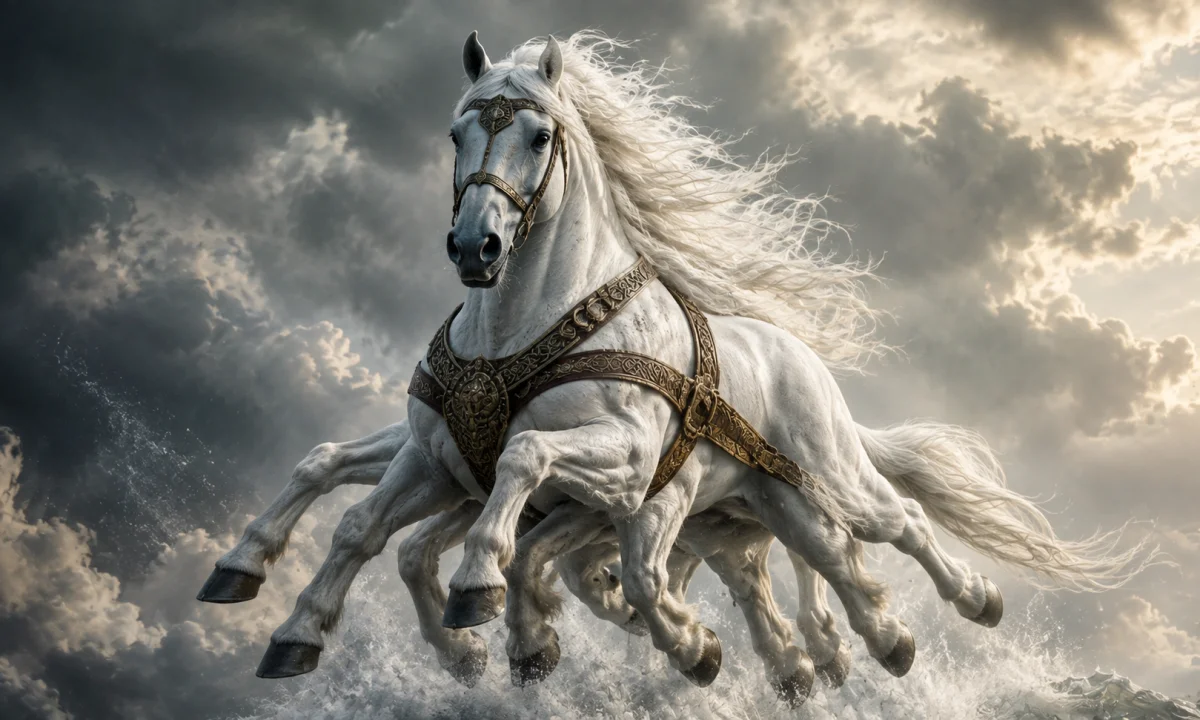
Sleipnir is the eight-legged horse of Norse mythology and the principal mount of the god Odin. Renowned as the fastest and finest of horses, Sleipnir carries Odin across the worlds of the Norse cosmos and appears in stories involving divine travel, the realm of the dead and the supernatural movement associated with Odin. Unlike many legendary animals, Sleipnir has a clearly recorded origin: he is the offspring of Loki and Svaðilfari, a powerful stallion belonging to a disguised giant.
Origins in Norse tradition
Sleipnir is known chiefly from two medieval Icelandic works that preserve older Norse mythological material: the Poetic Edda and Snorri Sturluson’s Prose Edda. These texts were written down in the thirteenth century, after Iceland’s conversion to Christianity, although many of the poems and stories they contain are thought to draw on earlier oral traditions. They do not represent a single surviving religious scripture, and details may differ between poetic and prose accounts.
The name Sleipnir is usually connected with an Old Norse word meaning “the gliding one” or “the slipper,” suggesting speed, smooth movement or an ability to travel over difficult surfaces. The precise etymology is not completely certain, and translations sometimes explain the name in slightly different ways. The Old Norse form is generally written Sleipnir; English-language works may preserve that spelling rather than anglicising it.
In the mythological poems, Sleipnir is named among the notable horses of the gods. The poem Grímnismál presents him as the best of horses, while the Prose Edda describes him as Odin’s exceptional mount and emphasises his eight legs. These references are brief, but they establish Sleipnir as a creature of extraordinary status rather than an ordinary divine animal with a simple decorative role.
The birth of Sleipnir
Sleipnir’s unusual birth is told in the Prose Edda, in the story of the construction of the gods’ fortified home. After the gods have established themselves in Asgard, a builder offers to raise an impregnable wall around it. He claims that he can complete the work within one winter, but demands the sun, the moon and the goddess Freyja as payment.
The gods agree to the proposal on the condition that the builder receives no assistance from anyone except his horse. They believe that this restriction will make the task impossible. The builder’s stallion, however, is named Svaðilfari and possesses remarkable strength. The horse hauls enormous stones and works so quickly that the wall nears completion before the deadline.
The gods fear that they will lose the sun, the moon and Freyja. They blame Loki, who had helped establish the agreement, and order him to prevent the builder from finishing the work. Loki changes his form into that of a mare and distracts Svaðilfari. The stallion breaks away from his labour and pursues Loki, leaving the builder without the assistance on which his plan depends.
The builder fails to complete the fortification in time. His identity as a giant is then exposed, and the god Thor kills him. Loki eventually returns, but later gives birth to a grey foal with eight legs. This foal is Sleipnir. Loki presents him to Odin, who accepts the animal as his own and rides him thereafter. The story makes Sleipnir the child of a trickster god and a giant’s stallion, crossing several categories that Norse mythology normally keeps distinct: god, giant, male and female, human-like intelligence and animal power.
The transformation is also significant for Loki’s character. Loki is not simply a god who owns or controls horses; he becomes a mare as part of a dangerous scheme and gives birth as a consequence of it. Sleipnir therefore belongs to a family of beings whose origins are connected with Loki’s shape-shifting and unpredictable relationship with the other gods.
Appearance and abilities
Sleipnir’s defining physical feature is his eight legs. The surviving myths do not provide a long physical description, but they consistently present him as a horse with an extraordinary gait and exceptional speed. The Prose Edda calls him the best of horses and says that he can run through the air and over water. His movement is therefore not limited by ordinary geography.
The eight legs may be understood simply as a visual sign of supernatural speed and strength. They make Sleipnir immediately recognisable and distinguish him from the many other horses in Norse myth. Modern explanations sometimes assign symbolic meanings to each pair of legs or connect them with funerary imagery, but such interpretations are speculative. The medieval sources do not explain why Sleipnir has eight legs.
His abilities suit Odin particularly well. Odin is associated with travel, wisdom-seeking, magic, battle, poetry and communication between different realms. He is also a god who frequently appears in disguise or moves beyond the boundaries separating gods, giants, humans and the dead. A mount capable of crossing air, water and supernatural boundaries reinforces this mobile and liminal aspect of his character.
Sleipnir is not described as a speaking horse or as an independent counsellor in the surviving stories. His importance lies primarily in his extraordinary nature and his service as Odin’s means of transport. Nevertheless, the horse is more than a vehicle. In Norse culture, horses could carry social, economic and ritual significance, and a supernatural horse belonging to the chief god naturally suggests power, status and access to realms beyond ordinary human reach.
Odin’s mount
Odin is the figure most closely associated with Sleipnir. In the Prose Edda, Odin rides him when travelling among the worlds. The horse’s speed allows the god to cross vast distances, and his unusual form signals that these journeys are not ordinary rides through the human landscape.
One of the most important episodes involving Sleipnir occurs after the death of Baldr. The god Hermóðr travels to the underworld to ask Hel to release Baldr. Odin lends him Sleipnir for the journey. The horse carries Hermóðr down toward the realm of the dead and leaps over the boundary surrounding it. Hermóðr then meets Hel, the ruler of the dead, and asks for Baldr’s return.
This episode shows that Sleipnir is not merely an emblem of Odin’s authority. He can also transport another god on a mission through the dangerous regions associated with death. The journey does not succeed completely: Hel agrees that Baldr may return only if all beings in the world weep for him, and the condition is ultimately not fulfilled. Sleipnir thus participates in one of Norse mythology’s most important stories without making the journey itself a victory.
The account also helps explain why later readers have sometimes described Sleipnir as an underworld or death horse. The sources, however, do not identify him as a death deity or as the ruler of the dead. He is a mount who can carry riders into and out of extraordinary places, including Hel’s domain. His association with the dead is important, but it should not be confused with ownership of that realm.
Relationships and mythological family
Sleipnir’s parents are Loki and Svaðilfari. Svaðilfari is not simply another name for Sleipnir, and he should not be confused with Odin’s horse. He is the powerful stallion who assists the giant builder in the fortification story. Sleipnir’s maternal parent is Loki in the form of a mare.
Sleipnir is also connected indirectly with several of Loki’s other monstrous children. In Norse tradition, Loki is the parent of the wolf Fenrir, the world serpent Jörmungandr and Hel, ruler of the realm of the dead. These beings are not siblings in a conventional human family structure, and their stories develop separately. Sleipnir should not be treated as a version of Fenrir, Jörmungandr or Hel merely because all are linked to Loki.
The relationship between Odin and Sleipnir is more straightforward than many divine relationships in Norse myth. Odin receives the foal from Loki and becomes his rider. The sources do not describe a lengthy taming process or a special verbal bond. Sleipnir’s extraordinary qualities are already present, and Odin’s possession of him is accepted as part of the established order of the gods.
Meaning and interpretation
Sleipnir can be interpreted through several related themes in Norse mythology. His speed represents the ability to cross enormous distances, while his eight legs mark him as a creature outside ordinary natural categories. His parentage links him to transformation, giants and the instability of boundaries. His use by Odin associates him with a god whose knowledge often comes from crossing limits that other beings cannot cross safely.
The horse’s ability to carry riders through the air and over water may reflect the importance of mobility in a mythology structured around multiple worlds. Gods, giants, the dead and human beings are not confined to separate, sealed universes. They can sometimes meet, travel or interfere with one another, although such crossings are dangerous. Sleipnir provides Odin and, in one story, Hermóðr with a means of navigating that connected but perilous cosmos.
Some scholars and commentators have proposed that the eight legs may represent the legs of four men carrying a funeral bier, linking Sleipnir with death and burial customs. This idea is often repeated in discussions of the horse, but it is an interpretation rather than a fact stated by the medieval sources. There is no surviving Norse passage that directly explains the number eight in this way.
Archaeological images are sometimes associated with Sleipnir, especially certain picture stones from the Viking Age. A rider approaching a woman on the Tjängvide stone from Gotland is often interpreted as Odin riding Sleipnir, while the scene has been connected with the god’s arrival in the world of the dead or with another mythological encounter. The identification is plausible but not certain. The image is stylised, and the stone does not provide a caption naming either the rider or the horse. It is therefore better described as a possible representation of Odin and Sleipnir rather than definite proof.
Distinction from other legendary horses
Sleipnir is sometimes confused with other famous horses from Norse and Germanic tradition. Grani, for example, is the horse ridden by the hero Sigurd in the heroic poems and later sagas. Grani is descended from Sleipnir in some traditions, but he is not Sleipnir himself. Grani is associated with heroic inheritance and the treasure of the dragon Fáfnir, whereas Sleipnir belongs primarily to Odin and the divine world.
Skinfaxi is the horse of Dagr, the personified day, while Hrímfaxi belongs to Nótt, the personified night. Their names and functions relate to the passage of day and night. They are not alternative names for Odin’s mount. Other horses named in the Eddic poems, including those associated with the sun and the gods, likewise belong to different mythological contexts.
Sleipnir should also be distinguished from the helhest of later Danish folklore. The helhest is commonly described as a three-legged horse associated with illness, death or graveyards. Despite the similarity of their links with death and their unusual number of legs, the helhest is a later folkloric figure and is not Sleipnir. The eight-legged horse of Odin belongs to the mythology preserved in Old Norse sources.
Later reception
Sleipnir has remained one of the most recognisable creatures from Norse mythology because his appearance is unusual and his origin is memorable. Modern fantasy literature, comics, films, television programmes, games and visual art frequently adapt him as a giant, armoured or otherwise enhanced horse. These versions may give him new powers, personalities or relationships that are not found in the Eddas.
In popular culture, the number of legs is sometimes changed for practical or artistic reasons, and Sleipnir may be treated as a general symbol of Odin, a mount of the dead or a powerful creature available to other characters. Such uses draw on traditional motifs but are creative adaptations rather than evidence about historical Norse belief. The older tradition presents a more specific figure: the eight-legged offspring of Loki and Svaðilfari, given to Odin and capable of carrying a rider across the boundaries of the mythological world.