WORLD
WORLD
Skoll
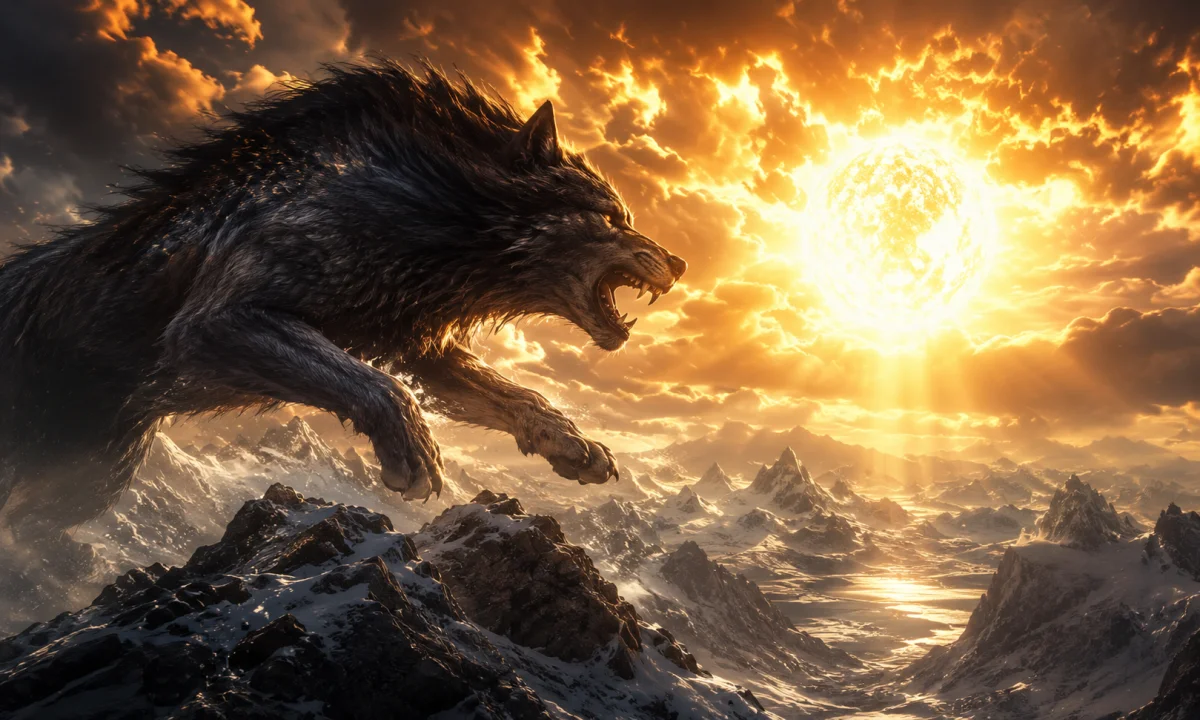
Sköll is a wolf in Norse mythology who pursues the sun across the sky. He belongs to the group of monstrous beings associated with the forces that threaten the ordered world of the gods and humans. According to accounts preserved in Old Norse poetry and prose, Sköll eventually catches the sun at Ragnarök, the catastrophic event that marks the destruction and renewal of the cosmos.
Origins in Norse tradition
Sköll is known primarily from two medieval sources: poems preserved in the Poetic Edda and Snorri Sturluson's Prose Edda. These works were written down in Iceland during the medieval period, although many of the poems contain material that is considerably older. The surviving sources do not provide a complete biography of Sköll, and they do not describe him as a fully developed character with a distinct personality. Instead, he appears as part of the mythic machinery of the sky and as one of the creatures destined to play a role in Ragnarök.
Norse cosmology imagined the sun and moon as beings or objects moving through the heavens, rather than simply as impersonal astronomical bodies. The sun is usually personified as Sól, while the moon is personified as Máni. Their movements are threatened by wolves. Sköll follows Sól, and another wolf, Hati Hróðvitnisson, pursues Máni. The two wolves are therefore closely connected in the tradition, but they are not the same figure.
The myth reflects a wider pattern in Norse storytelling: forces of order are constantly exposed to forces of chaos. The sun travels along its appointed course, yet a predator follows it without rest. This pursuit does not normally interrupt the daily movement of the heavens. Its decisive moment is reserved for Ragnarök, when the old cosmic order breaks apart.
The name Sköll
The Old Norse name is commonly written Sköll, with the spelling Skoll also widely used in English. The exact meaning of the name is not entirely certain. It is often connected by interpretation with ideas such as mockery, deception, or treachery, but the linguistic details are debated. It is safer to treat proposed translations as scholarly interpretations rather than as an unquestionably established definition.
Uncertainty also affects the spelling and pronunciation used in modern languages. The original Old Norse form contains letters and sounds that are not represented in ordinary English spelling. English-language books, games, and other modern works frequently omit the diacritic and use Skoll. Both forms refer to the same mythological wolf when the context is Norse tradition.
Sköll and the sun
Sköll's central role is to chase Sól. In the account of the world given in the Prose Edda, the sun drives or travels through the sky while a wolf pursues her. The pursuit explains why the sun must move continually and why danger is always present in the heavens. At Ragnarök, Sköll is said to catch and devour the sun.
The relevant traditions sometimes use poetic descriptions rather than presenting the wolf as an ordinary animal. Sól is a radiant divine figure, and the wolf that follows her is a supernatural predator whose reach extends across the sky. Sköll is therefore not simply a large earthly wolf. He belongs to the same mythic scale as other beings who threaten the gods, the heavenly bodies, and the structure of the world.
One poem in the Poetic Edda states that when the wolf takes the sun, the sun will bear a daughter who will follow her mother's path after the old sun has disappeared. This detail is important because it shows that the destruction of the sun is not necessarily the permanent end of sunlight. Norse myth often combines catastrophe with renewal: the present world is destroyed, but elements of a new world survive.
The relationship with Hati
Sköll is frequently confused with Hati, but the surviving sources distinguish them. Sköll pursues the sun, whereas Hati Hróðvitnisson pursues the moon. Hati's patronymic means “son of Hróðvitnir.” Hróðvitnir is generally understood as another name for Fenrir, the monstrous wolf who is bound by the gods and who breaks free at Ragnarök.
The sources do not offer an equally clear genealogy for Sköll. Some modern retellings describe Sköll and Hati as brothers or as both being children of Fenrir. That relationship is common in contemporary summaries and works of fiction, but it should not be treated as firmly established by the oldest surviving accounts. The texts clearly associate the two wolves with the sun and moon, while their exact family relationship varies in interpretation.
Hati is also sometimes given the shorter name Hati, while the full form Hati Hróðvitnisson helps distinguish him from other mythological figures and clarifies his connection to Hróðvitnir. The similarity of the wolves' roles, combined with differing translations and modern retellings, has led to considerable confusion between them.
Sköll at Ragnarök
Ragnarök is the great crisis of Norse mythology. It involves the breaking of bonds, the arrival of hostile powers, battles among gods and monsters, and the destruction of the world by fire and flood. The death of the sun is one of its cosmic signs.
Before Ragnarök, the sun and moon are already pursued by wolves. During the final catastrophe, the pursuers achieve what they have long attempted. Sköll catches Sól, while Hati is associated with the destruction or capture of Máni. The sources do not present a detailed combat scene between Sköll and the sun. His function is more elemental: he is the predator whose pursuit finally reaches its appointed end.
This event belongs to a larger sequence in which many restraints fail. Fenrir breaks free from his bonds, the world-serpent Jörmungandr rises from the sea, and other enemies confront the gods. In this setting, Sköll is not an isolated monster but part of the encircling danger that has always surrounded the cosmic order.
The destruction of the sun also has a future dimension. The surviving sun's daughter is said to continue along the solar path, and a renewed world emerges after the destruction. The myth therefore does not simply express fear that daylight will vanish forever. It presents cosmic time as a cycle in which an established order can be replaced by another.
Appearance and powers
The surviving medieval sources give very little physical description of Sköll. He is identified as a wolf, but they do not provide a detailed account of his fur, size, eyes, limbs, or other visual features. Modern illustrations often depict him as enormous, dark, fiery, or supernatural, but these details belong to artistic interpretation rather than to a securely preserved ancient description.
His most important power is his ability to pursue a heavenly body. Sköll can follow the sun through the sky and eventually capture it. This makes him more than an animal enlarged by poetic exaggeration. He is a cosmological creature whose actions affect the entire world.
There is no strong evidence that Sköll was widely worshipped as an independent deity. He is better classified as a mythological wolf or supernatural being. Norse religion included many kinds of beings besides gods, including giants, dwarfs, elves, spirits, and monsters. Sköll belongs to the threatening and monstrous side of this mythic universe rather than to the class of gods who receive cults in the surviving evidence.
Possible symbolism
Sköll can be understood through several overlapping ideas, although no single symbolic interpretation is certain. His endless pursuit represents danger within cosmic order: even the regular movement of the sun is not completely secure. The image also gives mythic form to the experience of darkness overtaking daylight.
Some interpretations connect the wolf's pursuit with eclipses or other unusual changes in the sky. Such comparisons are plausible as ways of understanding how modern readers might relate the story to natural phenomena, but the surviving sources do not explicitly state that Sköll was created as a scientific explanation of eclipses. Norse people had their own observations of the heavens, yet the texts present the story primarily as mythic prophecy and cosmology.
The wolf's role may also express a broader Norse concern with hostile wilderness. Wolves were real predators, but they also carried powerful associations in myth. Their strength, hunger, and movement beyond human control made them suitable images for forces that threaten social and divine boundaries. In the case of Sköll, the wilderness predator has become large enough to hunt the sun itself.
Sköll among the wolves of Norse mythology
Several famous wolves appear in Norse tradition, and they should not be automatically identified with one another.
- Sköll pursues Sól, the sun, and catches her at Ragnarök.
- Hati Hróðvitnisson pursues Máni, the moon. He is connected by name to Hróðvitnir, usually identified with Fenrir.
- Fenrir, also called Fenrisúlfr, is the gigantic wolf bound by the gods. At Ragnarök he breaks free and kills Óðinn before being killed by Óðinn's son Víðarr.
- Garmr is a dog or wolf-like guardian associated with the underworld and the realm of Hel. His identity is sometimes compared with or merged with other canine figures, but he is not simply another name for Sköll.
The word ulfr, meaning “wolf,” appears in personal names, poetic descriptions, and mythological names throughout the Old Norse material. Not every wolf in a mythological text is one of these named beings. Modern fantasy often combines their traits, but traditional sources give them separate roles.
Surviving sources and interpretation
The principal poetic evidence comes from the Poetic Edda, a collection preserved in a medieval Icelandic manuscript. Poems such as Vafþrúðnismál and Grímnismál contain information about the sun, moon, wolves, and the end of the world. Because these poems were transmitted orally before being written down, their exact dates and earlier forms are difficult to establish.
Snorri Sturluson's Prose Edda, composed in the thirteenth century, provides a more connected narrative. Snorri explains the movements of the sun and moon and identifies the wolves that chase them. His work is invaluable, but it was written by a Christian-era Icelandic author who was preserving and organizing pre-Christian mythology. It should not be assumed to represent a complete or unchanged record of ancient religious belief.
The sources also differ in detail and emphasis. A poetic line may name a wolf without supplying a full genealogy, while a later prose account may organize related traditions into a more systematic explanation. As a result, claims that Sköll definitely had a particular parentage, appearance, or personality should be treated cautiously unless they are clearly marked as later interpretation.
Later reception
Sköll has become increasingly familiar outside academic discussions of Norse mythology because modern fantasy frequently uses Norse names and imagery. He appears in some novels, role-playing games, comics, video games, and other fictional settings, where he may be portrayed as a gigantic beast, a rival of Fenrir, or a creature with magical powers unrelated to the surviving myths.
These adaptations often give Sköll a more individualized character than the medieval sources do. They may also make him the brother or companion of Hati, assign him a detailed design, or place him in stories about gods and heroes. Such portrayals can draw inspiration from the traditional pursuit of the sun, but they are modern creations rather than evidence for additional ancient legends.
In the older Norse material, Sköll's significance lies precisely in his focused cosmic function. He is the wolf behind the sun, the unseen threat that follows daylight until the final collapse of the world. His story is brief, but it connects the daily sky, supernatural predators, Ragnarök, and the possibility that a new sun will rise after the old order has ended.