 WORLD
WORLD
Fallen Angels
Articles about Fallen Angels within Religious Traditions.
Last articles
Abaddon
Abaddon is a figure from Jewish and Christian traditions whose meaning has shifted over time. In the Hebrew Bible, the word abaddon most often refers to “destruction” or the realm of destruction, not a personal being. In…Fallen Angels: myths, traditions and legends
Fallen angels are heavenly beings understood in some Jewish, Christian and related traditions to have transgressed divine order and lost their rightful place or status. The category does not come from one single, fully developed scriptural account. Instead, it emerged through the interpretation of several biblical passages, Second Temple Jewish writings, early Christian theology, medieval literature and later religious and occult traditions. Different sources explain the fall in different ways, including rebellion, pride, disobedience, forbidden knowledge, improper relations with humans or refusal to accept divine authority.
The familiar story of Satan leading a great angelic revolt before the creation or fall of humanity is largely a synthesis of texts and later interpretations rather than a continuous narrative stated in one biblical passage. Some traditions connect fallen angels with the Watchers described in the Book of Enoch, while others identify them with the devil and the demons of Christian theology. These traditions overlap, but they are not identical. Accurate interpretation requires distinguishing scriptural references, extra-canonical literature, theological development and later imaginative retellings.
Meaning and boundaries
The expression fallen angel generally refers to an angel or heavenly being believed to have departed from obedience to God. The fall may be understood as a moral rebellion, a violation of heavenly boundaries or a loss of celestial status. In Christian theology, fallen angels are commonly associated with demons, although the exact relationship between the two categories developed gradually.
The term is less straightforward in Judaism. Jewish texts contain traditions about rebellious or sinful heavenly beings, but Judaism does not possess one universally accepted doctrine matching every later Christian account of Satan and the fallen angels. Individual texts and commentaries offer different interpretations of angelic obedience, accusation, punishment and transgression.
Islam recognises angels as obedient servants of God and normally distinguishes them from jinn. Iblis refuses God’s command concerning Adam, but the Quran identifies him as one of the jinn rather than explicitly as an angel. For this reason, describing Iblis simply as a fallen angel imposes a Christian category on an Islamic figure whose nature is explained differently in Islamic scripture and theology.
Fragmentary biblical foundations
The Hebrew Bible does not present a complete account of an angelic rebellion led by Satan. Several passages later became important in constructing such a narrative, but their original settings concern different subjects and literary purposes.
Genesis describes the “sons of God” taking human women before the flood. The passage is brief and does not explicitly call these beings fallen angels. Some ancient Jewish interpreters understood them as heavenly beings who violated the proper boundary between heaven and earth. Other interpretations have identified them as powerful human rulers or members of a particular ancestral line.
The Book of Job presents “the satan” as an accuser or adversarial figure within the divine court rather than as an independent enemy equal to God. He tests Job only with divine permission. The Hebrew expression functions as a title in this context and does not necessarily carry every characteristic later associated with the personal name Satan.
Isaiah contains a taunt against the king of Babylon that describes the fall of a shining figure from heaven. The Latin rendering of a phrase in this passage produced the name Lucifer, meaning light-bringer or morning star. In its immediate context, the passage mocks the downfall of an arrogant earthly ruler. Later Christian interpretation connected its imagery with the fall of Satan, but the text does not originally introduce Lucifer as the personal name of a rebellious archangel.
Ezekiel includes a lament over the ruler of Tyre using imagery of Eden, beauty, pride and expulsion. Christian interpreters sometimes read the passage as referring beyond the human ruler to Satan’s primordial fall. That theological reading became influential, although the original prophetic context addresses the pride and destruction of a political ruler.
The Watchers and the Book of Enoch
The most detailed ancient narrative of angelic transgression appears in the Book of Watchers, the earliest major section of 1 Enoch. This Jewish work expands the brief episode in Genesis concerning the sons of God and human women. It describes a group of heavenly beings called Watchers who descend to earth, take human wives and transmit prohibited forms of knowledge.
The Watchers are led in the surviving tradition by figures whose names appear in variant forms, especially Shemihazah and Asael or Azazel. Their teachings include weapons, adornment, sorcery and forms of celestial knowledge. The resulting disorder is both physical and moral: their giant offspring devastate the earth, violence spreads and the boundaries established by God are violated.
Divine judgment follows. The rebellious Watchers are bound and confined to await final punishment, while the giants are destroyed. In the Enochic account, the spirits emerging from the dead giants become harmful spirits that trouble humanity. This provides one ancient explanation for the origin of demons that differs from the later Christian identification of demons directly with fallen angels.
The Book of Watchers was highly influential in some ancient Jewish and early Christian communities. The New Testament Letter of Jude refers to angels who abandoned their proper position and were kept in bonds for judgment, using language closely related to Enochic tradition. Second Peter likewise speaks of sinning angels cast into a place of confinement while awaiting judgment.
First Enoch was not included in the Jewish biblical canon or in most Christian biblical canons, although it remains scriptural within the Ethiopian Orthodox Tewahedo tradition and the Eritrean Orthodox Tewahedo tradition. Its influence nevertheless extended far beyond communities that accepted it as canonical.
The Watchers and the satanic rebellion
The fall of the Watchers and the rebellion of Satan began as distinguishable traditions. The Watchers descend because of desire, oath-bound cooperation and the transmission of forbidden knowledge. The later Satanic rebellion is more often associated with pride, rivalry, disobedience and an attempt to oppose divine authority.
Over time, Jewish and Christian writers sometimes connected these narratives. Rebellious heavenly beings, evil spirits, the serpent of Eden, the satanic accuser and the devil could be placed within a larger history of cosmic opposition. The degree of identification differed between authors and periods.
This development means that a later list of fallen angels may combine figures who originally belonged to separate sources. A Watcher named in an apocalyptic text, a demon from a magical work and Satan as interpreted in Christian theology do not automatically belong to one ancient hierarchy.
Satan, the devil and the fall
In the New Testament, Satan or the devil appears as a tempter, deceiver and adversary of God’s purposes. He tests Jesus, opposes the spread of the Christian message and is associated with evil powers. The Book of Revelation identifies the great dragon with the ancient serpent, the devil and Satan, creating a powerful connection between several images of cosmic opposition.
Revelation describes war in heaven between Michael and his angels and the dragon and his angels. The dragon is cast down to earth with his forces. The vision became central to later portrayals of Satan’s expulsion, although its place within Revelation concerns apocalyptic conflict and the defeat of the accuser. Interpreters have differed over whether it describes an event before human history, a spiritual meaning of Christ’s victory, an ongoing cosmic conflict or a future eschatological event.
Jesus’ statement about seeing Satan fall like lightning from heaven also contributed to Christian imagery of expulsion. The brief saying appears in the context of the disciples’ success over demonic powers and does not provide a detailed origin story.
Later Christian theology brought these passages together with Isaiah, Ezekiel, Genesis and Enochic traditions. Satan came to be understood as a created angel who became proud, rebelled against God and drew other angels into his fall. This synthesis became widespread, but its details differ among theologians, denominations and literary works.
Lucifer and the problem of names
Lucifer is among the most misunderstood names associated with fallen angels. In classical Latin, the word could refer to the morning star, the planet Venus when visible before sunrise. It was not originally an exclusively demonic name.
The Latin biblical tradition used the term in translating the taunt against the king of Babylon in Isaiah. Christian interpreters later understood the king’s heavenly ambition and collapse as reflecting Satan’s fall. Through this interpretive history, Lucifer became widely treated as Satan’s pre-fall name.
The identification is influential in Christian literature and popular culture, but it should not be presented as an explicit biblical biography. Neither the Hebrew passage nor its immediate historical context names an angel who later became the devil.
Other names attached to fallen angels also require caution. Some occur in Enochic literature, magical texts or medieval demonologies, while others gained prominence through modern occultism and fiction. Different spellings may result from transmission across Hebrew, Aramaic, Greek, Latin and modern languages. Similar names should not be merged without evidence.
Azazel and uncertain identity
Azazel has several distinct associations in ancient sources. In Leviticus, the name appears in the ritual of the Day of Atonement, where one goat is designated for the Lord and another for Azazel and sent into the wilderness. The exact meaning of Azazel in this passage has long been debated. Interpretations include a wilderness being, a place of removal or a symbolic expression connected with the expulsion of impurity.
In 1 Enoch, Asael or Azazel is a rebellious Watcher associated with forbidden instruction and divine punishment. Later traditions connected this figure with demons, wilderness and the transmission of corrupting knowledge.
These materials are historically related in interpretation, but they should not be collapsed into a simple statement that the biblical ritual openly describes one named fallen angel. The identity and development of Azazel depend heavily on the source being examined.
Pride, knowledge and forbidden boundaries
Fallen-angel traditions explore several explanations for the origin of evil. In the Watchers narrative, evil spreads through the violation of boundaries and the misuse of knowledge. Heavenly beings reveal skills and secrets in ways that produce violence, exploitation and disorder.
Later Christian tradition placed greater emphasis on pride. A magnificent angel desires a status that does not belong to him, rejects divine authority and falls through self-exaltation. This interpretation made the fall of Satan a model of pride as the foundational spiritual sin.
Desire also plays an important role in some accounts. The Watchers descend because they desire human women, while other traditions describe envy toward humanity or refusal to honour God’s plans for human beings. These explanations are not present in every source and should not be combined as though they formed one original account.
The recurring theme is not merely the possession of knowledge or power, but their use outside the order established by God. The fallen being transforms a gift, office or capacity into an instrument of rebellion.
Fallen angels and demons
In much Christian theology, demons are fallen angels who joined Satan’s rebellion. They retain intelligence and spiritual power but direct them toward deception, temptation and opposition to divine purposes. They are created beings rather than independent gods or forces equal to God.
This doctrine differs from the explanation in 1 Enoch, where the harmful spirits afflicting humanity arise from the dead giant offspring of the Watchers. The Watchers themselves remain imprisoned while the spirits of the giants roam the earth.
Other ancient cultures possessed categories of harmful spirits that were not fallen angels. When Jewish and Christian traditions encountered these ideas, local beings could be reinterpreted within demonological frameworks. The result was a complex body of belief drawing from scripture, folklore, theology and cultural contact.
Modern fiction often treats demons and fallen angels as rival supernatural species. Traditional Christian theology more commonly understands demons as angels transformed morally through rebellion, not as a separately created race.
Punishment and confinement
Fallen angels are frequently associated with confinement, darkness and future judgment. In Enochic tradition, the Watchers are bound beneath the earth until the appointed time of punishment. Jude and Second Peter preserve related images of rebellious angels held for judgment.
Later Christian imagination associated fallen angels with hell, but theological accounts do not always describe their present condition in the same way. Some sources depict evil spirits as active in the world, while others emphasise their imprisonment or future punishment.
Revelation presents the devil as active, defeated and eventually condemned. These stages belong to an apocalyptic vision rather than a simple description of one fixed location. The common image of Satan ruling hell as its independent king owes much to later literature and art. In mainstream Christian theology, hell is not Satan’s victorious kingdom but a condition or place of punishment.
Free will and the possibility of repentance
The fall raises questions about angelic freedom. Christian theologians generally maintained that angels possessed will and intellect and therefore could choose obedience or rebellion. Their choice was often understood as more complete and final than ordinary human decisions because angelic knowledge was believed to differ from human knowledge.
For this reason, traditional theology usually denies that fallen angels repent or return to their former state. This conclusion belongs to theological reasoning rather than to a detailed scriptural narrative describing every fallen being’s decision.
Jewish interpretations of transgressing angels are more varied, and some narratives place greater emphasis on divine judgment than on a systematic doctrine of irreversible angelic choice. Modern stories that depict fallen angels seeking redemption belong mainly to literary and popular reinterpretation.
Medieval theology and demonology
Medieval Christian theologians developed increasingly systematic accounts of angelic creation, hierarchy and rebellion. They discussed when the fall occurred, what sin caused it, how many angels participated and what powers the fallen spirits retained.
These questions did not produce complete agreement. Some writers emphasised pride, others envy or disordered desire. The idea that a third of the angels fell drew support from the dragon sweeping a third of the stars from heaven in Revelation, although the passage is symbolic and does not explicitly state that one-third of all angels rebelled.
Medieval and early modern demonologies also assigned names, ranks and functions to evil spirits. Some systems mirrored angelic hierarchies or imagined an infernal court. They combined theology with folklore, magical traditions and literary invention and should not be treated as direct descriptions from scripture.
Fallen angels in Islamic interpretation
Islamic tradition does not generally organise evil supernatural beings through the Christian category of fallen angels. Angels obey God, while jinn possess the capacity for belief and disobedience. Iblis refuses to bow before Adam and becomes an adversary, but the Quran identifies him as belonging to the jinn.
Some Islamic interpretations discussed whether Iblis had once occupied a place among angels because of his devotion, while maintaining that his nature was that of a jinn. Other discussions addressed the difficult Quranic narrative involving Harut and Marut, two angels associated with a test involving magical knowledge. Later stories expanded their account considerably, but not all such elaborations were accepted as reliable.
Equating Iblis, Harut and Marut with Christian fallen angels obscures important theological distinctions. Islamic sources must be interpreted through Islamic concepts of angels, jinn, obedience and human temptation.
Literary transformation
Fallen angels became major figures in Christian poetry and drama. The most influential literary treatment in English is John Milton’s Paradise Lost, which portrays Satan and his followers after their defeat in heaven. Milton’s Satan is proud, eloquent and politically self-dramatising, qualities that deeply shaped later literature.
Milton did not simply reproduce a biblical narrative. He created an epic using scripture, theology, classical literature and his own poetic imagination. Details from the poem are often repeated as though they came directly from the Bible, including expanded scenes of heavenly war, infernal debate and Satan’s psychological motivations.
Romantic and later writers sometimes treated the fallen angel as a symbol of rebellion against tyranny, intellectual independence or tragic isolation. This literary figure could appear heroic or sympathetic even when traditional theology regarded angelic rebellion as the rejection of divine goodness.
Occult and modern classifications
Later magical and occult works assigned fallen angels planetary, elemental or astrological powers. They also connected them with named demons from grimoires and created elaborate hierarchies not found in early scripture.
Modern esoteric systems frequently combine Enochic Watchers, Christian demons, Kabbalistic angels, pagan deities and literary characters. Such combinations may form coherent modern spiritual or magical systems, but they should not be presented as one ancient angelology.
Internet lists often give precise ranks, symbols, sigils and supernatural abilities to dozens of supposed fallen angels without identifying their sources. Some names are historically attested in religious or magical manuscripts, while others have been altered, conflated or invented in recent fiction.
Popular culture and common misconceptions
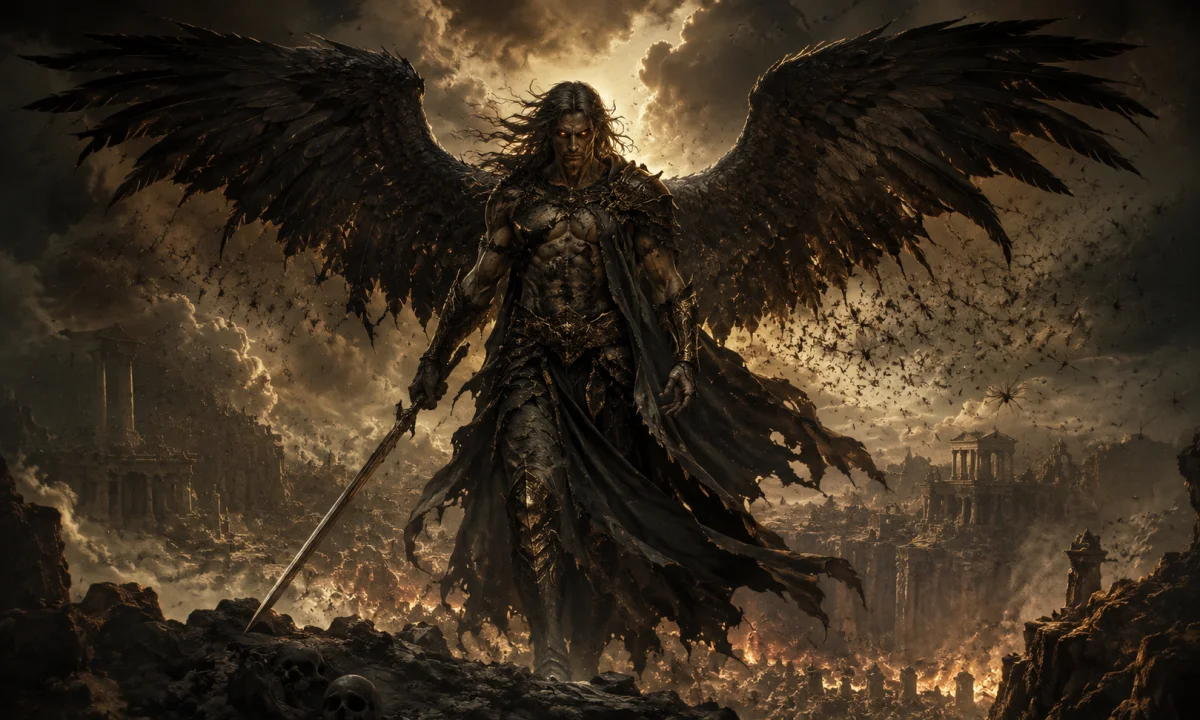
Fantasy, horror, comics, television and games often portray fallen angels as winged warriors who retain celestial beauty while opposing heaven. Their wings may become black, burned or skeletal as a visual sign of corruption. These features are modern artistic conventions rather than standard descriptions in ancient religious texts.
Popular stories also treat heaven and hell as rival kingdoms of comparable power. Jewish, Christian and Islamic traditions do not normally present evil beings as equal to God. Fallen angels remain created and limited beings even when they are portrayed as dangerous.
Another common misconception is that every named demon was originally an angel with a known heavenly rank. Some demon names developed from foreign gods, folklore, textual corruption, magical traditions or literary invention. An angelic origin should be claimed only when a relevant tradition actually provides one.
Fallen angels remain powerful figures because they concentrate questions about freedom, pride, desire, knowledge and the corruption of spiritual power. Their history is not one fixed story but a series of related interpretations formed through ancient Jewish writings, Christian theology, Islamic comparison, medieval speculation and later literature.