WORLD
WORLD
Ran
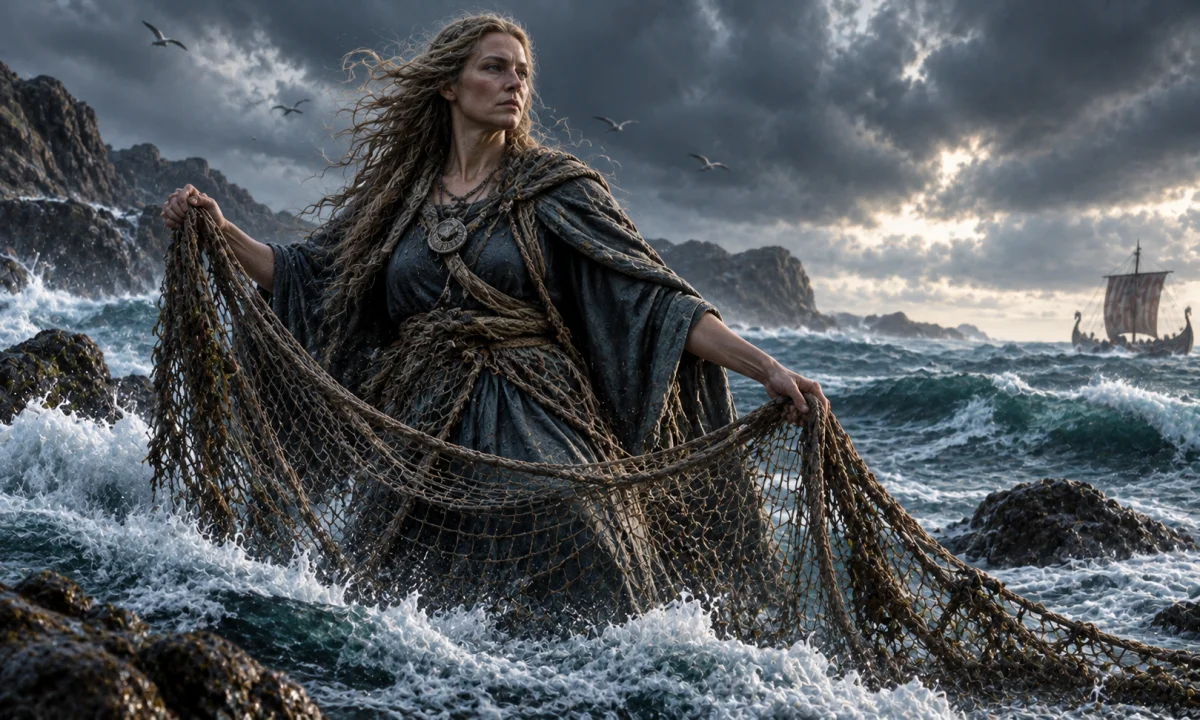
Rán is a female figure associated with the sea in Norse mythology. She is best known as the wife of Ægir, a personification or divine being connected with the ocean, and as the owner of a net used to seize people who venture onto the water. In surviving Norse literature, Rán represents the sea’s destructive and inescapable power, especially the danger of drowning. She is not described as a universal sea goddess in the same way that some later summaries present her, and the evidence for her worship as an independent deity is limited.
Origins and cultural setting
Rán belongs to the religious and mythological world of medieval Icelandic and Scandinavian literature. These traditions developed within societies that depended heavily on seafaring, fishing, trade and coastal travel. The sea could provide wealth and food, but it could also destroy ships without warning. Norse myths and poetic language therefore often treated the ocean as a living power rather than as an inanimate landscape.
Her name appears chiefly in the Prose Edda, a thirteenth-century Icelandic work associated with the poet and scholar Snorri Sturluson, and in the poetic vocabulary preserved by Old Norse poets. The Prose Edda presents Rán as Ægir’s wife and connects her with a net that catches those who fall into the sea. She is also linked with nine daughters, who are identified with waves or forms of the sea.
The surviving evidence does not provide a complete mythology for Rán. There is no preserved creation story centred on her, no extended account of her actions among the gods, and no clear record of temples or a formal cult dedicated to her. Much of what is known comes from poetic interpretation and from Snorri’s explanation of traditional poetic expressions. As a result, Rán is historically more secure as a figure of Norse mythological language than as a fully documented goddess with a large independent body of legend.
Name and identity
The Old Norse name Rán is commonly associated with the idea of taking, robbing or seizing. This meaning suits her role as the power that takes sailors from the living world. The exact history and nuances of the name are matters for linguistic interpretation, however, and its meaning should not be treated as an entire biography. A mythological name can suggest an attribute without proving that every later description developed directly from that word.
Rán is usually classified as a sea goddess in modern English, but that label can be misleading if it suggests a clearly defined pagan office comparable to the later idea of a goddess ruling a particular domain. In the Old Norse sources, she functions more specifically as a threatening embodiment of the sea. She is a personified force of maritime death, while Ægir can represent the sea in a broader and sometimes more hospitable form.
The distinction between Rán and Ægir is important. They are presented as a married pair, but they are not simply two names for the same being. Ægir is associated with the sea, feasting and the hosting of the gods, while Rán is associated especially with her net and with those lost at sea. Their relationship reflects two contrasting aspects of the ocean: the sea as a source of fellowship and abundance, and the sea as a power that claims human lives.
Rán and Ægir
Ægir is one of the most prominent figures connected with the sea in Norse literary tradition. In the poetic and mythological material, he is sometimes treated as a giant or jötunn rather than as one of the Æsir or Vanir. The boundary between god, giant and natural power is not always rigid in Old Norse myth, and Ægir’s relationships with the gods show that these categories do not function like a simple modern family tree.
Rán is named as Ægir’s wife. Together they have nine daughters, whose names are understood as poetic names for waves or different movements of the water. The daughters are generally listed as Himinglæva, Dúfa, Blóðughadda, Hefring, Uðr, Hrönn, Bylgja, Bára or Dröfn, and Kólga. The precise spellings and forms vary between manuscripts and editions, and the list is not always presented identically.
These daughters should not automatically be imagined as nine individually developed princesses with separate myths. Their names belong largely to the poetic vocabulary of waves, breakers, surges and sea movements. The family of Ægir and Rán therefore gives a mythological structure to the changing behaviour of the ocean. The sea has a household, but that household is also a set of poetic images.
The net of Rán
Rán’s defining object is her net. In the Prose Edda, the net is described as a means by which she catches those who go out onto the sea. The image is direct and powerful: a drowning person is not merely overcome by weather or water but is taken by a personified being waiting beneath or within the waves.
The net also belongs to a wider pattern of Norse mythological symbolism. Nets, ropes and bonds often represent capture, fate and the loss of freedom. A net can be hidden beneath the surface, impossible to see until escape is no longer possible. In Rán’s case, it gives the sea an active intention. The ocean does not simply happen to kill; in poetic imagination, Rán reaches out and claims its victims.
Snorri’s discussion of the net occurs within a broader explanation of mythological and poetic material involving Loki and the dwarf Andvari. The details are complicated by the way the Prose Edda preserves and explains earlier traditions, and the story does not turn Rán into a major participant in the action. The important point is that her net was sufficiently familiar in poetic tradition to serve as a recognizable mythological object.
Because of this association, skaldic poetry could use expressions connected with Rán as metaphors for the sea or for drowning. Such poetic language is not always a literal narrative statement. When a poet says that the sea has gone to Rán, or that someone has been taken by her, the phrase may describe death at sea through mythological imagery rather than report a separate story about Rán’s actions.
The drowned and the sea after death
Rán is frequently described in modern retellings as receiving the drowned in her underwater hall. This idea reflects her association with those who die at sea, but the surviving sources do not provide a detailed, consistently described afterlife ruled by her. Norse traditions about the dead are varied, and literary sources do not reduce every form of death to a single destination.
The best-known division concerns Valhalla, associated with Odin and warriors selected after battle, and Fólkvangr, associated with Freyja. Other traditions connect the dead with Hel, with burial mounds, or with other supernatural destinations. People who die at sea appear in poetic language connected with Rán, but this does not establish a fully systematized “realm of Rán” comparable to Hel’s domain.
Rán should therefore not be identified with Hel. Hel is a distinct figure, the daughter of Loki and ruler of a realm for many of the dead. Rán is a sea-associated being whose net captures sailors and whose name functions in maritime imagery. Both figures can be connected with death, but they belong to different mythological roles.
Appearance and powers
The Old Norse sources do not give Rán a detailed physical description. They do not clearly state that she had a fish’s tail, a particular colour of hair, a crown, or a fixed underwater palace. Such features are common in later artistic representations of sea goddesses and mermaids, but they should not be presented as established attributes of the medieval Norse Rán.
Her principal attribute is the net. Her power is not described through a catalogue of magical spells or weapons but through her association with the sea’s ability to seize and drown. She is consequently more symbolic than many of the better-known gods and goddesses of Norse mythology. Her presence can be felt in an event—the disappearance of a sailor—rather than in a long sequence of narrated adventures.
The nine daughters provide a second set of attributes by extending Rán’s identity into the movements of the waves. Through them, the ocean becomes changeable and many-formed. Calm water, rising surf, violent breakers and sudden swells can all be incorporated into a family of supernatural beings. This does not mean that each daughter represents a precisely defined type of wave in every source; the names and interpretations vary, and the evidence is primarily poetic.
Rán in Norse poetic language
Old Norse poetry often describes natural forces through kennings, compact metaphorical expressions that assume an audience familiar with myth. The sea could be called Ægir, Rán, or a phrase referring to one of them. Ships might be described through images involving the sea’s household, and drowning could be expressed as being captured by Rán’s net.
This poetic role helps explain why Rán can seem both important and obscure. Her name appears in the mythological vocabulary of poets, yet the surviving narratives preserve relatively little about her personality. A figure does not need a large collection of stories to be useful in kennings. Rán’s significance lies partly in the emotional and cultural force of the image: the sea is a living power that can take what human beings place upon it.
Such language also reflects the practical realities of Scandinavian life. A ship was essential for travel across northern waters, but it was vulnerable to storms, currents, ice and navigational error. The story of Rán transforms this danger into a relationship between humans and a supernatural claimant. The sailor does not merely vanish; the sailor has been taken.
Rán and other water-associated figures
Rán is sometimes confused with several other beings from Norse or wider Germanic tradition. She is not the same as Njörðr, the Vanir god associated with the sea, seafaring, wealth and favourable winds. Njörðr’s role is generally beneficial or prosperous, whereas Rán’s imagery concerns the sea’s fatal power.
She is also distinct from Nerthus, a Germanic earth or fertility deity mentioned by the Roman author Tacitus. Nerthus is not described as Rán, and there is no reliable basis for merging the two figures simply because both are female supernatural beings connected with nature. Their names, sources and mythological contexts are different.
Rán should likewise be distinguished from mermaids, sirens and other European water spirits. Those figures come from different traditions, and their familiar traits—singing to sailors, having a human upper body and fish-like tail, or granting and withholding treasures—are not part of the securely attested Norse description of Rán. The similarity between a dangerous sea woman and later mermaid imagery has encouraged artistic blending, but it does not demonstrate shared identity.
Religious significance and evidence for worship
There is no strong surviving evidence for a widespread, organized cult of Rán. Archaeological finds, inscriptions and place-names do not establish a network of shrines dedicated specifically to her. This absence does not prove that no one ever addressed or feared her, since much pre-Christian religious practice left little written evidence. It does mean that claims about regular offerings, priestesses or formal rituals devoted to Rán should be treated cautiously.
Her importance can be understood within the broader religious imagination of seafaring communities. Norse people made offerings to gods and powers connected with travel, fertility, protection and prosperity, but the surviving sources rarely provide a complete record of how every mythological figure was approached in everyday practice. Rán may have been feared as a force of the sea without possessing the kind of public cult associated with more prominent deities.
Her image also expresses an attitude toward nature that is neither purely benevolent nor purely hostile. The sea provides routes, fish and wealth, yet it cannot be controlled completely. Rán embodies the point at which human skill and courage fail. Her net is a reminder that successful voyages were never guaranteed, even for experienced sailors.
Later reception
Rán has remained attractive to writers, artists and creators of fantasy because her central image is concise and dramatic: a sea woman with a net who claims the drowned. Later depictions often give her a grand underwater court, elaborate clothing, magical beauty or a mermaid-like body. These additions can be effective artistic interpretations, but they are not all features of the medieval Norse tradition.
Modern fantasy, games, novels and visual media may also present Rán as a powerful queen of the ocean, a villain, a sorceress or a member of a large pantheon of gods. Such versions draw on her name and traditional associations while expanding a relatively compact source tradition into a fuller character. They should be understood as modern adaptations rather than evidence that the historical Norse sources gave Rán an extensive biography.
In the older material, her force comes from what is left unsaid. Rán does not need a long speech or a heroic quest to be memorable. The invisible net, the sudden wave and the missing sailor are enough to define her as one of the clearest personifications of the sea’s lethal power in Norse mythology.