WORLD
WORLD
Ornias
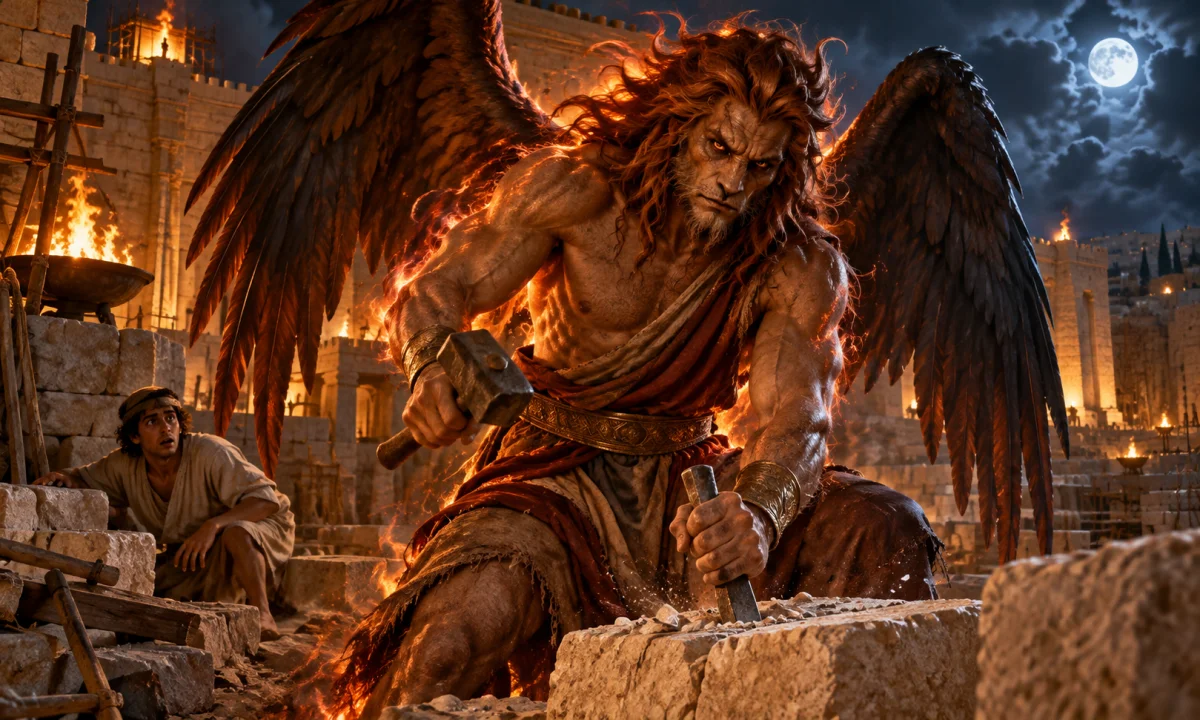
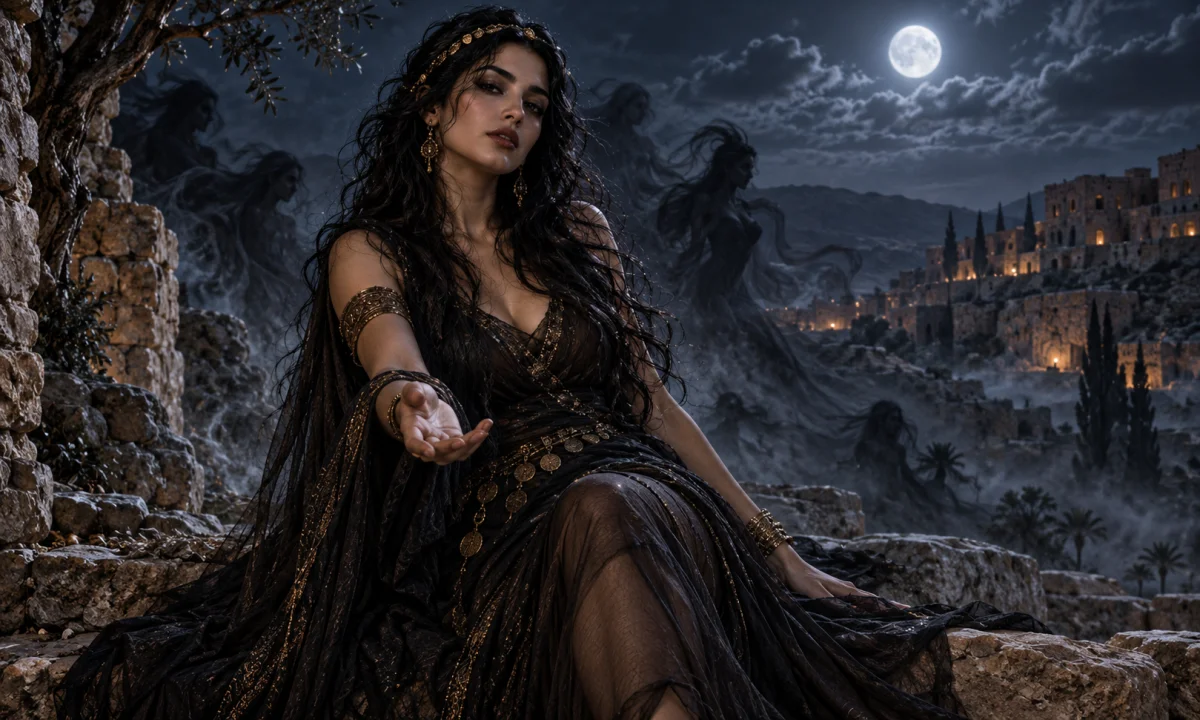
Ornias is a demon who appears in the Testament of Solomon, a late antique pseudepigraphal work about King Solomon’s supposed authority over spirits. In the story, Ornias troubles a young labourer involved in building the Temple in Jerusalem, taking part of the boy’s wages and weakening him. Solomon eventually captures the demon with a divinely empowered ring and compels him to assist with the Temple’s construction.
Ornias is not a demon from the Hebrew Bible, nor is he a major figure in Jewish or Christian religious tradition outside the Testament of Solomon. His importance comes from that work’s elaborate catalogue of demons, angels, magical names and supernatural beings. Because the Testament survives in differing Greek manuscripts and translations, details about Ornias’s identity, powers and relationships are not entirely consistent.
Origins in the Testament of Solomon
The Testament of Solomon presents itself as a first-person account written by Solomon near the end of his life. Modern scholars generally classify it as a pseudepigraphal text: it claims the authority of a famous biblical king, but it was composed later and was not included in the Jewish or Christian biblical canons. Its date is uncertain. The surviving form is usually placed somewhere in late antiquity, although scholars disagree about how the text developed and whether it incorporates earlier materials.
The work combines several traditions. It contains biblical characters, Jewish ideas about angels and demons, Greco-Roman astrological concepts, magical practices, and themes associated with Christian demonology. Its central fiction is that Solomon received a supernatural ring from the archangel Michael. The ring bears a powerful seal, often described as a pentagram or five-pointed sign in modern translations. With it, Solomon can summon and restrain demons, question them, and force them to contribute to the building of the Temple.
Ornias appears near the beginning of this series of encounters. His episode establishes one of the work’s main themes: demons may harm human beings, but a divinely authorized ruler can compel them to serve a sacred purpose. The story also introduces the mixture of practical misfortune and supernatural explanation that characterizes much of the Testament.
The story of Ornias
According to the narrative, a young man working on the Temple is being harassed by a demon. The worker reports that Ornias comes around sunset, takes away part of his wages and sucks the thumb of his right hand. The attacks leave the boy increasingly weak. The detail is unusual and has generated different interpretations, but the basic scene is clear: Ornias is depicted as a parasitic spirit who drains a worker’s livelihood and bodily strength.
The afflicted worker appeals to Solomon. The king prays for help, and the archangel Michael provides the ring that enables him to control the demon. Solomon uses the ring’s seal to summon and bind Ornias. The encounter changes Ornias from a hidden tormentor into a source of information. As in other sections of the Testament of Solomon, the demon is forced to disclose its name, nature and activities.
Solomon then orders Ornias to assist in the construction of the Temple. The demon is also used as an intermediary in the king’s dealings with other spirits. In the narrative’s expanding hierarchy, Ornias helps bring the chief demon Beelzebul before Solomon. Beelzebul subsequently becomes a major informant, identifying other demons and describing their activities, weaknesses and celestial or astrological associations.
This episode gives Ornias a role that is more important than his brief appearance might suggest. He is both an aggressor against an individual human being and one of the first demons brought under Solomon’s control. His capture opens the way to the larger supernatural catalogue that follows.
Name and identity
The name is usually written Ornias in English translations, based on the Greek form found in editions of the Testament of Solomon. Transliteration varies, and readers may encounter slightly different spellings in older translations, manuscript discussions or occult reference works. Such variations do not necessarily indicate separate demons.
Ornias should not automatically be identified with every similarly named spirit in later demonological literature. The name is not securely established as part of the older biblical tradition, and it does not have the same broad and continuous history as figures such as Satan, Asmodeus or Beelzebul. Most claims about Ornias come from the Testament of Solomon or from modern summaries of that text.
The text’s classification of Ornias is also not completely straightforward. He is plainly treated as a demon, but the Testament does not use a single systematic demonological scheme throughout. Different spirits are described in terms of their effects on people, their celestial associations, their preferred times or places, and their relationships with other beings. Some passages also use language connected with angels, spirits of the air and other supernatural classes without defining a consistent hierarchy.
In some translations, Ornias makes statements about his descent or relation to the archangels, or about being troubled by another spiritual power. These passages are difficult to interpret because the Greek text is transmitted in variant forms and translation choices differ. They should not be treated as evidence that Ornias was traditionally regarded as an angel in the same sense as Michael or Gabriel. Within the story, he functions as a hostile spirit subjected to Solomon’s authority.
Appearance and behaviour
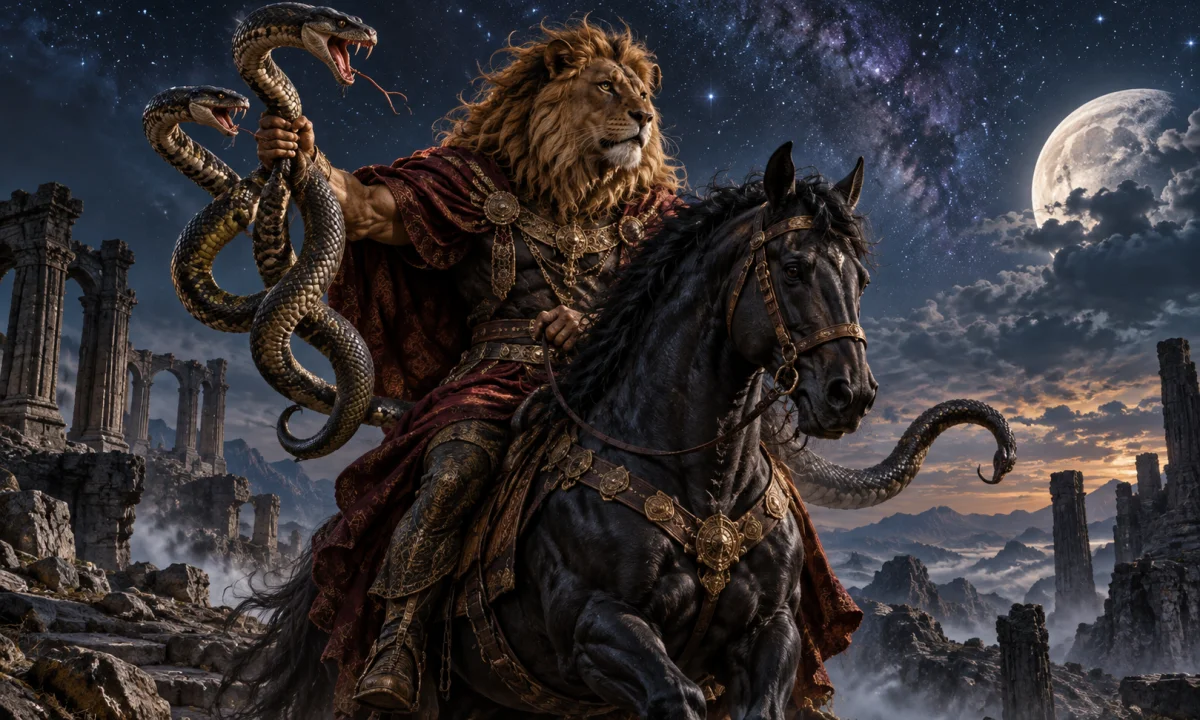
The surviving account does not provide a detailed, stable physical description of Ornias. Unlike later occult catalogues, it does not give him a standard portrait, animal features, clothing, weapon or fixed visual emblem. Descriptions found in modern demon encyclopedias or fantasy media may therefore go beyond what the Testament of Solomon actually says.
His most distinctive feature is behavioural rather than visual. Ornias appears at sunset, interferes with a worker’s pay and sucks the worker’s thumb. These actions suggest several connected ideas:
- Economic harm: taking part of the worker’s wages turns a supernatural attack into a form of exploitation.
- Physical depletion: the weakening of the victim resembles the wider folklore motif of a spirit that drains vitality.
- Night-time danger: Ornias’s appearance at sunset places him at a traditional boundary between day and night, when harmful spirits were often thought to become active.
- Hidden oppression: the worker suffers a repeated injury that may not be visible to others until he seeks Solomon’s help.
These features do not establish that Ornias was a widely worshipped or independently attested folk demon. They belong to the narrative setting of the Testament of Solomon, where demons often embody particular illnesses, temptations, accidents or social troubles.
Ornias and the Temple
The relationship between Ornias and the Temple is central to his story. He first appears as an obstacle to the workforce, but Solomon forces him to become a participant in the building project. This reversal reflects the theological and political image of Solomon used by the text: the wise king possesses knowledge and authority over the entire spirit world, and even rebellious beings can be placed under his command.
The Temple is more than a building site in this context. It represents sacred order, legitimate kingship and the establishment of a holy centre. Demons that would normally bring disorder are made to serve the construction of that centre. Ornias’s forced labour therefore has symbolic importance. His power over a worker is temporary and limited, while Solomon’s divinely sanctioned authority extends over him.
The story also reflects a broader ancient interest in explaining how monumental sacred buildings could have been constructed. Legends in several cultures attribute extraordinary architecture to gods, giants, spirits or magically empowered rulers. The Testament of Solomon adapts that type of story to a Jewish and Christian environment, presenting demonic labour as the result of Solomon’s command rather than as an independent tradition about the historical Temple.
Relationship with Beelzebul
Ornias is associated with Beelzebul because he helps Solomon summon him. In the Testament of Solomon, Beelzebul is presented as a chief or ruling demon who can speak about other spirits. The exact hierarchy varies across the work, and later readers should be cautious about treating it as a complete or universally accepted system of demonology.
The connection does not mean that Ornias is another name for Beelzebul. They are separate figures within the narrative. Ornias is an early captive and intermediary; Beelzebul has a more elevated position in the text’s demonological conversations. Later writers sometimes rearrange or simplify these relationships, but the original story distinguishes the two.
Nor should Ornias automatically be equated with Asmodeus, another prominent demon associated with Solomon in later traditions. Asmodeus appears in the biblical Book of Tobit and in later Jewish, Christian and Islamic storytelling, although his character changes across those traditions. Ornias belongs primarily to the much narrower literary world of the Testament of Solomon.
Religious and cultural significance
The Testament of Solomon is valuable as evidence of how some late antique writers imagined the relationship between sacred authority and harmful spirits. It is not a straightforward record of popular belief, and it should not be used to claim that all Jewish or Christian communities accepted the same demonology. Instead, it is a literary and religious work that brings together several streams of thought.
Ornias illustrates the text’s interest in demons as named, interrogated beings. A demon is not merely an abstract force of evil. It has a name, a particular method of attack and a limited field of influence. Through questioning, Solomon turns hidden spiritual danger into organized knowledge. This pattern resembles magical and exorcistic traditions in which knowing a spirit’s name is associated with gaining power over it.
The story also presents human suffering in concrete terms. The worker loses wages and health, not simply moral purity. Ornias therefore belongs to a class of literary demons whose activity is connected with bodily weakness, financial loss and the vulnerability of ordinary people. The text does not provide a modern medical explanation for the worker’s condition; it interprets the experience within its own supernatural worldview.
At the same time, the text is not an ethnographic account of a single ancient cult devoted to Ornias. There is no secure evidence that he received independent worship or that he had a widespread shrine tradition. His surviving identity is literary, preserved through the manuscript history of the Testament of Solomon and through later readers who extracted names from its demon catalogue.
Variants and uncertain interpretations
Important details about Ornias depend on the version being read. The Testament of Solomon exists in Greek manuscript forms that are not identical, and modern translations sometimes differ in how they render obscure words or damaged passages. Statements about Ornias’s lineage, supernatural nature or conflict with another spirit may therefore appear differently from one edition to another.
The demon’s association with a particular zodiacal sign, astrological period or specialized magical power is especially uncertain in modern summaries. The work does contain astrological and decanic material, but not every attribution attached to Ornias in contemporary occult lists can be traced securely to the primary narrative. Claims that he has a fixed animal form, a standard sigil, a specific rank in a demonic hierarchy or a formal office in Hell should be regarded as later developments unless they are clearly grounded in a particular textual version.
For the same reason, Ornias should not be described as a universally recognized demon of lust, theft, disease or labour. The text gives him a distinctive attack on a Temple worker, but later classifications may generalize or reinterpret that scene. His most securely attested characteristics are his name, his harassment of the worker, his appearance at sunset, his draining or taking of resources, his capture by Solomon and his forced service in the Temple project.
Later reception
Ornias has had a limited but noticeable afterlife in modern occult writing, demon-name databases, fantasy fiction, role-playing games and online discussions of the Testament of Solomon. In these settings, he may be assigned an appearance, rank, sigil or set of powers that the ancient text does not clearly provide. Such portrayals belong to modern adaptation rather than to a continuous historical tradition.
His relative obscurity makes him different from demons who became major figures in medieval theology, early modern grimoires or popular horror culture. When Ornias appears in contemporary works, he is often used as an example of a lesser-known ancient demon whose short narrative can be expanded into a more elaborate character. The historical Ornias, however, remains principally the parasitic spirit and compelled labourer found in the Testament of Solomon.