WORLD
WORLD
Orobas
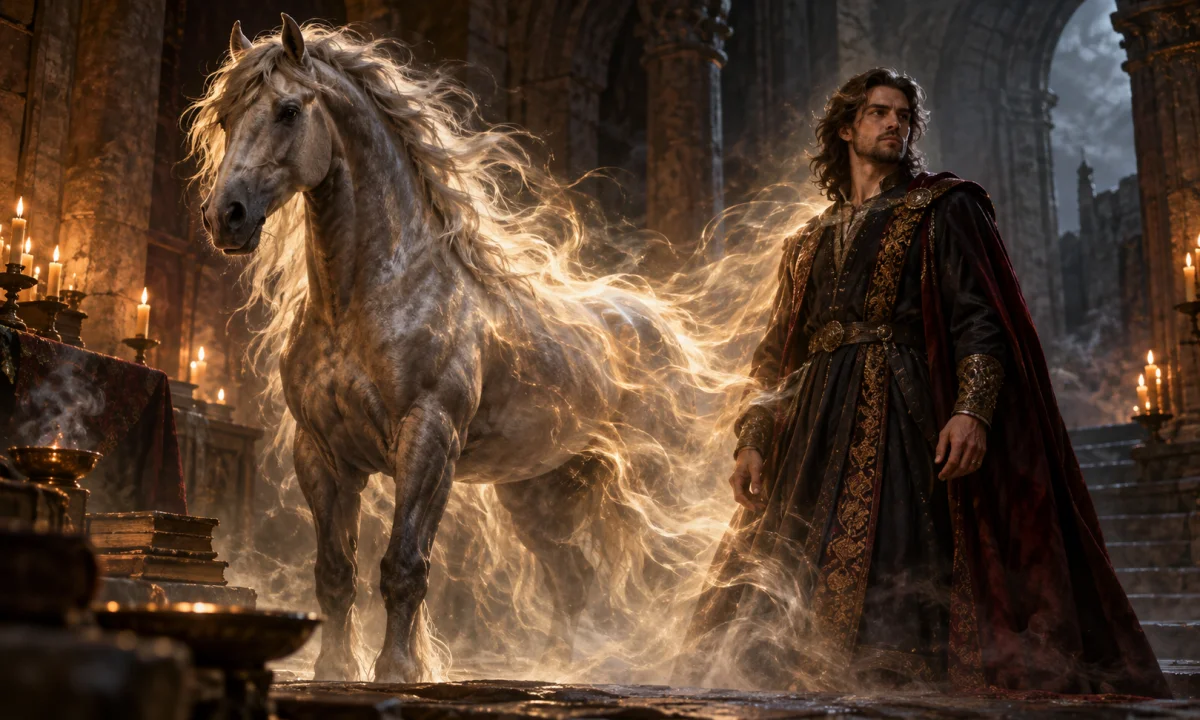
Orobas is a demon of European grimoire tradition, best known from the Ars Goetia, the first section of the Lesser Key of Solomon. He is described as a great prince who initially appears as a horse but can take human form when commanded by the ritual practitioner. In the hierarchy of that text, Orobas is associated with truthful revelation, social influence and protection from deception.
Origins in grimoire tradition
Orobas does not belong to the pantheon of an ancient pre-Christian religion, nor is he a figure from the Bible or a major character in Christian scripture. His identity comes from the learned demonology of early modern Europe, especially the catalogues of spirits used in magical handbooks known as grimoires.
The best-known account appears in the Ars Goetia, a work transmitted in manuscript form during the seventeenth century and traditionally connected with the larger Lesser Key of Solomon. The Ars Goetia presents a hierarchy of seventy-two spirits, each with a title, a seal, a stated number of subordinate spirits and particular abilities. Orobas is listed as the fifty-fifth spirit in that sequence.
His entry also belongs to an older stream of European demonological writing. Similar descriptions occur in earlier catalogues associated with the Pseudomonarchia Daemonum, a list of demons connected with the sixteenth-century German physician and demonologist Johann Weyer. The wording and details vary between manuscripts and printed versions, as is common with grimoire material. These texts should be understood as products of Christian occult literature rather than as records of a single, universally recognized religious tradition.
In the theological environment that produced these books, demons were generally understood as fallen or hostile spirits. At the same time, magical manuals assigned them specialized offices and treated them as beings who could be summoned, questioned or compelled through ritual. This created a tension between official Christian condemnation of magic and the practical interest in spiritual hierarchies found in occult manuscripts.
Name and classification
The name is most commonly written Orobas. Older texts and modern editions may preserve differences in spelling or pronunciation, but there is no widely accepted ancient etymology that securely explains the name. Attempts to derive it from particular ancient languages remain speculative. Orobas should therefore not be presented as a disguised or directly inherited form of a known Egyptian, Greek, Roman or Near Eastern deity without strong evidence.
In the Ars Goetia, Orobas is classified as a prince. The title is part of the formal hierarchy of the grimoire and does not indicate a political office in any historical human kingdom. The text states that he governs twenty legions of spirits. Such numbers are characteristic of the catalogue's system of ranks and commands; they are not independently verifiable claims about a supernatural population.
The classification “demon” reflects the framework of Christian demonology in which the grimoire was written. It is not a neutral term shared by all religions. In different cultural contexts, a spirit connected with prophecy, horses or magical knowledge might be described using very different categories. Orobas's particular identity, however, is tied to the European goetic tradition and should not be merged with unrelated horse spirits or prophetic beings from other cultures.
Appearance and principal attributes
Orobas is said to appear first in the form of a horse. The ritual text then states that he may assume human form at the request of the exorcist or operator. This two-stage appearance is one of his most recognizable features. Unlike some spirits in the catalogue, the description does not provide an elaborate account of his human clothing, facial features, color or bodily details.
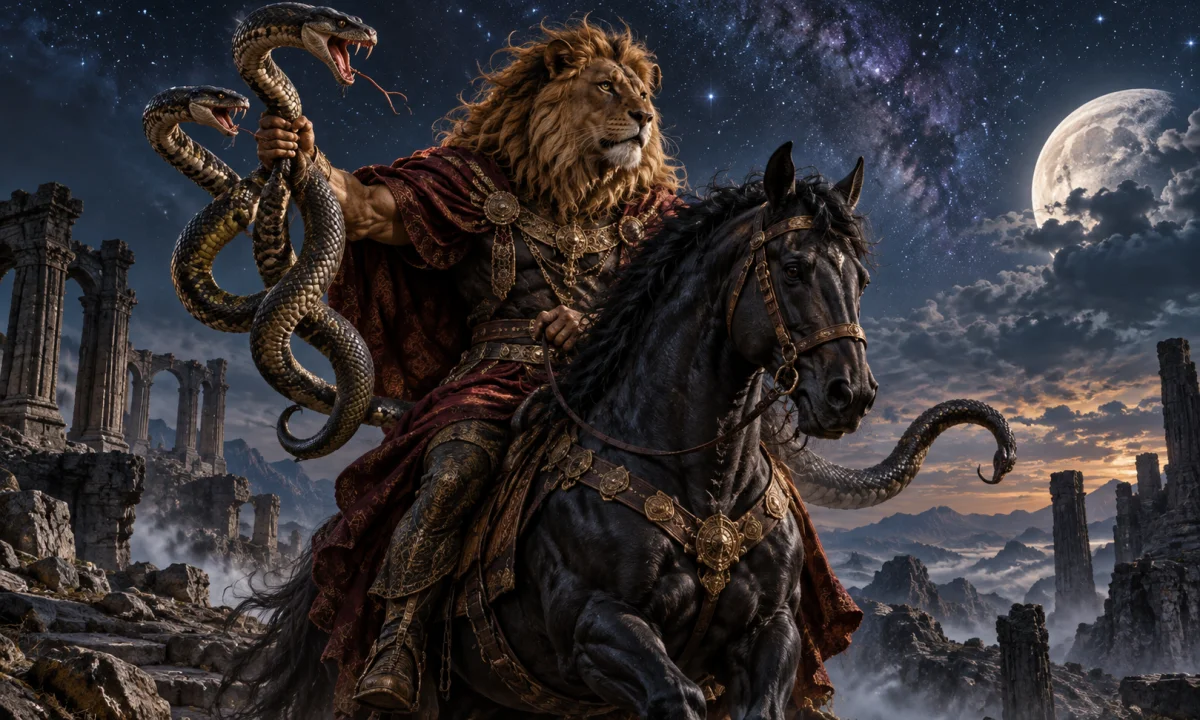
The horse form has encouraged later artists and occult writers to give Orobas an equine head, a fully horse-like body or a human figure accompanied by a horse. These visual interpretations are not all equally traditional. The core early description establishes a horse appearance followed by a human manifestation, but it does not supply a complete iconographic canon.
His principal abilities include:
- Providing answers about the past, present and future.
- Speaking about divine or spiritual matters, according to versions of the older demonological catalogue.
- Granting dignity, rank or other forms of advancement.
- Winning or influencing the favor of friends and enemies.
- Protecting the practitioner from deception or temptation by other spirits.
- Giving answers that the grimoire characterizes as truthful.
The emphasis on truthfulness is unusual within a demonological system that often warns that spirits deceive human beings. Orobas is specifically described as faithful to the person who summons him and as unwilling to deceive that operator. The text also presents him as preventing other spirits from misleading or tempting the practitioner.
These claims belong to the internal logic of the grimoire. They are not historical evidence that people consistently experienced Orobas as a reliable supernatural informant. They show instead how the compiler wished to distinguish one spirit from the many other entities in the catalogue.
Prophecy, status and favor
Orobas's powers fall into three closely related groups: knowledge, advancement and protection. His ability to answer questions about past, present and future places him among the divinatory spirits of the Ars Goetia. He is not described as a prophet attached to a temple, a sacred landscape or a particular ethnic community. His prophetic role is a service assigned within the ritual hierarchy of the grimoire.
The promise of dignity and high position reflects the social world of early modern Europe. Rank, patronage and access to powerful people were major concerns in societies structured by monarchy, aristocracy, clerical office and strict social hierarchy. A spirit who could grant titles or influence the favor of friends and enemies addressed practical anxieties about reputation, advancement and protection.
“Dignities” and “prelacies” in some versions suggest honors, offices or ecclesiastical advancement. The language does not mean that Orobas was worshipped as a patron deity of leadership. Instead, it presents him as an intermediary who could supposedly deliver worldly benefits through occult means.
His promised truthfulness also makes him especially useful within the fictional or ritual economy of the catalogue. A practitioner seeking information about hidden matters would need to know whether a summoned spirit could be trusted. By assigning Orobas the quality of fidelity, the text gives him a distinctive function among spirits whose traditional reputation is often one of fraud, ambiguity or danger.
The horse form and its interpretation
The horse is a significant animal in European history and mythology, but no single interpretation of Orobas's appearance can be proven from the grimoire itself. Horses were associated with travel, warfare, wealth, status and movement between places. They could also appear in stories about the dead, magical transformation and the passage between ordinary and supernatural worlds.
Some modern interpreters connect Orobas's horse form with broader symbolic themes such as power, speed, instinct or the ability to cross boundaries. These are reasonable readings of the image, but they are interpretations rather than documented explanations supplied by the original text. The grimoire does not say why Orobas appears as a horse, nor does it connect him to a specific horse cult or ancient myth.
The transformation from animal shape to human shape may also be read as a conventional feature of spirit encounters. In many legends and magical narratives, a supernatural being appears in an alarming or nonhuman form before becoming more intelligible to the human witness. For Orobas, however, the most secure statement is simply that the text gives him an initial equine form and permits a human appearance on command.
Ritual context and the seal
Like the other spirits in the Ars Goetia, Orobas is accompanied by a distinctive seal or sigil. In the ritual system of the book, such a mark functions as a sign associated with the spirit and is used in the preparation of the ceremony. The text also places the spirit within a larger framework involving divine names, protective circles, conjurations, constraints and formal dismissal.
This structure is important for understanding the character of Orobas. He is not presented as an independent folkloric creature encountered in villages, forests or household tales. He is a named entry in a technical magical catalogue. His identity is defined through the book's ritual procedures, rank system and claims about what he can do.
The term goetia has a long and complicated history. In classical Greek, related language was associated with harmful or deceptive magic, and later European writers used “goetic” magic for forms of spirit evocation distinguished from more elevated or supposedly theurgical practices. The Ars Goetia therefore belongs to a tradition in which ceremonial formality and Christian theological language coexist with the summoning of beings classed as demons.
Historically, it is difficult to determine how often the specific rituals were performed or how seriously every manuscript owner regarded them. Some readers may have treated the material as practical magic, while others may have approached it as forbidden knowledge, intellectual curiosity or a literary catalogue of demons.
Orobas in relation to other spirits
Orobas is sometimes confused with other horse-associated supernatural figures, but the similarities are usually limited to appearance. He is not a centaur, a nightmare spirit, a kelpie, a demon horse from medieval legend or one of the divine horses of Indo-European mythology. His horse form identifies him within the goetic description; it does not establish a shared origin with every equine being in world folklore.
He should also be distinguished from prophetic gods and oracular spirits. Orobas can allegedly reveal information about the past, present and future, but he is not a god of prophecy with temples, priesthoods or a known sacred festival. His authority comes from the grimoire's hierarchy rather than from a public religious cult.
The title “prince” can create another possible misunderstanding. Orobas is not one of the princes of Hell in a universally standardized Christian doctrine. Christian demonology has never possessed a single complete hierarchy accepted by all churches. The ranks in the Ars Goetia are part of a particular occult classification, and different demonological writers arrange spirits differently.
Historical and cultural significance
Orobas illustrates how early modern European demonology transformed scattered ideas about spirits into organized systems. The catalogue gives him a name, rank, seal, jurisdiction and recognizable appearance. This process resembles the classification of angels and other spiritual beings in religious and occult literature, even though demons were usually treated as dangerous or illegitimate entities.
His profile also reveals the concerns of the people who produced and read grimoires. The desire to know hidden events, obtain social advancement, gain influence over allies and rivals, and avoid deception appears repeatedly in magical literature. Orobas combines all of these concerns in a relatively compact figure.
From a religious perspective, the entry reflects the ambivalence of Christian Europe toward forbidden knowledge. The ritual language invokes divine authority while directing the operator to command a being identified as demonic. This does not represent mainstream Christian worship. It belongs to a marginal and often condemned occult practice that borrowed Christian names, prayers and symbols while assigning them to a magical procedure.
Later reception
Orobas became more widely known through modern editions and translations of the Ars Goetia, as well as through twentieth- and twenty-first-century occult writing. Contemporary practitioners may interpret him as a spirit of honest divination, influence, protection or personal transformation. These interpretations are modern developments and should not be treated as direct statements from ancient religion.
His horse-headed or equine form has also made him suitable for visual art, fantasy fiction, role-playing games and other forms of popular culture. Modern works may portray Orobas as a monster, a summonable ally, an enigmatic adviser or a powerful magical character. Such portrayals often combine details from the Ars Goetia with invented personalities and abilities. They are adaptations rather than evidence for additional traditional stories.
The most historically secure image of Orobas remains comparatively simple: a prince in an early modern European demonological catalogue, first appearing as a horse, capable of assuming human form, associated with truthful answers and worldly favor, and said to command twenty legions of spirits. Beyond those features, many elaborate interpretations belong to later occult speculation, artistic imagination or modern fiction rather than to a continuous ancient mythology.