WORLD
WORLD
Mumba
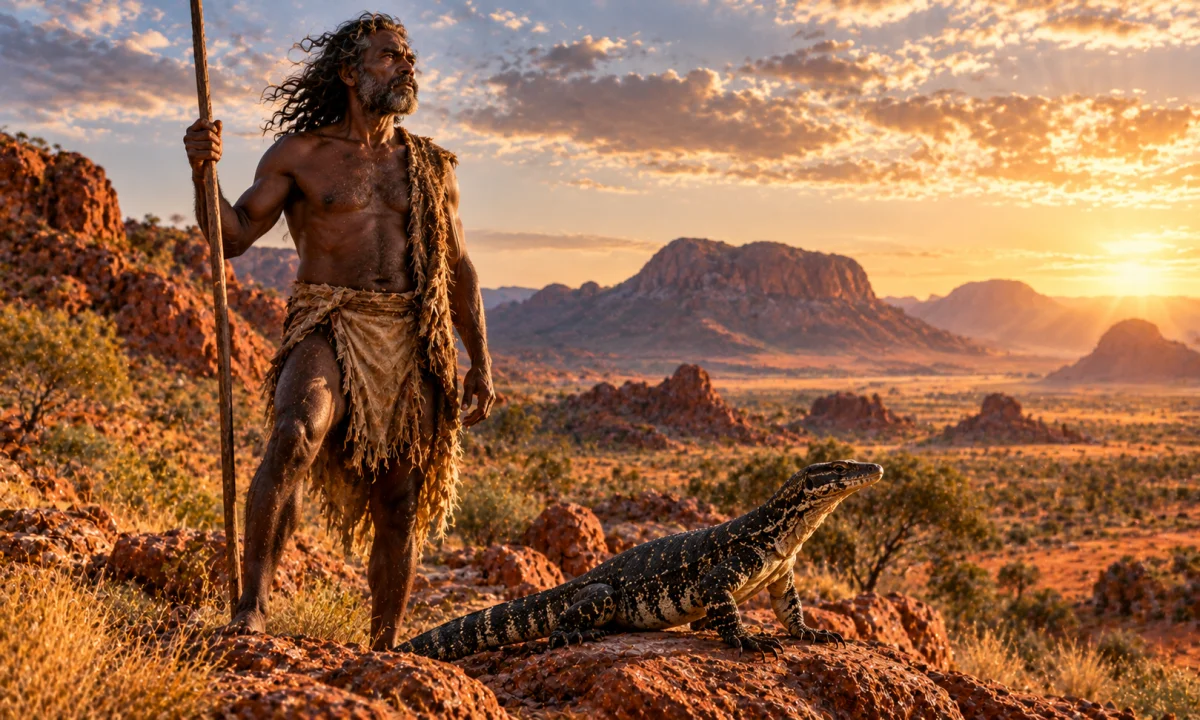
Mumba is a name found in some modern English-language lists of Australian Aboriginal mythological beings, where it is usually described as a dangerous water creature or aquatic spirit. Its identity is uncertain, however. Unlike well-documented figures such as the Rainbow Serpent, Baiame, Bunjil or the bunyip, Mumba does not have a clearly established, widely recorded tradition that can confidently be assigned to one Aboriginal nation or language group.
Origins and cultural setting
Australian Aboriginal religious traditions are not a single mythology. They belong to many distinct peoples, each with its own language, Country, ancestral beings, ceremonies and laws. More than 250 Indigenous Australian languages were spoken before European colonisation, and traditions associated with a river, waterhole, mountain or particular tract of land could be specific to the people responsible for that Country.
The term Dreaming is often used in English to describe the interconnected religious traditions through which ancestral beings shaped the land, established relationships and made law. “Dreaming” does not simply mean a collection of imaginary stories. It can refer to ancestral time, continuing spiritual realities, places, ceremonies, kinship responsibilities and the authority attached to particular knowledge.
Knowledge was traditionally transmitted through spoken narrative, ceremony, song, dance, visual designs and restricted forms of instruction. Early European writers often recorded Aboriginal names inconsistently, used their own categories such as “god”, “devil” or “monster”, and removed stories from the social and ceremonial settings that gave them meaning. Consequently, a name appearing in a later book or website does not necessarily represent a single traditional figure known throughout Aboriginal Australia.
Mumba belongs to this problem of uncertain identification. The name is repeated in some summaries of Australian mythology, but those summaries commonly provide little information about the community from which it comes, the original spelling, the language of the name or a continuous body of traditional narratives. The available descriptions should therefore be treated cautiously.
Name and identity
In modern compilations, Mumba is most often presented as a water-dwelling being, sometimes with a serpent-like or monstrous form. The spelling may vary, and some references may preserve a transcription error, a simplified English spelling or a name detached from its original linguistic context. There is no secure basis for assuming that every occurrence of “Mumba” refers to the same being.
It is also difficult to determine whether Mumba was originally understood as an ancestral being, a local spirit, a guardian of a water place, a dangerous creature or a later label applied by non-Indigenous writers. These categories overlap imperfectly with Aboriginal religious concepts. Calling a being a “monster”, for example, may emphasise its danger while obscuring its relationship to Country, law and human conduct.
For this reason, Mumba should not be described without qualification as a pan-Aboriginal god or as a universally recognised Australian equivalent of a European dragon or sea serpent. The safest description is that Mumba is an uncertain name associated in modern sources with an aquatic mythological being.
Appearance and powers
Descriptions that identify Mumba as a water creature generally give it a large, serpentine or otherwise non-human appearance. Some modern retellings attribute to it the ability to remain hidden beneath rivers, lakes or billabongs and to threaten people who approach the water. These details are not consistent enough to establish a single traditional appearance.
No reliable, widely attested account provides a fixed set of physical features comparable to the distinctive descriptions sometimes associated with the bunyip. Depending on the source, Mumba may be imagined as reptilian, serpent-like or simply as a frightening being inhabiting deep water. Such variation may reflect different local traditions, the adaptation of Aboriginal motifs to English storytelling or the repetition of an unverified description.
Claims that Mumba causes whirlpools, floods, drownings or storms should likewise be treated as tentative unless tied to a clearly identified community tradition. Water is spiritually and practically significant across Aboriginal Australia, but the general importance of water does not prove that every water-related attribute belongs to Mumba.
Role of water beings in Aboriginal traditions
Water places frequently have powerful cultural significance. A spring, river, soak, billabong or waterhole may be connected with ancestral activity, creation events, ceremonial obligations, food resources and rules governing access. Stories concerning such places can explain why a site must be approached in a particular way, who has authority over it and what behaviour is dangerous or improper.
Some water beings are protectors, some are dangerous, and some have both qualities. A being associated with a waterhole might punish trespass, regulate conduct, guard a resource or mark an event in ancestral history. Its significance would not necessarily be reducible to fear. The being could form part of a wider system of law and responsibility linking people to land and to one another.
If Mumba derives from a local aquatic tradition, its original meaning may therefore have involved much more than the image of a monster hiding in water. A short English description can preserve the warning while losing the kinship, ceremonial and geographical knowledge associated with the place.
Stories and variants
There is no securely established cycle of Mumba stories comparable to the many recorded narratives involving major ancestral figures. Modern accounts generally repeat a brief description rather than preserve a detailed narrative with named relatives, journeys, transformations or interactions with human communities.
This absence does not demonstrate that no traditional story ever existed. Oral traditions can be local, restricted, sacred or poorly recorded, and some knowledge may not be intended for public circulation. It does mean that particular episodes should not be presented as established facts without a clear cultural and documentary basis.
Some accounts may have been influenced by the wider English-language tradition of the bunyip, a name used for a range of frightening water beings in colonial writing. European observers frequently grouped different Indigenous traditions together under broad labels. A local being could consequently be renamed, compared with or absorbed into the bunyip tradition, while its original name and significance disappeared from the record.
The name Mumba may also have been reproduced through modern reference works that copied one another. When a description is repeated many times without a named language group, locality or independent traditional account, repetition alone is not evidence of antiquity or wide cultural recognition.
Interpretation and cultural significance
The most responsible interpretation of Mumba begins with place. If the name belongs to a specific Aboriginal tradition, its meaning would be determined by the Country, language and custodians associated with it. A being cannot be fully understood by extracting its name and a physical description from that setting.
Water warnings in Aboriginal societies could have practical as well as spiritual force. Deep water, unstable banks, strong currents, crocodiles and sudden changes in weather all present real dangers. A story about a powerful inhabitant may help communicate rules about when and where people should enter the water, especially to children or visitors. At the same time, explaining a tradition only as a safety device would be inadequate, because Aboriginal law and spirituality do not separate the natural world from moral and social responsibilities in the same way as many modern Western categories.
Scholars and cultural educators also stress the importance of distinguishing public knowledge from restricted knowledge. A published account may be partial because some parts of a tradition are not meant to be disclosed. It is therefore inappropriate to fill gaps in the record with invented genealogies, powers or dramatic adventures merely to create a more complete-looking character.
Distinction from similar figures
The bunyip
The bunyip is a broad English-language term associated with frightening beings said to inhabit waterways. It became especially prominent in colonial Australian writing, which often collected diverse local traditions under one name. Mumba is sometimes placed beside the bunyip or treated as a variant of it, but the two names should not automatically be considered identical. Bunyip descriptions vary greatly, and the term itself has a complicated history of colonial interpretation.
The Rainbow Serpent
The Rainbow Serpent is a collective English label for powerful ancestral beings found in numerous Aboriginal traditions, although the relevant names and stories differ from one community to another. These beings are commonly associated with water, fertility, landscape formation, rain and law. Mumba should not be presented as another name for the Rainbow Serpent without specific evidence. A water association alone does not establish identity.
Muldjewangk
Muldjewangk is a water being associated particularly with Ngarrindjeri traditions in the Murray River and lower Murray Lakes region. It is sometimes described in popular writing as a monster or water spirit. It belongs to a particular cultural context and should not be merged with the uncertain figure called Mumba.
Yowie
The yowie is usually described in modern English as a large hairy human-like being. It has been connected with several Aboriginal traditions, but its identity and history are also subject to regional variation and later popularisation. It is not an aquatic figure and should not be confused with Mumba simply because both appear in lists of Australian legendary beings.
Later reception
Mumba has had little clearly documented influence on major Australian literature, film or Indigenous public cultural movements. Its current visibility seems to come mainly from general mythology websites, lists of legendary creatures and popular reference material. In these settings, it may be portrayed as a generic water monster, often with details that are not supported by a clearly identified traditional source.
Modern retellings can introduce Aboriginal names to wider audiences, but they also risk flattening diverse cultures into a single catalogue of monsters and gods. Responsible use of the name should preserve the uncertainty surrounding its documentation, avoid assigning it to an entire continent and distinguish a modern fantasy depiction from an Aboriginal tradition.
Until a specific community tradition or reliable cultural record is identified, Mumba is best regarded as an uncertain and possibly locally derived name for an aquatic being, rather than as a securely defined figure of Australian Aboriginal mythology. Its study illustrates why Aboriginal mythological subjects must be discussed through language, Country, custodianship and historical context, not only through lists of supernatural characters.