WORLD
WORLD
Kananeski Anayehi
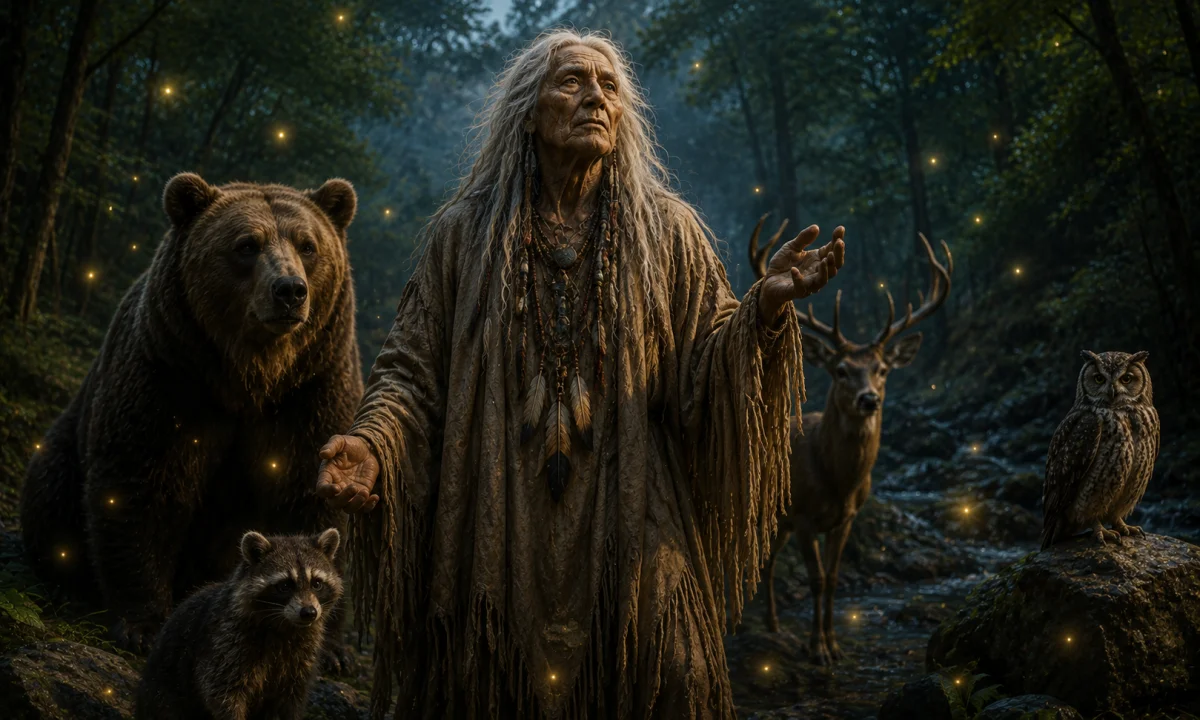
Kananeski Anayehi is a name associated in some modern accounts with a hairy or wild people of Cherokee tradition. The name is often presented in English as “hairy people,” “hairy beings,” or “hairy ones,” and the figure is consequently compared with the wider North American idea of a forest giant. The identification is not completely secure, however. Kananeski Anayehi is not a uniformly documented character with one agreed story, appearance, or role across all Cherokee communities and sources.
Care is therefore needed when describing Kananeski Anayehi. The name appears more often in recent lists of legendary beings and discussions of Cherokee ideas about wild forest inhabitants than in the best-known published cycles of Cherokee sacred narratives. Spellings also vary because Cherokee names have been represented in English by several different systems. A form found in one account may not be identical in pronunciation or meaning to a form found in another.
Cherokee cultural setting
Cherokee traditional knowledge includes stories about animals, spirits, monsters, ancestral beings, sacred forces, and people who live beyond ordinary human society. These categories do not always correspond to modern Western divisions between “myth,” “legend,” “fairy tale,” and “supernatural folklore.” A being may be part of a story about origins, a warning told to children, a teaching about proper conduct, or a local tradition connected with a particular mountain, river, or community.
The Cherokee, or ᏣᎳᎩ (Tsalagi), are an Indigenous people of the southeastern woodlands of North America. Their traditional homeland includes areas now associated especially with western North Carolina, eastern Tennessee, northern Georgia, and northern Alabama. Following removal and other historical pressures, Cherokee communities also became established in Oklahoma, while the Eastern Band of Cherokee Indians remained in North Carolina. Cherokee cultural traditions have continued in these different settings, although particular stories, words, and interpretations may differ.
Much Cherokee knowledge was preserved through oral transmission rather than through a single authoritative written mythology. Missionaries, ethnographers, collectors, and later writers recorded portions of Cherokee narrative and belief, but those records are selective. They may reflect the language skills, assumptions, and purposes of the recorder as much as the full range of Cherokee tradition. A name that appears in a modern catalogue may therefore represent a local account, an older transcription, an altered translation, or a later attempt to classify a being according to European ideas of monsters and giants.
Name and identity
The expression Kananeski Anayehi is commonly treated as a Cherokee name for hairy people or hairy beings. The English gloss should not be treated as perfectly fixed. Cherokee words can be difficult to represent in English, and small differences in spelling may conceal differences in pronunciation, grammatical form, or dialect. The name is also sometimes written without consistent marks for vowel length, tone, or the sounds of the Cherokee language.
In popular descriptions, Kananeski Anayehi are usually characterized as humanlike inhabitants of remote forests and mountains. They are generally described as larger, hairier, and more isolated than ordinary people. Some accounts call them a race or population rather than a single individual. Others use the name as though it referred to one type of forest spirit or giant. There is no universally accepted Cherokee classification that resolves these differences.
It is also uncertain how widely the name was used historically in Cherokee-speaking communities. The existence of the name in modern English-language material does not by itself demonstrate that it was a central or widespread element of traditional Cherokee religion. In particular, it should not automatically be placed alongside prominent figures such as the Uktena or Tsul 'Kalu as though all belonged to the same level of Cherokee tradition.
Appearance and customary attributes
Descriptions associated with Kananeski Anayehi commonly emphasize a body covered in hair. The beings are imagined as human-shaped, with the ability to move through woodland terrain and remain hidden from ordinary people. Their size is not consistent. Some retellings make them giant-like, while others describe them as simply larger or more physically imposing than humans.
They are often placed in wilderness settings: dense forests, high mountains, caves, and areas far from settled communities. This location is significant even when a story gives no detailed supernatural power. In Cherokee narratives, the forest is not merely an empty landscape. It is a living environment containing animals, plants, spirits, dangers, and sources of medicine. A wild person encountered there may represent the limits of human settlement and knowledge rather than a monster whose only purpose is to attack.
Modern summaries sometimes add traits such as immense strength, an unpleasant smell, cannibalism, advanced stealth, or a fear of fire. These details are not consistently established for Kananeski Anayehi and should not be presented as universal attributes. They may have been borrowed from other giant traditions, from general wilderness-monster imagery, or from modern attempts to connect the name with reports of Bigfoot. The safest description is that the name is associated with hairy, humanlike wilderness beings, while the details vary.
Stories and narrative patterns
No single, widely recognized story cycle about Kananeski Anayehi is available in the way that Cherokee stories about Kanati and Selu, the Uktena, or the origin of the Ani Tsagihi are known through repeated publication and retelling. Accounts using the name tend to provide a description rather than a complete sequence of traditional episodes.
Where hairy forest people occur in Cherokee-related storytelling, they may function as beings who live outside the ordinary social order. Their distance from villages can mark a boundary between cultivated life and the deep wilderness. An encounter with such beings may test a person's courage, judgment, respect for the land, or ability to distinguish appearance from intention.
That narrative function is important. A wild-looking being is not necessarily equivalent to an evil demon. Cherokee stories include dangerous beings, but they also recognize powerful entities that cannot be reduced to a simple good-and-evil scheme. Some supernatural figures are helpful under particular conditions, harmful when offended, or dangerous because humans misunderstand the rules governing an encounter. Without a specific traditional story, it is inappropriate to assign Kananeski Anayehi a single moral character.
Nor is it safe to claim that every report of a hairy person in Cherokee country refers to Kananeski Anayehi. Indigenous storytelling often contains local names for unusual people, spirits, animals, and events. Later collectors may group unlike traditions under one English heading, while modern audiences may group them all under the label “Bigfoot.” Similarity of appearance does not prove identity.
Meaning and interpretation
The idea of a hairy or wild people can be understood on several levels. At the most literal level, it describes beings who resemble humans but belong to the forest rather than to settled society. At a symbolic level, it reflects a recurring human concern with the boundary between civilization and wilderness, the known and the unknown, and human beings and other forms of life.
Within a Cherokee cultural framework, the forest should not be interpreted simply as a place outside culture. Cherokee relationships with plants, animals, water, mountains, and weather are part of a larger moral and spiritual world. Stories involving wilderness beings may encourage attentiveness to one's surroundings and humility toward forces that cannot be controlled. They can also preserve a sense that the land contains histories and presences not exhausted by human observation.
Interpretation must nevertheless remain grounded in actual evidence. It is tempting to turn Kananeski Anayehi into a symbol of an ancient belief in a zoological “missing link,” or to treat every modern sighting of a large, hairy animal as proof of the traditional being. Neither conclusion follows from the name alone. Traditional narrative, religious belief, local folklore, and modern cryptozoology are different forms of cultural material and should be kept distinct.
Relationship to other Cherokee beings
Kananeski Anayehi should not be confused with the Yunwi Tsunsdi, often translated as “Little People.” The Yunwi Tsunsdi are generally described as small supernatural inhabitants of the natural world. They may be benevolent, mischievous, or dangerous depending on the account and the way humans treat them. Their small stature and their association with particular natural places distinguish them from the large or hairy forest people described under the name Kananeski Anayehi.
They should also be distinguished from Tsul 'Kalu, a famous Cherokee giant and master of the hunt associated especially with the western North Carolina mountains. Tsul 'Kalu is a named individual with a substantial body of recorded narrative, including stories connected with hunting and with a prominent mountain landscape. A general category of hairy or wild people is not the same as this particular giant, even when modern illustrations or summaries place them together.
Nor should Kananeski Anayehi be identified with the Uktena. The Uktena is a powerful horned serpent in Cherokee tradition, associated in recorded stories with danger, transformation, and a conflict involving the culture hero or medicine figure known as the Thunderer in some English presentations. Its serpentine form and aquatic or mountainous associations differ sharply from the humanlike forest image attached to Kananeski Anayehi.
Other Cherokee beings, including the Raven Mocker and the Spearfinger, also belong to distinct narrative traditions. A Raven Mocker is a harmful supernatural being associated with the death of elders, while Spearfinger is a dangerous female monster in a story connected with the geography of the southern Appalachian region. These figures should not be combined merely because all may appear in general lists of Cherokee monsters.
Sources, variation, and responsible description
The surviving record of Cherokee traditional narratives includes oral testimony, Cherokee-language material, translations, missionary writings, ethnographic collections, and later popular retellings. Each type of record has limitations. An English translation may simplify a name or turn a descriptive phrase into the apparent name of a separate creature. A collector may preserve one community's version while leaving out other local traditions. A modern website may repeat an unsourced description until it appears more established than it is.
For Kananeski Anayehi, these problems are especially important because the name is not accompanied by a single agreed body of canonical stories. Statements about a fixed height, a universal diet, a particular cave, or a specific relationship with a Cherokee deity should be treated skeptically unless they can be tied to a clearly identified traditional account. Claims that the beings were always hostile, always peaceful, or universally known throughout the Cherokee world are likewise too strong.
The most responsible presentation identifies Kananeski Anayehi as a name associated with hairy, humanlike wilderness beings in some accounts, notes the uncertainty surrounding the documentation, and avoids presenting later embellishments as ancient doctrine. This approach respects both the richness of Cherokee storytelling and the limits of what can be established from the surviving record.
Modern reception
In modern popular culture, Kananeski Anayehi is sometimes included in lists of Indigenous versions of Bigfoot. That comparison is understandable because both are linked in popular imagination with large, hairy, elusive beings living in forests. It is not, however, an exact equivalence. “Bigfoot” is a modern North American popular and cryptozoological category that gathers together many different regional traditions, eyewitness reports, hoaxes, fictional representations, and interpretations of unexplained tracks.
Using Bigfoot as a translation can obscure the cultural setting of a Cherokee name. It may also encourage the idea that traditional stories were early scientific reports of an unknown primate. The traditional significance of a wild being may instead concern conduct, landscape, community boundaries, spiritual danger, or the recognition that human knowledge is limited.
Contemporary books, games, podcasts, artwork, and supernatural fiction may freely expand the name by assigning Kananeski Anayehi dramatic powers, detailed societies, or confrontations with other monsters. Such creative treatments can be identified as modern adaptations rather than evidence for a uniform Cherokee tradition. The older and more cautious understanding remains a name of uncertain scope, connected in some sources with hairy people of the remote woodland, whose exact identity and narrative role vary according to the account.