WORLD
WORLD
Inle
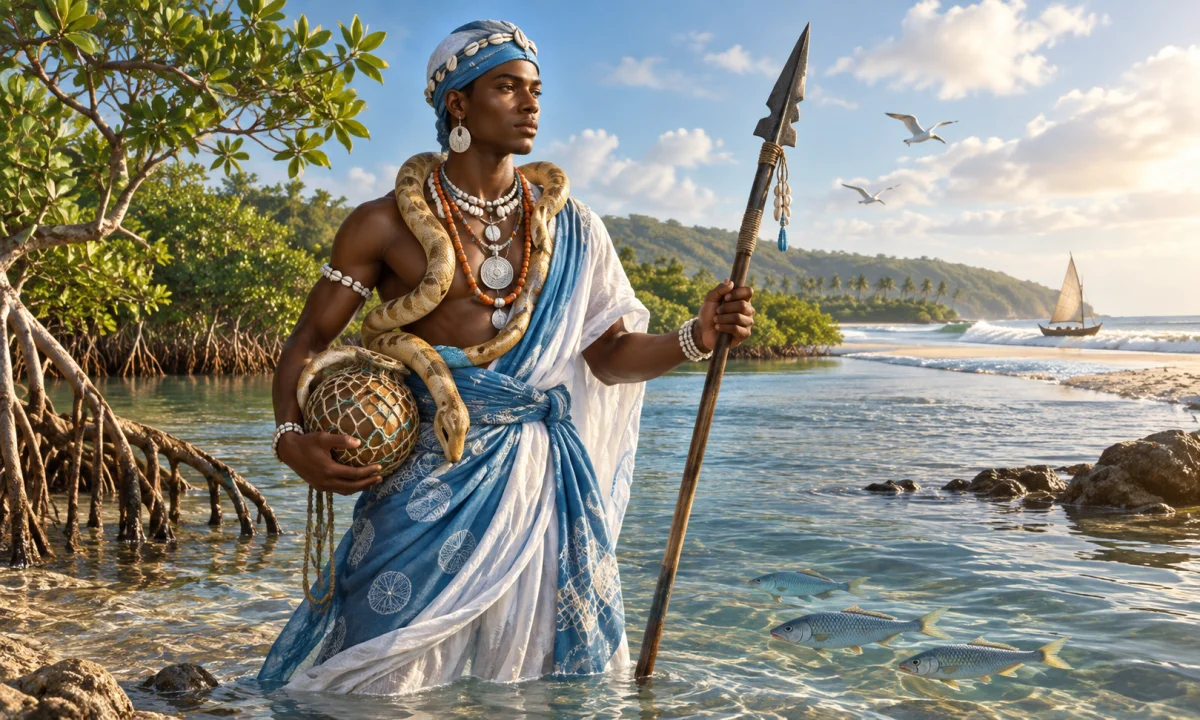
Inle is an orisha venerated especially in Cuban Lucumí, the Caribbean religious tradition that developed from Yoruba beliefs carried from West Africa to Cuba. He is commonly associated with healing, medicine, fishing, rivers, and the knowledge of plants and the natural world. His name and attributes vary considerably between communities. Inle is not a single, universally defined figure across all Yoruba and Afro-Caribbean traditions, and descriptions found in popular summaries sometimes combine Cuban religious practice with details from other orishas.
Origins in Yoruba and Lucumí tradition
Lucumí religion, also called Regla de Ocha or Santería in many contexts, emerged in Cuba among Yoruba-speaking people and their descendants, especially during the era of the transatlantic slave trade. Enslaved Africans brought religious ideas, ritual knowledge, praise names, songs, and concepts of divine power from several parts of West Africa. In Cuba, these traditions developed under severe pressure from colonial rule and Catholic evangelisation. Orishas were sometimes identified with Catholic saints, although the orishas were not simply equivalent to those saints.
Inle is generally understood as the Cuban form of the Yoruba orisha Erinlẹ, whose name is also written in several other ways, including Erinle, Inle, and Inlé. The spelling Inle is particularly familiar in Cuban and wider Spanish-speaking usage. Yoruba names may be represented differently when transferred into Spanish, English, or other writing systems, so variation in spelling does not always indicate a different being.
The Yoruba Erinlẹ is associated with a river and with the settlements and traditions connected to that river in present-day southwestern Nigeria. The historical relationship between the river, the local cult, and the wider orisha tradition is important: Erinlẹ is not merely an abstract god of water. His identity is rooted in a particular sacred landscape, in hunting and fishing, and in specialised knowledge of health and the environment.
Inle therefore belongs to a living religious tradition rather than to a fixed mythology preserved in one ancient book. Knowledge of him survives through initiation, ritual practice, oral teaching, chants, divination, family and community traditions, and the religious lineages of individual practitioners. Different houses of worship may preserve somewhat different accounts of his character and relationships.
Name and classification
The name Erinlẹ is often interpreted in connection with the Yoruba words for an elephant and the earth, although the exact explanation and translation of the name can vary. Popular interpretations sometimes render it as “the elephant of the earth” or connect it with a great presence within the land. Such translations should not be treated as a complete definition of the orisha. Yoruba divine names may carry layers of praise, metaphor, historical reference, and ritual meaning that cannot be reduced to one English phrase.
In Lucumí practice, Inle is usually classified as an orisha, a divine power associated with particular forces, places, occupations, moral qualities, and ritual relationships. He is often described as a male orisha, but gender in descriptions of orishas can be more complex than modern categories suggest. Some accounts present him as a healer and fisherman; others emphasise his connection with hunting, medical knowledge, or the waters of the river.
Inle should not be confused with every figure whose name is connected with water or healing. He is distinct from Yemayá, whose principal associations include the sea, motherhood, and the generative power of the ocean; from Oshún, associated especially with rivers, sweetness, beauty, fertility, and intimate human relationships; and from Olokun, associated with the deep ocean and its immense, hidden wealth. Inle may share aquatic symbolism with these orishas without being interchangeable with them.
Inle as healer and keeper of knowledge
One of Inle’s most enduring roles is that of a healer. He represents practical knowledge of the body, medicinal plants, food, water, and the environments in which people live. In Cuban religious understanding, this association has sometimes led to a connection with physicians, nurses, surgeons, herbalists, and other people whose work involves treating illness. The association is symbolic and devotional; it does not mean that every medical professional is automatically a devotee or that Inle replaces medical care.
His healing power is closely related to observation. A fisher or hunter must read currents, weather, animal behaviour, vegetation, and changes in the landscape. These skills become part of a broader image of Inle as one who understands hidden relationships in nature. He can be portrayed as a figure who knows where nourishment is found and how the living world sustains human communities.
Inle’s association with medicine also reflects a broader religious principle found in Yoruba-derived traditions: the natural world is not spiritually empty. Plants, rivers, animals, tools, colours, foods, and bodily conditions may all participate in a network of sacred forces. Knowledge of herbs and other materials is therefore not merely technical in a religious setting. It can involve responsibility, ritual preparation, respect for spiritual powers, and careful transmission from teacher to student.
Fisherman, hunter, and river figure
Inle is frequently represented as a fisherman, and fishing equipment is among the objects associated with him in Cuban practice. The fish is an especially recognisable emblem. It can suggest both his relationship with rivers and his ability to provide sustenance. Fishing also carries a symbolic meaning: the fisher searches beneath the surface and brings something concealed into human reach. This imagery suits Inle’s connection with diagnosis, discovery, and knowledge that is not immediately visible.
Some traditions also connect Inle with hunting. This aspect is more prominent in accounts of the Yoruba Erinlẹ than in every Cuban description of Inle. Hunting and fishing are not identical roles, and they should not be merged without qualification. Both, however, involve intimate knowledge of animal life, terrain, patience, and the ability to live from the resources of the environment.
His river associations distinguish him from a purely oceanic deity. Rivers are routes of movement and sources of drinking water, irrigation, food, and settlement. They can also mark boundaries between communities and connect distant places. A river figure such as Inle consequently occupies an important position between wilderness and society, danger and nourishment, concealment and revelation.
Symbols and ritual associations
Descriptions of Inle commonly mention fish, fishing tools, hooks, nets, water, medical instruments, and medicinal plants. Colours vary by lineage and regional practice, but blue and green are often associated with him because of his relationship with water and vegetation. Some Cuban traditions also use yellow or other colours in particular ritual contexts. There is no single universal colour code accepted by every Lucumí community.
Images of Inle may show him as a handsome young man, a fisherman, a hunter, or a refined healer. In some representations he carries a staff, fishing implement, or medical instrument. These images are devotional and symbolic rather than historical portraits. The details of ritual objects, sacred vessels, clothing, offerings, and initiation practices belong to religious communities and should not be treated as a universal catalogue of public folklore.
Some accounts associate Inle closely with Abatá, a female aquatic power who may be described as his sister, companion, or complementary presence, depending on the tradition. The precise relationship is not consistent across all sources. Abatá is sometimes linked with marshes, lagoons, or other watery environments, while Inle is more often linked with the river and fishing. Because these accounts vary, it is safer to identify the relationship as a traditional association rather than state one fixed genealogy.
Inle is also sometimes connected with Osanyin, the orisha of medicinal plants and herbal power. This does not make the two figures identical. Osanyin’s central domain is the spiritual and medicinal potency of plants, whereas Inle is more broadly associated with healing, fishing, hunting, river environments, and the practical knowledge required to preserve life. A particular religious lineage may emphasise cooperation or affinity between them.
Stories and variations
There is no single canonical biography of Inle. Yoruba and Lucumí religious narratives are preserved in forms such as patakíes, oral stories that explain divine relationships, ritual customs, moral lessons, and the origins of particular practices. Patakíes can differ from one religious house to another, and an account repeated in a modern book or online source may represent one lineage rather than the tradition as a whole.
Stories about Inle often focus less on a long sequence of adventures than on his skills and relationships. He may appear as a hunter or fisherman whose knowledge makes him valuable to other powers. His ability to find food, understand the landscape, or heal illness places him in a position of service. These narratives can present knowledge as a sacred responsibility rather than as private property.
Some popular accounts describe Inle as having a close relationship with Yemayá, Oshún, or another water-associated orisha. Such relationships are not uniform throughout Yoruba-derived religions. In one community, a figure may be described as a spouse, child, sibling, or companion; in another, that relationship may be absent or told differently. Care is especially necessary with genealogies, since they are often repeated without distinguishing a local Lucumí story from a belief shared across the entire Yoruba world.
Accounts of Inle’s body or appearance can also vary. A few modern retellings give dramatic explanations for physical features or bodily transformation, but these should not automatically be treated as ancient or universal tradition. Religious narratives may be local, initiatory, symbolic, or adapted over time. The absence of one detail from another community’s account does not by itself disprove either tradition.
Religious meaning in the Caribbean
Inle’s importance in Cuba reflects the way African religious traditions adapted to a new environment while preserving relationships with Yoruba sacred powers. The Caribbean setting gave new significance to rivers, coasts, fishing, plantation landscapes, medicinal plants, and the experience of illness under slavery and colonial rule. Inle’s identity as a healer and provider could therefore speak to both older Yoruba concepts and the realities of Afro-Cuban life.
His veneration also illustrates how Lucumí religion maintained specialised divine roles without treating nature as a collection of unrelated objects. Water, fish, plants, the human body, and medical knowledge can be linked through a sacred understanding of interdependence. Inle embodies the value of attentive observation: one must learn the river, recognise useful plants, understand the signs of illness, and respect the forces that make healing possible.
Devotion to Inle is not limited to a decorative interest in fish or blue-green imagery. Within religious communities, his worship may involve prayer, offerings, divination, ritual obligations, and relationships established through initiation. The exact practices are determined by tradition and religious lineage. Public descriptions cannot fully represent the knowledge reserved for initiated practitioners, and they should not be used as substitutes for participation under the guidance of an authorised religious elder.
Distinguishing Inle from similar figures
- Inle and Erinlẹ: These names usually refer to related forms of the same orisha in Yoruba and Cuban contexts, but spelling, pronunciation, and attributes vary. A Cuban description of Inle should not be assumed to represent every tradition connected with Yoruba Erinlẹ.
- Inle and Yemayá: Both may be associated with water, but Inle is more closely connected with rivers, fishing, healing, and natural knowledge, while Yemayá is principally linked with the sea, motherhood, and the generative ocean.
- Inle and Oshún: Oshún is strongly associated with rivers, beauty, love, fertility, sweetness, and prosperity. Shared river symbolism does not make Oshún and Inle the same orisha.
- Inle and Olokun: Olokun is associated with the deep sea, hidden riches, mystery, and immense aquatic power. Inle’s usual sphere is closer to the river, the fisher, the healer, and the living environment.
- Inle and Osanyin: Osanyin is especially connected with medicinal plants and their spiritual potency. Inle’s role includes healing but also encompasses fishing, hunting, rivers, and medical knowledge more broadly.
Modern representation
Inle appears in contemporary discussions of Afro-Caribbean religion, mythology, diaspora identity, herbal knowledge, and spiritual symbolism. He may also be represented in paintings, devotional objects, music, and popular writing. These modern forms can make his name more widely known, but they often simplify a complex and lineage-based tradition.
Modern fantasy works sometimes recast Inle as a generic water god, a healer with unlimited supernatural powers, or a character detached from Lucumí and Yoruba religious contexts. Such portrayals belong to creative adaptation, not necessarily to traditional belief. A respectful account keeps the distinction clear: Inle is an orisha rooted in Yoruba-derived religious practice, especially Cuban Lucumí, whose associations with rivers, fishing, medicine, and ecological knowledge remain connected to living communities and changing traditions.