WORLD
WORLD
Ibeji
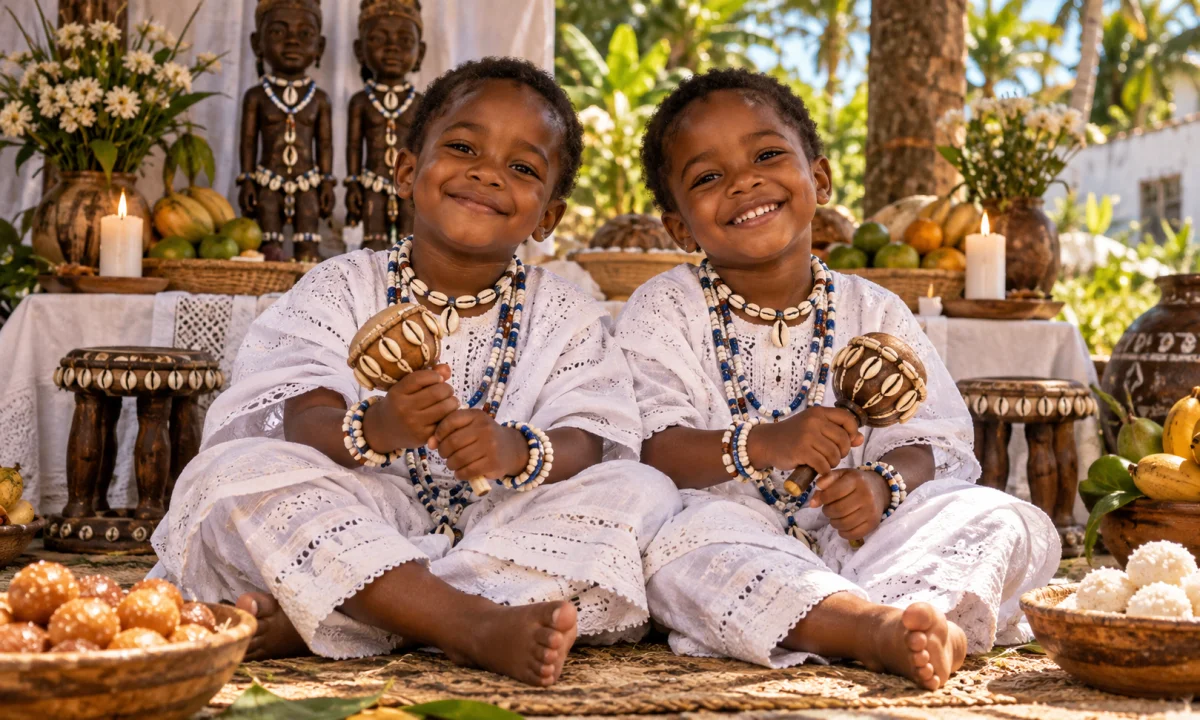
Ibeji refers to the sacred twins of Yoruba religious tradition and, more broadly, to the spiritual importance attached to twins in Yoruba-speaking communities. The name is especially familiar in the Caribbean through Cuban Lukumí, often called Santería, where the twin orisha are commonly known as the Ibeyis or Jimaguas. Their traditions began in West Africa and were carried across the Atlantic by enslaved Yoruba-speaking people, where they developed alongside Catholic and other Caribbean religious influences.
Ibeji is therefore not originally a Caribbean being. The Caribbean forms belong to a wider religious history linking Yoruba traditions in present-day Nigeria and neighbouring regions with Afro-Caribbean practices. Names, stories, ritual details and relationships vary between communities, and “Ibeji” can refer either to twins themselves, to a sacred twin power, or to carved figures representing deceased twins.
Origins in Yoruba tradition
Among the Yoruba, the birth of twins has traditionally been regarded as spiritually significant. Twins are called ibeji, a word generally understood as relating to two births or paired children. Their arrival may be welcomed as a blessing, but it can also create religious responsibilities for the family. In older Yoruba settings, the survival of both twins was not taken for granted, and the death of one child required particular rites to preserve balance between the living child, the deceased twin and the wider family.
Yoruba religious life does not always draw a sharp modern distinction between “mythological characters,” “ancestors” and “divine powers.” Ibeji traditions combine all three dimensions. The twins may be treated as children with a special relationship to the orisha, as a paired sacred force, and as beings whose presence affects the prosperity and protection of their household.
The importance of twins is also connected with the unusually high historical rate of twin births in parts of southwestern Nigeria. The reasons for that demographic pattern have been studied medically and historically, but its religious meaning belongs to Yoruba cultural interpretation. Twins were not simply regarded as ordinary siblings born at the same time. They were understood as sharing a mysterious bond that could extend beyond death.
Name, identity and classification
Ibeji is the common Yoruba term, while Ibeyi is a widespread form in Caribbean Spanish-speaking religious contexts. In Cuban Lukumí, the figures are often called Ibeyis, Ibeyi or los Jimaguas. “Jimagua” is a Caribbean Spanish term for a twin and is not itself a Yoruba name.
The twins are often treated as a pair of orisha, but their classification is not identical in every tradition. Some accounts describe them as a distinct sacred power associated with childhood, joy and paired identity. Other accounts emphasize their connection with particular orisha families, especially Changó, the thunder deity, and Ochún, the river and beauty deity. These relationships are common in Cuban religious teaching, but genealogies are not completely uniform across all Yoruba or Lukumí lineages.
In Yoruba thought, the two twins are commonly named Taiwo and Kehinde. Popular explanations often translate Taiwo as “the first to taste the world,” because Taiwo is said to be sent out first to discover whether the world is safe. Kehinde, despite being born second, is sometimes regarded as the senior twin because Kehinde sent Taiwo ahead. The details and interpretation of this relationship vary, and the names should not be treated as evidence that one twin is simply “older” in every social or ritual sense.
Twins, balance and sacred responsibility
The central idea in Ibeji tradition is not merely duplication. The twins represent a relationship in which two persons are distinct but spiritually interdependent. Their paired existence can symbolize balance, complementarity and the coexistence of different qualities within one sacred pattern.
Ibeji are frequently associated with children, play, laughter, music, abundance and good fortune. Their youthful character does not make them insignificant. In Yoruba religious imagination, children may possess unusual spiritual power precisely because they stand close to the invisible world and have not yet acquired the social limitations of adulthood.
The twins are also associated with fertility and the wellbeing of the family. A household connected with Ibeji may seek protection, prosperity and the continued health of its children. Their power is often described as capable of changing quickly: they may be affectionate and generous, but they must also be treated respectfully. This combination of playfulness and seriousness appears in many accounts of child-associated sacred beings.
Music and dancing are important parts of Ibeji devotion. Drums, songs, food and brightly coloured clothing may be used in ceremonies, although practices differ among Yoruba communities and Caribbean houses of worship. The emphasis on rhythm reflects the broader importance of music in Yoruba and Afro-Caribbean religious life, where drumming can communicate with orisha and organize communal ritual.
The ere ibeji: memorial figures for a deceased twin
One of the best-known expressions of Ibeji devotion is the ere ibeji, a carved wooden figure made for a twin who has died. The word ere can refer to an image or sculpted figure, so an ere ibeji is not simply a general idol representing twins. It is usually a personal memorial object connected with a particular deceased child.
If one twin died, the family could commission or obtain a figure representing that child. The living twin might be washed or cared for alongside the figure, and the family could present food, oil or other offerings according to local custom. The image provided a visible focus for mourning and continuing relationship. It was not necessarily understood as a realistic portrait; its purpose was religious, emotional and familial.
Ere ibeji figures are often carved with enlarged heads, elaborate hairstyles, jewellery, scarification patterns or other signs of status. Their formal style is connected with Yoruba ideas about the head, identity and spiritual personhood. The exact appearance varies by region, carver and period. Some figures are highly stylized, while others include details associated with the child’s family or community.
Art museums have sometimes displayed ere ibeji primarily as examples of African sculpture. That presentation can obscure their original role. These objects were not created only for aesthetic appreciation. They belonged to practices of remembrance, care and ritual obligation, and many were handled, dressed, washed or fed by family members. Their significance cannot be reduced to the category of “twin statue.”
Stories and relationships
Ibeji stories differ among oral traditions, Ifá interpretations and religious lineages. A widely circulated narrative tells of twins whose music or drumming defeats, drives away or persuades Death. In some versions, the twins use their shared skill and persistence to restore people whom Death has taken; in others, their music forces Death to abandon a community. The details are not fixed, but the story expresses a recurring theme: paired intelligence and joyful performance can overcome a force that ordinary people cannot resist.
The twins’ relationship with Changó is particularly prominent in many Caribbean accounts. Changó, known in Yoruba as Ṣàngó, is associated with thunder, lightning, kingship, force and drumming. In Cuban Lukumí, Ibeyis may be described as Changó’s children, often with Ochún as their mother. Some communities instead emphasize Yemayá or other maternal relationships, while Yoruba traditions may present different genealogies or avoid reducing the twins to a single family tree.
The association with Ochún helps explain links between the twins and sweetness, rivers, beauty, children and prosperity. Their connection with Changó highlights courage, rhythm and the ability to defeat danger. These relationships should be understood as theological patterns that vary across traditions, rather than as one universally accepted family history.
Ibeji in Cuba and the Caribbean
Enslaved Africans from Yoruba-speaking regions were taken to the Caribbean during the Atlantic slave trade. In Cuba, Yoruba religious knowledge contributed to the development of Lukumí, a tradition shaped by African ritual systems, Spanish colonial conditions, Catholic imagery and interaction with other African-derived religions. The Ibeyis remained recognizable within this environment, although their names, stories and ritual forms changed.
In Cuban practice, the Ibeyis are often represented as two children and are associated with play, cleverness, protection and victory over hardship. They may be pictured with drums, toys or other objects connected with childhood. Some images show the pair in matching clothing, while others distinguish them by colour or accessory. Such visual choices are not entirely standardized and may reflect the customs of a particular religious house or artist.
The Ibeyis are also commonly linked with the Catholic Holy Children of Atocha, especially in popular descriptions of Santería symbolism. This is a form of religious correspondence or syncretism produced by historical circumstances, not proof that the Yoruba twins and the Catholic figures are originally the same beings. Afro-Cuban practitioners may interpret such associations differently, and not every house places the same emphasis on them.
Other Caribbean societies preserve Yoruba-derived or Orisha-centred traditions, but the vocabulary and ritual organization differ. Trinidad and Tobago, for example, has religious movements shaped by Yoruba, Fon, Ewe and other West African influences, while Haitian Vodou has its own spirits, histories and ceremonial structures. Ibeji should not automatically be identified with every pair of child spirits found in Caribbean religions. Similar themes do not establish identical origins.
Meaning of the twofold form
The paired nature of Ibeji can be interpreted through several related ideas:
- Complementarity: the twins embody difference held within a single relationship.
- Continuity: when one twin dies, ritual care maintains a bond between the living and the dead.
- Family prosperity: twins may be connected with fertility, abundance and the protection of children.
- Spiritual power: their youth and shared identity allow them to act in ways that challenge stronger or older beings.
- Resilience: stories of the twins overcoming Death or danger express the hope that life can be restored and misfortune resisted.
These interpretations should not be turned into a single universal symbolic formula. The meaning of Ibeji depends on whether one is discussing a living Yoruba family, a carved memorial figure, an Ifá narrative, a Cuban Lukumí ceremony or a modern artistic representation. Religious significance is carried by practice and relationship, not by a fixed list of attributes.
Distinction from related figures
Ibeji are sometimes confused with Erê, childlike spirits associated with Brazilian Candomblé. The terms and concepts can overlap in popular discussion because both may involve children, play and African-derived religious traditions. They are not automatically the same figures. Brazilian Candomblé developed through several West and Central African religious inheritances, and its terminology varies by nation and community.
Ibeji should also be distinguished from Abiku, a Yoruba concept concerning a child believed to die repeatedly and return to the same mother. Abiku stories deal with the troubling cycle between human life and the spirit world; they are not simply another name for twins. Likewise, the Yoruba creator deity orisha known as Èṣù should not be confused with the twin figures, even though Caribbean spellings and popular writing sometimes create confusion among unfamiliar names.
Modern reception
In the twentieth and twenty-first centuries, Ibeji figures have appeared in museums, photography, fashion, music and contemporary art. Their paired form is visually distinctive, and ere ibeji carvings have become widely recognized examples of Yoruba sculpture. Modern artists may use the twins to explore family, grief, gender, diaspora and the survival of African traditions under colonial and postcolonial conditions.
The Cuban musical duo Ibeyi brought the name to a broad international audience through music that combines Yoruba and Afro-Cuban religious references with contemporary sounds. Their work is a modern artistic interpretation, not a substitute for the full range of Yoruba or Lukumí theology. Popular culture may also use “Ibeji” as a general symbol of twins or childhood, but such uses should be distinguished from the ritual traditions in which the name carries specific familial and religious responsibilities.
For Yoruba and Afro-Caribbean communities, Ibeji are not merely decorative twin characters. They express the continuing relationship between siblings, ancestors, families and the sacred world. Their traditions preserve both the joy of paired childhood and the seriousness of loss, showing how remembrance can become a form of protection, devotion and continuity.