WORLD
WORLD
Babalú Ayé
Babalú Ayé is an Orisha associated with illness, healing, epidemics, and the vulnerable human body in the Yoruba-derived religious traditions of the Caribbean, especially Cuban Lukumí or Regla de Ocha. He is commonly connected with smallpox and other contagious diseases, but his role is not limited to causing sickness. He may also protect people from disease, restore health, and represent the difficult relationship between suffering, social exclusion, and communal care.
Origins in Yoruba-derived religion
Babalú Ayé belongs to the religious world shaped by Yoruba traditions from West Africa and their development in the Americas. During the Atlantic slave trade, Yoruba-speaking people from different regions were forcibly brought to Cuba and other parts of the Caribbean. Their religious practices survived through oral teaching, ritual, music, family traditions, initiation, and the reinterpretation of Catholic forms under colonial conditions.
In Cuba, these traditions became associated with Regla de Ocha, often called Santería in broader popular usage. The word “Orisha” refers to a divine power or sacred being connected with aspects of nature, human life, ancestry, and the structure of the cosmos. Individual Orishas have different personalities, ritual relationships, foods, colors, songs, taboos, and areas of responsibility. These features are not always identical from one house of worship, community, or lineage to another.
Babalú Ayé is not simply a Caribbean invention, nor is he a figure with one universally fixed biography. His Cuban form developed from African religious concepts carried across the Atlantic and reshaped in a new historical environment. Enslavement, epidemics, racial oppression, Catholic influence, and the practical need to preserve sacred knowledge all affected how his identity was transmitted.
Name and identity
The name is written in several ways, including Babalú Ayé, Babalú-Ayé, and Babalúaiyé. The form used in Cuban Lukumí reflects the transformation of Yoruba language in the diaspora. The name is often translated as “Father of the World” or “Father of the Earth,” although translations and explanations vary. It should not be assumed that a single English gloss completely captures the religious meaning of the name.
Babalú Ayé is closely related to Yoruba and Fon religious figures associated with disease, especially Ṣọ̀pọ̀nná, Sopona, Obaluaye, and Omolu. The relationships among these names differ according to region, language, religious lineage, and scholarly interpretation. In some traditions, they refer to different aspects or manifestations of one broad divine power; in others, they are treated as distinct but closely related figures. Cuban Babalú Ayé should therefore not be reduced to a simple one-to-one translation of every West African deity connected with smallpox.
The term Obaluaye is especially important in discussions of the figure. In Yoruba-derived traditions, Obaluaye may be understood as a title, a related identity, or a particular manifestation of the power later known in Cuba as Babalú Ayé. The exact classification depends on the community and its ritual vocabulary. There is no single authority that makes every interpretation universal across Yoruba, Cuban, Brazilian, Haitian, and other African-diasporic traditions.
Role and religious powers
Babalú Ayé is most strongly associated with contagious disease, historically above all smallpox. Before vaccination and modern public health, smallpox could devastate entire communities. A religious figure connected with such a disease could be feared as a source of affliction while also being approached as a powerful healer. This dual role is central to understanding Babalú Ayé.
He may be invoked in circumstances involving epidemics, fevers, skin diseases, chronic illness, disability, and physical suffering. Devotees may ask for protection, recovery, or the relief of pain. His authority is sometimes described as extending over the boundary between health and illness: he can send disease, restrain it, or remove it. Such descriptions belong to a religious worldview and should not be confused with biomedical explanations of disease.
His associations also include the earth, decay, bodily vulnerability, and the hidden processes through which life and death are connected. These themes do not necessarily make him an evil or destructive being. Rather, they place him among the powers that confront unavoidable aspects of human existence. Babalú Ayé is often approached with respect because sickness can humble the powerful, expose social inequalities, and reveal the dependence of every person on care from others.
In some interpretations, his authority includes fertility of the land, harvest, and the wealth that comes from the earth. These associations are not always emphasized in the same way as illness and healing, and their importance varies among traditions. The earth-related meaning of his name contributes to his connection with what lies beneath the surface, including burial, decomposition, renewal, and the material conditions of life.
Appearance and sacred symbols
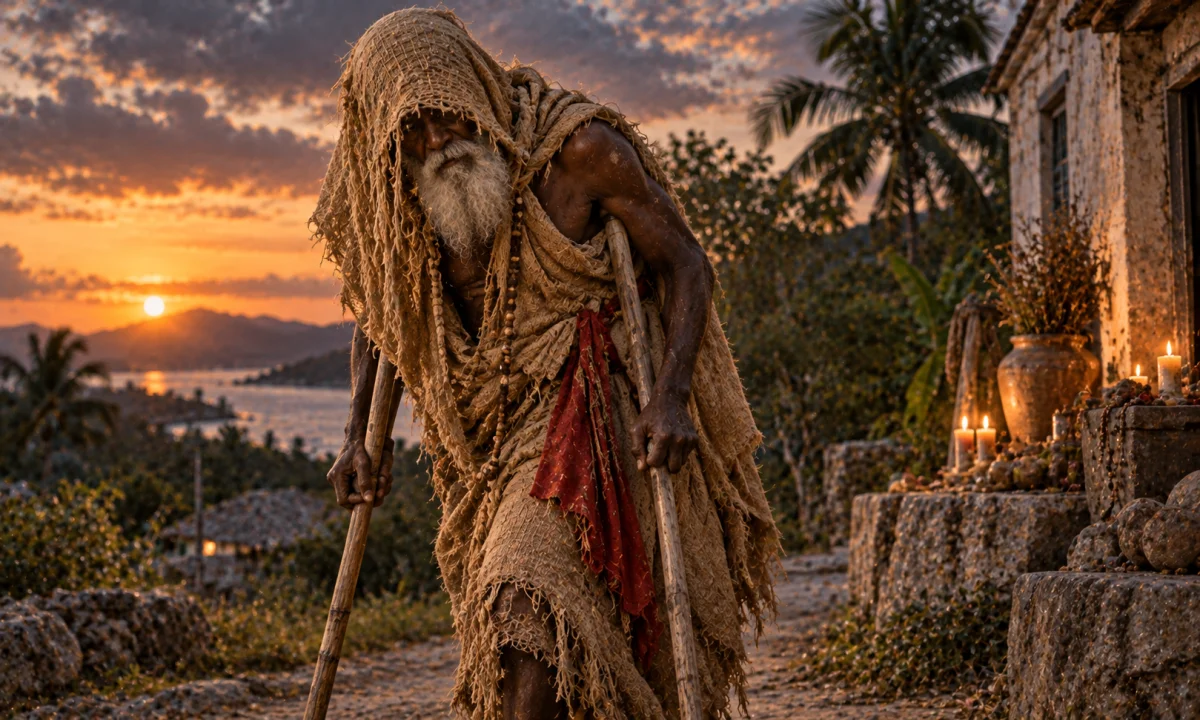
Babalú Ayé is commonly represented as a suffering or physically afflicted man whose body is partly concealed by a garment of raffia, straw, or palm fibers. The garment may be called aso-ìkò in Yoruba-related contexts, although terminology and ritual details vary. It can cover the body and face, suggesting both the visibility and concealment of disease. It may also indicate sacred power that should not be approached casually or looked upon without proper preparation.
Images often show him leaning on crutches or walking with difficulty. These features evoke illness, disability, endurance, and dependence on support. They are not merely signs of weakness. Within his religious symbolism, the afflicted body can belong to a powerful divine presence. A person who appears abandoned or excluded may possess authority over the fate that others fear.
Dogs are strongly associated with Babalú Ayé in Cuban devotional imagery. They may appear beside him, and offerings or prayers can involve dogs in ways that differ according to ritual context. Dogs can suggest loyalty, companionship, guardianship, and the presence of living creatures at the margins of human society. In images of San Lázaro connected with Babalú Ayé, the dogs are among the most recognizable features.
Other visual and ritual associations can include earth-colored materials, healing substances, medicinal plants, and objects related to illness or bodily care. There is no single standardized iconography shared by every practitioner. Some sacred knowledge is transmitted through initiation and is not intended for public description, so general accounts cannot represent the full ritual life of Babalú Ayé.
Stories and oral traditions
Stories about Babalú Ayé are preserved as patakíes, sacred narratives that explain relationships among the Orishas, ritual obligations, human behavior, and the consequences of neglect or disrespect. These stories are transmitted orally and exist in multiple versions. Their purpose is not always to provide a fixed biography in the modern literary sense.
A recurring pattern presents Babalú Ayé as a figure marked by sickness, rejection, or exile. In some versions, he suffers a severe disease and is forced to leave human society. His damaged or covered body causes others to fear him, yet his condition is connected with extraordinary spiritual authority. Another figure, often an Orisha associated with compassion, water, or healing, may help him, while dogs remain faithful when people turn away.
The details of these narratives differ considerably. Names of the other Orishas, the cause of the affliction, the nature of the exile, and the act that leads to healing may change from one lineage to another. These variations should not be treated as errors that can be corrected by selecting one supposedly official version. Oral religious traditions commonly preserve several legitimate forms of a story, especially when they have crossed languages and continents.
Some narratives emphasize that disease can follow arrogance, broken obligations, or disregard for sacred rules. Others focus more strongly on compassion toward people who are visibly ill or socially rejected. In both cases, Babalú Ayé can expose the fragility of communities that fear sickness but abandon those who suffer from it. His stories may therefore function as religious teaching about humility, responsibility, and care as well as accounts of divine power.
Babalú Ayé and San Lázaro
In Cuba, Babalú Ayé is closely connected with Saint Lazarus, especially through popular devotion to San Lázaro. This association developed through religious syncretism, the process by which African sacred identities were expressed through Catholic figures under colonial rule. December 17, the Catholic feast day associated with Saint Lazarus, became an important occasion for public and private devotion to the figure identified in Cuban practice with Babalú Ayé.
The Catholic tradition itself contains more than one Lazarus. One is Lazarus of Bethany, the man whom the Gospel of John describes as being raised from the dead by Jesus. Another is the poor man named Lazarus in the parable found in the Gospel of Luke, who suffers at the gate of a rich man and is later comforted after death. Popular images of San Lázaro in Cuba, especially those showing an old or afflicted man with crutches and dogs, are not a straightforward illustration of Lazarus of Bethany.
The figure in Cuban devotion combines Catholic imagery with the religious identity of Babalú Ayé, but the two traditions are not identical. Some devotees understand the relationship through a shared sacred presence; others distinguish the Orisha from the saint while honoring them together. Public shrines, processions, home altars, candles, promises, and acts of penitence may express this blended devotional history. The meaning of San Lázaro can also vary between formal religious practice and popular Catholic devotion.
Devotion and ritual life
People may turn to Babalú Ayé during illness, family crises, epidemics, or periods of prolonged suffering. Promises made to San Lázaro can include prayer, pilgrimage, candles, offerings, donations, or other acts of devotion. The famous pilgrimage to the sanctuary of El Rincón near Havana is associated with San Lázaro and draws people whose religious identities may be Catholic, Lukumí, or shaped by both traditions. Public devotion does not always reveal the private theological understanding of each participant.
Within Regla de Ocha, ritual relationships with Babalú Ayé are governed by the practices of particular religious houses and elders. Offerings, songs, ceremonies, initiatory obligations, and divination are not uniform public customs. Food offerings and other ritual materials should not be presented as universal prescriptions, because what is appropriate can depend on lineage, circumstance, and the guidance of an initiated practitioner.
His worship has also been shaped by the history of epidemics in the Caribbean. Smallpox, yellow fever, cholera, and other diseases caused widespread death and social disruption, while enslaved and impoverished communities often received inadequate medical protection. A deity associated with illness could consequently represent both fear and hope: fear of an uncontrollable outbreak and hope for survival when official institutions failed to protect vulnerable people.
Cultural significance
Babalú Ayé gives religious form to experiences that many societies prefer to hide: pain, infection, disability, poverty, old age, exclusion, and the fear of death. His covered body and difficult movement challenge the assumption that holiness must appear physically perfect or socially powerful. The sick and marginalized person is not outside the sacred order. On the contrary, suffering can be a place from which spiritual authority becomes visible.
His symbolism also reflects a moral question. Communities often fear disease more than they value the people who live with it. Babalú Ayé can be understood as a reminder that rejection does not eliminate vulnerability. Anyone may become dependent on others, and the treatment of the afflicted is a test of communal ethics. The faithful dog in his imagery is therefore meaningful not only as an animal companion but also as a sign of loyalty when human society withdraws.
Scholars commonly interpret his traditions through several overlapping histories: Yoruba and neighboring West African religious ideas, the catastrophic experience of epidemic disease, the conditions of enslavement, Catholic syncretism, and Cuban forms of community organization. No single interpretation exhausts the figure. For practitioners, Babalú Ayé is not merely a symbol of disease or a subject of folklore; he is a living sacred power approached through prayer, ritual, obligation, and inherited relationships.
Related figures and common confusions
Babalú Ayé should not be confused with every deity who has a connection with illness or the earth. Ọ̀ṣun, for example, is strongly associated with rivers, sweetness, fertility, beauty, and forms of healing in Yoruba-derived traditions, but she is not another name for Babalú Ayé. Yemọja or Yemayá is associated with waters and motherhood, while Obàtálá has different relationships with creation, moral authority, and bodily form. A story in which one of these Orishas helps Babalú Ayé does not make the figures interchangeable.
The Brazilian Candomblé figures Omolu and Obaluaiê are closely related to the West African religious complex surrounding disease and healing, and they share important historical roots with Babalú Ayé. Nevertheless, Brazilian ritual forms, names, garments, festivals, and theological emphases developed in their own context. They should be discussed as related traditions rather than automatically treated as identical versions of the Cuban Orisha.
Likewise, Babalú Ayé is not simply the same being as a Christian saint, even where a Catholic saint provides his principal public image. The association with San Lázaro is historically and religiously significant, but it represents a process of identification and layered devotion rather than proof that the two figures originated in the same tradition.
Modern presence
Babalú Ayé remains visible in Cuban religious life, in the wider African diaspora, and in discussions of Afro-Caribbean identity. His image may appear in devotional art, processions, altars, music, and representations of San Lázaro. He is also sometimes used in commercial or popular culture as a generalized “god of disease,” a description that can flatten his more complex roles as healer, protector, judge, and advocate for the afflicted.
Modern portrayals should be separated from the traditions maintained by practitioners. An image of a man with crutches, straw, and dogs may evoke Babalú Ayé, but visual recognition alone does not communicate the ritual relationships, oral teachings, and community responsibilities that give the Orisha meaning. His continuing importance lies especially in the way Caribbean religious traditions make illness visible without reducing the sick person to illness alone.