WORLD
WORLD
Decarabia
Decarabia is a demon listed in the Ars Goetia, the first section of the seventeenth-century grimoire known as the Lesser Key of Solomon. In that tradition, Decarabia is the sixty-ninth spirit and holds the rank of a marquis. The spirit is associated especially with birds, their behaviour, and the occult virtues attributed to birds and precious stones. Decarabia is said to appear first as a star within a pentacle and then, when commanded by the magician, to assume human form.
Decarabia belongs to the learned demonology of European ritual magic rather than to a well-attested ancient mythology or an independent popular tradition. The surviving descriptions are brief and formulaic. They provide a name, rank, appearance, abilities, number of subordinate legions, and a seal, but no developed mythology, genealogy, or narrative cycle. As a result, many modern descriptions of Decarabia contain creative additions that are not found in the older grimoire tradition.
Decarabia in the Ars Goetia
The Ars Goetia presents Decarabia as one of a large number of spirits summoned and constrained within a Christian magical framework. The work arranges these beings according to titles such as kings, dukes, princes, marquises, presidents, and earls. These ranks resemble aristocratic and administrative hierarchies familiar from early modern Europe, although their exact significance within the text is symbolic and ritual rather than historical.
Decarabia is described as a great marquis. The title does not mean that Decarabia was a marquis in any ancient religious society. It is part of the vocabulary used by European grimoires to organise and classify spirits. The text also states that Decarabia governs thirty legions. A legion in this context is a conventional unit of infernal spirits, not a military force documented outside the magical literature.
The entry is characteristically concise. Decarabia has no stated relationship to Satan, Lucifer, Beelzebub, or any other major figure in Christian demonology. Nor does the text identify Decarabia as a fallen angel, a pagan god, or a transformed human. Later writers may place individual Goetic spirits into broader systems, but those arrangements should not be treated as part of Decarabia’s original description.
Origins and textual setting
The Lesser Key of Solomon is a compilation of magical material that circulated in manuscript form before appearing in printed editions. Its first section, the Ars Goetia, draws on earlier traditions of spirit catalogues, magical books, Christian demonological ideas, and ritual instructions. The work is conventionally associated with King Solomon, but that attribution is legendary and pseudepigraphical. There is no reliable historical evidence that the biblical Solomon wrote the grimoire.
The form of Decarabia’s name and description belongs to this grimoire tradition. The name is also written Carabia in some versions and editions. The variation reflects the unstable transmission of occult manuscripts and the editorial choices of later copyists and publishers. The precise etymology of Decarabia is uncertain. It should not be confidently derived from a particular ancient language or identified with a deity simply because the name resembles another word.
Although the Ars Goetia uses Christian language and places its spirits within an infernal hierarchy, Decarabia has no clearly documented existence in biblical literature, early Christian scripture, or a major pre-Christian mythology. Its surviving identity is primarily literary and ritual: it is the sixty-ninth named spirit in a European grimoire catalogue.
Name and classification
The most common modern spelling is Decarabia, while Carabia appears as an alternate form. Some occult publications preserve both names, and others treat the shorter form as a variant rather than as a separate being. There is no strong evidence that Decarabia and Carabia were originally intended to be two different spirits.
The title of marquis places Decarabia among the aristocratic ranks used by the Ars Goetia. These ranks do not always correspond to a consistent theology. One spirit may be called a duke, another a king, and another a marquis, but the text does not provide a complete explanation of how these offices function or how they relate to one another. The classification is therefore best understood as part of the grimoire’s system of presentation rather than as evidence of a universally recognised infernal government.
Decarabia’s position as the sixty-ninth spirit is also a feature of the text’s sequence, not a statement about the spirit’s importance in all demonological traditions. Numbering can change between related lists, and the order of Goetic spirits has no equivalent in older biblical or classical demonologies.
Appearance and visual symbolism
The traditional description says that Decarabia first appears in the form of a star in a pentacle. The wording is unusual when compared with entries that begin with the image of an animal, a human figure, or a composite monster. It gives Decarabia an explicitly symbolic and geometric appearance before the spirit takes a human form at the magician’s command.
A star can suggest brightness, celestial distance, guidance, or a sign in the heavens. A pentacle, in the ritual setting of the Ars Goetia, functions as a protective and authoritative emblem. It is important, however, not to impose a single universal meaning on these elements. The text does not explain Decarabia’s star in a detailed cosmology, nor does it identify the spirit with a particular planet, constellation, or star deity.
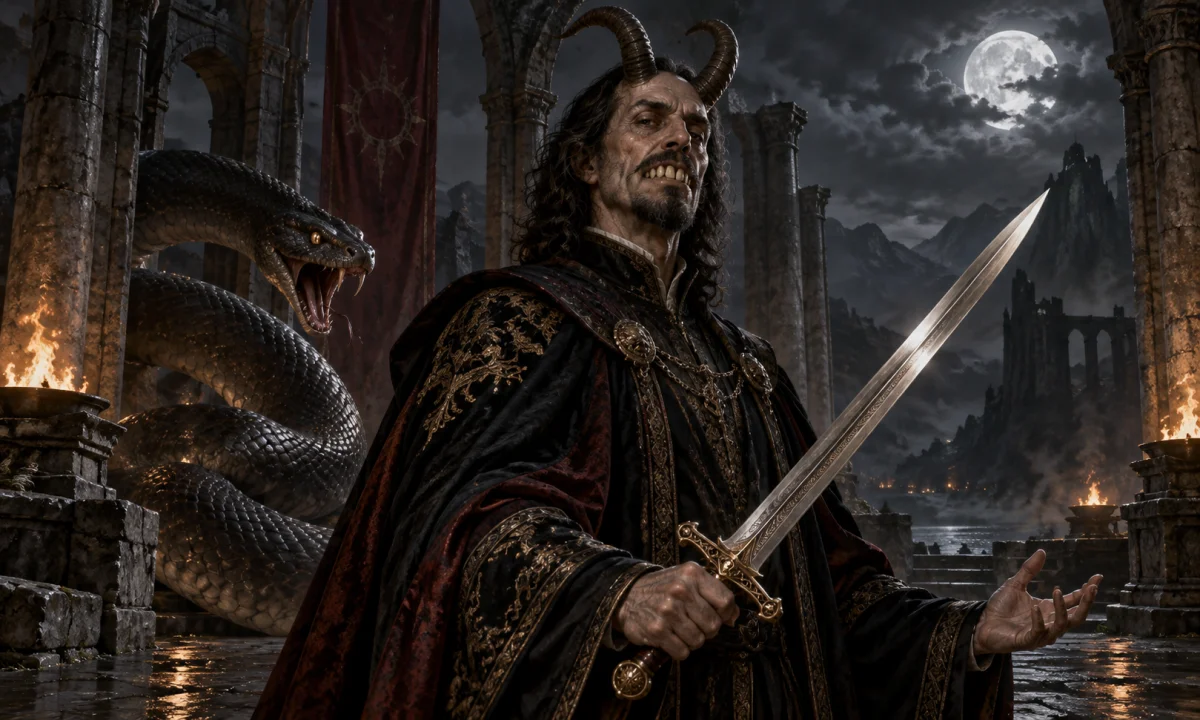
The later human form is similarly unspecified. The description does not give Decarabia a particular age, gender, costume, face, or bodily feature. Images that portray Decarabia as a winged demon, an androgynous figure, a bird-headed being, or a radiant celestial person are later artistic interpretations rather than fixed features of the original account.
Birds and precious stones
Decarabia’s principal office is to reveal or teach the virtues of birds and precious stones. In early modern occult language, “virtue” commonly meant a hidden quality, power, or efficacy believed to belong to a natural object. The word does not necessarily refer to moral goodness. A stone’s virtue might be understood as a healing, protective, divinatory, or sympathetic property, while a bird’s virtue could involve its behaviour, symbolism, voice, movement, or presumed influence.
The entry therefore connects Decarabia with forms of natural magic and occult knowledge. Birds and stones were both important in premodern systems of symbolic classification. Birds were observed for their calls, flight, nesting, migration, and associations with particular places or deities. Precious stones were valued not only for beauty and rarity but also for alleged medicinal and magical properties. These beliefs varied widely across different authors and periods.
The text does not provide a specific list of birds, minerals, or magical correspondences taught by Decarabia. It also does not say that Decarabia created birds or stones, ruled a particular species, or served as a guardian of mines and forests. Such details may appear in modern retellings, but they go beyond the short Goetic entry.
The summoned birds
Decarabia is also said to cause birds to fly before the magician, singing and drinking as natural birds do. This detail is striking because it emphasises not merely the appearance of birds but their apparently ordinary behaviour. The birds are described as acting naturally, which gives the spirit’s power an observational and demonstrative quality.
The passage can be read as an image of controlled natural phenomena. The magician does not simply receive information about birds; birds are brought into the ritual scene as living signs. Their flight, song, and drinking may be interpreted as a display of Decarabia’s command over the visible world or as a confirmation that the spirit has answered.
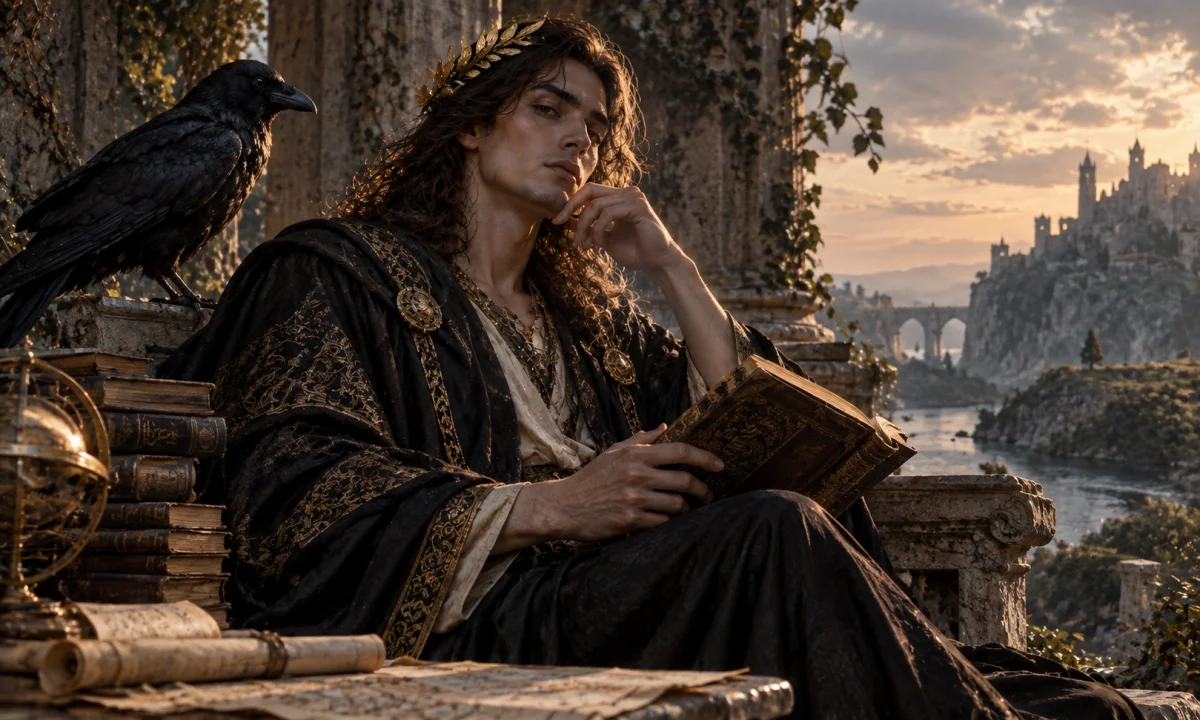
There is no named bird associated exclusively with Decarabia in the traditional account. The text does not mention ravens, owls, eagles, doves, peacocks, or any other species. Assigning one particular bird to Decarabia is therefore a modern choice unless it is clearly presented as an artistic or occult interpretation.
Symbolic interpretation
Decarabia’s combination of stars, birds, and gemstones creates a field of symbols related to observation, elevation, beauty, and hidden properties. Birds move between earth and sky, while stars appear as distant lights and precious stones conceal brilliance within solid matter. Together, these images may suggest knowledge of things that are visible but not fully understood.
From a historical perspective, the association is also consistent with the interests of Renaissance and early modern occult philosophy. Natural objects were often believed to participate in chains of correspondence linking the earthly, celestial, and spiritual realms. A mineral, plant, animal, planet, or star could be studied for signs of a deeper order. Decarabia’s stated powers fit this intellectual environment, although the Ars Goetia itself does not offer a philosophical essay explaining them.
Interpretations should remain separate from historical claims. It is reasonable to discuss the symbolic relationship between birds and stars, or between precious stones and concealed power, as a reading of the imagery. It is not justified to claim that Decarabia was originally a bird goddess, a stellar spirit, or a personification of mineral magic without independent evidence.
Stories and relationships
Decarabia has no substantial cycle of myths. The Ars Goetia does not recount a creation story, a rebellion, a battle, a love story, or a punishment involving the spirit. It does not describe an encounter between Decarabia and Solomon in narrative form. The relationship with Solomon exists mainly through the legendary framework in which Solomon is said to command or bind spirits.
Likewise, the traditional entry gives no consort, parent, offspring, rival, or named companion. Decarabia’s thirty legions are a numerical indication of rank and authority, not a cast of individually identified followers. Any elaborate family tree or set of personal relationships belongs to later invention, role-playing material, fiction, or modern occult system-building.
Distinguishing Decarabia from similar figures
Decarabia should not be confused with Garuda, Horus, Thoth, or other bird-associated divine figures. Those beings belong to distinct religious and mythological traditions and have their own histories, iconographies, and functions. Decarabia’s connection with birds comes from a European grimoire description and does not establish a link with Egyptian, Hindu, Buddhist, or other bird-related figures.
Decarabia is also not the same as a generic “bird demon.” The Goetic entry does not describe a bird-bodied demon or a spirit with a permanent avian form. Its first appearance is stellar and geometric, followed by a human shape. The birds are objects of knowledge and manifestations of the spirit’s office, not necessarily Decarabia’s own body.
Nor should Decarabia be identified with Decarabia-like names found in unrelated fictional works or modern occult lists without checking the context. Similar spellings can result from copying, translation, deliberate adaptation, or coincidence. The safest identification is the one supported by the Goetic catalogue: the sixty-ninth spirit, a marquis associated with birds and precious stones.
Later reception
In modern ceremonial magic and occult publishing, Decarabia is often reproduced through the name, rank, seal, number, and traditional description associated with the Ars Goetia. Some practitioners develop additional correspondences involving colours, planets, metals, animals, or ritual timing. These systems are not uniform, and many are modern expansions rather than inherited features of the early grimoire.
Decarabia also appears occasionally in fantasy fiction, games, illustrated demon catalogues, and other forms of popular culture. Such works may redesign the spirit as a winged creature, a bird-like monster, a star-being, or a guide to gemstones. These portrayals can draw inspiration from the traditional entry while freely changing its appearance, personality, powers, and history. They should be understood as adaptations, not evidence for an older mythology.
The most historically secure image of Decarabia remains comparatively simple: a named spirit of the Ars Goetia, ranked as a marquis, associated with the occult qualities of birds and precious stones, capable of displaying birds behaving naturally, and represented initially as a star within a pentacle. Beyond those details, the tradition leaves considerable room for interpretation, but not for confident claims that the surviving sources do not support.