WORLD
WORLD
Caim

Caim—also spelled Camio or Caym—is a demon of early modern European ceremonial demonology. He is best known as the fifty-third spirit in the Ars Goetia, the first section of the Lesser Key of Solomon, where he is described as a powerful president who commands thirty legions of spirits. His most distinctive features are his bird form, his knowledge of animal voices, and his ability to provide answers about past, present and future.
Origins in European demonological literature
Caim does not belong to a well-attested ancient mythology or to a continuous popular folklore tradition. His surviving identity comes primarily from early modern grimoires: texts that catalogue spirits, describe magical procedures and provide names, seals and hierarchies for ritual use. These works developed within a Christian European intellectual environment influenced by biblical interpretation, late medieval angelology and demonology, astrology, ritual magic and older books of spirits.
The earliest important form of the description appears in Johann Weyer’s Pseudomonarchia Daemonum, published in 1577. Weyer presented lists of demons and their powers while criticising the practices of ceremonial magicians. A related description later appeared in the Ars Goetia, generally understood as a seventeenth-century compilation within the broader Lesser Key of Solomon. The two accounts are closely related, although spelling, wording and minor details vary between editions and manuscripts.
These texts should not be treated as evidence that Caim was a widely worshipped demon in antiquity. They are evidence for a particular literary and occult tradition in early modern Europe. The classification of Caim as a demon reflects the Christian demonological framework of the grimoires, rather than a separate ancient religion devoted to him.
Name and variant spellings
The name appears in several forms, including Caim, Camio and Caym. Some editions and later occult writers use one spelling consistently, while others present alternatives together. The variation reflects the transmission of names through handwritten manuscripts, translation, printing and the copying of older catalogues.
The relationship between “Caim” and “Camio” is not always presented identically in every source. In the Goetic tradition, they are commonly treated as names for the same spirit, but the spelling should not be used to imply a secure ancient etymology. No generally accepted historical evidence establishes that the name derives from a particular pre-Christian deity or from a distinct non-European spirit.
Caim is sometimes connected by modern writers with Cain, the biblical son of Adam and Eve. This association is understandable because the names resemble one another, and both figures have been placed in demonological contexts. However, the standard Goetic descriptions do not identify Caim with the Cain of Genesis. The biblical Cain is a human ancestor and fratricide in the Book of Genesis; Caim is a named spirit in early modern magical catalogues. They should therefore be kept separate unless a particular later author explicitly links them.
Rank and classification
In the Ars Goetia, Caim is called a President. This is one of the ranks used in the grimoire’s hierarchy of spirits, alongside kings, dukes, princes, marquises, counts, knights and other offices. The titles do not describe a political system known from ancient religion. They reflect the courtly and bureaucratic language commonly used by European demonological writers to organise supernatural beings.
Caim is said to command thirty legions. A legion in this setting is a conventional unit in the supernatural hierarchy, not a historical Roman military formation. The number is part of the structured catalogue style of the grimoires, in which each spirit is assigned a title, a number of subordinate spirits and one or more specialised abilities.
His position as a president and his command over thirty legions place him among the more formally ranked spirits of the Goetic system. The title does not necessarily mean that he is more powerful than every spirit with a different rank. It indicates his place in the catalogue’s hierarchy and the type of authority attributed to him by the text.
Appearance and animal form
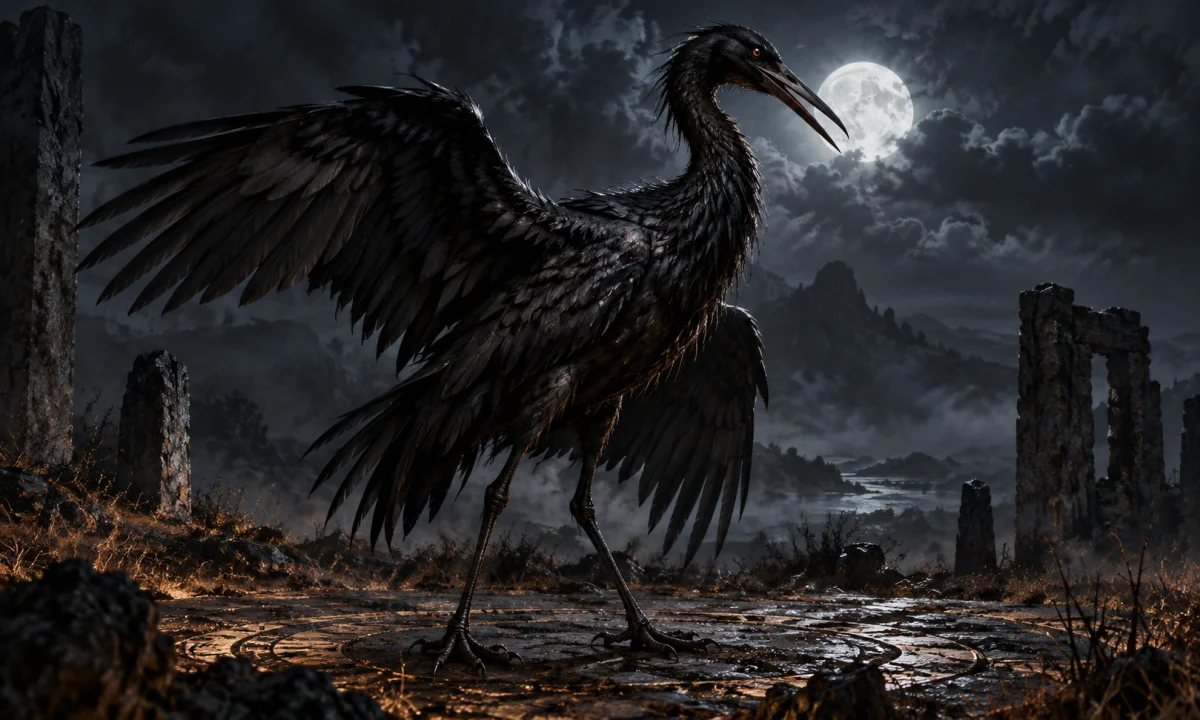
Caim is said to appear initially as a thrush, a small songbird. After this first manifestation, he takes the form of a man carrying a sharp sword. The combination is unusual even within demonological literature: the spirit is first associated with an ordinary bird and then with a human figure marked by a weapon and an official, commanding presence.
The bird is important because Caim’s powers concern communication among living creatures. His appearance as a thrush may also suit the emphasis on song and sound, although the grimoire does not explain the symbolism. It would be speculative to claim that the thrush preserves a direct memory of a particular ancient bird deity. The text gives the form, but not a detailed myth explaining why Caim has it.
The sword is likewise described but not given a narrative explanation. In Christian and ceremonial symbolism, a sword can suggest authority, judgement, force or the ability to divide and distinguish. Those associations may help explain how later readers interpret the image, but they are interpretations rather than explicit statements made by the Goetic text.
Powers and areas of knowledge
Caim’s principal gift is the ability to make a person understand the voices of animals and other natural sounds. The descriptions mention the speech of birds, the barking of dogs, the singing or sound of waters, and the voices of other creatures. This makes him distinctive among the spirits of the Ars Goetia, many of whom are associated with wealth, love, warfare, knowledge, invisibility or political influence.
The power is not simply described as translating one human language into another. It concerns access to forms of communication that humans ordinarily cannot understand. Caim therefore belongs to a group of supernatural figures whose knowledge crosses boundaries between human beings, animals and the natural world.
He is also said to give truthful answers concerning things past, present and future. This places him within the divinatory side of grimoire magic. The wording presents him as a source of information rather than as a spirit whose primary role is temptation, possession or physical destruction. His reputation is consequently linked more strongly with secret knowledge and interpretation than with a specific moral vice.
The promise of understanding animal voices can be read as a form of occult wisdom. In ordinary life, birdsong, the movement of water and the behaviour of animals may appear meaningful without being verbally intelligible. Caim’s attributed power removes that barrier. In a symbolic reading, he represents the desire to recover a lost or hidden language of nature.
Stories and relationships
Caim has no substantial myth cycle in the manner of figures such as Lucifer, Asmodeus or the biblical demons. The principal accounts provide a compact catalogue entry rather than a narrative. They identify his name, rank, appearance, number of legions and powers, but do not describe a birth, a fall from heaven, a family, a conflict with a named hero or a sequence of legendary adventures.
There is also no standard scriptural story in which Caim appears. The Ars Goetia and related demonological texts generally treat him as an established spirit within their own hierarchy, without supplying a detailed origin story. Later occult writers may give him additional symbolism or connect him with other beings, but such developments should not be confused with the core descriptions preserved in the early modern catalogues.
His absence from major mythic narratives is significant. Caim’s importance comes from the way demonological texts organise and describe spirits, not from a large body of traditional tales. Any account that presents him as an ancient god, a primordial animal spirit or a central figure in biblical history is going beyond the strongest evidence associated with his name.
Symbolism and interpretation
Caim can be interpreted through several themes present in his traditional description. The first is communication across boundaries. He allows the human practitioner to understand birds, dogs, waters and other creatures, suggesting access to knowledge that lies outside ordinary human speech.
The second is divination. His answers about past, present and future place him among spirits invoked for hidden information. Like other grimoire spirits, he embodies a controlled attempt to obtain knowledge that Christian religious authorities often regarded as illicit or dangerous when pursued through magic.
The third is the tension between nature and authority. Caim appears as a bird but is also assigned a formal rank and shown with a sword. The bird represents sound, instinct and the living environment; the sword and title represent command, discipline and hierarchy. This contrast is not explained by the original text, but it has made Caim a particularly suggestive figure for later symbolic readings.
From a historical perspective, Caim also illustrates how European demonology transformed diverse materials into an organised catalogue. The grimoires gave spirits names, offices and powers in a manner resembling a royal court or military administration. This structure made the supernatural world appear classifiable and procedurally accessible, even though the spirits themselves were placed within a religious framework that condemned or feared their invocation.
Ritual context in the grimoires
The Ars Goetia presents its spirits in the context of ceremonial operations involving divine names, prayers, protective procedures, circles, seals and commands. Caim’s entry is therefore not an independent folktale but part of a ritual manual. His seal and other associated details belong to that magical system, whose manuscripts and printed editions do not always agree in every feature.
Descriptions of ritual practice should not be mistaken for evidence that historical communities commonly invoked Caim. The existence of a grimoire instruction demonstrates that a writer or compiler included the spirit in a magical catalogue. It does not establish how often the rite was performed, whether it was considered effective, or whether a broad popular cult existed.
Within the Christian culture that produced these texts, the invocation of demons was generally treated as illicit. Some authors wrote about spirits in order to condemn magic, while others preserved or used magical material despite official religious opposition. The grimoires consequently occupy an ambiguous position: they are shaped by Christian demonology, but they also preserve practical occult traditions that religious authorities often rejected.
Distinguishing Caim from similar figures
- Caim and Cain: Cain is the biblical figure who kills his brother Abel. Caim is a Goetic spirit. Similar spelling does not prove that they are the same being.
- Caim and Camio: Camio is commonly treated as a variant spelling or name of Caim in Goetic literature. Because editions differ, the exact relationship should be described according to the source being used.
- Caim and animal-speaking spirits in folklore: Many traditions contain beings who understand or teach the language of animals, but that broad motif does not establish a direct connection with Caim.
- Caim and ancient bird deities: His thrush form does not demonstrate descent from an ancient bird god or goddess. The surviving evidence places the description in early modern demonological literature.
The name may also be confused with unrelated personal names, place names or religious terms that happen to resemble it. Similarity of sound is not enough to establish a shared origin, especially in texts transmitted through several languages and spelling systems.
Later reception
Caim has remained known chiefly through modern editions of the Ars Goetia, occult reference works and discussions of ceremonial magic. In these contexts, writers often preserve his traditional identification as a bird-shaped or bird-associated spirit who grants knowledge of animal voices and divinatory information.
Modern fiction, games and visual media may adapt Caim as a demon, monster, spirit or supernatural antagonist. Such portrayals frequently expand his personality, motives, history or powers beyond the brief grimoire entry. A sword-bearing human form, a connection with birds and an interest in hidden languages are the most recognisable elements likely to be retained, but a fictional version is an adaptation rather than evidence for an older tradition.
In contemporary occult discussion, Caim may also be treated as an archetype of communication with animals, the interpretation of natural sounds or the search for concealed knowledge. These approaches belong to modern interpretation. The historical Caim of demonological literature remains a ranked spirit of the Goetic catalogue: first appearing as a thrush, then as a sword-bearing man, commanding thirty legions and granting an understanding of animal voices and divinatory matters.