WORLD

Birrahgnooloo
Birrahgnooloo is a rain-associated female figure in the traditional religious narratives of the Kamilaroi, more commonly written today as Gamilaraay, an Aboriginal people of northern New South Wales. In accounts recorded by nineteenth- and early twentieth-century European ethnographers, she is described as the wife or female counterpart of Baiame and the mother of Daramulum, an important sky and initiation figure. Her name, spelling, and precise role vary between records, and surviving descriptions should not be treated as a single, universally shared Aboriginal doctrine.
Cultural setting
Gamilaraay country lies principally across the inland plains and river systems of northern New South Wales. Traditional religious knowledge in this region was expressed through stories, ceremonial practice, kinship, law, relationships with particular places, and knowledge of the sky and natural environment. European writers often grouped these traditions under broad labels such as “mythology,” but the stories were not merely imaginary tales. They could explain social obligations, ritual authority, the origins of beings and landscapes, and the proper relationship between human communities and the wider world.
Birrahgnooloo belongs to a body of traditions concerning powerful beings associated with the sky, rain, storms, fertility, and the ordering of human life. The best-known figure in this group is Baiame, whose name is associated in several New South Wales traditions with a creator or ancestral being. Baiame is not, however, a single identical figure in every Aboriginal community that uses a similar name. Aboriginal nations and language groups have their own traditions, and accounts recorded from one region should not automatically be transferred to another.
The information available about Birrahgnooloo comes mainly through colonial-era ethnographic records and later summaries of those records. Such material is valuable but limited. Outsiders recorded names using English spelling conventions, sometimes relied on interpreters, and often interpreted Aboriginal religious concepts through European categories such as “goddess,” “god,” “wife,” or “mother.” The records therefore preserve important information while also requiring careful reading.
Name and identity
The spelling Birrahgnooloo is one of several forms found in English-language discussions. Other transcriptions may differ in the number of vowels or consonants, and a spelling used in one source does not necessarily represent a fixed traditional orthography. Many Aboriginal languages were first written down by outsiders, whose spellings varied according to the sounds they thought they heard and the conventions of their own languages.
Birrahgnooloo is most often identified as a rain being or rain goddess. The word “goddess” can be useful as a short English description of a powerful female supernatural figure, but it should not imply that Gamilaraay religious thought had exactly the same categories as ancient Greek or Roman religion. Her traditional identity is better understood through her relationships with rain, sky beings, fertility, and the ancestral order of the world.
In commonly repeated accounts, Birrahgnooloo is the consort of Baiame and the mother of Daramulum. These relationships are significant because they place her within a family-like structure among major ancestral or celestial beings. At the same time, the surviving evidence is not extensive enough to provide a complete biography, a single canonical genealogy, or a detailed set of myths shared by all Gamilaraay communities.
Association with rain and water
Rain is especially important in the ecology of inland Australia. It sustains rivers, waterholes, plants, animals, and human communities, while its irregularity can make its arrival a matter of survival. A being associated with rain may therefore represent much more than a weather phenomenon. Rain can signify nourishment, renewal, fertility, seasonal change, and the continuing vitality of the land.
Birrahgnooloo’s rain association places her among beings whose actions connect the sky with the earth. Water descending from the sky links celestial power to rivers, wetlands, plants, animals, and people. In this sense, her role can be interpreted as part of a wider sacred understanding of ecological dependence. Such an interpretation should remain cautious: the available accounts do not supply a detailed system of symbolism attributed directly to Birrahgnooloo, and modern explanations should not be presented as verbatim traditional teachings.
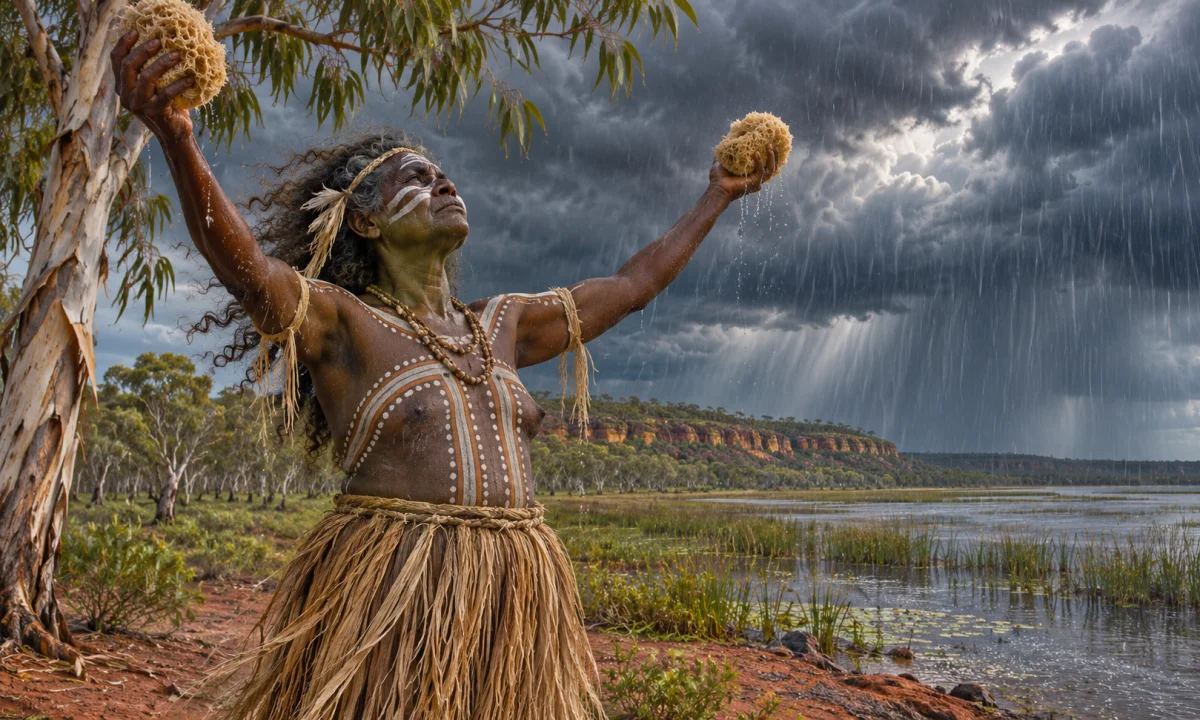
Descriptions of her appearance are also scarce. Unlike some legendary beings that are portrayed in elaborate physical form, Birrahgnooloo is not consistently represented in the surviving English-language material by a standard body, costume, animal shape, weapon, or emblem. Claims that assign her a particular visual form should therefore be treated carefully unless they can be tied to a specific Aboriginal tradition or documented community source.
Relationship with Baiame
Baiame appears in accounts from several Aboriginal groups in New South Wales, although the meaning and significance of the name vary by community. He is frequently described in older literature as a creator, sky being, or ancestral law-giver. Some accounts associate him with the creation of people, the establishment of social rules, and the transmission of ceremonial knowledge.
In descriptions of Gamilaraay tradition, Birrahgnooloo is presented as Baiame’s wife. This relationship may be read as part of a wider pattern in which celestial beings are connected through kinship and marriage, just as human social relations help structure obligations and identity. It is important, however, not to assume that “wife” carries exactly the same meaning in every account or that all Aboriginal groups understood Baiame and Birrahgnooloo as a universal divine couple.
The pairing also illustrates the limitations of early ethnographic summaries. European observers sometimes compressed complex ceremonial and ancestral relationships into familiar family terms. A kin relationship may have involved ritual, cosmological, social, or symbolic dimensions that are not captured by a simple translation such as “husband” and “wife.” The basic association is widely repeated, but its full cultural meaning cannot be reconstructed from a short English description alone.
Relationship with Daramulum
Birrahgnooloo is commonly described as the mother of Daramulum, a prominent being in traditions associated with Gamilaraay and neighboring peoples. Daramulum’s name is often translated or explained in English as “one-legged,” although translations and interpretations vary. He is frequently connected with Baiame, initiation ceremonies, the sky, and the transmission of customary law.
Daramulum is not simply a minor child in a divine genealogy. In the traditions recorded by ethnographers, he has an important relationship to men’s initiation and to the continuation of ancestral law. Some accounts describe him as acting between Baiame and human communities or as having a role in establishing ceremonial practices. Because Birrahgnooloo is identified as his mother, her place in the genealogy connects rain and water with the transmission of life, law, and ritual inheritance.
That connection should not be overstated. The surviving accounts do not provide a single long narrative centred on Birrahgnooloo’s parenting, nor do they consistently describe particular adventures shared by her and Daramulum. Her importance is usually inferred from her position within the ancestral network rather than from a large collection of individually recorded episodes.
Stories and traditional variants
There is no securely established, universally accepted cycle of stories about Birrahgnooloo comparable to the extensive bodies of literature surrounding figures such as Baiame or Daramulum. Her name often appears in genealogical or descriptive passages rather than in detailed narratives. As a result, modern retellings can easily make her seem more fully documented than she really is.
Variations may arise from several sources:
- Different Gamilaraay or neighboring communities may preserve distinct versions of relationships among Baiame, Birrahgnooloo, and Daramulum.
- Early writers used inconsistent spellings for Aboriginal names and sometimes recorded only material they considered relevant to their own questions.
- Some ceremonial knowledge was restricted, gender-specific, or not intended for public publication.
- Later books and websites often repeat short summaries without explaining the limits of the original evidence.
These factors do not make Birrahgnooloo an invented figure. Rather, they show why her identity must be described with appropriate precision. The rain association and links with Baiame and Daramulum are well established in the commonly circulated record, while details about her appearance, personal actions, symbols, and individual myths are much less secure.
Religious and cultural significance
Birrahgnooloo’s significance can be understood through the close relationship between weather, water, land, and community. In an environment where rain may be seasonal and unpredictable, a rain-associated ancestral being represents a force that sustains life and connects the sky with the earth. Her position as a female figure and mother also places her within a pattern of generative relationships, although it would be misleading to reduce her to a simple “fertility goddess” in the style of a classical European deity.
Her relationship with Daramulum is particularly important for understanding how Aboriginal religious traditions may connect natural processes with social law. The same ancestral order can include rain, celestial beings, human origins, initiation, and rules governing community life. These were not necessarily separate subjects. They formed an integrated understanding of how the world came to be and how people should live within it.
It is also important to avoid describing such traditions solely as primitive explanations of weather. Rain stories can carry environmental knowledge, moral meaning, social authority, and a sense of responsibility to country. The sacred significance of water is practical as well as spiritual. Rivers, waterholes, clouds, storms, and seasonal conditions are part of a living cultural landscape rather than merely scenery in a story.
Distinction from similar figures
Birrahgnooloo should not be confused with every Aboriginal female spirit associated with water, rain, or fertility. Australia contains hundreds of Aboriginal nations and language groups, each with distinct traditions and sacred beings. A rain figure from one region may have no direct relationship to Birrahgnooloo, even if an English-language summary gives them similar labels.
She should also be distinguished from Daramulum. Daramulum is generally described as a male ancestral or celestial figure associated with initiation and the sky, while Birrahgnooloo is a female rain-associated figure identified in common accounts as his mother. They belong to related traditions in some records, but they are not alternative names for one being.
Nor should Birrahgnooloo be automatically equated with Baiame’s female counterparts in every neighboring Aboriginal tradition. Similar patterns of creator beings, sky beings, ancestral couples, and rain powers occur across Australia, but resemblance does not prove identity. The names, stories, ritual roles, and relationships need to be considered within their specific cultural and linguistic settings.
Sources and limits of the surviving record
Knowledge of Birrahgnooloo in English is largely dependent on records made by non-Indigenous observers during the colonial period. These records may preserve names and relationships that would otherwise be difficult to trace, but they are not neutral transcripts of an entire religious system. Informants may have chosen what to disclose, interpreters may have shaped the wording, and researchers may have misunderstood the significance of what they were told.
Modern readers should therefore distinguish between documented tradition and later interpretation. It is reasonable to say that Birrahgnooloo is recorded as a Gamilaraay rain-associated female being, connected in common accounts with Baiame and Daramulum. It is less responsible to claim a detailed appearance, a fixed pantheon, or a complete set of myths without a clear traditional basis.
Contemporary Aboriginal communities and cultural knowledge holders remain important authorities on how ancestral names and stories should be understood. Public summaries can introduce Birrahgnooloo, but they cannot replace community-based knowledge, language revitalisation, or the cultural contexts in which these traditions continue to have meaning.
Modern reception
Birrahgnooloo has a relatively limited presence in global popular culture compared with better-known figures such as Baiame, the Rainbow Serpent, or various European and classical deities. Her name may appear in online lists of Australian Aboriginal gods and goddesses, fantasy references, or simplified descriptions of “rain deities.” Those uses often provide only a short label and may omit the uncertainty surrounding spelling, source material, and regional tradition.
Modern representations are most respectful when they identify Birrahgnooloo specifically with the Gamilaraay-related tradition in which she is recorded, avoid presenting all Aboriginal cultures as one mythology, and do not invent costumes, powers, or dramatic stories to fill gaps in the evidence. Her known significance lies not in an elaborate modern character profile but in her place within a network of rain, sky, kinship, ancestral law, and the sustaining relationship between water and life.