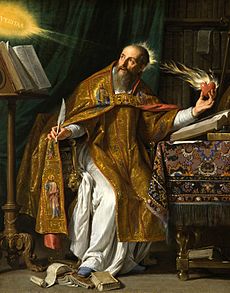
St. Augustine of Hippo is one of the most influential figures in Christian history. He was born on November 13, 354, in Thagaste, a small town in North Africa. His early life was marked by a struggle between his desire for a worldly lifestyle and his search for spiritual truth. Augustine’s writings and teachings have shaped Christian theology and philosophy for centuries, making him a pivotal figure in Christian mythology. His journey from a life of sin to becoming a bishop is a testament to the transformative power of faith.
The Early Life of Augustine
Augustine’s early life was influenced by his mother, Monica, who was a devout Christian. She prayed for his conversion throughout his life. His father, Patricius, was a pagan and did not support Monica’s faith. Augustine was educated in rhetoric and literature, which led him to a career in teaching. However, he struggled with personal vices, including a strong desire for pleasure and a lifestyle that contradicted his mother’s teachings. This internal conflict set the stage for his later spiritual awakening.
 St. Augustine Of Canterbury
During his youth, Augustine became involved in various philosophical movements, including Manichaeism, which combined elements of Christianity with Gnosticism. This belief system appealed to him as it promised knowledge and a deeper understanding of the universe. However, he later rejected it as he found it lacking in moral substance. His experiences during this period would greatly influence his writings on sin and grace.
The Search for Truth
Augustine’s search for truth led him to Milan, where he encountered the teachings of Ambrose, the bishop of Milan. Ambrose’s eloquent preaching and interpretation of Scripture opened Augustine’s eyes to the beauty of Christianity. He began to see the faith not just as a set of rules, but as a relationship with God. This realization marked a significant turning point in his spiritual journey. Augustine was deeply moved by the idea of God’s grace and how it could transform a person’s life.
 St. Athanasius
During this time, Augustine struggled with his desires and the pull of his past. He famously recounted a moment of profound inner conflict in a garden, where he heard a child’s voice saying, “Take up and read.” He interpreted this as a divine command and picked up a nearby Scripture. The passage he read spoke of living a life of righteousness, which prompted his conversion. This moment is often cited as a key event in his life, symbolizing the power of the Scriptures to change hearts.
Augustine’s literary contributions are vast and varied, covering topics such as theology, philosophy, and morality. One of his most famous works is “Confessions,” an autobiographical account of his life and spiritual journey. In this book, Augustine reflects on his past sins and his relationship with God. He explores the nature of sin and the concept of original sin, which would later become a fundamental aspect of Christian doctrine.
Another significant work is “The City of God,” written in response to the fall of Rome in 410 AD. In this book, Augustine contrasts the earthly city, characterized by sin and decay, with the City of God, which represents eternal truth and divine order. He argues that true happiness and fulfillment can only be found in God, rather than in worldly achievements. This work has had a lasting impact on Christian thought and the understanding of the relationship between faith and society.
 St. John Of Britto
Augustine’s Theology
Augustine’s theology emphasizes the necessity of God’s grace for salvation. He believed that humans are inherently flawed due to original sin, which makes them incapable of achieving righteousness on their own. Instead, it is through God’s grace that individuals can be redeemed and brought into a relationship with Him. This understanding has shaped Christian teachings on salvation and the role of faith in the life of believers.
He also contributed to the development of the doctrine of the Trinity, emphasizing the co-equal nature of the Father, Son, and Holy Spirit. Augustine’s exploration of the Trinity has influenced countless theologians and remains a central tenet of Christian belief. His ability to articulate complex theological concepts in relatable terms has made his works accessible to both scholars and laypeople.
Augustine as a Bishop
In 396 AD, Augustine was appointed as the Bishop of Hippo, a position he held until his death in 430 AD. As a bishop, he was deeply involved in the pastoral care of his community, addressing issues of faith, morality, and social justice. Augustine was known for his commitment to the well-being of his congregation, often engaging in debates with heretical groups to defend orthodox Christianity. His leadership style was marked by compassion and a desire to guide others towards a deeper understanding of God.
Augustine also played a significant role in the development of church governance. He advocated for a structured approach to church leadership and the importance of unity among believers. His letters and sermons often addressed the challenges faced by the early Church, including divisions and heresies. Augustine’s influence extended beyond his lifetime, as his teachings laid the groundwork for future church leaders and theologians.
Legacy and Influence
St. Augustine’s legacy is profound and far-reaching. His writings continue to be studied and revered by Christians around the world. The concepts he introduced, such as original sin, divine grace, and the nature of the Trinity, have become foundational to Christian doctrine. His ability to engage with philosophical ideas while remaining rooted in Scripture has made him a bridge between faith and reason.
Throughout the centuries, Augustine’s thoughts have inspired countless theologians, philosophers, and writers. Figures such as Thomas Aquinas, Martin Luther, and John Calvin drew heavily from Augustine’s teachings in their own works. His influence can be seen in various Christian denominations, shaping the beliefs and practices of millions of believers.
Controversies and Criticisms
Despite his significant contributions, Augustine’s teachings have not been without controversy. Some of his views on original sin and predestination have sparked debates among theologians. Critics argue that his ideas may lead to a deterministic view of salvation, where human free will is undermined. This has led to various interpretations and adaptations of his theology throughout history.
Additionally, Augustine’s writings on sexuality and morality have faced scrutiny. His views, shaped by his own struggles with lust and desire, can sometimes appear harsh or overly rigid. This has led to discussions about the balance between grace and law in the Christian life. Nevertheless, Augustine’s ability to address these complex issues has opened the door for ongoing dialogue within the Church.
St. Augustine of Hippo remains a towering figure in Christian mythology. His life story, theological insights, and pastoral care have left an indelible mark on Christianity. Through his writings, he has encouraged countless individuals to seek a deeper relationship with God and to understand the complexities of faith. As we reflect on his contributions, we are reminded of the enduring power of grace and the importance of pursuing truth in our own lives.