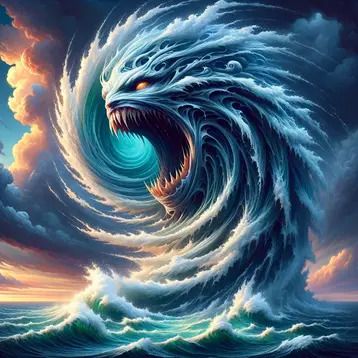
Charybdis is a fascinating figure from Greek mythology, often depicted as a monstrous sea creature. She is best known for her role in the tales of Odysseus, particularly in Homer’s epic poem, the Odyssey. Charybdis is often associated with the treacherous waters of the sea, creating whirlpools that could swallow ships whole. Understanding her story not only reveals the dangers of the ancient world but also provides insight into the Greek understanding of the sea and its many perils. Charybdis represents the unpredictable nature of the ocean, a force that was both revered and feared by the ancient Greeks.
The Origins of Charybdis
The mythological origins of Charybdis can be traced back to ancient times, where she was often portrayed as a daughter of the sea god, Poseidon. According to some versions of the myth, Charybdis was a nymph who was transformed into a monster as punishment for her insatiable hunger. This transformation served as a cautionary tale about the consequences of greed and excess. Her insatiable appetite led her to swallow vast amounts of water, creating a massive whirlpool that would drag anything nearby into the depths of the sea. This monstrous aspect of Charybdis embodies the dangers that lurked beneath the surface of the water.
 Chiron
Charybdis’s story is intertwined with that of her counterpart, Scylla, another sea monster who lived nearby. Together, they created a perilous passage for sailors, particularly for those attempting to navigate the waters between Sicily and the Italian mainland. The dual threat of Scylla’s vicious attacks from the rocks and Charybdis’s deadly whirlpool made this stretch of water infamous among ancient mariners. As a result, sailors had to make a difficult choice: risk being devoured by Scylla or face the destructive force of Charybdis. This dilemma highlights the unpredictable nature of the sea and the choices that individuals must make in the face of danger.
The Role of Charybdis in the Odyssey
Charybdis plays a significant role in the Odyssey, particularly during Odysseus’s journey home after the Trojan War. In one of the most famous episodes, Odysseus is faced with the challenge of navigating past both Charybdis and Scylla. The advice given to him by the sorceress Circe emphasizes the importance of making wise choices in the face of danger. She warns him that if he tries to confront Scylla directly, he may lose some of his crew. However, if he sails too close to Charybdis, he risks losing his entire ship and crew. This moment in the story encapsulates the themes of wisdom and caution that are prevalent throughout the epic.
 Chelone
As Odysseus and his men approach the treacherous waters, they are filled with fear and uncertainty. They know that Charybdis has the power to create a massive whirlpool that could consume them in an instant. When they finally reach the area, Odysseus chooses to sail closer to Scylla, accepting the loss of a few men to avoid total destruction. This decision illustrates the complex nature of leadership and sacrifice. Odysseus’s choice reflects the difficult decisions that leaders often face, where the safety of the many may come at the cost of the few. In this way, Charybdis serves as a symbol of the dangers that leaders must navigate in their journeys.
The Symbolism of Charybdis
Charybdis symbolizes not only the physical dangers of the sea but also the deeper psychological struggles faced by individuals. Her character represents the chaos and unpredictability of life, where one can easily be swept away by circumstances beyond their control. The whirlpool that she creates serves as a metaphor for the challenges and obstacles that individuals encounter on their journeys. Just as sailors must navigate the treacherous waters, people must learn to navigate the challenges in their own lives. Charybdis embodies the idea that life is full of choices, and sometimes those choices can lead to dire consequences.
Moreover, Charybdis can also be seen as a representation of the feminine aspect of chaos and destruction. In many myths, female figures are often associated with danger and unpredictability. This reflects the ancient Greeks’ understanding of women as powerful forces, capable of bringing both creation and destruction. Charybdis, in her monstrous form, embodies the darker aspects of femininity, serving as a reminder of the dangers that can arise from unchecked desire and ambition. This duality of creation and destruction is a recurring theme in many myths, and Charybdis is a prime example of this complexity.
 Chimera
Charybdis in Modern Culture
The story of Charybdis has transcended ancient Greek mythology and continues to influence modern culture. Her character has appeared in various forms of literature, film, and art. For instance, many contemporary adaptations of the Odyssey have sought to portray the terrifying nature of Charybdis and the challenges faced by Odysseus. In these adaptations, Charybdis is often depicted with vivid imagery, showcasing the power and danger of the whirlpool that she creates. This modern portrayal helps to keep her story alive and relevant in today’s world.
Additionally, Charybdis has become a symbol in popular culture, representing the idea of being caught between two dangerous choices. The phrase “between Scylla and Charybdis” has entered the lexicon as a way to describe situations where one must choose between two undesirable outcomes. This expression highlights the enduring nature of her story and its applicability to contemporary life. In various contexts, people often find themselves navigating difficult choices, just as Odysseus did in his epic journey.
Conclusion of Charybdis’s Story
Charybdis remains an enduring figure in the rich tapestry of Greek mythology. Her story serves as a cautionary tale about the dangers of greed and the unpredictable nature of the sea. Through her connection with Odysseus and the challenges he faced, Charybdis exemplifies the complex choices that individuals must navigate in their lives. Her character is a reminder of the balance between wisdom and caution, as well as the importance of understanding the consequences of one’s decisions. As long as stories are told, Charybdis will continue to captivate audiences and inspire reflections on the nature of danger and choice.