WORLD

Ulgan
Ulgan, more commonly written Ülgen or Ölgen, is a powerful creator and sky-associated figure in the traditional religious culture of several Turkic-speaking peoples of the Altai region of southern Siberia. He is especially associated with Altai communities, including traditions recorded among the Altaians and related groups. Older European-language works often describe him as a “supreme god” or “good god,” but those labels can oversimplify a diverse and locally varied religious world.
Ulgan is not best understood as a universally recognised deity of all Siberian peoples. Siberia contains many distinct religious traditions, languages and ritual systems, and the name Ulgan belongs primarily to the mythic and religious vocabulary of the Altai region. Even within Altai traditions, accounts differ in the spelling of his name, his rank, his family relationships and the extent of his creative powers. Some descriptions present him as the principal heavenly creator; others place him within a wider sacred order in which the high sky, ancestral powers, local spirits and other deities also have important roles.
Origins and cultural setting
Traditional Altai religion developed in a landscape of high mountains, forests, rivers and open steppe. Its religious imagination reflects close attention to the sky, weather, animals, fire, water, mountains and the boundaries between the human world and other realms. Religious specialists, often called kam in Turkic contexts, acted as ritual practitioners and intermediaries. In English, they are frequently described as shamans, although the word can conceal differences between individual traditions.
Accounts of Ulgan were preserved mainly through oral tradition and through the records of travellers, missionaries, folklorists and ethnographers. These records do not form a single ancient scripture. They were collected at different times, from different communities and through interpreters, often after Russian expansion and Christian missionary activity had already altered local religious life. As a result, descriptions of Ulgan must be treated as evidence for particular traditions and historical moments rather than as a fixed creed shared by every Altai person.
The Altai religious world is often represented as vertically organised. The human world occupies a middle region, while heavenly realms lie above it and an underworld lies below. Sacred mountains, trees, hearths, drums and ritual journeys could connect these regions symbolically or ceremonially. Ulgan is generally placed among the powers of the upper world, whereas Erlik is commonly associated with the underworld. This opposition is useful for understanding many narratives, but it should not be turned into a simple equivalent of absolute good versus absolute evil. The stories vary, and the religious meanings of these figures are more complex than a modern moral binary suggests.
Name and identity
The form Ulgan is an anglicised spelling. Other forms include Ülgen, Ölgen, Ulgän and similar variants produced by differences in language, transcription and pronunciation. The name has sometimes been connected with ideas such as greatness or loftiness, but proposed explanations are not uniform, and the meaning of the name should not be presented as certain without specifying the language and source involved.
Older comparative writings sometimes treated Ulgan as a pan-Turkic or even pan-Siberian sky god. Modern scholarship is generally more cautious. Similar ideas about a high god, creator, heavenly realm or opposing underworld power occur across northern Eurasia, but similarity does not prove that all such beings are the same. Names, rituals and theological roles must be considered in their local settings.
Ulgan is also sometimes identified with Tengri, the great sky power known in several Turkic and Mongolic traditions. That identification is not consistently correct. Tengri can refer to the sky, a heavenly divine power or a supreme sacred principle, depending on the tradition and period. In some accounts Ulgan occupies a related position; in others the two names should remain distinct. A description of Ulgan as “the Altai sky god” can therefore be useful as a broad orientation, but it is not a complete definition.
Ulgan as a creator and heavenly ruler
In many recorded accounts, Ulgan is a creator or organiser of the world. He is associated with the formation of the earth, the ordering of the heavens and the establishment of life. Some stories describe him as creating human beings or giving them their proper place. Other versions assign parts of creation to several beings, or portray the world as emerging through cooperation, conflict or negotiation among supernatural powers.
His position in the upper world gives him authority over matters connected with the sky and the conditions that sustain life. Rain, fertility, weather and the renewal of the natural world may appear within his sphere, although the specific powers attributed to him differ from one account to another. It is safer to describe him as a heavenly creator and guarantor of cosmic order than to list a fixed catalogue of powers shared by every Altai tradition.
Some ethnographic descriptions place Ulgan in a series of heavenly levels, sometimes seven or more, above the human world. In these accounts, he may be said to reside in the highest or one of the highest regions of the sky. Such numerical arrangements are not consistent across all sources. They may reflect a particular local cosmology, an individual narrator’s account or the way an ethnographer organised oral material. The image of a tiered heaven is important, but the exact number and structure of the levels should not be treated as universal.
Ulgan is often described as benevolent in contrast with the dangerous or disruptive forces of the lower world. Yet “benevolent” does not mean that he functions simply as a personal protector in the manner of a modern fictional hero. A high creator’s significance lies in maintaining the conditions of existence, fertility and social order. The relationship between human beings and heavenly powers also depends on ritual respect, offerings and proper conduct.
Appearance and symbols
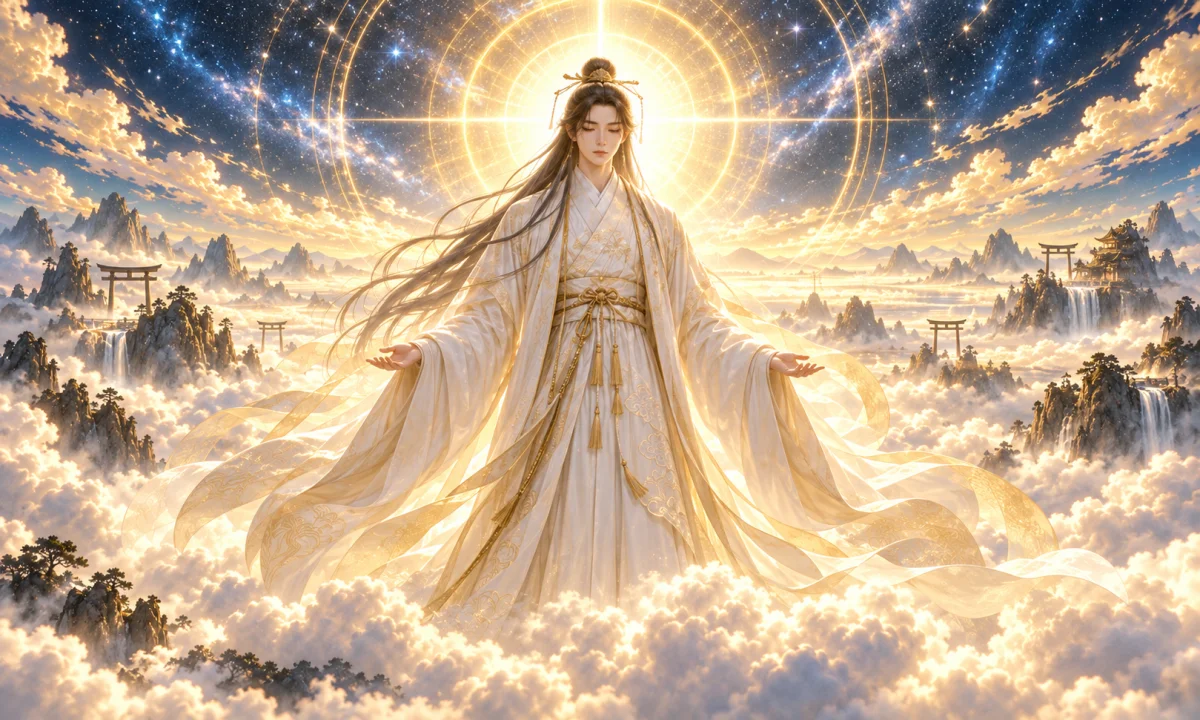
Ulgan does not possess one standard appearance preserved in an authoritative sacred image. Oral traditions may present him in anthropomorphic form, but visual details are not stable. His identity is communicated more often through his cosmic position and powers than through a consistent physical description.
When represented symbolically, he may be associated with the upper world, the open sky, light, height, thunder, rain and the generative forces of nature. These associations should not be confused with a formal iconography. Altai religious practice was not based on a single canon of images comparable to the temple iconographies of some literate religious traditions.
Mountains and trees could serve as points of contact between earthly and heavenly realms. The vertical pole of a ritual structure or the symbolic structure of a shaman’s drum could represent movement through cosmic regions. Such objects were not necessarily images of Ulgan himself. They belonged to a wider ritual system in which a practitioner travelled, imagined or enacted passage between worlds.
Relationships with Erlik and other beings
The most familiar relationship in accounts of Ulgan is his opposition or rivalry with Erlik, a powerful figure of the underworld. Creation narratives sometimes present the two as brothers, companions or originally related beings. Their relationship varies considerably. In some versions, Erlik challenges Ulgan’s authority, claims a share in creation or becomes ruler of the realm beneath the earth. In others, the conflict is less a single dramatic event than part of a broader division between the upper and lower worlds.
It is important not to reduce Erlik to a Christian-style devil. He may be dangerous, associated with death, illness and misfortune, and feared by human beings, but he is also a major cosmic power with his own domain. Religious traditions often require negotiation with or protection from such a being rather than simply denying his existence. The contrast between Ulgan and Erlik expresses a tension between heavenly order and chthonic danger, but it does not erase the complexity of the underworld’s role.
Some accounts attribute a number of sons or subordinate heavenly beings to Ulgan. Names and numbers vary, and many published lists cannot be assumed to represent all Altai communities. The figure Yayık, for example, appears in some discussions of Altai and related traditions as a mediator or heavenly spirit, but his precise status differs by source. Likewise, Umay, a prominent protective and maternal figure in several Turkic traditions, is sometimes placed within broad discussions of Turkic mythology alongside Ulgan. This does not mean that she is uniformly his wife, daughter or subordinate. Such relationships should not be stated as fixed without a clearly identified local tradition.
Other spirits connected with mountains, rivers, animals, clans and households could be more directly important in everyday religious practice than a distant creator. Ulgan’s high status does not imply that ordinary ritual life focused exclusively on him. People might address different powers for different needs, including health, hunting, fertility, protection and the well-being of livestock.
Creation narratives and their variations
Creation stories associated with Ulgan exist in several forms, but they are not a single canonical myth. In some narratives the primeval world begins as water or an undifferentiated expanse. A creator or culture-bearing being then helps bring land into existence. In other versions, land, human beings and animals are formed through the actions of more than one supernatural figure.
A recurring theme in northern Eurasian creation narratives is the emergence of land from water, sometimes with the assistance of a bird or a being who dives beneath the surface to retrieve earth. Some retellings connect such motifs directly with Ulgan; others belong to neighbouring or related traditions and should not automatically be labelled Ulgan myths. Similar narrative patterns can arise through long cultural contact, shared historical ancestry or independent development.
Stories also explain the separation of the heavenly, earthly and underworld regions. The division may establish Ulgan’s rule above and Erlik’s rule below, while humans remain in the middle realm. These narratives are not merely maps of the universe. They can express ideas about mortality, sacrifice, disorder, human limits and the need to respect boundaries between different kinds of existence.
Because the stories were transmitted orally, variation is not evidence that one version is necessarily false. A narrator, community or ritual specialist could preserve a different emphasis from another. Written transcriptions also reflect the choices of collectors, who sometimes combined material from several informants or interpreted local concepts through familiar categories such as “god,” “devil,” “angel” or “myth.”
Ritual and religious significance
Ulgan’s importance is connected with the relationship between the upper world and human welfare. Rituals directed toward heavenly powers could seek blessing, protection, favourable weather or prosperity. Offerings and prayers formed part of a broader system of exchange and obligation between people and the spiritual beings believed to influence their lives.
Ritual specialists could perform ceremonies involving ascent through the symbolic levels of the cosmos. A drum, costume, song or carefully structured movement might represent the journey of the practitioner’s soul or helping spirits. Not every ceremony was directed to Ulgan, and not every ritual specialist followed the same cosmological model. Nevertheless, the association of heavenly powers with the upper regions gives Ulgan a place within the wider religious language of vertical travel and mediation.
Fire also held an important place in many Central Asian and Siberian traditions. Household fire could be treated with respect and associated with continuity, purity or protection. This does not establish that fire was uniquely Ulgan’s element. Rather, it shows how heavenly, household and ancestral dimensions of religion could intersect without being collapsed into one deity.
Historical interpretation
Descriptions of Ulgan are shaped by the history of recording and classification. Russian and European observers often searched for a single supreme god comparable to the deity of a monotheistic religion. They therefore selected Ulgan as a “good god” or “creator,” sometimes giving him a more systematic theology than the oral evidence supports.
Later comparative writers also attempted to reconstruct a single ancient “Altaic religion.” Such reconstructions can draw attention to real similarities across Turkic and neighbouring cultures, but they may blur local distinctions. The term Siberian mythology is itself a broad modern category, not the name of one unified traditional religion. Ulgan should be situated within Altai traditions first, and only then compared with other northern Eurasian figures.
Christianity, Russian administration, Soviet religious policies and later cultural change affected the transmission of traditional beliefs. Some communities maintained elements of older ritual practice alongside Christian observance or secular institutions; others experienced significant disruption. Contemporary Altai identity may draw on traditional figures as part of cultural heritage even when older religious practices are no longer followed in their original form.
Distinguishing Ulgan from similar figures
- Tengri: A major sky-related divine concept in Turkic and Mongolic religious history. Tengri and Ulgan may be compared, but they are not automatically interchangeable.
- Erlik: A powerful underworld figure frequently presented as Ulgan’s counterpart or relative. He is not simply another name for Ulgan.
- Umay: A maternal and protective figure in several Turkic traditions. Her relationship to Ulgan varies and should not be assigned a single universal genealogy.
- Burkhan: A term that can mean a sacred or divine being in different Central Asian contexts. It may appear in translations or descriptions of Altai religion, but it is not always a personal name for Ulgan.
- Other Siberian sky gods: Peoples such as the Buryats, Evenks, Yakuts and many others possess their own religious traditions. Similar sky or creator figures should not be merged with Ulgan merely because they occupy a high cosmic realm.
Ulgan in modern culture
Ulgan appears occasionally in encyclopaedias of mythology, comparative religion, fantasy writing, games and online retellings. Modern summaries often portray him as a perfectly benevolent “supreme god” who created the world and eternally battles a devil-like Erlik. This version is easy to understand, but it usually smooths out regional differences and imports categories from European religious storytelling.
There is no single universally accepted modern representation of Ulgan. Responsible use of the figure keeps his Altai setting visible, distinguishes traditional evidence from creative invention and avoids presenting one ethnographic reconstruction as the belief of every Siberian or Turkic people. His significance lies not only in the role of a creator, but also in the complex religious landscape of the Altai, where heavenly powers, underworld beings, local spirits, ancestors and human ritual specialists were understood as participants in an ordered yet precarious cosmos.