WORLD

Erlik
Erlik, often called Erlik Khan, is a powerful underworld figure in the traditional religious world of several Turkic-speaking peoples of Inner Asia, especially the Altai peoples of southern Siberia. He is commonly described as the ruler of the realm of the dead, a spirit associated with disease and misfortune, and an adversary or counterpart of the heavenly creator Ülgen. His character, however, is not identical in every tradition. Accounts collected from different communities and ritual specialists vary in their stories, names, family relationships and descriptions of his powers.
Cultural setting
Erlik belongs most clearly to the religious traditions of the Altai region, a mountainous area in southern Siberia and western Mongolia. These traditions were maintained through oral transmission, ritual performance and shamanic practice rather than through a single canonical scripture. Related ideas also occur among other Turkic-speaking peoples of Siberia and Central Asia, but the name, role and importance of Erlik are not uniform across all of them.
Older ethnographic records were produced by Russian researchers who listened to oral narratives, recorded ritual songs and described shamanic performances. Such records are valuable, but they do not represent one universally agreed mythology. A story told by one Altai narrator may differ considerably from an account given by another community or by a ritual specialist working in a different religious environment. Christian missionary influence, Russian colonial administration and later scholarly classification also affected the way these traditions were recorded.
The religious setting in which Erlik appears is often described as shamanic, although that label can be too broad if it is treated as the name of one unified religion. Many Siberian traditions understood the world as containing several interconnected levels: a heavenly or upper realm, the human middle world and an underworld beneath it. Powerful beings, ancestral spirits, local spirits and rulers of particular regions could all influence human life. A specialist commonly called a shaman, or by a more specific indigenous term, might travel between these realms in trance or ritual imagination.
Name and identity
The name appears in several spellings, including Erlik, Erлик in Cyrillic transcription, and forms such as Erklik or Erlik Khan. The title “Khan” is an honorific or political-style title used in many translations and descriptions; it does not necessarily indicate that every tradition imagined Erlik as a human ruler who had become divine. The precise etymology of the name remains uncertain, and proposed connections with words meaning strength, manliness or power should not be treated as established fact.
Erlik is usually classified as the sovereign of the dead and the lord of the underworld. In some traditions he is a major supernatural being who existed near the beginning of the cosmos. In others he is a rebellious or disruptive figure whose opposition to the high god helped establish the present order of the world. He can therefore resemble a demon in some descriptions, but the category is potentially misleading. “Demon” usually suggests a particular theological idea of an inherently evil spirit, while Erlik is part of a wider cosmological system in which death, illness, sacrifice and spiritual danger have their own place.
He is also not simply the equivalent of the Christian Devil or Satan. Some accounts present him as an enemy of the heavenly creator, and later interpreters have understandably compared him with a devil-like being. Traditional Altai concepts are more complex. Erlik is a ruler with authority over a specific realm, and his relationship with other divine or spiritual powers can include conflict, negotiation and ritual appeasement rather than only a battle between absolute good and absolute evil.
Appearance and attributes
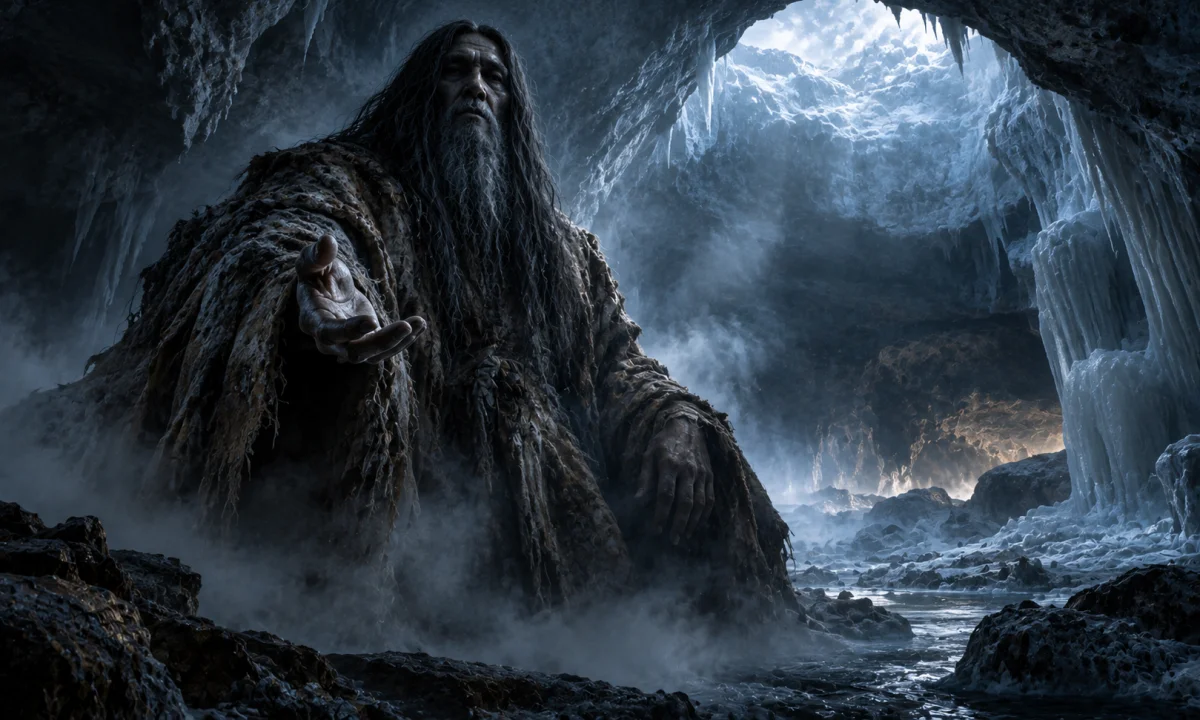
Descriptions of Erlik vary, but he is often represented as dark, frightening and physically imposing. Ethnographic accounts and later retellings may describe him with a black face, tangled hair, horns, a beard or other features associated with age and danger. He may ride a dark animal or appear surrounded by beings from the underworld. These details are not fixed across all communities, and some belong more clearly to particular ritual narratives than to a universal image.
His darkness has several possible meanings. It can signify the subterranean realm, night, death, hidden knowledge and the threatening side of spiritual power. It should not automatically be interpreted as a simple moral symbol of wickedness. In many traditional cosmologies, dark and underworld powers are dangerous but also necessary to the structure of the universe. Erlik’s authority over the dead gives him a defined cosmic function, even when his actions are harmful to human beings.
Erlik is associated with an underworld located beneath the human world. Descriptions of this realm sometimes include a palace, a river or lake, guards, servants and layers through which a soul must pass. Some accounts give him an iron palace or an imposing subterranean court. Such images are best understood as recurring motifs in recorded narratives rather than as universally shared details. The underworld’s exact geography differs according to the storyteller and the ritual tradition.
Role as ruler of the dead
At death, a person’s soul may be understood as travelling toward the realm governed by Erlik. He receives or claims the souls of the dead and presides over their fate below the earth. In some accounts, a deceased person may be judged according to their conduct, ritual obligations or relationship with spiritual powers. Other traditions focus less on moral judgment and more on the danger of the dead person’s soul becoming lost, trapped or harmful to the living.
Erlik’s servants may escort souls to his domain or act as agents of illness and death. The precise organization of these beings varies. Some sources describe named sons or subordinate spirits, while others emphasize unnamed messengers and disease-bringing entities. Lists of Erlik’s children, including groups of sons and daughters, occur in certain recorded traditions, but the names and functions are inconsistent. They should not be presented as a single fixed genealogy accepted by all Altai or Siberian peoples.
Because Erlik controls the destination of the dead, he can also be connected with funerary rites and the protection of the living from dangerous spirits. A shaman might seek to recover a stolen soul, negotiate with underworld beings or guide a dead person away from the community. These practices did not necessarily treat Erlik as a figure who could be defeated permanently. His power was a fact of the cosmos, and ritual action aimed at restoring balance or obtaining temporary protection.
Disease, misfortune and sacrifice
Erlik is frequently associated with sickness, premature death and other forms of misfortune. In this context, illness may be understood as the work of hostile spirits, the loss of a soul or a disturbance in the relationship between human beings and the spirit world. A shaman could diagnose the spiritual cause of an affliction and attempt to retrieve the endangered soul or make an offering to the responsible power.
Animal sacrifice and offerings appear in accounts of rituals directed toward underworld powers. Dark-coloured animals, especially black horses, cattle or sheep, are mentioned in some descriptions, although practices differed by community, period and circumstance. It would be inaccurate to claim that every offering to Erlik used a particular animal or that sacrifice always had the same meaning. The offering might be intended to appease him, secure the return of a soul, protect a household or establish a relationship with a powerful spirit.
Ritual specialists might address Erlik with formal songs, petitions and journeys through the imagined structure of the cosmos. In such performances, the shaman could act as negotiator, healer and guide. The ritual did not necessarily express devotion in the same manner as worship of a benevolent creator. Respect, fear, bargaining and appeasement were all possible elements of the relationship.
Erlik and Ülgen
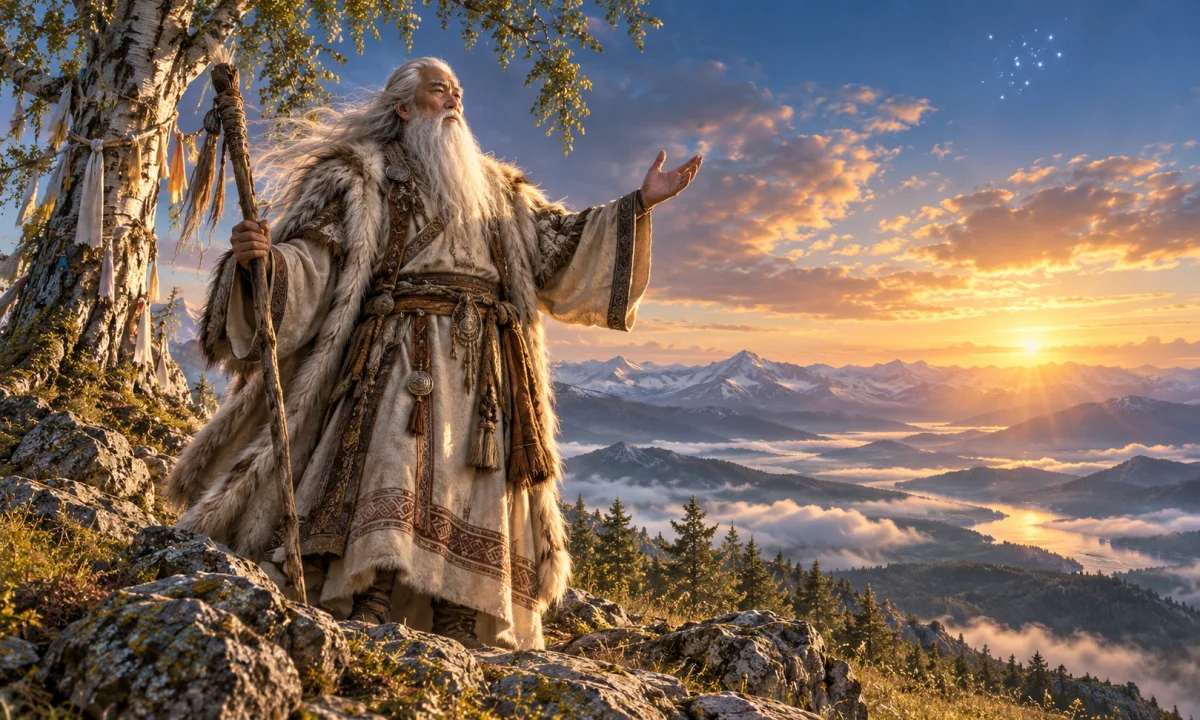
The most widely known myths place Erlik in opposition to Ülgen, a high or heavenly creator figure especially prominent in accounts from the Altai region. Ülgen is often associated with the upper world, light, order and the creation or protection of human beings, while Erlik is associated with the underworld and death. This division is useful, but it should not be turned into a rigid universal doctrine. The status of Ülgen and Erlik differs between sources, and the meanings assigned to them have also been shaped by the categories used by outside observers.
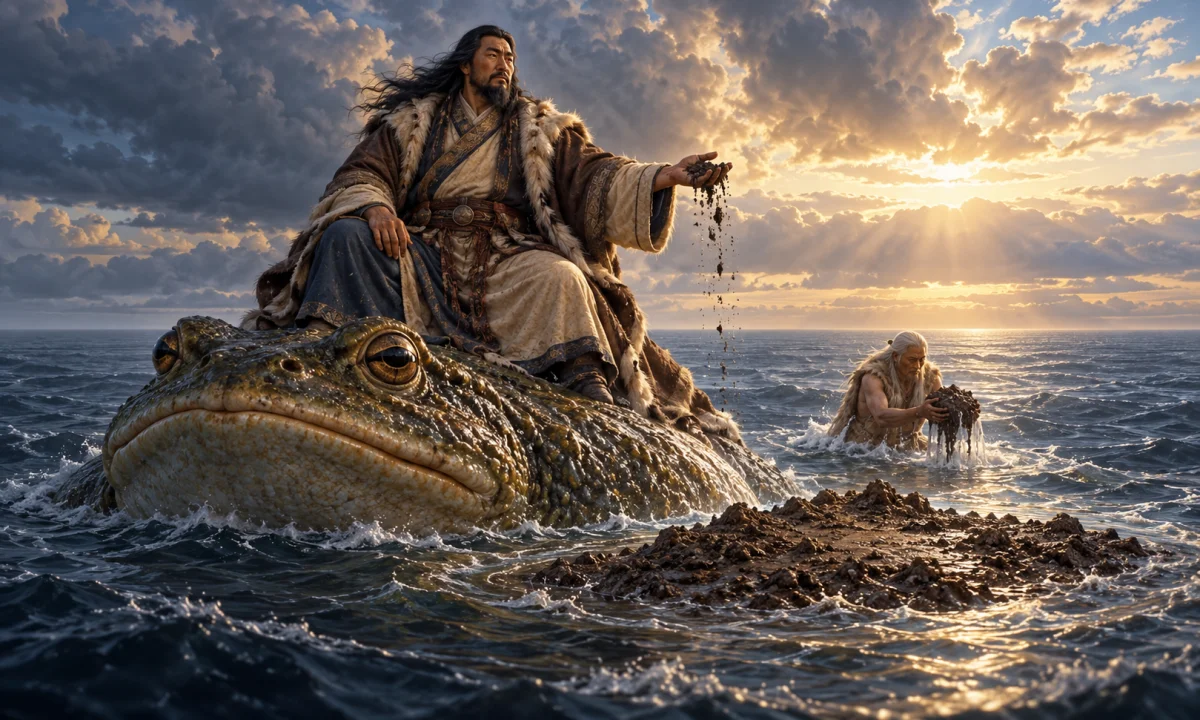
One important group of creation stories begins with a primordial expanse of water. Ülgen and Erlik appear together, sometimes as companions or brothers, and the creation of land follows an act of diving beneath the water. In one version, Erlik brings up earth but hides some of it in his mouth. When the concealed material expands, he is forced to spit it out, producing irregular ground or mountains. Other versions portray the two figures differently, with Erlik’s disobedience or pride leading to his separation from Ülgen.
These narratives do not form one authorized creation account. Some present Erlik as an early participant in the making of the world before becoming an opponent. Others emphasize his challenge to Ülgen’s authority. A few accounts imply that evil, death or imperfection entered the world through Erlik’s actions, while others focus more on the division of cosmic realms. The repeated pattern is not a single precise plot but a relationship between upper-world and underworld powers whose conflict helps explain why the world contains both life and death.
In some stories, Erlik asks for a share in the creation or governance of human beings. When this is refused, he becomes hostile and claims authority over the dead. In others, he is punished and sent beneath the earth after attempting to reveal forbidden knowledge or interfere with the creator’s work. The details are particularly sensitive to local versions and to the way narrators combined traditional motifs with ideas encountered through Christianity or other religious systems.
Cosmic opposition and moral interpretation
Erlik’s opposition to Ülgen is sometimes described as a conflict between good and evil, but that interpretation can oversimplify the traditions. The recorded myths certainly portray Erlik as dangerous and destructive in many contexts. Nevertheless, he is not merely a chaotic force without a place in the cosmos. He rules a domain, receives the dead and participates in a system of obligations between humans and supernatural beings.
Some scholars have cautioned against reconstructing a fully systematic “Turkic mythology” from scattered accounts. Terms such as heaven, hell, god, devil and creator may be convenient translations but can import assumptions from Christian theology. The religious ideas surrounding Erlik were expressed through songs, rituals, local beliefs and narratives rather than through a single philosophical system. Interpretations should therefore allow for ambiguity, regional variation and changes over time.
His figure can be understood as expressing several anxieties at once: the inevitability of death, the unpredictability of illness, the danger of violating ritual relationships and the limits of human control. At the same time, Erlik’s existence gives the underworld a recognizable authority. The dead do not simply vanish from the cosmos; they enter a realm governed by a powerful being with whom ritual specialists may attempt to communicate.
Distinction from similar figures
Erlik should not be automatically identified with every underworld ruler or death god in Asia. He is not the same figure as the Mesopotamian Ereshkigal, the Greek Hades, the Egyptian Osiris or the Buddhist and Hindu forms of Yama, even though comparisons can be useful when discussing how cultures imagine death and the afterlife. Their histories, religious settings and functions are different.
He should also be distinguished from the many local spirits found in Siberian traditions. Not every disease spirit, underworld servant or hostile being is Erlik himself. Some accounts give him a court or family of subordinate powers, but those figures may have their own names and roles. Likewise, the term “shaman” does not refer to one standardized priesthood shared by every community associated with Erlik.
Nor should Erlik be confused with modern fantasy versions of a generic demon king. Contemporary illustrations often give him fixed horns, a trident, a hellish throne or a standardized army of demons. These images may be artistically effective, but they usually combine motifs from several religious traditions rather than reproducing a specific Altai account.
Later reception and modern representations
Erlik has become more visible outside Siberian and Central Asian cultural contexts through comparative mythology, fantasy literature, games, online folklore collections and modern discussions of Tengrism. In these settings he is often presented as the “devil” of ancient Turkic religion or as the eternal enemy of Ülgen. That language can be understandable as a rough comparison, but it obscures the regional diversity and ritual context of the traditional material.
Modern Tengrism is itself a varied contemporary movement, and its interpretations of Erlik may differ from those found in nineteenth- and early twentieth-century ethnographic records. Some modern writers emphasize him as a necessary lord of death or as part of a balanced cosmos; others portray him in more explicitly evil terms. These are modern interpretations and should not be treated as direct evidence for a single ancient doctrine.
The most responsible understanding of Erlik keeps several layers separate: the oral traditions of particular Siberian and Central Asian communities, the historical records made by ethnographers, scholarly interpretations of those records and later popular culture. Across many versions, he remains a formidable ruler of the underworld and a power associated with death, illness and spiritual danger. His importance lies not only in opposition to Ülgen, but also in the way his presence gives shape to the boundary between the living world and the realm of the dead.